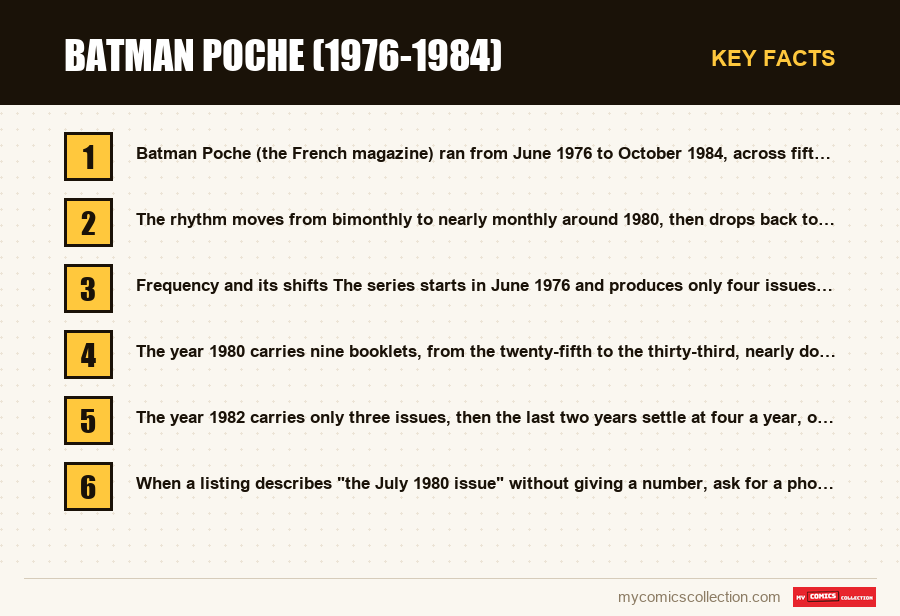
Batman Poche (the French magazine) ran from June 1976 to October 1984, across fifty-two numbered issues with no gaps, from 1 to 52. Each issue credits three artists, a sign of a table of contents with several episodes, of which the catalog records only the opening title. The rhythm moves from bimonthly to nearly monthly around 1980, then drops back to quarterly. The last issues are the hardest to find.
You have a stack of small square-spined booklets in a box, a Batman on the cover, and no idea where the series ends. The question is not theoretical: knowing that a magazine has fifty-two issues and that none is missing from the run changes everything about how you build a wish list, negotiate a lot and spot the copy you are missing. Batman Poche has the pleasant quality of being arithmetically simple and physically temperamental.
As always on this guide, only verified information (creators, numbers, dates) is stated as fact; the analysis is ours, with no reproduction of any panel or protected dialogue.
What the magazine actually published
The title announces one character, the table of contents announces several. The opening titles recorded in the catalog show, across the run, stories centered on Batgirl, on Superman, on Superboy, and even on the butler of Wayne Manor with "Les aventures d'Alfred". This is not a matter of scholarly detail: it means that a collector who comes for the Bat actually buys an anthology of the American publisher's series, and that a collector who comes for Superman has good reason to look at this magazine that he would have passed over on its title alone.
The recorded titles also reflect the range of tone the editorial team accepted. "Danger: pizza!" and "Les trois vœux" do not promise the same thing as "Voleur d'âmes" or "Les démons de la nuit". Between the police farce, the drawing-room mystery and the darker gothic register, the magazine clearly drew on American productions with very different intentions, without seeking the editorial unity that other French collections of the period aimed for.
Three entries are a useful reminder that the booklet was not made of comics alone. The opening title of two issues is an in-house announcement promoting the publisher's collections, and that of another points to a crossword page. If you judge an issue on that label alone, you will believe in a story that does not exist: open it, the story lies behind the promotional page or the puzzle.
A table of contents with several episodes, a single title on record
Here is the most important point of this article, and also the most uncomfortable. The fifty-two issues each credit three artists. An artist does not share a short episode of the period with someone else: three names mean several stories linked under one cover. Yet the catalog records only one title per number, the one that opens the collection.
The consequence is clear. No available record allows anyone to state that a given issue of Batman Poche contains a particular American story, nor that it offers the first French appearance of a character. Episodes two and three of each booklet are simply not documented, and the creator lists cover them all without saying who did what. The only honest answer is to open the copy and record the titles page by page.
This uncertainty has practical value for you. It explains why two sellers describe the same issue in two different ways, why the lists in circulation contradict each other, and why an issue can hold a surprise when you open it. Above all, it should make you wary of any listing that asserts an exact American content without photographing the table of contents.
Frequency and its shifts
The series starts in June 1976 and produces only four issues before the end of that first year, two of which carry the same quarter notice. Then the rhythm stabilizes: over the next two years, the cover dates fall every two months, from February to December, with the regularity of a settled bimonthly. This is the phase in which the issues are most easily found today, because the print run of an established magazine is usually at its most comfortable.
The acceleration comes next. The year 1980 carries nine booklets, from the twenty-fifth to the thirty-third, nearly double the bimonthly pace. For a collector, this surge is good news only in appearance: more issues to find in a short period, and issues whose pagination and production can vary from one month to the next when a publisher pushes the pace.
The fall is abrupt. The year 1982 carries only three issues, then the last two years settle at four a year, one per quarter, up to the October 1984 issue that closes the series. This terminal slowdown is the real difficulty of the collection: end-of-life print runs, reduced distribution, and readers who had already moved on and kept fewer copies.
When cover dates stop being reliable
If you sort your booklets by date, you will get the order wrong at least four times. The twenty-fifth carries a notice covering February, March and April, while the twenty-sixth announces February and March: the date of the second is therefore earlier than that of the first even though its number places it after. The same overlap recurs a little further on in the same year.
Elsewhere, two consecutive issues show the same month of July, and several make do with a quarter notice where their neighbors give a precise month. The cover indicates a window of sale, not a position in the series.
The filing rule is therefore simple and applies to every exchange with a seller: the number is what counts, the date is a clue. When a listing describes "the July 1980 issue" without giving a number, ask for a photo of the spine or of the issue number on the cover before buying, or risk receiving a duplicate.
The issues that really matter
The first issue of June 1976 is the only one whose principle value is not in question: it is the entry point of the series, and it is also the issue a reader of the seventies was most likely to buy out of curiosity and then mistreat. You can find it, but rarely in fresh condition.
Next come the issues whose list of artists includes a name the market seeks for its own sake. The twenty-second credits Neal Adams among its three artists, the thirty-third credits Frank Miller, and others feature Joe Kubert, Bernie Wrightson, Marshall Rogers or Jim Starlin. Be careful about what this means exactly: the record does not specify which episode each one worked on, so the presence of the name is established but its place in the booklet still has to be checked on the copy itself.
The fiftieth also draws attention, as much for its round number as for its opening title, "Autobiographie de Bruce Wayne", which promises a reflective story about the character. Finally, the last one, published in October 1984, is worth having for its closing position, and because an end-of-series issue rarely sells at newsstands in the same quantities as a launch.
Do you collect this series?
Track what you own, what you are missing and what your collection is worth. 7-day trial.
Start my trial →
Recognizing an edition and a printing
The spine carries the title and the number: it is the first thing to photograph when you sell or buy at a distance. It also tells the story of the booklet, since a legible spine that has not whitened indicates a copy that has not lived standing up in an exposed bookshelf.
For the issues of the accelerated phase of the early eighties, compare two copies of the same number whenever you can: variations in paper and trimming between booklets produced at a sustained pace are the classic source of error for the hurried collector, who thinks he has found a variant when he has only a simple production difference. Sources disagree on whether this collection was reprinted, and we will not assert anything that the record does not show.
The pitfalls when buying
The first pitfall is the "complete" lot that is not. Since the series ends at the fifty-second issue and the last eight are quarterly, a well-meaning seller who stopped buying in 1982 will happily present his pile as complete: always check for the presence of the end, not the beginning.
The second pitfall is confusion between collections. The same publisher released several neighboring pocket series, and its own in-house announcements appear even in these tables of contents: a booklet whose cover shows the Bat does not necessarily belong to this series, and the spine settles the question better than a front photo.
The third pitfall is the listing that sells the table of contents. Since the secondary episodes are not documented, a detailed description of the American content is either the result of a check on the copy or a reconstruction. Ask which, and ask for a photo of the table of contents page: it is the only proof that counts, including for the issues where Batgirl or Robin are announced.
Completing the series without losing ten years
The good news first: the highest number in the series corresponds exactly to the number of issues published, so there is neither a skipped number nor a doubled one to fear. Your wish list is a continuous sequence, and any "gap" you observe is a copy missing from your own collection, never a number that did not exist. Many French magazines of the period did not offer you that comfort.
The method that works is therefore to treat the series as two halves with distinct markets. The bimonthly years are completed in lots, often at estate and attic sales, because those issues were bought in quantity and kept together. The quarterly ending, on the other hand, is completed one copy at a time and requires patience: put these titles on a permanent alert rather than hoping to see them turn up in a lot.
Finally, keep one arbitration rule for duplicates. Between two copies of the same issue, prefer the one whose spine is intact even if the cover of the second is brighter: a cover can be protected, a broken spine cannot be repaired. You will find other sorting methods in our collecting guides.
What drives the price today
No single figure means much here, because the market for these booklets plays out in ratios rather than reference prices. A copy with a firm spine and sharp corners commonly trades at several times the level of a read and folded copy of the same number, and that gap is much wider than the one separating two different issues in comparable condition. In other words, condition weighs more than rank within the series.
Three secondary factors come after. The presence of a sought-after name in the list of artists pulls an issue upward, but less strongly than on the American market, because the French buyer first buys the magazine and its nostalgia. The genuine scarcity of the final issues acts lastingly. And the completeness of a lot creates a premium, because it saves the buyer years of hunting.
To place a specific copy, reasoning is more useful than an average: compare completed sales of the same issue in the same condition, and set aside listings without a photo of the spine.
Tracking the collection, and knowing what you still need
A continuous series of this length is hard to follow on a sheet of paper, because the useful information is not only "I have it" but "in what condition, and from which sale". For each booklet, note the number, the condition of the spine, and the provenance: after a few purchases, those three columns will tell you whether you are paying too much for the convenience of lots.
Also keep a "table of contents verified" column. Since the secondary episodes are documented nowhere, each time you open a copy and record its titles, you produce information that nobody else has. That is the real pleasure of a collection like this one: you are not checking a known list, you are building it. For the established part, creators and dates, you now know where certainty stops, and that is the boundary to hold when you describe a lot to another Batman fan.
Frequently asked questions
The series has fifty-two issues, and the highest number published matches that total exactly: no number was skipped and none was doubled. Your wish list is therefore a continuous sequence from the first to the last. Any absence you find in your stack is a copy still to be found, not a phantom number.
Because each issue bound several episodes under a single cover. The available records give the creators of the whole booklet but name only one title, the one that opens the collection. Without opening the copy, it is therefore impossible to know which artist worked on which episode, or which stories filled out the table of contents.
No. The recorded opening titles feature Batgirl, Superman, Superboy and even a story devoted to the butler Alfred. The magazine worked as an anthology, which makes it an interesting ground for a collector who follows other characters from this universe and who might have dismissed the series on its title alone.
Because the cover notices mix precise months, double months and simple quarters. Two consecutive issues can therefore show the same month, or the second can announce a period starting before the first. The date indicates a window of sale, not a rank: always sort by issue number.
The last eight issues, published at the rate of one per quarter over the final two years. An end-of-series run sells and circulates less than a launch, and the readership had already scattered. The bimonthly years of the middle, by contrast, still turn up regularly in whole lots and are completed without any particular difficulty.