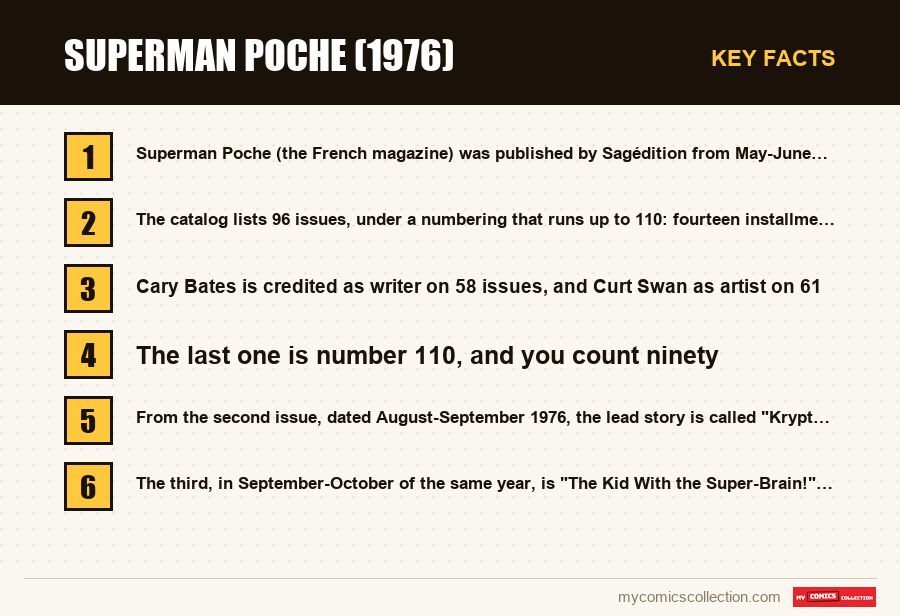
Superman Poche (the French magazine) was published by Sagédition from May-June 1976 to March 1987. The catalog lists 96 issues, under a numbering that runs up to 110: fourteen installments carry a double number. It is not a solo title but a DC anthology, where Superboy, Krypto, Batman and Jimmy Olsen share the billing. Cary Bates is credited as writer on 58 issues, and Curt Swan as artist on 61. Completing the series requires first understanding its numbering.
You open a flea-market crate and come across a stack of small square volumes, spines glued, the Superman logo on a colorful background. The last one is number 110, and you count ninety. Before concluding that you are missing twenty issues, read the spines: the series used double numbering for its last seven years, and that is the first thing to know so you do not hunt for copies that never existed.
As always in this guide, only verified details (creators, issue numbers, dates) are stated as fact; the analysis is our own, with no reproduction of panels or protected dialogue.
What Superman Poche actually published
The title announces one character, the contents serve a whole family. From the second issue, dated August-September 1976, the lead story is called "Krypto to the Rescue!". The third, in September-October of the same year, is "The Kid With the Super-Brain!", and the sixth, in March-April 1977, "Superboy Meets Ben-Hur!". In other words, the magazine drew from the start on the youth and animal side of the Kryptonian universe, the one French readers of the time knew little about.
The presence of the Bat is the other surprise. The seventh issue, in May-June 1977, is titled "Superman and Batman Leave Earth"; the sixteenth, in November-December 1978, "Dick Grayson, Detective"; the thirty-fourth, in June 1980, "Gotham Today, the World Tomorrow!". The writers credited on these installments, Bob Haney and Bob Rozakis in particular, are those of the duo and sidekick series. A collector who hunts only Superman therefore misses part of the contents, and the reverse holds too: a fan of Robin will find episodes here he was not expecting.
Jimmy Olsen and Lois Lane complete the picture. The tenth issue, in November-December 1977, carries the title "Loïs revient de loin !!", spelled with a diaeresis by the French editorial team; the sixty-seventh, in March 1983, "Jours noirs et nuits blanches pour Jimmy Olsen" ("Dark Days and Sleepless Nights for Jimmy Olsen"). The editorial line is therefore stable over eleven years: an anthology of the inner circle, not a collection of fights.
The pocket format, and what it demands of the collector
Sagédition was not a publisher of large-format stapled magazines. The choice of pocket format changes everything about handling: glued rather than stapled spine, a page block that shows wear at the first firm flip, and a thick page count that makes the cover gape when the volume has been left open. These objects were read by children in 1976, then shelved upright, where they warped.
The practical consequence is that a Superman Poche is not judged like a stapled magazine. The question is not whether the staple has rusted, since there is none, but whether the page block still holds to the spine, and whether the 1976 glue has not crystallized. A volume that loses its first pages when tilted is unrecoverable as it stands, however fresh its cover looks.
Three publishing regimes, and why they matter
The series changes rhythm twice, and each switch shows in the cover dates. From the first issue, dated May-June 1976, through the seventeenth, January-February 1979, the date systematically covers two months: this is a deliberate bimonthly. From the eighteenth, carrying the single date "February 1979", the dating becomes monthly and stays so until December 1980.
Then the mechanism begins to jam. The fifty-first issue is recorded as "51-52" under a November 1981 date, and the procedure is repeated thirteen times after that. The double number is the classic symptom of a publisher who wants to keep an announced numbering without sustaining the pace: it releases less often and counts double. For you, this means the series is completed with ninety-six purchases, not one hundred and ten.
The end is frankly erratic. Between the ninety-second issue, dated March 1985, and the next, dated July 1985, four months elapse; the last, numbered 110, carries the date March 1987, while the previous one is from November 1986. The final issues therefore came out through a distribution that had become haphazard, which largely explains why they are the hardest to find today.
Curt Swan and Kurt Schaffenberger, the series' true signature
If you are looking for graphic consistency in this anthology, it rests on two names. Curt Swan appears in the credits of 61 of the 96 issues, Kurt Schaffenberger of 40. In other words, close to two-thirds of the series rests on Swan's line, the artist who defined the character's look for decades, and a strong minority on Schaffenberger's, long associated with the Lois Lane stories.
Their distribution over time is telling. Swan is present from the first issue and still on the last, in March 1987; Schaffenberger, for his part, gains ground in the second half, from the 1981 installments onward. A collector who builds a collection by artist rather than by number therefore has two possible routes through the same series, and the second is concentrated in the rarest years.
Around them circulate names the French market knows elsewhere: José Luis García-López, credited on seven issues, Nick Cardy on six, Eduardo Barreto on six as well, but exclusively in the 1985 and 1986 installments. This last detail is useful: a Superman Poche drawn by Barreto mechanically belongs to the end of the series, and therefore to its thinnest segment of the market.
Cary Bates, the writer of the title
On the writing side, the domination is even clearer. Cary Bates is credited on 58 of the 96 issues, present in three installments out of five, from the first volume of 1976 through the double issues of 1986. No other writer comes close to that figure, and it gives the series a recognizable tone, made of puzzles with twist endings rather than long arcs.
The baton passes in the second half. Paul Kupperberg, credited twenty-one times, and Bob Rozakis, twenty times, appear mainly from 1981 onward, and even take sole charge of some late installments, such as the double issue 74-75 of October 1983, "Dernier scoop sur Krypton" ("Last Scoop on Krypton"). Following these two names is a good way to spot the volumes of the final period without memorizing the numbering.
Do you collect this series?
Track what you own, what you are missing and what your collection is worth. 7-day trial.
Start my trial →
The issues that matter, and why
The first, dated May-June 1976 and opening with "Simple partie de bowling" ("Just a Bowling Game"), is the natural starting piece. It is sought for what it is, a number one, not for its contents: the lead story is a light tale, and the credits combine three writers and three artists, including Dick Giordano and Swan. This is the usual setup for a pocket volume, stacking several short episodes.
At the other end, the hundredth, dated March 1986 and titled "Né pour être Superman" ("Born to Be Superman"), combines two arguments: a round number and membership in a distribution period that was already failing. The very last, numbered 110 and dated March 1987, closes the series; its credits list Kurt Busiek and Alan Moore on writing, which is unusual for a French newsstand publication of that time.
One curiosity deserves mention for anyone who sorts their volumes by date: the forty-first issue is not dated by month but by "1er trimestre 1981" (first quarter 1981), while the fortieth is from December 1980 and the forty-second from January 1981. A volume dated this way is neither a fake nor an error on your part: it is the mention actually printed on the copy.
Recognizing and dating a copy
First rule: on this series, the cover date is your best marker, and its form places you immediately in the chronology. A two-month mention places you either before 1979 or at the very end; a single-month mention, between February 1979 and December 1984 for the most part. A number made of two figures joined by a hyphen tells you without ambiguity that you are after 1981.
Second rule: the French titles are a fingerprint in their own right. "Fiévre disco" in February 1980, "L'invinsible ennemi" in February 1982, "Carichant" in September 1982 are the titles as the catalog records them, typos included. These slightly unstable spellings point to a quick production, and they are valuable: they let you identify a volume whose cover is unreadable from the inside title alone.
Third rule, the most important: do not rely on the single title to know what the volume contains. The catalog records only one story title per issue, whereas a pocket volume of this thickness holds several. For nine installments, including numbers 42, 59, 73 and 78, the recorded title is simply "Sommaire" (contents), and for four others a variant around "nouvelles collections" (new collections): these are service pages, not stories. The actual contents of these issues must be checked on the copy, page by page.
Condition, and buying pitfalls
On a 1976 pocket volume, inspect in this order: the spine hinge, by opening it flat in the middle; the hold of the first and last pages; then the corners, which round off very quickly in this format. A volume stored upright for thirty years often shows a hollowed spine and a slightly tilted cover, defects that are hard to reverse but not serious when they are disclosed.
The pitfall specific to this series is the listing that offers a lot "from 1 to 110" and delivers ninety-nine pieces. The seller is not always acting in bad faith: they are counting numbers, not objects. Ask for the number of physical volumes, and for the list of spines bearing a double number. A second, symmetrical pitfall: a lot advertised as "complete, 96 volumes" may really be complete, and then deserves serious examination rather than being dismissed because its numbering seems inconsistent.
A last point of vigilance concerns titles that promise more than they contain. The December 1985 issue is called "Les Maîtres de l'Univers" ("Masters of the Universe"), the February 1986 one "Leurs magnétiques majestés : Alexandre le Grand et la reine Zazzala" ("Their Magnetic Majesties: Alexander the Great and Queen Zazzala"). These titles catch the eye in a listing, but each describes only one episode among several. Do not pay a premium on a title without having seen the full contents.
Completing the series, and tracking its value
The strategy that works on this series is the reverse of what applies to monthlies: start from the end. The 1985 to 1987 volumes, where Barreto is the artist and publication gaps reach four months, were released in smaller quantities and rarely circulate. The bimonthly issues of 1976 to 1978, by contrast, regularly reappear in lots at flea markets and online sales.
For value, reason in gaps rather than absolute figures. On this series, three factors drive it: the hold of the glued spine, whether the copy belongs to the first or the last chronological segment, and the completeness of the lot. A genuinely complete set of the ninety-six issues, with the doubles correctly identified, trades in a different category from the sum of its parts, because it spares the next buyer the hunt for late volumes. An isolated volume from 1976 to 1978, even in fine condition, remains a common piece.
Finally, keep an inventory by spine number rather than by story title, since the recorded titles do not describe all the contents. For each entry, note the number as printed, double numbers included, the cover date in its exact form, and the condition of the spine. That is the only record that will tell you, two years from now, what you are really missing. The other French series guides in our blog follow the same method, and the Nightwing hub sheds light on the path of Dick Grayson that the November-December 1978 issue crosses.
Frequently asked questions
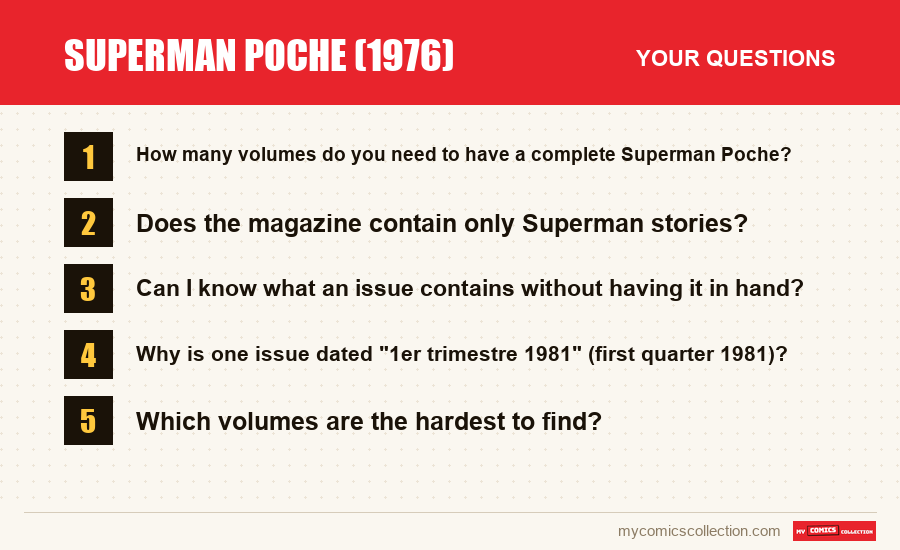
Ninety-six issues, for a numbering that runs up to 110. Fourteen installments carry a double number, from the 51-52 dated November 1981 through the 108-109 of November 1986. If you look for one hundred and ten distinct objects, you will hunt indefinitely for numbers that were never printed separately.
No. The recorded titles feature Krypto as early as August-September 1976, Superboy in March-April 1977, Batman in May-June 1977, Dick Grayson in November-December 1978 and Jimmy Olsen in March 1983. It is an anthology of the Kryptonian circle and its Gotham neighbors, not a solo title.
Not completely. The catalog gives only one story title per volume, whereas a pocket volume publishes several. Nine installments have only "Sommaire" (contents) as their recorded title. The actual contents must be checked with the volume open, and no match with a specific American publication can be asserted on that basis alone.
That is the mention actually printed on the forty-first volume, sitting between a December 1980 issue and a January 1981 one. It reflects the delicate transition from the monthly rhythm to the arrival of double numbers. A volume dated this way is in order; do not file it as an anomaly.
Those of the last period, in practice from 1985 to March 1987. Publication gaps reach four months there, and distribution had collapsed. A quick marker: Eduardo Barreto's art, credited on only six issues, all located in these last two years of the series.