The first issue of Robin, Detective Comics No. 38 published in 1940, has no observable current market. A statement taken on August 30, 2026 on a general auction site in the American market only shows nineteen current ordinary listings and seven listings of verified copies, counted separately. These are amounts claimed by sellers, not completed sales. In regular ads, the lowest amount charged is $3.99, the middle amount is $9.98, the highest is $1,499.99; On the verified side, the range is from $75.00 to $21,249.99 with a central value of $3,950.00. A median of $9.98 for an issue from the 1940s is not a price: it is proof that the statement contains almost no copies of the correct issue. On an object of this rank, the correct attitude is to name the absence of reference rather than inventing a number to fill it.
There is a category of objects for which the question “how much is it worth?” » has no answer accessible from a results page. The first booklet where Robin appears is one of them. It's not a matter of high price: a high price reads very well, you just need to have points of comparison. It is a matter of such rarity that the comparison itself no longer exists. When a title only circulates in a few visible copies at a given time, the collector's usual tool-looking at what others are asking for, drawing an order of magnitude, positioning oneself-purely and simply ceases to work. And it stops working without warning, because the results page continues to display figures with the same confidence as for a booklet from the 2000s.
The reading of August 30, 2026 makes this mechanism visible in an almost caricatured way. Nineteen ordinary announcements, seven announcements of verified copies: these two numbers are too small to establish anything, and this must be said firmly before going any further. No statistical reasoning holds up on seven observations scattered between $75.00 and $21,249.99. What this statement documents is therefore not a price level, but the state of a market: its virtual non-existence. This article explains how to read this situation, why the figures displayed are misleading, and above all what to write in your own collection when reliable data is missing.
What the August 30, 2026 statement really says
Let's go through the numbers one by one, keeping in mind that they describe seller requests on a single date, not completed transactions. On the query “Robin Detective Comics 38 1940”, the general auction site consulted displayed nineteen ordinary advertisements. Nineteen. For a booklet whose name is associated with one of the best-known characters in American comics, this figure should immediately raise alarm: this is not market depth, it is bottom of the drawer. The lowest amount claimed was $3.99, the middle amount was $9.98, the highest was $1,499.99.
The verified copies were counted separately, as they should, since they cannot be compared to the raw issues. Seven announcements, again a derisory number. The lowest amount there was $75.00, the middle value was $3,950.00, the highest amount was $21,249.99. The difference between $75.00 and $3,950.00 within the same segment of seven lines is enough to demonstrate that this segment is not homogeneous. Seven objects spread over two orders of magnitude do not form a population; they form a list.
Finally, and this is the decisive point, this reading was taken only once. A single measurement shows no change. It does not say whether the amounts claimed are going up, down or stagnant, because there is no second point to compare it to. Anyone who interprets these numbers as a trend is telling themselves a story. The maximum of $21,249.99 is no exception to this rule: an isolated amount at the top of a list reflects the hope of a seller, not a price observed by a transaction.
The absurd median as a warning signal
The most informative figure on the statement isn't the highest, it's the most mundane: $9.98. A median of $9.98 on a booklet published in 1940 is absurd. No issue from the 1940s in circulation, whatever its condition, sells for the price of a recent issue found in the bin. Absurdity is therefore not a detail to be ignored: it is the most reliable warning signal available to the buyer, and knowing how to recognize it is the whole subject of this article.
What does this median measure, if it does not measure the fascicle sought? It measures homonyms. It adds objects that share a few characters with the query and nothing else. Clearly, half of the ads shown cost less than $9.98 because half of the ads shown are not the subject. The calculation is mathematically correct and informatively empty, which is the worst possible combination: it produces a presentable, rounded, credible number, which nothing forces the buyer to doubt.
Another title, a misleading storage code
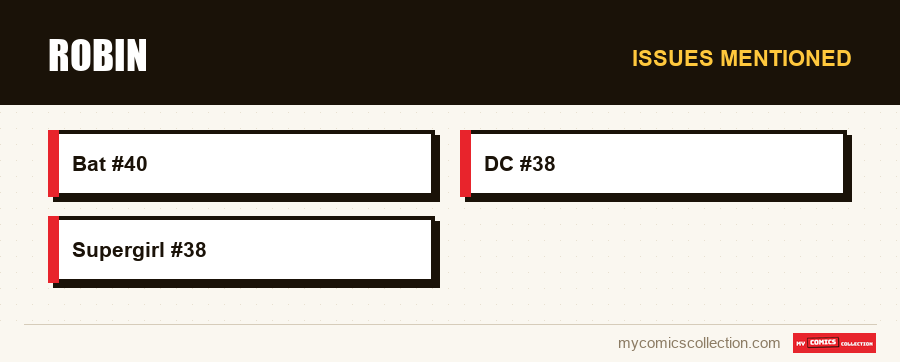
The cheapest line in the statement, at $3.99, was an ad for “Batman Shadow of the Bat #40,” followed by “38 MS42.” The number sought appeared in the seller's storage code, not in the identity of the booklet. A keyword search does not differentiate between an issue number and a shelf reference.
Un autre personnage entièrement
Three of the five cheapest listings were for Supergirl: « Supergirl (3rd Series) #38 » at $4.98, « Supergirl, DC #38 » dated 1999 at $5.99, and « Supergirl #38 FN 6.0 1999 » at $7.10. Nothing to do with the booklet sought, except the number 38 and a common publisher.
A shop window, not a copy
The fifth line, at $7.99, was a store ad with the title "Detective Comics (1937 - present)." This is not a booklet put up for sale: it is a dealer's catalog entry which will appear in all statements relating to this title, regardless of the number sought.
Zéro sur cinq
None of the five cheapest ads was the booklet you were looking for. This complete failure rate at the bottom of the ranking alone explains why the median collapses to a level that makes no sense for a 1940 print.
We must take stock of what this implies. It's not that part of the survey is polluted: it's that the entire lower half is. An average, a median, an “observed price” calculated on this basis do not describe a market for the 1940 issue; they describe how often the number 38 appears in ad titles in a worldwide catalog. These are two unrelated quantities, and the second disguises itself very well as the first.
A current listings report measures what sellers hope to achieve on a given date. It measures neither what buyers agreed to pay, nor how many copies actually changed hands. On an abundant object, the difference between the two remains bearable because the volume corrects the excesses. On an object of which only nineteen ordinary lines and seven verified lines remain, this corrective mechanism no longer exists.
In this situation, the only really usable information would be a history of sales actually concluded, with dates, states and amounts paid. This survey does not provide it, and nothing in the data presented here allows it to be reconstructed. Saying it honestly is better than putting forward an order of magnitude which would, in the strict sense, be an invention.
Why an old title always produces noise
The phenomenon observed here is not accidental, and that is what makes it predictable. A title published since the 1930s accumulates hundreds of issues, relaunches, spin-off series, reissues and store announcements. Its name alone therefore no longer designates anything precise. Conversely, the booklet sought only exists in a few visible copies. We obtain a paradoxical but perfectly logical configuration: the rarer the object, the higher the number of unrelated results, because rarity only reduces the numerator and leaves the denominator intact.
This asymmetry also explains why research on modern fascicles does not pose this problem. A recently published issue is described by a standardized title, it circulates in numerous copies, and the noise is diluted in the mass of relevant announcements. On a 1940 booklet, the relationship is reversed: the mass is entirely made up of noise and the signal is contained in a handful of lines that must be identified one by one, by hand.
The number found is not the number
The number 38 can designate an issue number, but also a storage code, a pagination, a price, an abbreviated year or an internal reference to the seller. The search engine does not distinguish these uses. A visual inspection of each line is the only reliable filter.
The year you are looking for is missing from the ads
The Supergirl ads found were for the year 1999. A query that mentions 1940 in no way guarantees that the results contain it: the engines readily release terms that do not find takers, and the date is the first term sacrificed.
Verified and raw don't compare
Mixing the seven verified ads with the nineteen regular ads would produce a single, false figure. These are two distinct markets, with different buyers and different expectations. The statement keeps them separated; all reading must do the same.
Reseller windows occupy the list
A store catalog entry is not an available item. It will appear in all reports relating to this title, regardless of the number searched, and will artificially inflate the count of advertisements believed to have been found.
A number of seven does not authorize any conclusions
Seven verified listings spread between $75.00 and $21,249.99 draw no usable range. The central value of $3,950.00 is not a reference price: it is simply the fourth line in a list of seven, with no other property than its position.
The title covers almost a century
A title launched in the 1930s and still published designates an immense collection. Searching for it by name is like searching an entire library hoping to come across a specific volume. The query must be narrowed by other criteria, or its results read with the greatest suspicion.
Collecting this series?
Track what you own, what you are missing and what your collection is worth. 7 day trial.
Start my trial →What distinguishes a rare item from an expensive item
The confusion between rarity and expensiveness is the source of most errors of assessment on this type of booklet. An expensive object has a market: it sells regularly, at high but comparable amounts, and the buyer has a benchmark. A rare object, in the sense of the statement presented here, no longer has a market at all. The transactions are too far apart and too few in number to form a series, and each depends on circumstances that do not recur: the exact condition of the copy, the presence or absence of verification, the time of sale, the identity of the buyer opposite.
This difference has an immediate practical consequence. On an expensive object, a twenty percent estimation error is still an estimation error. On a rare object, there is no estimate to be made: there are individual transactions to document. We cannot “evaluate” what does not have frequency, we can only note what happened, once, on a date, under described conditions. Any other approach amounts to interpolating between points that do not exist.
The collector who approaches this segment must therefore change his mental tool. The useful question is not "what is the price", but "what actual sales can I document, and by what date". If the answer is none, then the information is missing, and the lack should be recorded as such. It is an uncomfortable posture, because it deprives us of a numerical answer, but it is the only one that does not create false certainty.
The line-by-line reading method
Since the aggregates are unusable, only individual examination remains. It's tedious, but out of nineteen ordinary advertisements and seven verified advertisements, it is perfectly feasible, and the small number of people, which prohibits any statistical conclusion, at least makes this manual work accessible. The process involves a few successive checks applied to each line.
First check: the exact title. The booklet sought belongs to a specific series; any announcement that names another series is dismissed without discussion, regardless of the number it displays. The three Supergirl announcements in the survey fall at this stage, as well as the announcement of the Batman derivative title whose title contained the number sought in a storage code.
Second check: the announced year of publication. An advert that says 1999 does not describe an issue from 1940. This check alone eliminates a lot of the noise, provided it is done on the text of the advert and not on the terms of the query, which guarantee nothing.
Third check: the nature of the ad. A shop entry describing a title in its entirety is not a copy for sale. It can be recognized by its title, which covers an entire publication period instead of designating a number. It must be removed from the count, otherwise we believe we have one more announcement than we really have.
Fourth control: the separation between verified and raw. The two populations never mix in the same calculation. The August 30, 2026 statement explicitly keeps them separate, and this is the only reason why we can see that the verified minimum at $75.00 and the central value at $3,950.00 of the same segment are so far apart. Melted into a single total, these seven amounts would have disappeared in the mass of the nineteen others and no one would have seen the dispersion.
At the end of these four checks, it often happens that nothing remains. This is a result, not a failure of the method. Noting that a statement of twenty-six advertisements contains no identifiable copy of the booklet sought is much more useful information than a median of $9.98 copied without examination. Those who approach the character through its adaptations, as in our comparison between the 1997 film and the comics, will also find the same gap between the notoriety of a name and the material reality of the publications which bear it.
What to note and save in your collection
An absurd median registers as a signal, not a price. If a statement returns a central amount of $9.98 for a 1940 issue, the note to be recorded is not “$9.98” but “statement not usable, contaminated by homonyms”. The number itself must never enter a value box, in any form, even provisional: once entered, it will behave like legitimate data and no one will remember its origin.
The ad count is worth noting in the same way as the amounts. Nineteen ordinary advertisements and seven verified advertisements: these two numbers say almost everything about the reliability of the statement, and they fit into a few characters. A value recorded without its number is a value that we will no longer be able to criticize later, because we will have lost the only information allowing us to know whether it was based on three lines or on three thousand.
The verified/raw distinction must appear in the file, never in memory. The gap between $75.00 and $3,950.00 within the verified segment alone shows that the status of an item changes everything. A sheet that mentions an amount without specifying which segment it relates to will become uninterpretable in a few months, and this ambiguity cannot be corrected after the fact.
For an object of this rank, the value entered comes from a dated and named source, or remains empty. This is the most important and hardest rule to keep. An empty box is honest: it indicates that the information has not been found and invites you to look for it. An approximate figure is an error that will never be corrected, because nothing in the form will remind you that it was approximate.
The date of the statement is part of the data, just like the amount. The figures discussed here are for August 30, 2026 and for that day only. Recorded without their date, they claim to describe a permanent state and suggest a stability that nothing demonstrates. Recorded with it, they become the first point in a series that future surveys can complete, and it is only from the second point that an evolution can be discussed.
No. It lists amounts claimed by sellers on August 30, 2026, on nineteen ordinary advertisements and seven verified advertisements. These are requests, not closed sales, and these numbers are too low to establish a price level. The statement describes the state of a results page on a date, nothing more.
Because the bottom half of the ranking does not contain the booklet you are looking for. The five cheapest listings were for a Batman spinoff title, three issues of Supergirl dated 1999, and a store catalog entry. The $9.98 median measures the frequency of homonyms, not the value of a 1940 print.
No. A single amount at the top of a seven-line listing expresses a seller's hope at a given time. Nothing in this statement indicates that a buyer accepted this amount, nor that a transaction took place. Extreme demand only becomes a benchmark if a sale confirms it.
It describes an entire title instead of a specific number, often with a publication range in the title, like the $7.99 line in the statement which covered the series from 1937 to today. This is a showcase, not an available copy, and will appear in all statements relating to this title.
Nothing in the value box, and an explicit note next to it. The date of the survey, the numbers observed and the reason why it is unusable are recorded. An empty box accompanied by a note is corrected the day an actual documented sale appears; an approximate figure remains in place indefinitely.
Document what you know, not what you assume
A useful collection is not one where every box is filled, but one where each number entered can be linked to a source and a date. My Comics Collection allows you to keep your issues, their condition and your follow-up notes in one place, and leave empty the values that nothing yet justifies.