To discover Robert Kirkman, open the first collected edition of Invincible (issues 1 to 4, 2003), then read Marvel Zombies (2005-2006, with Sean Phillips). Next tackle The Walking Dead (2003-2019, 193 issues) up to issue 48, then up to the war of issue 126. Finish Invincible (144 issues, 2018) before turning to Skybound's recent series: Outcast, Oblivion Song and Void Rivals (2023). The path runs from the most direct to the longest.
Kirkman is the writer of two of the longest independent American series of the modern era, both launched at Image in 2003. That creates a reader's problem: which one to start with, and how many hundreds of issues to budget for? The answer has less to do with the fame of each title than with how Kirkman writes, in a patient serial where each episode sets up the next.
As always on this guide, only verified facts (creators, issues, dates) are stated as fact; the analysis is our own, with no reproduction of protected art or dialogue.
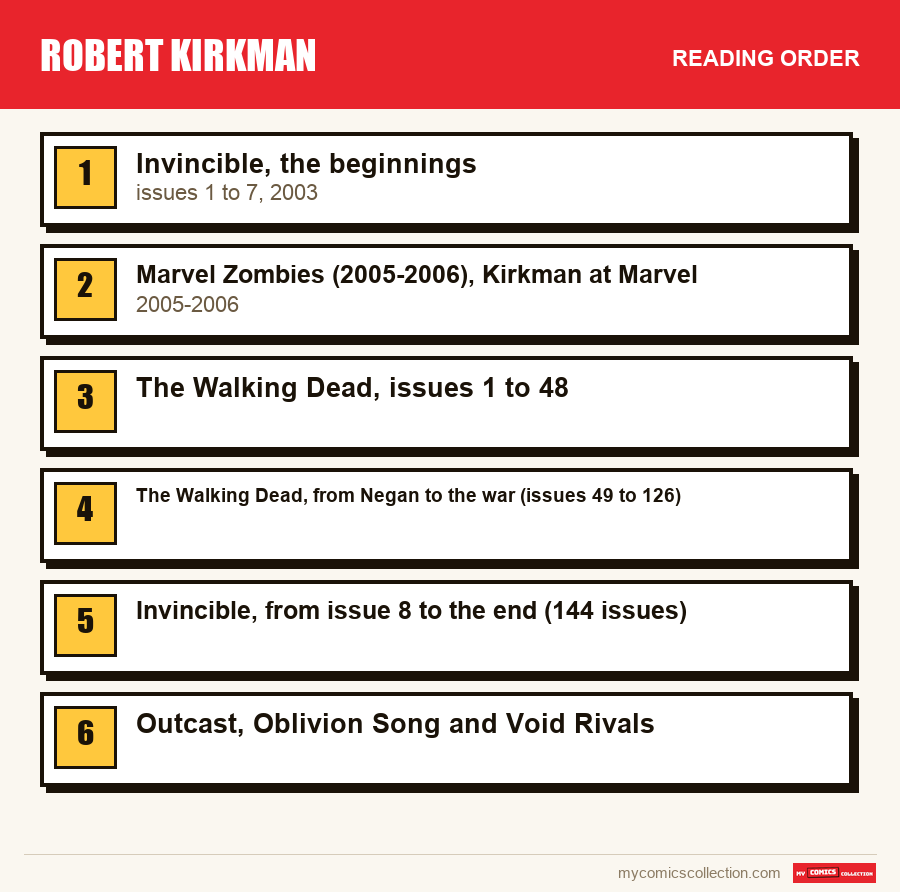
The principle behind this path
This guide does not retrace Kirkman's career. If you want to understand how The Walking Dead was born at Image, first read our history of The Walking Dead in comics, which details the 2002 pitch, the choice of Tony Moore and the switch to Charlie Adlard. Here, the question is only about reading: what to open first, and in what order to continue.
Two constraints shape the order. The first is length: 144 issues for Invincible, 193 for The Walking Dead, more than three hundred episodes between them. The second is genre: one is a superhero story that turns into family drama, the other a survival story with no superheroes. The path below alternates the two to avoid a repetition effect, and puts the recent series at the end, because they are not finished yet.
Step 1: Invincible, the beginnings (issues 1 to 7, 2003)
The inaugural single issue, from January 2003, hands the art to Cory Walker and the color to Bill Crabtree. It sets up Mark Grayson, a high schooler whose powers arrive late, and his father Nolan, the hero Omni-Man. The first collected edition, Family Matters, gathers issues 1 to 4 and reads like a classic superhero coming-of-age story, which is its job: establishing characters before putting them to the test.
Why begin here: the volume is short, it reads alone, and it gives the measure of the writer's method, which is to let you believe in a light series before changing its tone. Issue 7, dated December 2003, marks a turning point we will not spoil. Our profile of Invincible #1 describes the context of this quiet launch at Image.
For collecting, the modest print run of these issues means condition varies a lot from one copy to another. If you read in collected form first, you keep the option of buying the single issues later, knowing what you like.
Step 2: Marvel Zombies (2005-2006), Kirkman at Marvel
Five issues, drawn by Sean Phillips. In a reality where Marvel's heroes have been turned into the undead, the series follows their hunger and their dilemmas with very dark humor. The title is a useful detour: Kirkman writes characters that belong to someone else, and the result shows what remains of that voice when the frame is imposed.
This is the shortest and most immediate read of the path. It requires no knowledge of The Walking Dead, but it prepares you for another use of horror by the same writer, more playful than at Image. The five single issues are easy to complete; the one-volume collected edition is enough for anyone who just wants to read.
Step 3: The Walking Dead, issues 1 to 48
The series starts in October 2003, with Tony Moore on art for the first six issues, then Charlie Adlard from the seventh. Rick Grimes, a sheriff's deputy, comes out of a coma and discovers a devastated world. The first American collected edition, Days Gone Bye, gathers the first six issues. The Governor arc, between issues 27 and 48, makes up the series' first big landing.
Why this stretch: forty-eight issues are enough to know whether the series suits you, and it ends on a moment of rupture that leaves a real sense of a stage completed. The Walking Dead reading guide offers an order for all 193 issues; our ranking of the best arcs flags the moments that matter most.
On the French side, Delcourt's Contrebande line follows the American split, six issues per volume. Our article on the French volumes and their original issue numbers gives the full concordance.
Step 4: The Walking Dead, from Negan to the war (issues 49 to 126)
This stretch contains landmarks that weigh across the whole series. Michonne appears in issue 19, already behind you. Negan makes his entrance in issue 100, and the "All Out War" arc fills issues 115 to 126, the high point of the buildup that precedes it. These last pages form the series' summit for many readers.
The reading changes in nature compared with the previous step. Instead of surviving a visible danger, the characters manage alliances, taxes and power relations. Kirkman stretches the story over several issues per transition episode, which slows the pace but strengthens the impact of the big scenes.
On the collecting side, this is where the single issues of the pivotal numbers draw the most attention. Always check the print run of each issue: some have been reprinted, and the difference shows in the legal box.
Do you collect this series?
Track what you own, what you're missing and what your collection is worth. 7-day trial.
Start my trial →
Step 5: Invincible, from issue 8 to the end (144 issues)
Ryan Ottley draws the rest from issue 8, and the series continues to issue 144, in 2018. Kirkman writes all of it, which gives it a rare coherence for a title this long. The whole shelves into about twenty-five collected editions, depending on the editions, with thicker omnibuses for anyone who prefers fewer volumes.
Why this step comes after The Walking Dead: it takes a comparable reading time, but it rests more on successive twists than on the continuous tension of the survival story. The reader therefore arrives with a habit of patience, useful here too. The genesis of the series and our comparison between the animated series and the comics explain what the TV serial did or did not take from the printed page.
If you discover Invincible through the screen, start from the first collected edition and do not skip a step: the hero's progression is built over the long haul.
Before these two big series, Kirkman had also written titles that do not fit this path: Battle Pope (2001), with Tony Moore, and Tech Jacket (2002), at Image, are early efforts that the curious reader will find mostly as collector's pieces. Their interest lies in what they show of a writer still looking for a format, a year before the simultaneous launch of the two series that would make a name.
Step 6: Outcast, Oblivion Song and Void Rivals
The last step, the most open one. Outcast is a horror story drawn by Paul Azaceta, published from 2014. Oblivion Song (2018) is a science fiction series drawn by Lorenzo De Felici, published by Skybound. Void Rivals appeared in June 2023, again with De Felici, and opens Skybound's Energon universe, conceived as a world shared with Transformers. Off the path, you can also try Haunt, created with Todd McFarlane.
This step is for the reader who already knows the two big series and wants to see what the writer does with an audience already won over. The series read independently, but Void Rivals belongs to an ongoing whole: the reader must accept not seeing everything wrapped up.
For collecting, these recent titles have no established market value: nothing allows us to assert their trajectory. Three things will matter: the longevity of each series, the number of printings and, for Void Rivals, the evolution of the Energon universe around it.
Two dates help place the reads in Kirkman's career. In 2008, the writer became a partner at Image Comics, a rare status for a writer who does not draw; in 2010, Skybound was founded, the structure that has published Kirkman's own series since, along with the titles sponsored there. Later collected editions often carry this logo, which lets you tell a recent printing from an older volume at a glance.
How to read: single issues or collected editions
With Kirkman, the question of format arises from the start. For reading, collected editions are the right choice: the arcs of The Walking Dead and Invincible were designed to be grouped into volumes of about six issues, which spares the monthly wait. For collecting, single issues remain the reference format, especially the number 1s and the pivotal numbers.
A simple method avoids mistakes: read one volume first, note what stays with you, then buy the matching single issues. For The Walking Dead, check the print run of each key issue; for Invincible, verify the volume and reprint indication. For the recent series, compare the covers on offer with the catalog before any purchase, rather than trusting a seller's description.
Recap: the recommended order
- Invincible, issues 1 to 7 (2003): the direct way in.
- Marvel Zombies (2005-2006, five issues): the detour at Marvel.
- The Walking Dead, issues 1 to 48: the first big landing.
- The Walking Dead, issues 49 to 126: Negan and the war.
- Invincible, issues 8 to 144: the complete serial.
- Outcast, Oblivion Song, Void Rivals: the Skybound series.
If you only have one evening a week, take Invincible up to issue 7, then the first volume of The Walking Dead. The rest deepens the picture of the writer without changing the essentials: each added step sharpens Kirkman's way of running a serial, but none contradicts it, and you can stop at any point of the path without having lost the thread of what came before.
Frequently asked questions
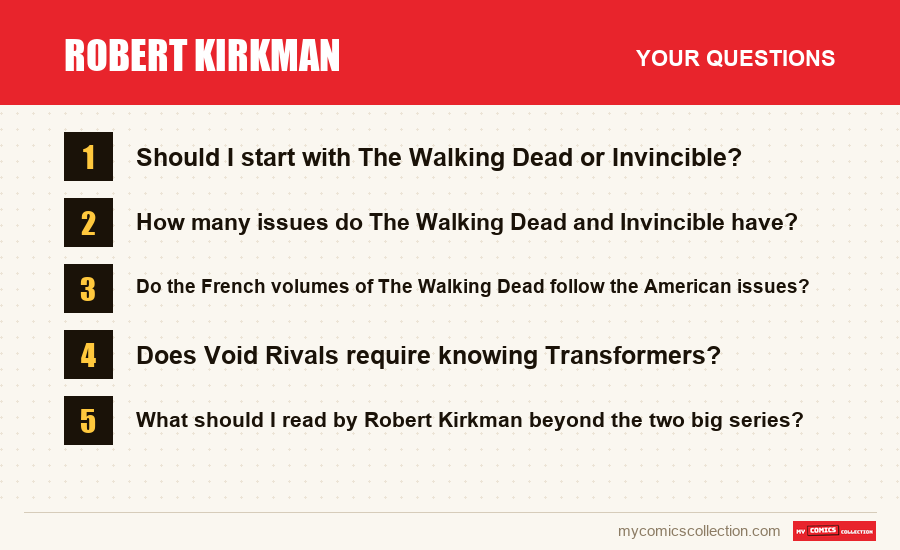
Invincible is the gentler way in, since its first collected edition gathers four issues and reads like a classic superhero story. The Walking Dead suits the reader who wants survival horror right away. The two series are independent; you can read them in alternation.
The Walking Dead has 193 issues, published from October 2003 to July 2019. Invincible has 144, from January 2003 to 2018. Both were launched at Image Comics and written in full by Robert Kirkman, with one change of artist in each.
Almost always: a Delcourt volume gathers six original issues, from volume 1 (issues 1 to 6) to volume 31. Only the end differs, with volume 33 containing just issue 193. Check the concordance in our dedicated article before buying a single volume.
No. Void Rivals, released in June 2023 with Lorenzo De Felici, tells of the meeting of two enemy pilots and reads without prior knowledge. It belongs to Skybound's Energon universe, shared with Transformers, but the first issue sets up its own characters and setting.
Marvel Zombies (2005-2006, with Sean Phillips) is the shortest detour, at five issues. Outcast, drawn by Paul Azaceta, and Oblivion Song, with Lorenzo De Felici, show the writer in horror and science fiction. Void Rivals, more recent, serves as a doorway to Energon.
A Walking Dead or an Invincible lying around in your boxes? Get it appraised before you shelve or sell it.
Estimate my comic