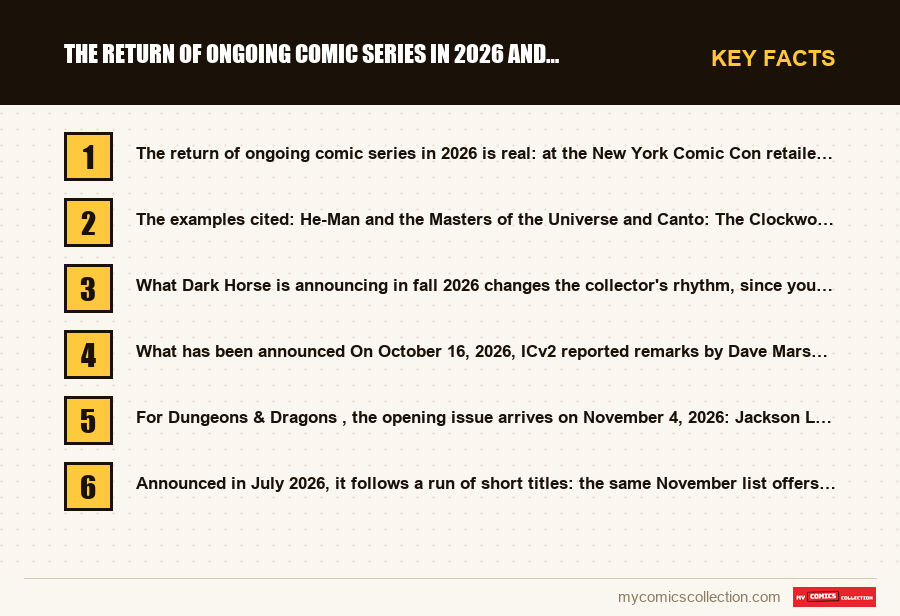
The return of ongoing comic series in 2026 is real: at the New York Comic Con retailer day, according to an ICv2 report dated October 16, 2026, Dark Horse said it wants to move its biggest licenses from four-issue miniseries to ongoing series and maxiseries. The examples cited: He-Man and the Masters of the Universe and Canto: The Clockwork Chronicles, now joined by Dungeons & Dragons #1 (November 4), Baldur's Gate 3 (January 6, 2027) and Barbie.
For several years, the miniseries was the default format for licensed comics: four issues, a collected edition, and on to the next thing. What Dark Horse is announcing in fall 2026 changes the collector's rhythm, since you now have to plan for series with no end date and for numbered arcs that run well past issue #6, which changes how you budget your shelf space and your monthly purchases.
This article draws on the ICv2 report from the New York Comic Con retailer day, on the Dark Horse publisher pages for He-Man and Dungeons & Dragons, on the November solicitation list as discussed by Bleeding Cool, and on Comics Beat's announcement of The Forgotten Five. The collector's reading of those announcements is our own analysis, and it does not include any estimate of value.
What has been announced
On October 16, 2026, ICv2 reported remarks by Dave Marshall, Dark Horse's editor in chief, at the New York Comic Con retailer day. According to that report, the publisher is moving its biggest licenses from four-issue miniseries to ongoing series and maxiseries. The report cites two recently launched ongoing series as examples: He-Man and the Masters of the Universe and Canto: The Clockwork Chronicles.
Two series make this shift concrete in November. For Dungeons & Dragons, the opening issue arrives on November 4, 2026: Jackson Lanzing and Collin Kelly write, and Ibraim Roberson and Arabson Oliveira draw. Announced in July 2026, it follows a run of short titles: the same November list offers the collected edition of The Fallbacks (issues #1 to #4) and an issue of Ravenloft, a four-issue series.
Canto: The Clockwork Chronicles #1, by David M. Booher and Drew Zucker, comes out on November 18, 2026. Bleeding Cool lists it, like Dungeons & Dragons, among the new ongoing series of the November list and reports that the publisher wants to increase its number of ongoing series. The same article notes that Minor Threats: The Cleaner #1, by Gerry Duggan, Patton Oswalt, Jordan Blum and Mark Torres (November 11), remains a four-issue miniseries, so the short format has not disappeared from the catalog, even as the publisher shifts its emphasis toward longer runs.
The rest of the calendar is already set for two licenses. Baldur's Gate 3 becomes an ongoing series whose issue #1 is expected on January 6, 2027, with a first six-issue arc written by Alyssa Wong and drawn by Vincenzo Carratù, centered on the character Astarion, who makes his comics debut. A second twelve-issue arc, from issue #7 to issue #18, goes to Becky Cloonan and Francesco Scimonelli. Barbie is also announced as an ongoing series, with a first six-issue arc by Ben Kahn and Natalie Nardozza.
Point 1: from miniseries to ongoing series at Dark Horse
The miniseries long structured the publisher's licensed output. Dark Horse has published licensed series for a long time, and the short four-issue format limited the commitment: a reader knew where the series would stop. The case of Dungeons & Dragons illustrates this well: the publisher first put out the license in short titles, like the four-issue Ravenloft or The Fallbacks, whose first volume collects four issues, before announcing an ongoing series in July 2026.
The case of Canto shows a similar path. David M. Booher's character first appeared at IDW, in limited series, before moving to Dark Horse. In its November list, the publisher announces The Clockwork Chronicles, a series with no fixed end, drawn by Drew Zucker. The November issue #1 therefore opens a new count, built on an already established character.
For the reader, the difference is concrete, and it shows up in both the monthly budget and the way the shelf fills over time. A four-issue miniseries can be completed in a quarter and suits the collected edition well; an ongoing series is followed month after month, and each arc can be picked up in a volume. Both formats coexist at Dark Horse, which means you have to read the listing for each title, one by one, before deciding on a pull list subscription at your shop.
Point 2: He-Man, an ongoing series that starts at issue #5
The example of He-Man and the Masters of the Universe deserves a collector's attention, because it upends the usual numbering. The announcement dates from December 2025: Tim Seeley writes, Reilly Brown draws, Jim Charalampidis colors and AndWorld Design letters. It begins at issue #5, with the arc The Battle of Snake Mountain, which reached shops on May 13, 2026 according to the Dark Horse listing. It continues the story begun with The Sword of Flaws, without starting again from zero.
The practical consequence: there is no issue #1 of this ongoing series. Issue #5 is the entry point of the new series, but it belongs to the continuation of a story begun in another series. A collector who files by title and number has to decide how to classify the whole: one continuous title, or two separate series.
The safest method is to file the issues in reading order and to note, in the inventory, the arc title and the release date of each comic. This avoids mixing up issues #1 to #4 of The Sword of Flaws with those of the ongoing series, and it helps you recognize, at the time of a resale, which series a copy belongs to.
Point 3: Baldur's Gate 3 and Barbie, series designed in arcs
The two New York Comic Con announcements have one thing in common: they are presented by arcs rather than by issues. Baldur's Gate 3 announces a first arc of six issues, then a second of twelve, from issue #7 to issue #18. Barbie announces a first arc of six issues. This presentation gives clear visibility: a reader knows from the start how many issues the first commitment covers, and can decide on that basis whether to start following the title.
This arc-based logic brings the ongoing series closer to the collected edition. A six-issue arc generally corresponds to one volume, so you can wait for the volume or follow the single issues depending on your preferences. For a collection, the arc also serves as a cataloging marker: "arc 1, issues 1 to 6" is easier to file than "ongoing series."
For Baldur's Gate 3, the publisher brings Astarion into comics with the series. That debut of a character in comics can be spotted in the listing for issue #1: note it in your inventory with the date of January 6, 2027.
Do you collect this series?
Track what you own, what you are missing and what your collection is worth. 7-day trial.
Start my trial →
Point 4: at Image and other publishers
The movement is not limited to Dark Horse. Image Comics announces The Forgotten Five #1 for December 16, 2026, which Comics Beat presents as a new ongoing series, written by Alex Segura and Sara Century and drawn by Pat Kennedy and Dean Kotz. At the same time, Image launches Daniel Warren Johnson's Chainkata on November 18, presented as a series launch whose listing gives no issue count. To place these titles within the publisher's catalog, the Image collecting guide serves as a reference.
Image nevertheless keeps the short format for other launches, with Merciless at four issues and Vampire on Aisle 6 at three. The fall 2026 season is therefore mixed: series with no announced end and miniseries share the same shelves.
What changes, from one publisher to the next, is the collector's habit. Where a miniseries could be followed with no commitment, an ongoing series asks you to decide, with your retailer, whether to subscribe and for how long. A pull list over several months rests on a reservation list that the retailer keeps up to date, so it is worth confirming with the shop how and when you can change it.
What this changes for a collector
First, the place of format in the inventory. For each title you buy, note whether it is a miniseries, an ongoing series, an arc of an ongoing series, or a continuation of an earlier series, as with He-Man. This field prevents duplicate issue #1s and gaps in the numbering, two problems that become much more common once series stop having a built-in ending.
Next, editions, which is where an ongoing series asks the most attention from a careful collector. An ongoing series multiplies the chances for variant covers: Canto #1 has four announced covers, and Dungeons & Dragons #1 has six covers, from A (Esad Ribić) to F (Eric Canete), including Tyler Jacobson and Antonio José Manzanedo. The guide to variant covers explains how to identify them, and the page on print runs and printings explains how to read the printing note.
Third point, condition. A monthly series means one comic a month to file as soon as you buy it. Slide each issue into a bag within days of release and store it upright, away from light, following the guide to preservation and storage.
Finally, tracking the following issues. The dates for the next issues of Dungeons & Dragons will come with the solicitations, as will those of Baldur's Gate 3 after January 6, 2027. An ongoing series implies a monthly appointment: noting the date of each issue in the inventory lets you quickly spot a missing comic.
This way of working holds regardless of the publisher. It needs no value estimate: it rests on format, edition, condition and date, the four pieces of information a reader can note down alone, without any outside help, on each issue of every series.
What remains to be confirmed
Everything above rests on publisher announcements relayed by the press, and a release date can move. Several items are not yet known in the sources read.
- The release date of the first issue of Barbie and the list of its covers.
- The schedule of Baldur's Gate 3 issues after issue #1 on January 6, 2027.
- The number of issues of Canto: The Clockwork Chronicles, Dungeons & Dragons and Chainkata, presented with no announced end.
- The list of other Dark Horse licenses that will move to an ongoing series or a maxiseries.
- The collected editions of these series and their French release dates.
Frequently asked questions
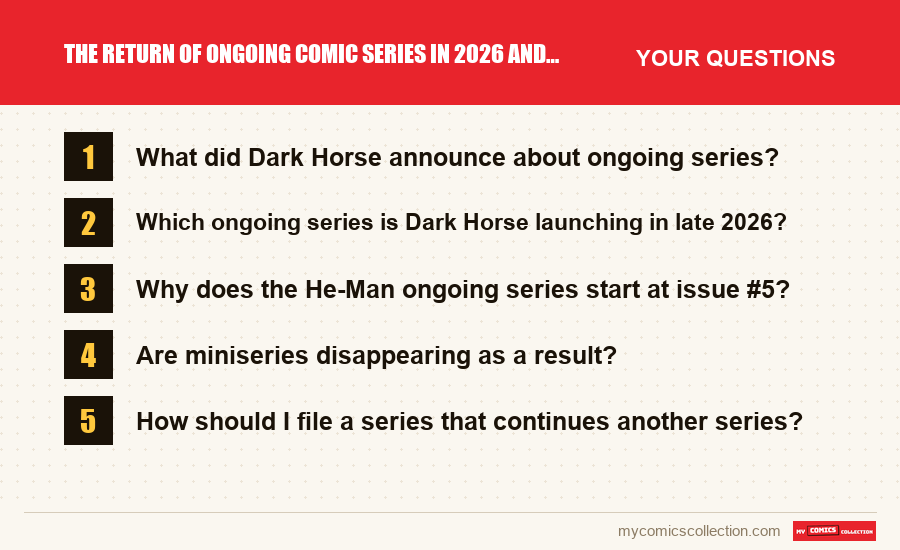
According to ICv2 (October 16, 2026), Dave Marshall said at New York Comic Con that Dark Horse's biggest licenses are moving from four-issue miniseries to ongoing series and maxiseries, citing He-Man and the Masters of the Universe and Canto: The Clockwork Chronicles as examples.
Dungeons & Dragons #1 comes out on November 4, 2026 and Canto: The Clockwork Chronicles #1 on November 18. Baldur's Gate 3 #1 is expected on January 6, 2027, and Barbie is announced with a first six-issue arc, with no date found in the sources.
Dark Horse announced in December 2025 an ongoing series written by Tim Seeley and drawn by Reilly Brown, which continues the story of The Sword of Flaws. It begins at issue #5, with the arc The Battle of Snake Mountain, released on May 13, 2026.
No. Dark Horse publishes Minor Threats: The Cleaner, a four-issue miniseries, in November 2026, and Image offers Merciless at four issues and Vampire on Aisle 6 at three. Both formats coexist: the listing for each title gives the planned number of issues.
File the comics in reading order and note the title, issue number, arc and release date in the inventory. For He-Man, this avoids mixing up the four issues of The Sword of Flaws with the ongoing series that begins at issue #5.
Already following Dark Horse series since their miniseries days? Get the condition of your comics assessed.
Estimate my comic