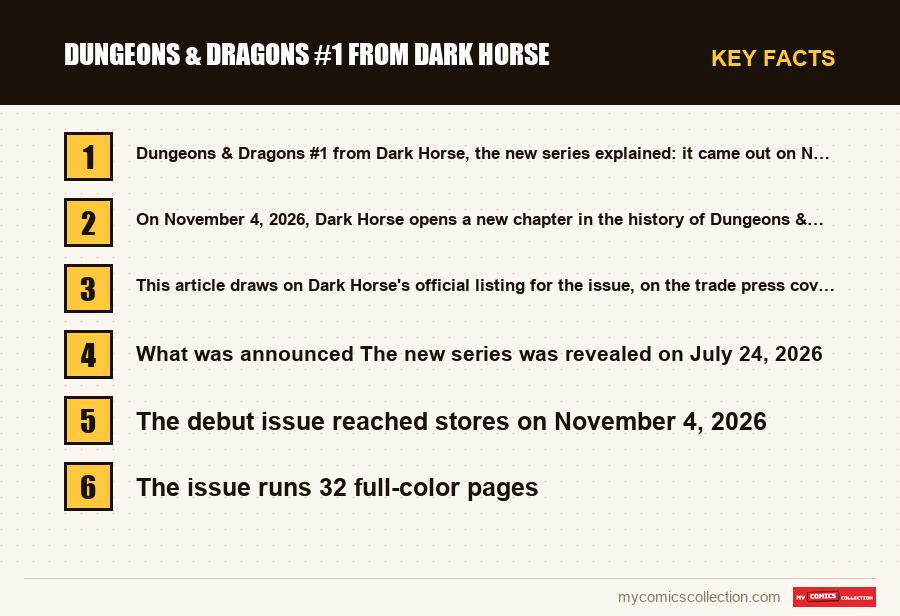
Dungeons & Dragons #1 from Dark Horse, the new series explained: it came out on November 4, 2026, according to the publisher's listing. Jackson Lanzing and Collin Kelly write, Ibraim Roberson draws, Arabson Oliveira inks, Daniel Brown colors and Haley Rose-Lyon letters. A draconic apocalypse threatens the Forgotten Realms, and Mordenkainen, stripped of his magic, must team up with heroes of Faerûn. This issue launches an ongoing series, with an essay or a campaign supplement at the back that is exclusive to the single issues.
A wizard without magic, a dragon whose name is a warning, and a tabletop role-playing game that is decades old: that is plenty to launch a series on the comic shop rack. On November 4, 2026, Dark Horse opens a new chapter in the history of Dungeons & Dragons comics, and the choice of an ongoing series changes the scale of what the publisher has put out since it took over the license.
This article draws on Dark Horse's official listing for the issue, on the trade press coverage of the July 24, 2026 announcement, and on published histories of the license. The collector's reading is our own, and it steers clear of any dollar estimates.
What was announced
The new series was revealed on July 24, 2026. Dark Horse presented an ongoing Dungeons & Dragons title written by Jackson Lanzing and Collin Kelly, with Ibraim Roberson on pencils, Arabson Oliveira on inks, Daniel Brown on colors and Haley Rose-Lyon on letters. The debut issue reached stores on November 4, 2026.
The issue runs 32 full-color pages. Dark Horse files it under fantasy and media tie-ins, recommends it for readers 14 and up, and publishes it at 6 5/8 by 10 3/16 inches. The official summary fits in a single sentence: a draconic apocalypse is closing in on the Forgotten Realms, and one name is on everyone's lips, Mordenkainen. Billed as the most powerful wizard in all of reality, he has lost his magic and must join forces with the legendary heroes of Faerûn to restore the balance.
The covers are the other half of the announcement. The main cover is by Esad Ribić. Variants are signed by Tyler Jacobson, Karen Darboe and Mateus Manhanini, and they are joined by a foil variant drawn by Antonio José Manzanedo and a 1-in-25 retailer incentive cover by Eric Canete. Dark Horse specifies that Manzanedo will draw a dragon foil variant for every issue, available on an open-order basis.
Each issue will also carry either an essay written by a figure from the tabletop role-playing community or a supplement that can be used in a campaign. For issue #1, the essay is by Erika Ishii, a voice actor known for their work on the actual-play series Dimension 20. Issue #2 is announced for early January 2027.
Point 1: Dark Horse and the license since 2025
Dark Horse did not just arrive with this first issue. The company took over the Dungeons & Dragons comics license in 2025, after fourteen years at IDW. Its output was built up through miniseries at first. Among them are Stranger Things and Dungeons & Dragons: The Rise of Hellfire (2025), The Fallbacks (2025 and 2026) and Total Party Killers (2026), while Ravenloft is announced for 2026.
That detail sheds light on the November gamble. A miniseries gets collected in a trade paperback at the end of its run, and the reader knows in advance where the story stops. An ongoing series builds a different habit: a monthly appointment at the shop, rotating covers, variants to keep track of, and a subscription decision to make without knowing the ending. For anyone already following The Fallbacks or Total Party Killers, issue #1 is therefore a doorway into the same editorial line, without being a direct sequel to those stories.
To place the publisher in its broader history, from Hellboy to film and game licenses, the guide to the history of Dark Horse Comics and the tier list of the best Dark Horse comics, both in the "Explore" box, offer landmarks that this article does not repeat.
Point 2: Mordenkainen and the Forgotten Realms
The central character of the series is Mordenkainen, nicknamed the Mad Mage in the announcement's pitch. This wizard was created by Gary Gygax for his own campaign, which makes him one of the oldest figures in the game's universe. In the series, he is pulled into the heart of the Forgotten Realms, a fantasy setting that Dungeons & Dragons products draw on heavily.
The official summary also says who surrounds him: famous heroes of Faerûn, among them the sage Volo and the witch Tasha, according to the press coverage. A team in which figures well known to players meet in a single story is a classic recipe for a licensed comic: every reader goes looking for a character they have met around a table.
For the collector, the interest is twofold. On one side, there are appearances by iconic characters in a series sold as single issues, which keeps readers' attention up month after month. On the other, there is a series whose dramatic engine, a wizard without power facing a dragon-sized threat, leaves plenty of room for supporting characters. It is the run as a whole, more than issue #1 taken alone, that will tell us which appearances matter.
Point 3: Forty years of Dungeons and Dragons comics before Dark Horse
Comics based on Dungeons & Dragons have lived in several houses. TSR and DC Comics launched the Dragonlance Saga albums in 1987, and then DC published a full line from 1988 to 1991: Advanced Dungeons & Dragons (36 issues), Dragonlance (34), Forgotten Realms (25), Spelljammer (15) and Avatar: War of the Gods (3). A licensing dispute ended the adventure, and some announced series, including a Ravenloft title, never appeared.
The following decade was more scattered. Marvel published Dragon Strike, a single issue, in 1994; TSR distributed four promotional issues in 1996; and a free Baldur's Gate comic accompanied the video game of the same name in 1998. In 2001, Kenzer and Company picked up the torch and published, through 2004, titles such as In the Shadow of Dragons, as well as Tempest's Gate, Black & White and Where Shadows Fall.
From 2004 to 2008, Devil's Due held the license: The Legend of Drizzt (22 issues), Dragonlance Chronicles (24 issues) and other novel adaptations. The company lost the license in 2008, with financial difficulties that the publisher blamed on returns from bookstores. IDW then took over from 2010 to 2024. Its Dungeons & Dragons series ran 16 issues between 2010 and 2012, and the catalog includes Legends of Baldur's Gate, Infernal Tides, Saturday Morning Adventures (2023 and 2024) and Fortune Finder, not to mention Rick and Morty crossovers published with Oni Press.
This timeline recalls a useful fact: the license changed hands with each generation, and each house left behind a distinct collection, from the DC era to the IDW years. A collector looking at the complete shelf therefore sees families of covers and formats that look very different from one another, and Dark Horse's issue #1 joins that lineage without replacing any of it.
Do you collect this series?
Track what you own, what you are missing and what your collection is worth. 7-day trial.
Start my trial →
Point 4: Lanzing, Kelly and Roberson, the creative team
Jackson Lanzing and Collin Kelly are a writing duo described by the press as Eisner-nominated, with work on Star Trek, Captain America and NYX. Kelly sums up the project by saying that this book is the very definition of a passion project for them: according to the announcement, the two writers have played tabletop role-playing games together for as long as they have written as a team.
Ibraim Roberson, on art, has already drawn pages for Star Wars, Weapon X and Annihilation 2099. Here he is backed by Arabson Oliveira on inks; Daniel Brown handles the colors and Haley Rose-Lyon the lettering.
What this team says about the series comes down to its track record: writers used to large-scale shared universes, an artist seasoned in action licenses. That may steer the tone toward epic rather than parody, but this is a reading based on the credits, not information from the publisher. The official listing speaks of a high fantasy epic centered on Mordenkainen, and it is the listing that counts.
What this means for a collector
Start by separating what the publisher has named from what remains to be confirmed at the shop. For issue #1, the official list includes a main cover by Esad Ribić, variants by Tyler Jacobson, Karen Darboe and Mateus Manhanini, a foil variant by Antonio José Manzanedo and a 1-in-25 variant by Eric Canete. Each copy should be noted with its cover letter, its artist and its printing, exactly as they appear on the issue.
Second, the 1-in-25 variant: it is not sold on an open-order basis, and the retailer receives it only in proportion to their orders of the regular cover. The method is therefore to read the ratio notice on the order form or the sale listing, then compare the artwork to the image published by Dark Horse. By contrast, Manzanedo's foil variant is open order, and the publisher announces one per issue: a dragon on every single issue, which creates a mini-series of covers to shelve together.
Third, the material outside the story pages. The essays and campaign supplements are announced as exclusive to the single issues. A later collected edition might not reprint them; the publisher has not said, so nothing allows us to claim it one way or the other. For a collector, the practical consequence is to handle the issue carefully through to its last page: the back-of-issue supplement is part of the object, and a crease on the back or a detached page damages the part of the issue that the publisher says is unique to the single-issue format.
Fourth, condition. A 32-page issue on standard paper is stored flat, in a sleeve, in a box with a rigid bottom; the basic guidelines are in the guide to comic storage and preservation. For foil variants, the shine scratches more easily than matte paper, so avoid sliding two copies against each other.
Finally, a word on method for tracking an ongoing series. Rather than buying everything at release, keep a simple list: issue number, cover letter, purchase date, condition on arrival. To tell a first printing from a reprint later on, note the printing line and the barcode, as explained in the article on the value of a French first edition versus its reprint.
What remains to be confirmed
The information in this article comes from the publisher's listing and announcement. Issue #1 is out; issue #2 is listed for early January 2027 with no specific day, and the date of an announced issue can still move before it ships.
- the schedule beyond issue #2, which none of the sources we read details;
- the possible planned end of the series: no issue count has been announced;
- whether a collected edition exists and what it contains, in particular whether the essays and campaign supplements are reprinted;
- the list of variants for later issues, beyond those the publisher has already described;
- the authors of the essays and supplements for issue #2 and beyond.
Frequently asked questions
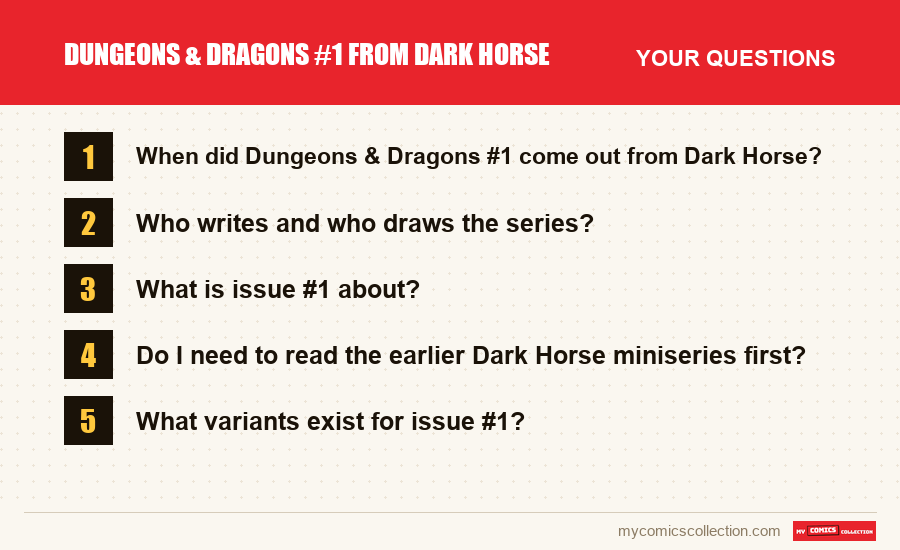
Issue #1 came out on November 4, 2026, the date on Dark Horse's listing. Issue #2 is listed for early January 2027, with no specific day in the sources we read; like any announced issue date, it can still slip.
Jackson Lanzing and Collin Kelly write. Ibraim Roberson draws, Arabson Oliveira inks, Daniel Brown colors and Haley Rose-Lyon letters. The main cover of issue #1 is by Esad Ribić. These credits come from the official listing and from the July 24, 2026 announcement.
A draconic apocalypse threatens the Forgotten Realms, and the name Mordenkainen keeps coming up. The wizard, stripped of his magic, must ally with the heroes of Faerûn to restore the balance. According to the press, the story brings in Volo and Tasha, among others. The official summary says nothing more.
Nothing in the sources we read points to a story link with The Fallbacks, Total Party Killers or The Rise of Hellfire. Issue #1 is presented as the start of an ongoing series centered on Mordenkainen in the Forgotten Realms, so you can pick it up without any prior reading.
Besides Esad Ribić's cover, the publisher cites variants by Tyler Jacobson, Karen Darboe and Mateus Manhanini, a foil variant by Antonio José Manzanedo and a 1-in-25 variant by Eric Canete. Note the letter and the artist's name on each copy to tell them apart.
Your fantasy single issues and cover variants deserve a serious appraisal before any sale or insurance.
Appraise my comic