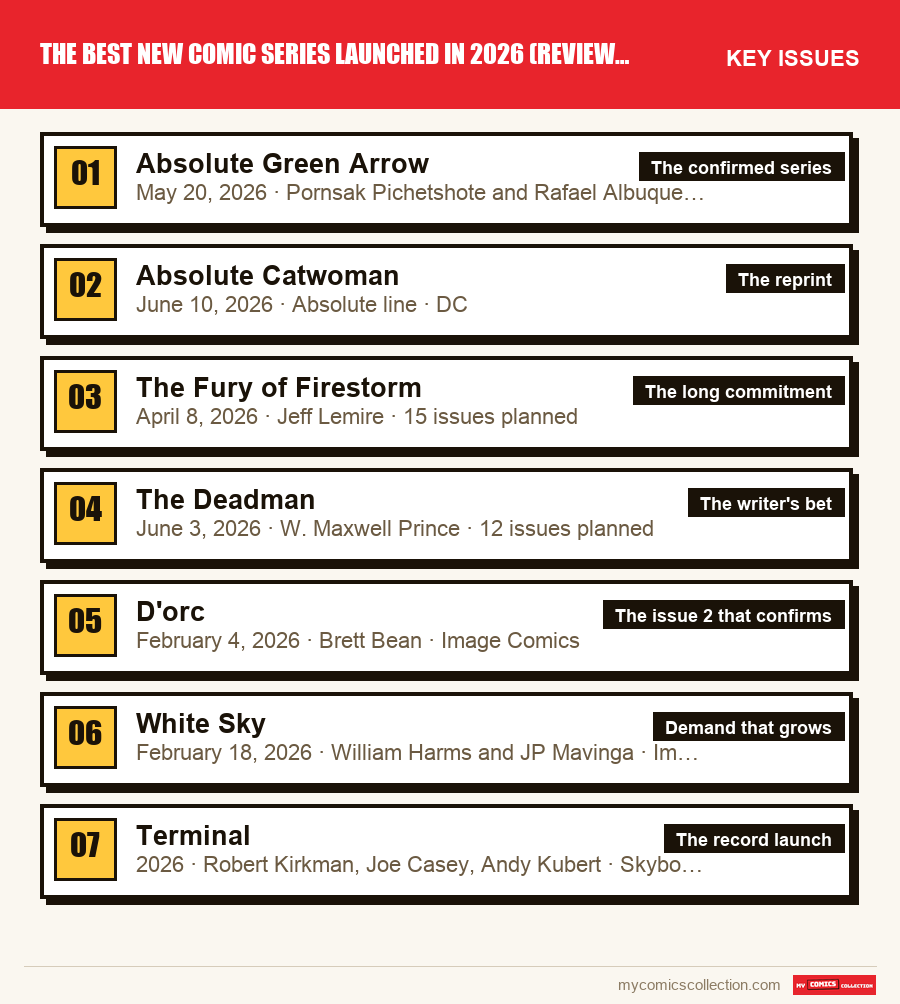
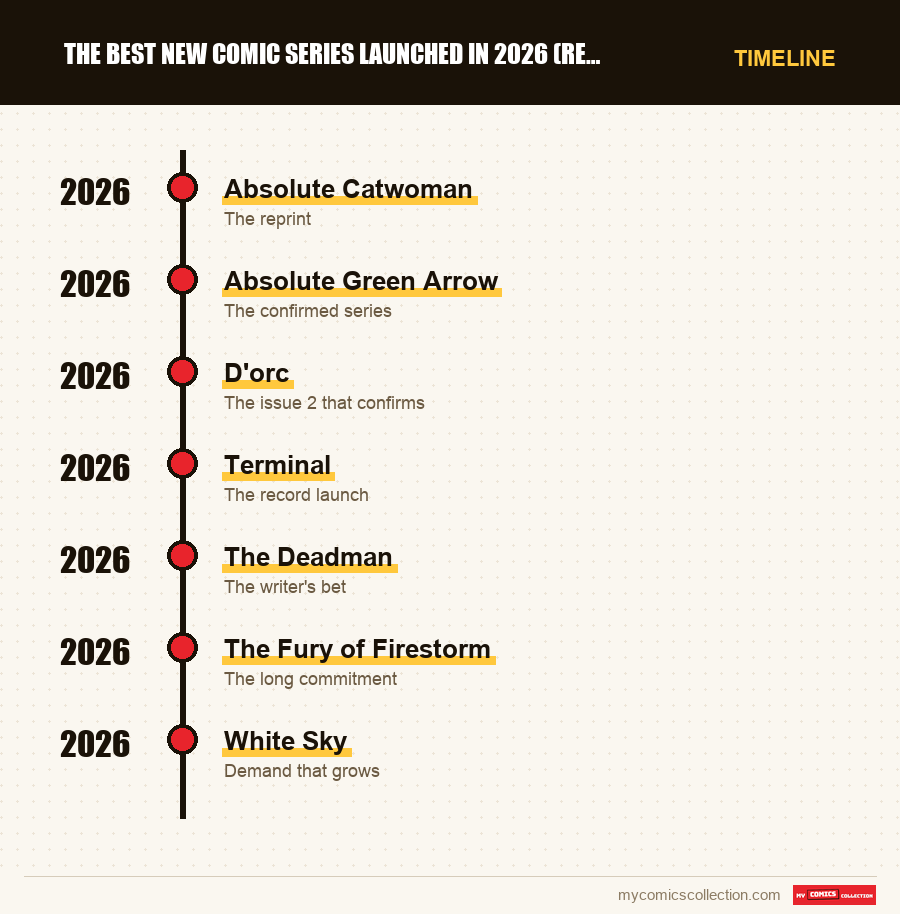
As of early October 2026, the series launched this year that have held up after several issues are, at DC, Absolute Green Arrow by Pornsak Pichetshote and Rafael Albuquerque (May 20), sold out before release then extended from 6 to 12 issues and given a spinoff, and Absolute Catwoman (June 10), reprinted in July; among the Next Level titles, the long-haul series announced as The Fury of Firestorm by Jeff Lemire (April 8, 15 issues planned) and The Deadman by W. Maxwell Prince (June 3, 12 issues). At Image, D'orc by Brett Bean (February 4), whose #2 totaled about 75,000 orders, and White Sky (February 18), whose reprint exceeded the first printing. At Skybound, Terminal, printed at 300,000 copies. September's issue 1s are too recent to judge.
An issue 1 proves nothing. It is ordered before being read, carried by the announcement, the cover and the creators' names, and it almost always sells better than everything that follows. The real question, for a new series, is not whether its launch made noise, but whether it held: whether readers came back for the second issue, then the fifth, and whether the publisher confirmed the series instead of letting it fade out.
This review is written as of October 3, 2026 and only covers series launched in 2026 that already have several issues behind them. It does not cover issue 1s of all eras, which are the subject of our ranking of the best issue 1s in comics history, nor the full set of series to follow, older ones included, which our list of the best ongoing series in 2026 covers. It says nothing about the October to December launches.
How to judge that a series "held"
We cannot directly measure reader loyalty: since 2022, no public sales record by title exists for the North American direct market. We must therefore rely on public, verifiable signals that reflect a publisher's confidence or shop demand. We retain five.
Orders for issue 2. When published, they say whether shops believe in what follows. It is the best indicator available, and the rarest.
Reprints. A reprinted issue 1 signals demand above initial orders. A second printing larger than the first signals demand growing after release, which is even more significant.
Extension. When a publisher announces that a miniseries planned for six issues will go to twelve, it makes a commitment not made lightly. It is the clearest signal that a series has found its audience.
Spinoffs. A special issue or spinoff series announced a few months after launch shows the publisher wants to exploit the universe created.
The collection. The quick announcement of a collected edition confirms that a series has a future in bookstores, beyond the single issue.
These signals do not measure quality, and we say so frankly: an excellent series can die for lack of readers, a mediocre series can last. But they measure what can be measured, and they let us distinguish launches that fizzled from those that held.
DC: the Absolute line grows and holds
DC's Absolute line, launched in October 2024, added two series in 2026. Both held, according to different signals.
Absolute Green Arrow
The most anticipated launch of the year at DC. Issue 1 was sold out at the distributor a week before release and went to a second printing before even arriving in shops. Above all, the series was then extended from six to twelve issues, and a spinoff special, Absolute Black Canary, was announced in July 2026. The tone, closer to crime fiction than to a superhero story, clearly found its audience.
Absolute Catwoman
Launched three weeks after Absolute Green Arrow, the series saw its issue 1 put back on press for July 15. It is a more modest signal than an extension, but it confirms that the Absolute line keeps attracting orders beyond its three founding titles.
DC: the Next Level series settling in for the long term
The Next Level label, opened in March 2026, groups relaunches of lesser-known characters in main continuity. A first wave in March brought together a Batwoman series written by Greg Rucka, a Lobo by Skottie Young and a Deathstroke: The Terminator by Tony Fleecs, then other titles followed in spring. Our analysis of Next Level and what to collect from it details its logic; we retain here the series whose announced length is in itself a commitment.
The Fury of Firestorm
A Firestorm relaunch entrusted to Jeff Lemire, scheduled for fifteen issues. For a dormant character, an announced length of this scale is a publisher's bet on a writer, and a guarantee for the reader: the story has room to develop.
The Deadman
DC's acrobat ghost, entrusted to W. Maxwell Prince, known for strange and dark stories, in a series planned for twelve issues. It is one of the label's titles where the writer's identity weighs the most.
Two other spring titles deserve a mention. Zatanna, written and drawn by Jamal Campbell from April 29, gives the magician a series carried by a complete creator, which is rare for this character; our history of Zatanna retraces her path. And Barbara Gordon: Breakout, by Mariko Tamaki, launched May 13, is a miniseries that reads as a block. On these two titles, we have no public signal of hold comparable to those of Absolute Green Arrow: we flag them as reads, not as proof.
Image and Skybound: the creations that found their audience
D'orc
A fantasy comedy whose issue 1 sold out on release day, then was reprinted twice. The strongest signal is elsewhere: according to the trade press, citing a source inside the publisher, issue 2 totaled about 75,000 orders at the end of February 2026, and issue 1 approached 100,000 across all printings. An issue 2 ordered at this level, for an unlicensed creation, is exceptional.
White Sky
A post-apocalyptic story whose issue 1, sold out on release day, was reprinted a month later. Orders for the second printing exceeded 30,000 copies and surpassed those of the first. It is the sign of demand that built after release, by word of mouth, and not a mere launch effect.
Terminal
A crime series printed at 300,000 copies against an initial hope of 100,000, with a second printing on August 26, 2026. It is the year's biggest original-creation launch.
A last mention for Tigress Island, by Patrick Kindlon and EPHK, launched in March at Image, sold out at the distributor before release, and for which a collection of issues 1 to 5 is announced in the November catalog. A quickly scheduled collection is a signal of publisher confidence.
Too early to judge: the September launches
September was a very busy month of issue 1s, and these series do not yet have the seniority needed to figure in this review. At DC, three Next Level relaunches came out the same day, September 2: Teen Titans by Kyle Higgins, Legion of Super-Heroes by Joshua Williamson and The Doom Patrol by Darcy Van Poelgeest. At Marvel, Alien vs. X-Men launched in September, and Jed MacKay's DNX event began on September 16. Our DNX reading guide gives the full calendar.
For these titles, one or two issues say nothing. The right moment to evaluate them will be spring 2027, when their fifth or sixth issue is out and we know whether the publisher has confirmed them.
What 2026 teaches about new series
Three lessons emerge from this year of launches.
Format matters. The series that held best are either creator-driven creations with no prerequisites, or reinventions in a new continuity. In both cases, the reader needs to know nothing. Relaunches in main continuity also hold, but with more discreet signals.
Announced length reassures. A series scheduled for twelve or fifteen issues tells the reader they are not committing for nothing. It is an argument publishers use more and more, and it answers the fatigue of series canceled at the sixth issue.
Issue 1 deceives. The most spectacular launches are not necessarily those that held best. The strongest signal of the year is not a record print run: it is an extension from six to twelve issues, and an issue 2 ordered at 75,000 copies.
Wait for the third issue
Before committing to a new series, read the first three issues. The first sells the idea, the second sets the rhythm, the third shows whether the team holds its subject.
Watch the publisher's announcements
An extension, a spinoff or a quick collection are public, free signals, and more reliable than release-week enthusiasm.
Keep the list up to date
A series you follow without logging it quickly becomes a gap-filled series. Issue-by-issue tracking lets you know, six months later, what you actually read.