It's tempting to assume a comic encapsulated in its CGC slab is permanently safe. The transparent polycarbonate case gives a fortress-like impression: the comic is sealed, protected, untouchable. In reality, a CGC slab is not invulnerable.
Preserving your CGC slabs long-term: best practices
It's tempting to assume a comic encapsulated in its CGC slab is permanently safe. The transparent polycarbonate case gives a fortress-like impression: the comic is sealed, protected, untouchable. In reality, a CGC slab is not invulnerable. It can scratch, crack, yellow from the inside, suffer from humidity or UV. And a damaged slab means a value drop, or re-holder fees that add up.
Here's everything you need to know to preserve your CGC slabs in the best possible conditions and sustainably protect the investment they represent.
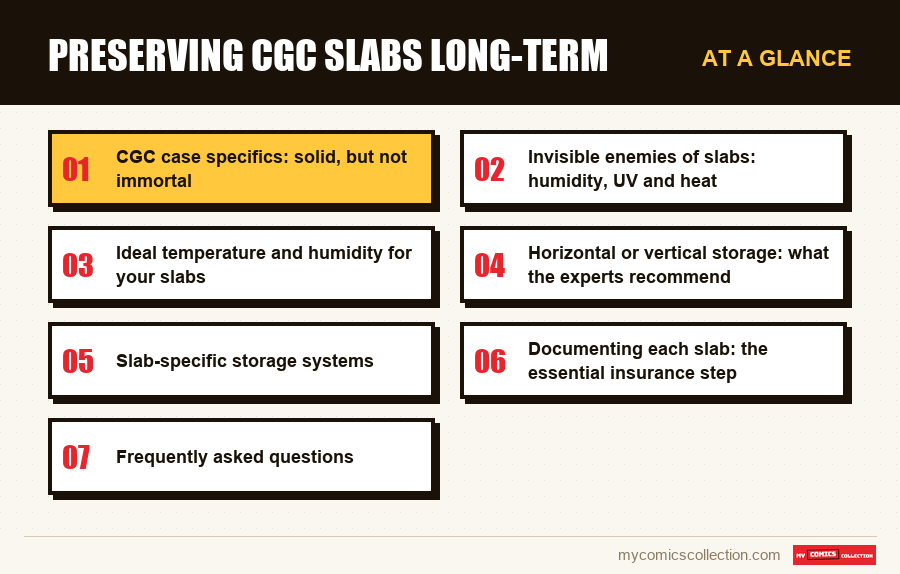
CGC case specifics: solid, but not immortal
The CGC case is made of polycarbonate, a rigid and lightweight plastic used in many industrial applications. It offers good mechanical protection against moderate shocks and isolates the comic from direct handling. That said, its limits are real:
- Scratches: polycarbonate scratches easily when in contact with other hard surfaces. Scratches on the front face diminish visual appeal and, in severe cases, can affect perceived resale value.
- Corners: the most fragile zone. A hit on a corner can create a crack or chip. A cracked case is no longer hermetic, which compromises the comic's protection inside.
- Internal yellowing: the paper of the comic inside can yellow over time, especially if the slab is exposed to heat, excessive humidity or UV. Even inside the case, chemical degradation of paper isn't stopped, only slowed.
- The seal: the case joints aren't 100% impermeable. Under extreme humidity or repeated temperature variations, micro-infiltrations are possible long-term.
Invisible enemies of slabs: humidity, UV and heat
The same factors that degrade raw comics also attack slabs, with less efficiency but still over the long term. Three main enemies:
Humidity is paper's number-one threat. Relative humidity (RH) above 60% promotes mold growth and accelerates oxidation of cellulose fibers. Paper yellows, becomes fragile and can develop stains. Inside a slab, these processes are slowed but not halted.
UV causes paper whitening and yellowing, plus ink fading. The glossy cover of an 1980s comic can lose its vibrancy if regularly exposed to direct sunlight or unfiltered fluorescent lighting. The case's polycarbonate doesn't filter all UV.
Heat accelerates every chemical reaction. Above 77-81°F (25-27°C), paper degradation progressively runs away. Un-air-conditioned rooms in summer, or storage in a garage or attic, can expose your slabs to temperatures well above this acceptable threshold.
Ideal temperature and humidity for your slabs
Preservation recommendations for CGC slabs match those for quality raw comics:
- Temperature: between 65-70°F (18-21°C). Stable temperature is as important as the absolute value: repeated hot/cold cycles cause contractions and expansions that stress materials.
- Relative humidity: between 40% and 50%. Below 35%, paper can become brittle. Above 55-60%, mold risk increases.
- Avoid sudden variations: moving a slab from a cold room to a warm, humid room causes condensation, including inside the case. Always let your slabs acclimate gradually if you move them to a different environment.
A digital hygrometer under $25 lets you continuously monitor your storage space conditions. It's a minimal investment to protect a collection that may be worth thousands of dollars.
Collecting this series?
Track what you own, what you are missing and what your collection is worth. 7 day trial.
Start my trial →Horizontal or vertical storage: what the experts recommend
This is one of the most frequent questions from collectors new to slabs: should you store them upright like regular comics, or flat?
Expert consensus leans clearly toward horizontal storage, for several reasons:
- Weight distribution: a slab laid flat distributes weight evenly across its lower surface. Upright, all the weight concentrates on the case's bottom edge and the comic's spine inside: pressure that, long-term, can create deformation.
- Tipping risk: slabs stored upright can fall, especially with vibrations (traffic, slamming door, minor earthquake). A slab falling from a shelf onto a corner can crack.
- Pressure on internal corners: the comic inside the case rests on a rigid backer. In vertical position, the comic's bottom corners can bear a slight continuous pressure: minimal but real over the long term.
If you store flat, limit stacks to 10-15 slabs maximum. Beyond that, cumulative weight (each slab weighs about 14-18 oz) can start to stress the bottom cases. Compartmented shelves let you combine convenience and protection.
Slab-specific storage systems
Standard longboxes aren't suited to CGC slabs: not in dimensions, not in strength. Specialized solutions exist:
Thick-cardboard slab boxes: offered by several specialized suppliers (BCW, E. Gerber, etc.), sized for standard CGC slabs and offering sufficient protection for home storage. Some models include foam wedging to prevent movement inside the box.
Compartmented shelves: for display or frequent-access storage, shelves with individual compartments let you see each slab without moving the others. Some collectors use game-card display stands sized appropriately.
Transport cases: for high-value slabs or travel to conventions, rigid cases with custom-cut foam offer the best protection. A hit on a well-padded case doesn't reach the slab inside.
Whatever solution you pick, the goal is the same: avoid direct slab-to-slab contact (mutual scratching risk), prevent impacts and falls, and maintain stable temperature and humidity around the cases.
What to do if a slab is damaged? The CGC re-holder
If your slab shows a cracked, broken or heavily scratched case, you can submit it to CGC's "re-holder" service. Re-holder involves opening the damaged case, confirming the comic inside is still intact and re-encapsulating it in a new case with the same grade and certification number.
It's an option, but it has a cost: re-holder fees add to international shipping. A lightly scratched case generally doesn't justify the expense. A cracked case or one whose seal is compromised, though, is worth seriously considering re-holder for to protect the comic inside.
Documenting each slab: the essential insurance step
Having well-preserved CGC slabs isn't enough: you also need to prove their existence and value in case of a claim. Documenting each slab is an often-overlooked but crucial step.
For each slab, keep at minimum:
- A photo of the front and the edge (which shows the certification number).
- The CGC number, viewable and verifiable on the CGC site.
- The grade and label (Universal, Signature Series, etc.).
- Purchase price and acquisition date.
- A recent value estimate based on comparable sales.
My Comics Collection centralizes all this information in one place, with dedicated fields for CGC slabs. In case of a claim, you can generate a complete report of your collection in a few clicks with all the supporting documents needed for your insurer.
Frequently asked questions
Yes. The CGC case significantly slows paper degradation but doesn't completely stop it. Chemical oxidation reactions continue inside the slab, especially if storage conditions are poor (heat, humidity, UV). That's why maintaining a stable 65-70°F (18-21°C) and 40-50% relative humidity is as important for slabs as for raw comics.
Technically yes, but it's a very bad idea. Opening a slab destroys the certification seal, the comic loses its official CGC grade and all associated value. If you want to read a comic you own in a slab, the right approach is to buy a second raw copy for reading and keep the slab intact.
The general rule is not to exceed 10 to 15 slabs in a horizontal stack. Beyond that, cumulative weight (between 9 and 15 pounds for 15 slabs) starts exerting noticeable pressure on the bottom cases. For larger quantities, favor multi-tier shelves with independent stacks, or specific storage solutions with separated compartments.
Each slab must be wrapped individually in bubble wrap before being placed in a rigid box. Never put slabs in direct contact with each other: polycarbonate scratches easily. Fill empty spaces with foam or crumpled paper to prevent any movement inside the box. Label boxes "Fragile" and transport them yourself if possible rather than entrusting them to movers.