In short
Plastic Man debuts in Police Comics #1 (August 1941) from Quality Comics, created by Jack Cole: Eel O'Brian, a safecracker doused with chemicals, becomes an elastic crimefighter. DC acquired him when Quality shut down in 1956. The turns that matter are Cole's Quality years with Woozy Winks, Phil Foglio's 1988 miniseries, Grant Morrison's Justice League, Kyle Baker's 2004 series and the 2024 Plastic Man No More!
Plastic Man is a character whose body is a drawing surface, and the people who have written him have kept pulling the story in two directions at once: toward farce, and toward something much darker. Following the stretch from a 1941 anthology feature to a Black Label miniseries shows how far one rubber hero can bend without breaking.
Issue numbers, cover dates and credits for Plastic Man, from Jack Cole's 1941 debut to the 2024 Black Label series, were checked in write-ups of the hero and of Woozy Winks, and months are given only for the dates that were read. Our own reading of each era is labeled as analysis. No dialogue or artwork is reproduced.
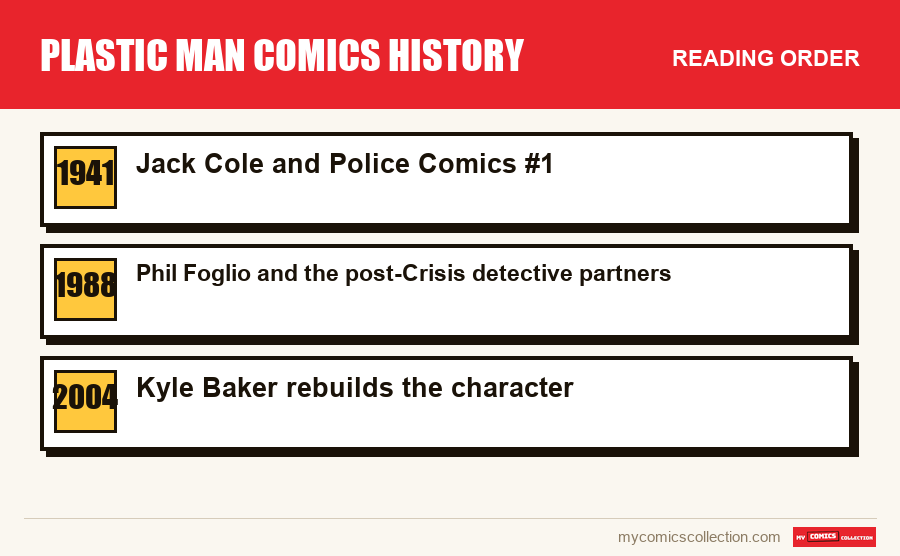
1941: Jack Cole and Police Comics #1
The debut sits in Police Comics #1, dated August 1941, a Quality Comics anthology. Jack Cole is the creator. The hero begins as Patrick "Eel" O'Brian, a safecracker in a burglary ring who is shot in the shoulder and doused with an unidentified chemical during a heist at the Crawford Chemical Works, then left behind by his gang. A monk at a mountain retreat tends to him and turns the police away, and Eel discovers rubber-like powers and chooses to fight crime in a costume.
The setup matters more than the powers. Plastic Man is a criminal who changes sides, and his humor comes from a man who knows exactly how the underworld thinks. The premise licenses a rubber body to behave like a cartoon in a world of gangsters, and that tension drives the best of the early stories.
For the collector, the 1941 issue sits in a Golden Age anthology, so the character begins as one feature among others rather than as a headliner. Police Comics is the book to know before any Plastic Man series exists.
1942 to 1956: Woozy Winks and the Quality years
Woozy Winks arrives in Police Comics #13 (November 1942), also created by Jack Cole. In that first story he is a small-time crook who saves a wizard from drowning and is rewarded with a power that makes the forces of nature protect him in danger. Later stories drop the power, and Woozy settles into the role of Plastic Man's inept assistant.
Quality then gives the hero his own title, Plastic Man, which runs 64 issues from 1943 to 1956. The Quality stories also move O'Brian into the city police and later into the FBI, a step that turns the reformed crook into an institutional lawman without changing his tone. Issues such as #2 (August 1944), #6 (December 1947) and #21 (January 1950) belong to this run.
Cole's Quality stories also show why the character resists a single tone. A hero who can become an armchair or a lamp lets the artist treat each page as a visual joke, and that freedom is the reason later cartoonists keep returning to the 1940s material. Anyone reading the Quality stories today meets that elastic page design before meeting any plot.
The period gives the character his permanent shape: a stretching hero, a dim sidekick and a comic voice. Almost every later writer treats those three pieces as the baseline to honor or to subvert.
1956 to the 1970s: DC acquires the character and tries again
Quality Comics ceases operations with comics cover-dated December 1956, and DC Comics acquires the character along with others from the publisher. A character that had carried his own monthly for years returned as part of a larger inventory, a different position from the one he held at Quality.
DC gave Plastic Man a fresh series in 1966, the first of several short-lived series that the character would headline at the company. Between solo books the rubber hero visits The Brave and the Bold, where #76 pits him against Molder and #95 (May 1971) brings in Ruby Ryder. For collectors, the lesson of these years is that a DC-era Plastic Man book needs its cover year written next to its number, because each short run restarts the count.
The 1960s and 1970s are a thin, uneven stretch compared with the Cole years, and the character has not been a major commercial hit at DC. What carries him through these decades is the admiration of other creators, among them Grant Morrison, Art Spiegelman, Alex Ross, Kyle Baker and Frank Miller. Spiegelman profiled Cole in the April 19, 1999 issue of The New Yorker, a piece later included in his 2001 book with Chip Kidd.
1988: Phil Foglio and the post-Crisis detective partners
In the post-Crisis era, Plastic Man received a four-issue miniseries in 1988 and 1989 by Phil Foglio. It reimagines Eel and Woozy as detective partners in New York City, a premise that keeps the comedy and moves the pair out of the Golden Age setting. The miniseries also explains the hero's name as a reporter's misreading of "Elastic Man."
The effect is a modernization. With two partners in one city, the book reads as a buddy comedy rather than a crime strip with rubber powers. The Crisis on Infinite Earths key issues explain the reset that made such a fresh start possible.
The 1990s: Morrison's Justice League and Waid's The Kingdom
Grant Morrison makes Plastic Man a prominent member of JLA, which puts the elastic hero beside DC's biggest names and gives him a regular place in a flagship team book.
In 1999, Plastic Man's son Offspring appears in Mark Waid's miniseries The Kingdom. The book adds a son to a character who had been a solo act, and it is the place to look for Offspring. The same year, a Plastic Man Special gives Woozy a different backstory as a competent agent called Green Cobra.
The decade matters because Plastic Man stops being a Quality leftover and becomes a team member with real stakes. Morrison's work is collected on our Grant Morrison page.
Do you collect this series?
Track what you own, what you are missing and what your collection is worth. 7-day trial.
Start my trial →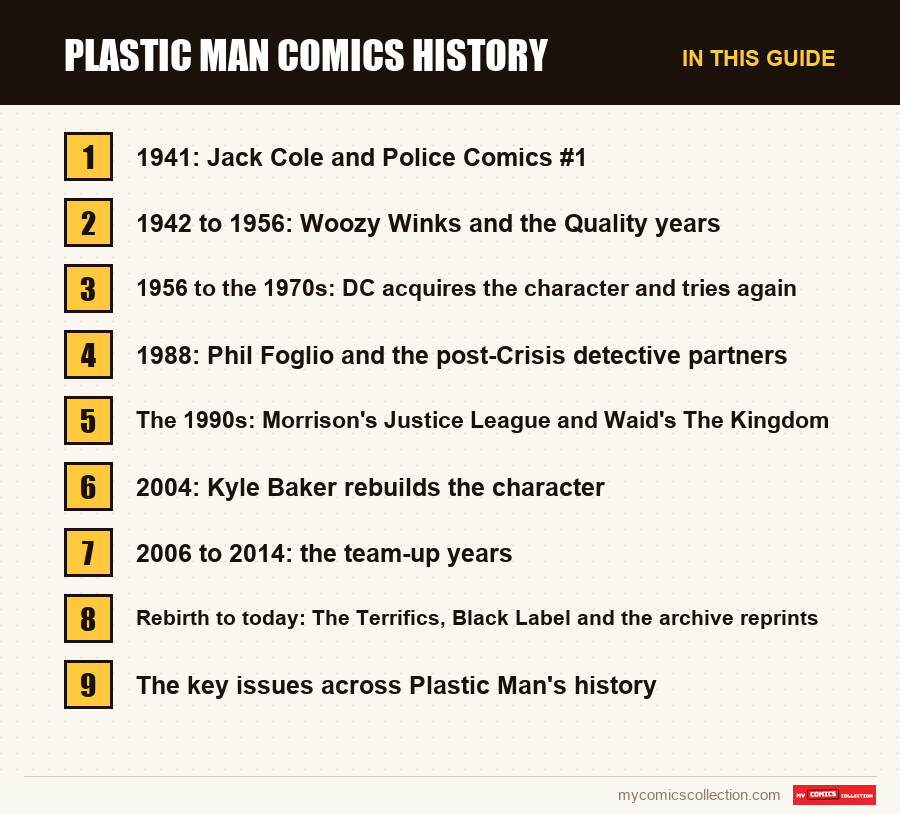
2004: Kyle Baker rebuilds the character
Kyle Baker's Plastic Man volume 4 runs 20 issues from February 2004 to March 2006, and it is the usual modern entry point. Baker writes and draws most of it, though not #7 and #12. Eisner juries name it Best New Series in 2004, then honor Baker's stretching comedy in the humor writer/artist category three years running, 2004 through 2006. The first collection, On the Lam (November 2004), gathers volume 4 #1 to #6, and Rubber Bandits (December 2005) gathers #8 to #11 and #13 to #14. A 2020 deluxe edition, Plastic Man: Rubber Banded, collects #1 to #20.
The series treats the stretching body as an instrument of comic timing. Where Foglio's version turned Eel into a detective partner, Baker returns to the chase comedy that Cole's Quality stories favored, which makes it a natural bridge back to the spirit of the Quality stories.
That is why the 2004 series is the common recommendation for new readers, and why volume 4 is the series to look for when a store lists a Plastic Man without further description.
2006 to 2014: the team-up years
After Baker, Plastic Man spends several years as a supporting player. Green Arrow/Black Canary #8, written by Judd Winick, features him, and so does Countdown to Mystery #1 (2007), written by Lilah Sturges. His son resurfaces too: Teen Titans volume 3 #34 (2006) features a costumed young man identified as Offspring, and Week 35 of 52 also shows him. Len Wein's Justice League of America volume 2 #35 to #41 (July 2009 to January 2010) and Justice League: Cry for Justice #6 (January 2010) cover Plastic Man's injury and decline.
The New 52 reset lands in 2011. Justice League International volume 3 #1 (November 2011) features a cameo in which Plastic Man is denied a spot on the team. That cameo is later retconned by Eel O'Brian's proper New 52 introduction in Justice League volume 2 #25 (February 2014).
This stretch is mostly interesting for what it shows about the character's role: Plastic Man is a hero DC likes to have around, but a solo series from the period is hard to find. The Justice League context is covered by our Justice League key issues.
Rebirth to today: The Terrifics, Black Label and the archive reprints
In the Rebirth era, The Terrifics places Plastic Man in a team with Mister Terrific and Metamorpho, in a story involving Simon Stagg and the Dark Multiverse. Plastic Man volume 5 #1 to #6 is collected in April 2019.
The Black Label imprint then brings Plastic Man No More!, a series of #1 to #4 (September to December 2024) written by Christopher Cantwell with art by Alex Lins and Jacob Edgar. Its place under that label is a sign of how far the character has been pulled from the tone of Cole's farce.
Reprints keep the earlier eras accessible: Plastic Man Archives volume 1 (February 1999) through volume 8 (August 2006) collect the Golden Age stories, and DC's Finest: The Origin of Plastic Man appeared in March 2025. Outside comics, The Plastic Man Comedy/Adventure Show on television voiced the hero with Michael Bell, while TV pilots planned by Hal Seeger Productions and Filmation never materialized, and a 2006 Cartoon Network pilot, "Puddle Trouble," with Tom Kenny, never became a series.
The most recent appearances keep him inside the Justice League orbit. Justice League Unlimited #3 carries a March 2025 date and #18 a June 2026 date, and DC K.O. #2 (January 2026) and DC K.O.: Boss Battle #1 (April 2026) also feature him. A cameo in the Super Friends episode "Professor Goodfellow's G.E.E.C.", voiced by Norman Alden, shows how long the character has circulated beyond the page, though it adds nothing to a comic checklist.
The key issues across Plastic Man's history
- Police Comics #1 (August 1941): Jack Cole creates Plastic Man at Quality Comics.
- Police Comics #13 (November 1942): Woozy Winks debuts, also by Cole.
- Plastic Man #1 (1966): DC launches the first of several short-lived solo series.
- Plastic Man miniseries #1 (1988): Phil Foglio reimagines Eel and Woozy as detective partners in New York.
- Plastic Man volume 4 #1 (February 2004): Kyle Baker's Eisner-winning series begins.
- Justice League of America volume 2 #35 (July 2009): Len Wein's seven-issue run on Plastic Man's injury and decline begins.
- Justice League volume 2 #25 (February 2014): Eel O'Brian's New 52 introduction.
- Plastic Man No More! #1 (September 2024): the Black Label series by Cantwell, Lins and Edgar.
How to follow Plastic Man in a collection
Begin by choosing between two entry points. For the origin, the Quality material is easiest through the Plastic Man Archives reprints, since the 1941 and 1942 issues sit in an anthology that is hard to find in original form. For a modern read, Baker's volume 4 is the starting point.
The numbering traps are real. DC's solo books restart their numbering, the 2004 series is a volume 4 while the 2019 collection gathers a volume 5, and the Quality title has its own count of 64 issues. Name the publisher, volume and year on a want list, and check the cover date when a seller lists a bare number. For a ranking of entry points, our guide to the best Plastic Man comics picks the reads.
Frequently asked questions
Jack Cole created Plastic Man. The character debuts in the Quality anthology Police Comics #1 (August 1941). Cole also created Woozy Winks, who debuts in Police Comics #13 in November 1942 and becomes the hero's dim-witted assistant in later stories.
Patrick "Eel" O'Brian is a safecracker who is shot and doused with an unidentified chemical during a heist at the Crawford Chemical Works. A monk at a mountain retreat tends to him and turns the police away. Eel discovers rubber-like powers and chooses to fight crime. He later joins the city police and then the FBI.
Quality Comics shut down in 1956, and DC Comics acquired Plastic Man along with other characters from the publisher. DC later gave the hero a series of its own in 1966, and the character has appeared in Justice League books and in solo projects ever since.
Kyle Baker's Plastic Man volume 4, which began in 2004, is the usual starting point. Its first collection, On the Lam, gathers issues #1 to #6. For the Golden Age, the Plastic Man Archives reprint Cole's Quality stories, starting from Police Comics #1.
It is a four-issue DC Black Label series published from September to December 2024, written by Christopher Cantwell with art by Alex Lins and Jacob Edgar. Its place under the Black Label imprint sets it far from the farce of Jack Cole's Quality stories, which began the character in 1941.
If a Quality-era or 1966 Plastic Man book is in your collection, a free valuation shows where that copy stands.
Estimate my comic