
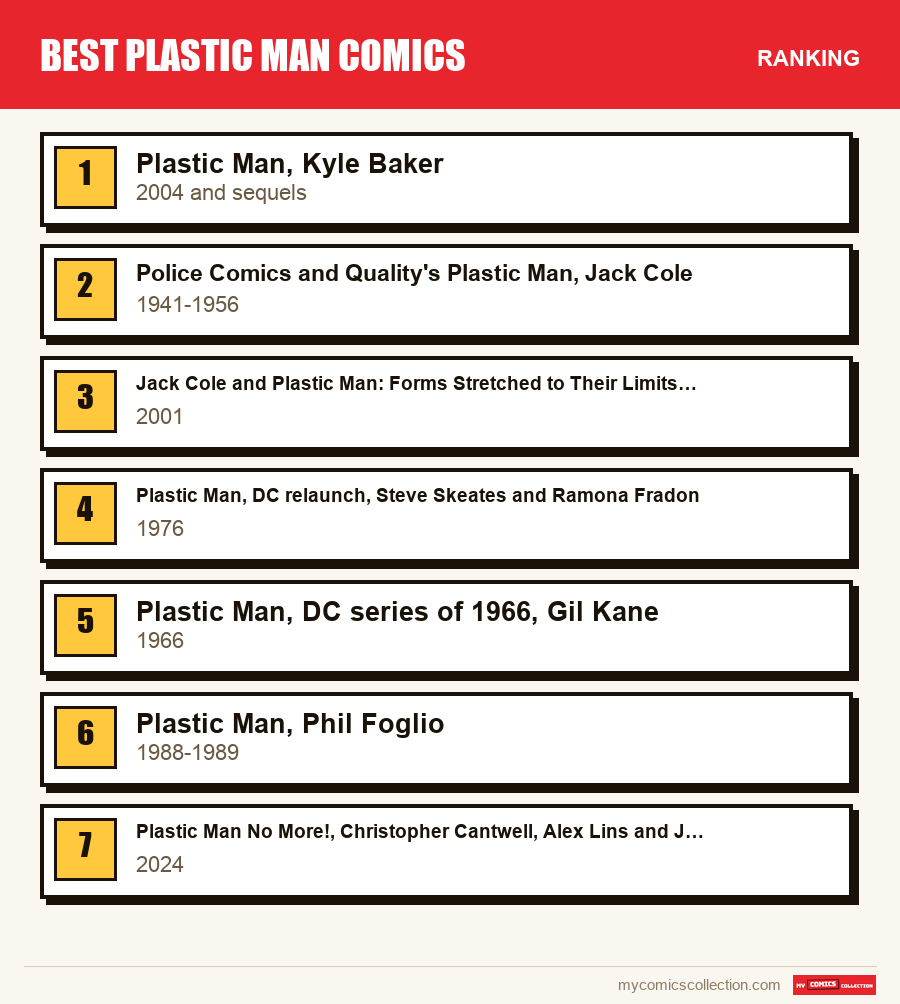
The best Plastic Man comics start with Kyle Baker's 2004 Plastic Man series, an Eisner winner, so that is where to start. Then go back to the source with Jack Cole's stories published by Quality Comics from Police Comics #1 (August 1941), the key issue. Round it out with Art Spiegelman and Chip Kidd's book on Cole (2001) and, for a dark read, Plastic Man No More! (2024).
Plastic Man is a hero whose body is the scenery: Patrick "Eel" O'Brian stretches, bends, melts into an armchair or a lamp, and his creators have turned him into a graphic playground that almost no other comics character offers. That freedom has attracted very different artists, from the original creator to contemporary authors who have treated him sometimes as a farce, sometimes as a nightmare. Here is how to find your way around, in order of interest for an arriving reader.
As always in this guide, we only state verified information (creators, issue numbers, dates); the analysis is ours, with no reproduction of protected artwork or dialogue.
His first appearance
Plastic Man is born in Police Comics #1, dated August 1941 and published by Quality Comics. His creator is Jack Cole, who writes and draws the character. At first it is just one story among others in an anthology: the feature then grows in importance, to the point that the hero gets his own series in 1943, Plastic Man, which continues at Quality until 1956.
The starting point is that of a burglar. Eel O'Brian is a safecracker in a gang; during a break-in at the Crawford Chemical Works, he is shot and drenched in a chemical, then abandoned by his accomplices. Taken in by a monk at a mountain refuge, he discovers that his body has become elastic and decides to fight crime. This origin explains the nature of the character: a former criminal who chooses the other side, with a humor that is closer to farce.
Quality ceases operations in 1956 and DC Comics takes over the character. The August 1941 issue is one of the Golden Age keys, hard to find and fragile; the reading itself goes through the collections of Cole's stories.
1: Plastic Man, Kyle Baker (2004 and sequels)
Kyle Baker writes and draws this series launched by DC in 2004, and it is the entry point we recommend first. It won the Eisner for Best New Series as well as the one for Best Writer/Artist in the humor category. The first collection, On the Lam, gathers the first six issues; Rubber Bandits gathers issues #8 to #11, #13 and #14.
What the series brings to the character lies in its rhythm: Baker treats the elastic body as an instrument of visual comedy, with fast-paced storytelling. The story mixes chase, satire and visual gags, and what the collection On the Lam announces from its title is a hero on the run.
This series suits anyone who has never opened a Plastic Man and shuns overly grave cape stories. No prior knowledge is needed. A deluxe edition published in 2020, Plastic Man: Rubber Banded, gathers the complete series for the first time.
2: Police Comics and Quality's Plastic Man, Jack Cole (1941-1956)
Going to the source remains essential. Between Police Comics #1 (August 1941) and the end of Plastic Man at Quality in 1956, the 64-issue series makes up the character's foundation. Jack Cole signs the founding stories, and his remarkably supple line turns every page into a demonstration of graphic invention.
This work gives the character his humor and his visual grammar: the transformation into an ordinary object, the scenery that warps, the sidekick Woozy Winks, a comic and loyal companion first endowed with a nature-related power before that power was taken away. Almost all later authors measure themselves against this model.
Cole's stories are for the reader who loves the Golden Age and graphic humor. You will find them in collected reprints, more accessible than the period issues. Read them in small sequences: the pleasure lies in the variety of gags more than in a long-breathed plot.
3: Jack Cole and Plastic Man: Forms Stretched to Their Limits, Art Spiegelman and Chip Kidd (2001)
This book is not one more comic, but it helps you read all the others. Published by Chronicle Books in 2001, it brings together an essay by Art Spiegelman on the life of Jack Cole, first published in The New Yorker in 1999, reproduced pages and several complete stories by Cole. The graphic design is by Chip Kidd.
It brings what a simple collection does not give: an account of the man behind the character, and an artist's eye on Cole's invention. This volume answers a simple question: why is Cole among the cartoonists still studied today? Read it after a first contact with the original stories.
4: Plastic Man, DC relaunch, Steve Skeates and Ramona Fradon (1976)
In 1976, DC relaunches a Plastic Man series with Steve Skeates writing and Ramona Fradon drawing. This period shows how the character survived the post-Quality years: he became a comic hero among the publisher's titles, and Fradon gives him a line of her own.
The series is for the reader interested in the Bronze Age and the humor of those years. It does not replace the original stories, but it offers a different point of view on the character. You will find it mostly in period single issues, which makes it a read of curiosity rather than an entry point.
5: Plastic Man, DC series of 1966, Gil Kane (1966)
DC's Plastic Man series, whose issue #1 is dated November 1966, stops after ten issues. Gil Kane draws issue #1. It dates from a time when the publisher was seeking to exploit its catalog of characters taken over from Quality, after the house ended in 1956.
This story is for the Silver Age collector more than for the reader discovering the character. Its interest is historical: it bears witness to Plastic Man's return to DC, a decade after Quality stopped.
Do you collect this series?
Track what you own, what you are missing and what your collection is worth. 7-day trial.
Start my trial →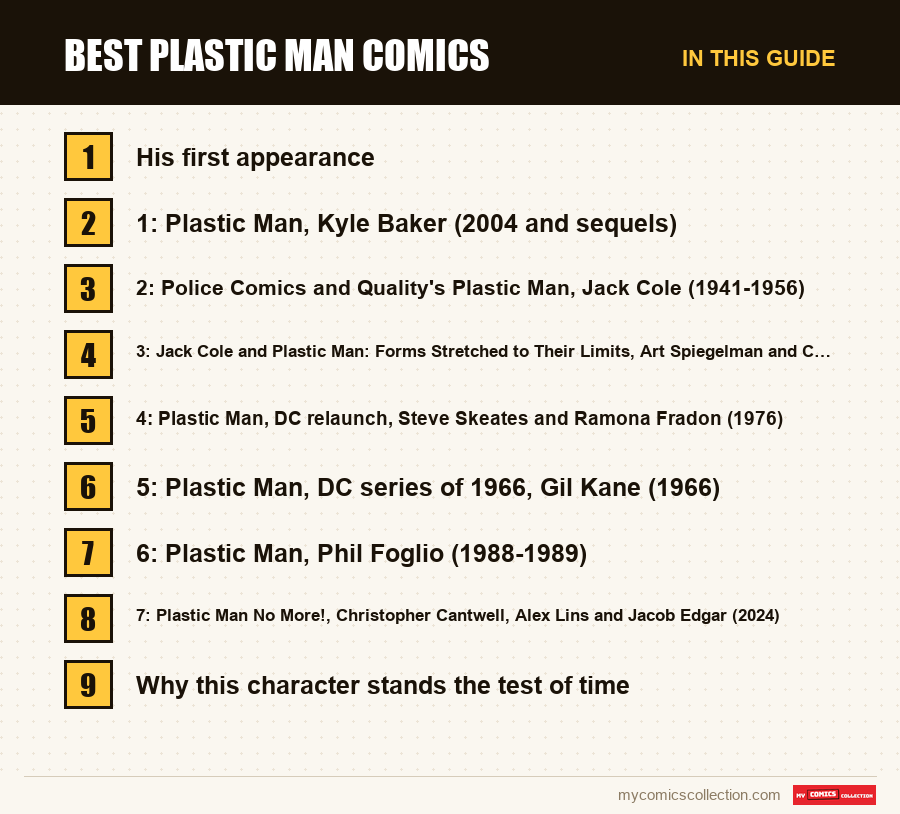
6: Plastic Man, Phil Foglio (1988-1989)
After Crisis on Infinite Earths (1985), DC offers a four-issue miniseries by Phil Foglio, published in 1988-1989, which presents a renovated version of Eel O'Brian. It is a post-Crisis reinterpretation: the character is rethought for the universe the publisher had just reorganized.
The miniseries is for the reader who wants to understand how Plastic Man was brought up to date before the Kyle Baker era. It reads quickly, in four issues, and complements the previous reads. In the following years, the character also becomes a prominent member of the Justice League during Grant Morrison's period on JLA, which gives him a place in the central group of the DC universe.
7: Plastic Man No More!, Christopher Cantwell, Alex Lins and Jacob Edgar (2024)
The contrast is radical. This four-issue miniseries from the DC Black Label imprint, whose issue #1 comes out in September 2024, imagines a Plastic Man whose powers go haywire and whose body suffers cellular damage. Christopher Cantwell writes; Alex Lins draws most of the story, while Jacob Edgar handles the Justice League scenes.
The tone mixes black humor, body horror and drama, which makes it a counterpoint to the farce of Baker or Cole. It is for an adult readership, the label carrying a mention for readers 17 and older. Do not start with it: it relies on knowing the character as he has always been, to better convey what is happening to him.
Why this character stands the test of time
Plastic Man crosses the decades because his concept renews itself effortlessly. With Jack Cole, in 1941, the elastic body serves the chase and the farce. With Phil Foglio, after Crisis on Infinite Earths, he becomes a former crook made new in a reorganized universe. With Kyle Baker, in 2004, he slides toward modern visual comedy, and with Christopher Cantwell, in 2024, toward the story of a body coming undone. Four eras, four readings of the same material: a man who does not fit in his own shape.
This plasticity also explains his role with the Justice League. A hero able to make himself a rope, a shield or a lamppost brings the group a comic register that no other member shares, and the writers who place him there know that he loosens up an ordinarily solemn team.
Where to start based on your profile
If you are looking for a funny, easy-to-approach comic, take Kyle Baker's series, starting with On the Lam. You have nothing to know beforehand.
If you like the Golden Age, open a Jack Cole collection to find the original material, then read Spiegelman and Kidd's book to understand it. Our guide to the ages of comics helps place this period.
If you read the Justice League, see how Plastic Man fits in during the Morrison years with our Justice League reading guide, then return to Baker to feel the difference in tone.
If you are looking for an adult, dark story, finish with Plastic Man No More!, once you know the character in his usual version. For other reads that bet on humor, consult our selection of humor comics.
The key issues to know
Here are the landmarks of Plastic Man's bibliography. To value one of them, compare several recent transactions on copies of the same condition, instead of relying on a single listing.
- Police Comics #1 (August 1941), Quality Comics: first appearance of Plastic Man, by Jack Cole.
- Plastic Man #1 (Quality, 1943): the start of his own series, which continues until 1956.
- Plastic Man #1 (DC, November 1966): the return to DC, drawn by Gil Kane.
- Plastic Man (1988-1989): the four-issue miniseries by Phil Foglio, after Crisis on Infinite Earths.
- Plastic Man #1 (2004): the launch of Kyle Baker's series.
- Plastic Man No More! #1 (September 2024): the Plastic Man of Christopher Cantwell and Alex Lins.
Quality's issues are rare and fragile, and the condition of the paper weighs more than the issue number itself; recent issues, for their part, are plentiful and are judged by comparing several listings. For the context of the publisher's major periods, see also the Golden Age collecting guide.
Frequently asked questions
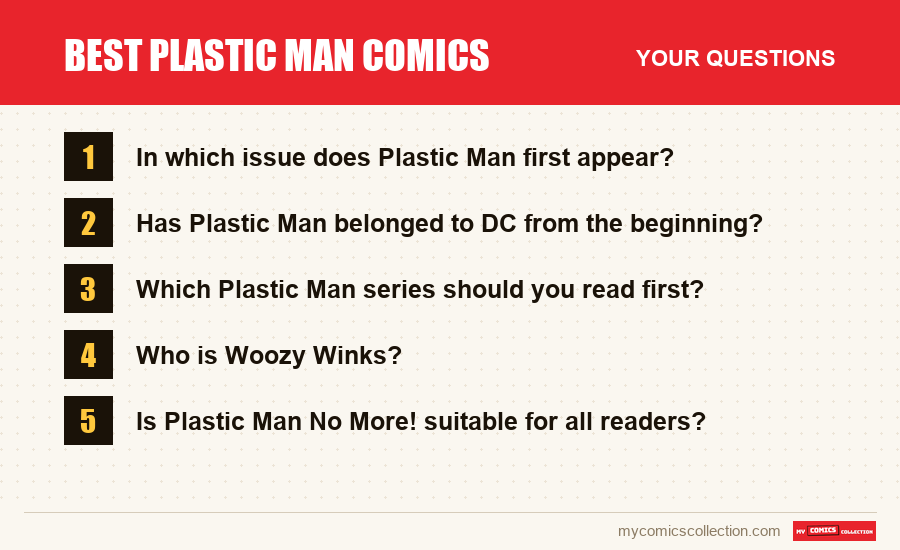
Plastic Man debuts in Police Comics #1, dated August 1941 and published by Quality Comics. He is the work of Jack Cole, who writes and draws the character, and he gets his own series in 1943.
No. He was created at Quality Comics in 1941. DC Comics took over the character after Quality closed in 1956, and the publisher devoted a series to him whose issue #1 is dated November 1966.
Kyle Baker's series, launched in 2004, is the most accessible. The collection On the Lam gathers its first six issues, and the series won the Eisner for Best New Series. It requires no prior reading.
He is Plastic Man's comic sidekick, well-meaning but clumsy. He originally had a power that made nature protect him, a power later removed, which leaves him a loyal friend rather than a full-fledged hero.
No. This 2024 DC Black Label miniseries, written by Christopher Cantwell with Alex Lins and Jacob Edgar, is meant for an adult audience and deals with body horror. It is better read after discovering the character in his usual version.
Do you have a Plastic Man issue, from yesterday or today? A free estimate helps you place it.
Estimate my comic