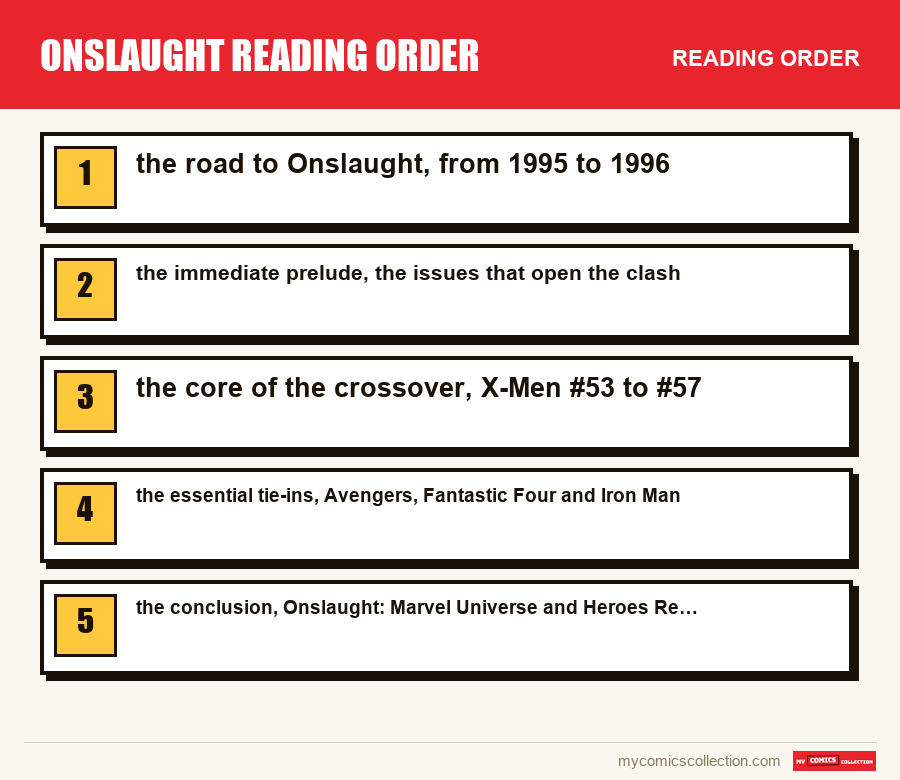
The Onslaught reading order covers Marvel's big 1996 crossover, which runs through the X-Men titles and then the Avengers and Fantastic Four books. The character was created by Scott Lobdell, Mark Waid and Andy Kubert, and makes his full first appearance in X-Men (second series) #53. Read the road leading up to it first (Uncanny X-Men #322-333, X-Men #42-52), then the core of the story in X-Men #53 to #57, and finish with Avengers #402, Fantastic Four #416 and Onslaught: Marvel Universe, which lead into Heroes Reborn.
With its many series and special issues, Onslaught is one of the most tangled crossovers of the 1990s. The risk is twofold: getting lost in the tie-ins, or missing the break that closes the story and opens another chapter of the publisher's history. This guide gives a short, safe list in order, with what to read beforehand, what you can skip and how to approach the whole thing in single issues or in collected editions.
As always in this guide, we only state verified facts (creators, issue numbers, dates). The analysis is our own, with no reproduction of protected art or dialogue.
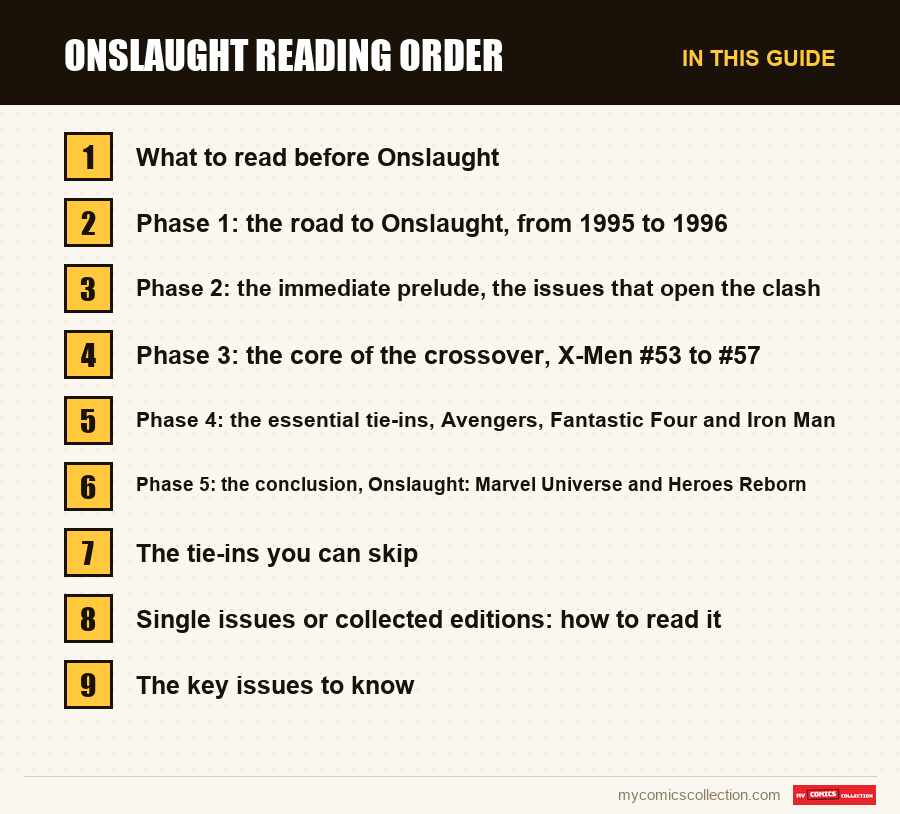
What to read before Onslaught
Onslaught does not require knowing thirty years of mutant continuity, but it rests on specific foundations. Heads up, spoiler about the character's origin: the villain's genealogy is described here in a single sentence, without the plot details.
- Fatal Attractions (1993): the 1993 X-Men crossover whose events gave rise to the character of Onslaught. You do not need to reread all of it, but it is the anchor point.
- Charles Xavier's act toward Magneto's mind: over the following years, this is what gives birth to the character of Onslaught. Our Magneto reading guide traces that side of the story.
- Uncanny X-Men #322: an issue that mentions the name Onslaught before the character fully appears.
- X-Men Prime #1 (July 1995): the special issue that opens the period, where the character makes a fleeting appearance; the collected editions of the buildup include it in the road to Onslaught.
For a reader in a hurry, the rule of economy is this: Fatal Attractions to understand where the villain comes from, Uncanny X-Men #322-332 and X-Men #42-52 to follow the escalation, then the core of the crossover. If you only have an afternoon, jump straight to X-Men #53: the crossover can be followed, even if you lose some depth.
Phase 1: the road to Onslaught, from 1995 to 1996
The first reading group covers what the collected editions call the "road to Onslaught." It is published in three reference volumes, which serve here as a reliable way to divide it rather than a claimed official order. The two central series are Uncanny X-Men, which carries that title from this period on, and X-Men (second series, launched in 1991).
- First block: X-Men Prime #1, Uncanny X-Men #322-326, X-Men #42-45, the 1995 annual and X-Men Unlimited #8.
- Second block: X-Men/Clandestine #1-2, Uncanny X-Men #327-328, X-Men #46-49, the 1995 annual, X-Men Unlimited #9 and Sabretooth #1.
- Third block: Uncanny X-Men #329-332, Archangel #1, X-Men/Brood #1-2, X-Men Unlimited #10, X-Men #50-52 and Wolverine #101.
Reading these blocks in full means a lot of single issues. For a tighter read, stay with the two main series, Uncanny X-Men #322-332 and X-Men #42-52, which carry most of the build-up. The miniseries and special issues (Archangel #1, X-Men/Brood, X-Men/Clandestine, Sabretooth #1) widen the period without changing the overall thread. To place this decade, our guide to the key issues of Uncanny X-Men gives the series landmarks.
Phase 2: the immediate prelude, the issues that open the clash
Right before the core of the crossover, a tight group of issues sets up the confrontation. A reference collected edition, X-Men: Prelude to Onslaught, gathers them: X-Men #50, Uncanny X-Men #333, X-Man #15-17 and Cable #32-33.
This is the zone where the crossover stops being a mood and becomes an identifiable threat. The character was created by Scott Lobdell, Mark Waid and Andy Kubert, and fully appears for the first time in X-Men #53, in 1996. An efficient way to read is therefore to take X-Men #50-52 and then Uncanny X-Men #333, read X-Man #15-17 and Cable #32-33 for the side of their series, then open X-Men #53.
Cable readers follow his series thread in Cable #32-36, and X-Force readers in X-Force #55 and #57-58: useful if you follow those two titles, optional if you follow the main line. Our guide to the best X-Force runs and the guides devoted to Cable serve as an entry point.
Phase 3: the core of the crossover, X-Men #53 to #57
Here is the hard core of the story, the part to read first. The first complete collected edition of the crossover opens with X-Men #53-54, Uncanny X-Men #334-335, Avengers #400-401, the one-shot Onslaught: X-Men (August 1996), X-Man #18, X-Force #57, Cable #34 and Incredible Hulk #444.
The rest of the sequence picks up in the second group, notably with Cable #35, X-Men #55, Uncanny X-Men #336 and the crossing issues of the other series. The last group of this core includes X-Men #56-57 and Uncanny X-Men #337, joined by the closing chapters in the Avengers and Fantastic Four series.
The safest method for the core of the story is to follow the two X-Men series in alternation (X-Men #53, Uncanny X-Men #334, X-Men #54, Uncanny X-Men #335, and so on through #57 and #337), inserting the tie-ins where the collected editions place them. The one-shot Onslaught: X-Men goes at the start of this core, as the first complete collected edition does.
Phase 4: the essential tie-ins, Avengers, Fantastic Four and Iron Man
The crossover spills out of the mutant series. The second side concerns the Avengers and Fantastic Four titles, several issues of which matter for what follows: Avengers #400-402, Fantastic Four #415-416, and Iron Man #332.
These issues count twice over. First, they tell the story of the other heroes' response. Second, Fantastic Four #416, Avengers #402 and Iron Man #332, cover-dated September 1996, are the last issues of their series before the relaunch. The crossover thus ends in the very issues that close the existing runs, which is an important numbering fact for any collector of those series. To go deeper on these series, see the Avengers reading guide and the Fantastic Four reading guide.
A reader of the X-Men alone can stick with Avengers #401-402 and Fantastic Four #415-416 as windows onto the other side, then move on to Onslaught: Marvel Universe. The collected edition X-Men/Avengers: Onslaught Vol. 3 gathers Avengers #402 and pages of Fantastic Four #416 with Thor #502, Wolverine #105, X-Men #56-57 and the closing issue.
Do you collect this series?
Track what you own, what you are missing and what your collection is worth. 7-day trial.
Start my trial →
Phase 5: the conclusion, Onslaught: Marvel Universe and Heroes Reborn
The close of the story is read in X-Men #56-57, Uncanny X-Men #337, Cable #36, the one-shot Onslaught: Marvel Universe (October 1996) and Onslaught: Epilogue. Heads up, spoiler: several members of the Avengers and the Fantastic Four sacrifice themselves by entering Onslaught's energy field, which destroys it, and they then reappear, with no memory, in a pocket universe created by Franklin Richards.
This tipping point leads to Heroes Reborn, a 1996-1997 set made up of four series: Jim Lee (WildStorm) handles Fantastic Four and Iron Man, and Rob Liefeld (Extreme Studios) handles Captain America and The Avengers. Liefeld's contract is cut short after six issues, his two titles go back to Lee, and Walt Simonson takes over Avengers when the series moves to WildStorm. The four series were planned for twelve issues each, plus a thirteenth issue written by James Robinson for the "World War III" finale. For the Jim Lee side, our guide Jim Lee: where to start provides landmarks.
The return takes place in the four-issue miniseries Heroes Reborn: The Return, written by Peter David and drawn by Salvador Larroca (December 1997), followed by third-series relaunches of Captain America and Fantastic Four (January 1998), then Avengers and Iron Man (February 1998). You can stop reading at Onslaught: Marvel Universe or continue with Heroes Reborn depending on your taste; both are coherent.
Later, the character returns in Onslaught Reborn (written by Jeph Loeb, drawn by Rob Liefeld, in five issues) and Onslaught Unleashed (four issues); he is then weakened and killed in Reign of X. These sequels are optional for reading the 1996 story. For further mutant reading, the Messiah Complex reading order and the Avengers vs X-Men reading order show other crossovers that bring mutants and Avengers together.
The tie-ins you can skip
The crossover list is long, and a reader who wants the story rather than completeness can reasonably leave part of it out.
- Punisher #11, Thor #502, Green Goblin #12, Spider-Man #72, The Amazing Spider-Man #415 and Sensational Spider-Man #8: these issues carry the crossover into other series, useful if you collect those titles, but the story of the X-Men and the Avengers does not depend on them.
- Incredible Hulk #444-445, Wolverine #104-105, X-Factor #125-126 and Excalibur #100: series-by-series tie-ins, worth reading in their place if you follow those titles.
- X-Man #15-19 and X-Force #55, #57 and #58: the spinoff-series side, useful for the context of those teams, optional for the main line.
- X-Men Unlimited #8-11: the anthology that accompanies the road and the start of the crossover.
They are optional because the main line of X-Men, Uncanny X-Men, Avengers, Fantastic Four and the closing one-shot stands on its own, not because these issues are any less carefully made. A collector of Wolverine or Thor will gladly read them.
Single issues or collected editions: how to read it
In single issues, Onslaught takes logistics: several series, annuals, one-shots and issues that cross over. You have to pull the relevant issues from each box and stack them in order, which is doable but slow.
Several collected editions exist to simplify the task. The most complete are X-Men/Avengers: Onslaught Omnibus, which gathers the core crossover issues and many tie-ins, and the four-book series X-Men: The Complete Onslaught Epic. For a tighter version, X-Men Milestones: Onslaught collects Uncanny X-Men #333-337, X-Men #53-57, the two one-shots and a few tie-ins. The road to the event is published separately, in three volumes titled The Road to Onslaught, and the follow-up after the battle is found in X-Men: Onslaught Aftermath (Uncanny X-Men #338-340, X-Men #58-61 and other issues).
Choose the format by use: to read Onslaught, an omnibus or the four Epic books are enough; to complete your 1990s X-Men runs, single issues remain the collector's ground. This list of collected editions is limited to those we have confirmed.
The key issues to know
A few landmarks help place what matters in the period, without ever giving a figure: a price moves, a reading landmark stays.
- Uncanny X-Men #322: an issue that mentions the name Onslaught before his full appearance.
- X-Men Prime #1 (July 1995): the character's fleeting appearance, in the special issue that opens the road to the clash.
- X-Men (second series) #53: the first full appearance of the character, created by Scott Lobdell, Mark Waid and Andy Kubert.
- Onslaught: X-Men (August 1996) and Onslaught: Marvel Universe (October 1996): the two one-shots of the crossover.
- Fantastic Four #416, Avengers #402 and Iron Man #332: the last issues of their series before the relaunch, cover-dated September 1996.
- Captain America #454 (August 1996), relaunched as a second series with a #1: a numbering milestone tied to Heroes Reborn.
For any issue on this list, check the cover, examine the spine and corners, then compare your copy with several completed sales. Our free appraisal tool offers a starting point.
Recap: the complete order
- Fatal Attractions (1993), as an origin landmark, optional if you are in a hurry.
- X-Men Prime #1, Uncanny X-Men #322-326, X-Men #42-45.
- Uncanny X-Men #327-328, X-Men #46-49.
- Uncanny X-Men #329-332, X-Men #50-52.
- Uncanny X-Men #333, X-Man #15-17, Cable #32-33.
- X-Men #53-54, Uncanny X-Men #334-335, Onslaught: X-Men, Avengers #400-401, Fantastic Four #415.
- Cable #34-35, X-Men #55, Uncanny X-Men #336 and, as you choose, the tie-ins of the series you follow.
- X-Men #56-57, Uncanny X-Men #337, Cable #36, Avengers #402, Fantastic Four #416, Iron Man #332.
- Onslaught: Marvel Universe and Onslaught: Epilogue.
- Next: Uncanny X-Men #338-340 and X-Men #58-61 for the consequences on the mutant side, or Heroes Reborn for the Avengers and Fantastic Four side.
Frequently asked questions
For the core of the story, open X-Men (second series) #53, where the character fully appears, then alternate with Uncanny X-Men #334. To understand the build-up, go back to Uncanny X-Men #322 and X-Men #42, which open the road to the clash.
The character was created by Scott Lobdell, Mark Waid and Andy Kubert, and his first full appearance is in X-Men (second series) #53, in 1996. His origin traces back to events in Fatal Attractions, the 1993 X-Men crossover.
No. The main line fits in X-Men #53-57, Uncanny X-Men #334-337, Avengers #400-402, Fantastic Four #415-416 and the two one-shots. The other issues, such as Punisher #11 or Thor #502, mostly matter to those who follow those series.
The end of Onslaught leads directly into Heroes Reborn: several Avengers and Fantastic Four members reappear in a pocket universe created by Franklin Richards, with no memory of their world. Heroes Reborn runs from 1996 to 1997 across four series.
Yes, X-Men/Avengers: Onslaught Omnibus gathers the core of the crossover and many tie-ins, from Cable #32-36 to Avengers #401-402. For a shorter version, X-Men Milestones: Onslaught collects Uncanny X-Men #333-337 and X-Men #53-57.
Do you own an Uncanny X-Men or X-Men single issue from the Onslaught period? Get its condition and value appraised.
Appraise my comic