The Avengers vs. X-Men (AvX) reading order covers a 12-issue main series published from April to October 2012, written by five writers (Brian Michael Bendis, Jason Aaron, Ed Brubaker, Jonathan Hickman and Matt Fraction), with art by John Romita Jr., Olivier Coipel and Adam Kubert. Read Avengers: X-Sanction first, then AvX #0, then the twelve issues in order, slipping in the Avengers, New Avengers and Uncanny X-Men tie-ins from the same month between them. Finish with AvX: Consequences.
Few Marvel events pose as concrete a reading problem as AvX: a biweekly main series, dozens of tie-in issues spread across seven ongoing series, and a prelude that was not written by the event's creative team. This article lays out a path, from the shortest to the most complete, so you know when to pick up each issue.
As always in this guide, we only state verified facts (creators, issue numbers, dates); the analysis is our own, with no reproduction of protected pages or dialogue.
What to read before
AvX can be read with no required prerequisites: the main series opens with a #1 you can pick up cold. Two titles do enrich the experience, though, and a third is general knowledge of the universe.
- Avengers: X-Sanction #1 to 4 (December 2011 to March 2012), written by Jeph Loeb and drawn by Ed McGuinness. This miniseries is presented as the prologue to the event. It reads in four issues.
- Avengers vs. X-Men #0 (March 2012), drawn by Frank Cho. It contains two stories, one by Brian Michael Bendis and one by Jason Aaron. This is the real narrative starting point; we come back to it below.
- A primer on Hope Summers and the Phoenix Force. The event revolves around the young mutant Hope and the arrival of the Phoenix Force. If those names mean nothing to you, the X-Men reading guide gives you the editorial context of the preceding years without forcing you to reread everything.
Keep the hierarchy in mind: X-Sanction is optional but fits the subject, the #0 is strongly recommended, and the rest of the two teams' past can be picked up along the way.
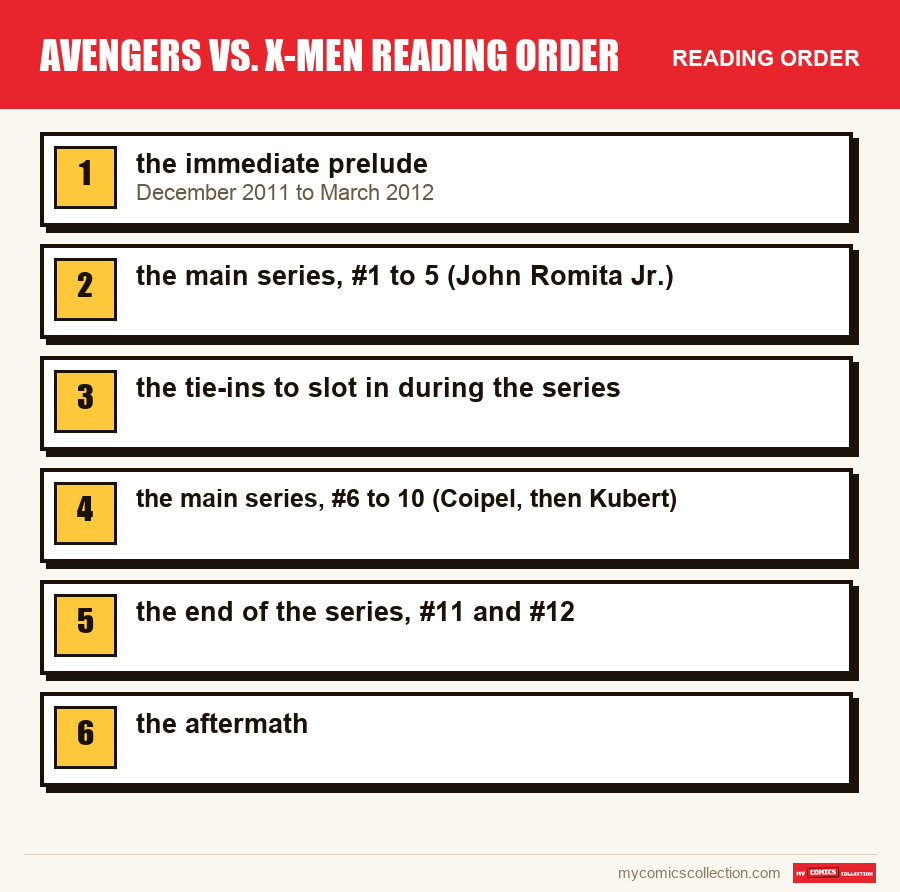
Phase 1: the immediate prelude (December 2011 to March 2012)
Start with Avengers: X-Sanction. Jeph Loeb and Ed McGuinness's four issues were published between December 2011 and March 2012, which is the period when the editors were setting the stage for the event. You will find characters and tensions that return later; you can also read them afterward, once the twelve issues are done, without losing the thread of the main plot.
Next, move on to Avengers vs. X-Men #0, cover-dated March 2012. This issue, drawn by Frank Cho, gathers two short stories: one by Brian Michael Bendis, the other by Jason Aaron. Both writers already set up the dynamic that structures the whole series: one writer on the Avengers side, one on the X-Men side, and voices that answer each other. Reading the #0 before the #1 spares you the feeling of walking into the middle of a conversation.
A word on the editorial setup: the main series was conceived as a collective effort, which is rare. The five writers share the issues in a rotation we detail in the next phase. That rotation explains why the tone shifts from one issue to the next: it is not inconsistency, it is the principle.
Phase 2: the main series, #1 to 5 (John Romita Jr.)
The Avengers vs. X-Men series runs from April to October 2012 in twelve issues, at a pace of roughly two issues per month. The first five are drawn by John Romita Jr. and break down like this:
- #1: Brian Michael Bendis;
- #2: Jason Aaron;
- #3: Ed Brubaker;
- #4: Jonathan Hickman;
- #5: Matt Fraction.
These five issues set up the conflict. Read each issue in publication order, without skipping. If one of those names appeals to you, our pages Jason Aaron: where to start and Jonathan Hickman: where to start extend your reading into their other series.
John Romita Jr.'s art on these five issues gives the whole a consistent visual identity. If you like this artist, his career page, John Romita Jr.: where to start, will help you choose what to read next.
Phase 3: the tie-ins to slot in during the series
The tie-in issues are the tricky part of AvX. Here is the list of ongoing series involved and their issue ranges:
- Avengers (vol. 4) #25 to 30;
- New Avengers (vol. 2) #24 to 30;
- Secret Avengers #26 to 28;
- Avengers Academy #29 to 33;
- Uncanny X-Men (vol. 2) #11 to 20;
- Wolverine and the X-Men #9 to 16, then #18;
- X-Men: Legacy #266 to 270.
Two miniseries round out the picture. AvX: VS runs six issues, launched in April 2012 and nicknamed "the fight book" by editor Tom Brevoort; each issue contains two fight stories handed to two creative teams. As for Avengers vs. X-Men: Infinite, it collects issues #1, #6 and #10 as a digital release; the first stars Nova, with a script by Mark Waid and art by Stuart Immonen.
How do you slot them in? The most reliable method is to sort your single issues by cover date, from March to October 2012. Read an issue of AvX, then the tie-ins dated the same month or the following month in the order of their issue numbers, then the next issue of AvX.
If you have to choose, favor the series that carry a team: New Avengers, Avengers and Uncanny X-Men show the event from both camps. Wolverine and the X-Men offers the view from the school, useful for understanding the role of young mutants in the story.
Phase 4: the main series, #6 to 10 (Coipel, then Kubert)
Starting with #6, the art changes. Olivier Coipel draws issues #6 and #7, then Adam Kubert takes over for #8, #9 and #10. The writer rotation continues:
- #6: Jonathan Hickman (art by Olivier Coipel);
- #7: Matt Fraction (art by Olivier Coipel);
- #8: Brian Michael Bendis (art by Adam Kubert);
- #9: Jason Aaron (art by Adam Kubert);
- #10: Ed Brubaker (art by Adam Kubert).
This stretch is where the series gains scale. The five issues came out from June to August 2012, in the thick of the period covered by the tie-ins: this is the moment to read AvX: VS alongside if you want the full-page fights. One practical tip: do not let more than two issues of tie-ins pile up behind the main series, or you risk reading a consequence before its cause.
Note the layout effect too. The shift from Romita Jr. to Coipel and then to Kubert gives the series three faces. If you read in a collected edition, these changes flow without a break; in single issues you feel them head-on, and that is a good reason to shelve your copies in artist blocks.
Phase 5: the end of the series, #11 and #12
The last two issues wrap up the story. In #11, Brian Michael Bendis writes and Olivier Coipel draws; in #12, Jason Aaron writes and Adam Kubert draws. Avoid online recaps of the final issues before you have read them: the ending is part of what makes the event most memorable.
Issue #11 is dated September 2012 and #12 October 2012. For the ongoing series, the tie-ins end with Avengers #30, New Avengers #30, Uncanny X-Men #20, X-Men: Legacy #270, Avengers Academy #33 and Wolverine and the X-Men #18: sort these last issues by cover date around the two concluding issues.
Do you collect this series?
Track what you own, what you are missing and what your collection is worth. 7-day trial.
Start my trial →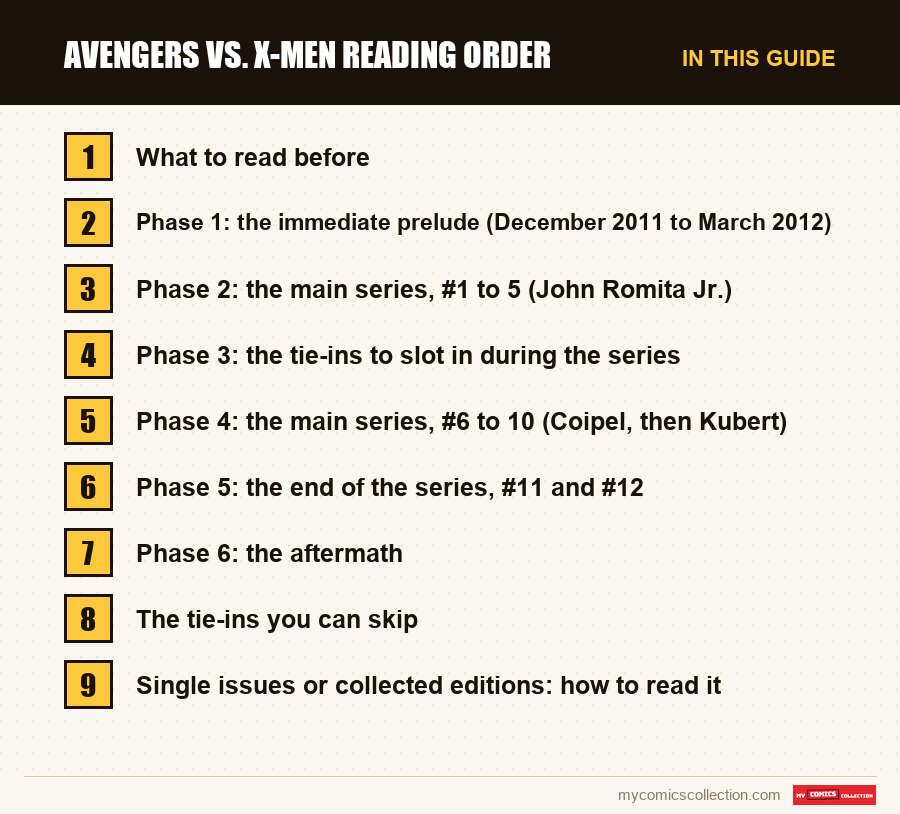
Phase 6: the aftermath
AvX: Consequences runs five issues, published in October and November 2012. The script is by Kieron Gillen, and the art is shared among Tom Raney, Mark Brooks, Steve Kurth and Dale Eaglesham. This miniseries is the direct sequel to the event: read it after #12 and before moving on to the series launched by the editorial relaunch that follows.
The event does indeed pave the way for the Marvel NOW! era, a universe-wide change of status quo. If you want to keep going in that direction, the pages X-Men crossovers and the Avengers reading guide point you toward the series of the following period. An alternate series, What If? Avengers vs. X-Men (four issues, script by Jimmy Palmiotti, art by Jorge Molina), offers a parallel retelling; save it for those who have already read the ending of the real series.
The tie-ins you can skip
Not all tie-ins are equal, and none is essential to understanding the main series. Here is what you can safely set aside.
- Avengers vs. X-Men: Program #1 and A-Babies vs. X-Babies #1: two one-shots, one of them with a parody title. They enrich the collection more than they move the story forward.
- AvX: VS: the clashes are spectacular, but self-contained. You do not lose the thread of the plot by ignoring them.
- Avengers Academy #29 to 33: the tone is aimed at readers of that series. If you do not follow it, the main series is enough.
- Secret Avengers #26 to 28: three issues from a side team, readable on their own.
The logic is simple: a tie-in is essential if it advances a character's situation that the main series leaves hanging, and optional if it merely offers another angle on a familiar scene. This distinction takes nothing away from the quality of these issues; it only tells you in what order of priority to read them.
Single issues or collected editions: how to read it
In single issues, the event takes discipline: twelve main issues, six of AvX: VS, five of Consequences, plus more than forty tie-in issues across the ongoing series. The simplest approach is to build stacks by series, then cross them by cover date.
In collected editions, the method changes. Open the table of contents of each volume before buying it: the AvX trade paperback does not necessarily include the Uncanny X-Men issues from the same month, and a tie-in volume may stop before the end of an ongoing series' range. We do not name a specific volume here, because editions vary by publisher and country.
For a collector, a complete collected edition is not equivalent to a run of single issues: they are two different objects, with different uses. If you are after reading, the collected edition is enough. If you are after collecting, the original single issues remain the reference. Before buying, check which period your copy belongs to and which printing it is.
The key issues to know
We give no dollar figure here: the market moves, and a price quoted today would be wrong tomorrow. Here instead are the issues whose editorial importance is established.
- Avengers vs. X-Men #0: March 2012 issue, drawn by Frank Cho, with two stories by Bendis and Aaron. Its status as a prelude makes it a natural companion to #1.
- Avengers vs. X-Men #1: the series opener, written by Bendis and drawn by John Romita Jr. It is the first issue, the one people associate with the event.
- Avengers vs. X-Men #12: the conclusion, written by Jason Aaron and drawn by Adam Kubert.
- AvX: Consequences #1: the starting point of the post-event era, from the pen of Kieron Gillen.
To value a copy, always compare copies of the same printing and the same condition. An event issue sells better when the cover, the variant and the condition are clearly documented. Our general analysis of event issue value is in event comics: which key issues hold the value.
Recap: the complete order
- Avengers: X-Sanction #1 to 4 (Jeph Loeb, Ed McGuinness), optional but recommended.
- Avengers vs. X-Men #0 (Bendis and Aaron, art by Frank Cho).
- Avengers vs. X-Men #1 to 5 (John Romita Jr.; Bendis, Aaron, Brubaker, Hickman, Fraction).
- Same-month tie-ins: Avengers, New Avengers, Uncanny X-Men, X-Men: Legacy, Wolverine and the X-Men, sorted by cover date.
- Avengers vs. X-Men #6 and 7 (Olivier Coipel; Hickman, Fraction).
- Avengers vs. X-Men #8 to 10 (Adam Kubert; Bendis, Aaron, Brubaker).
- Avengers vs. X-Men #11 (Bendis, Olivier Coipel) and #12 (Aaron, Adam Kubert).
- Final tie-ins from the ongoing series: Avengers #30, New Avengers #30, Uncanny X-Men #20, X-Men: Legacy #270, Avengers Academy #33, Wolverine and the X-Men #18.
- AvX: Consequences #1 to 5 (Kieron Gillen).
- Optional: AvX: VS #1 to 6, Avengers vs. X-Men: Infinite, What If? Avengers vs. X-Men #1 to 4.
Frequently asked questions
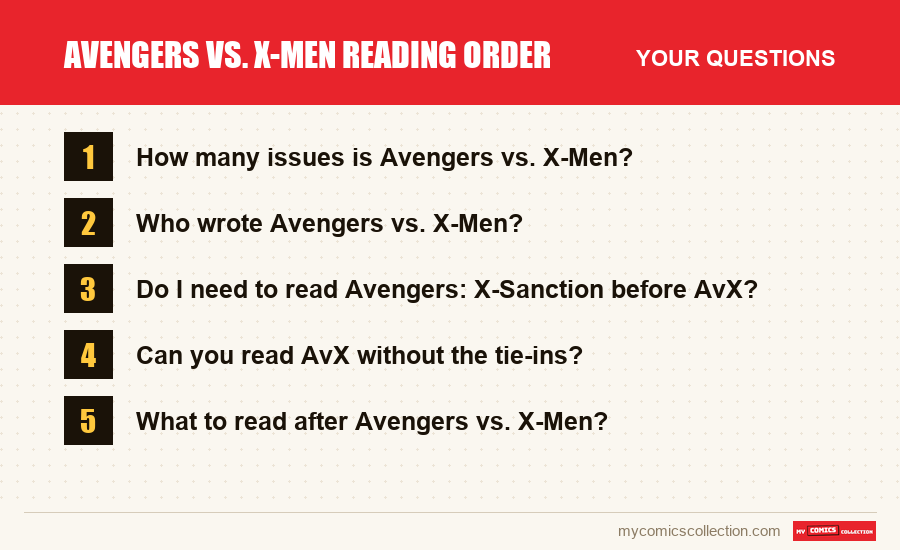
The main series runs twelve issues, published from April to October 2012. On top of that come the #0 issue from March 2012, the six-issue miniseries AvX: VS and the five-issue AvX: Consequences. The tie-ins in the ongoing series bring the total to several dozen issues.
Five writers share the series: Brian Michael Bendis, Jason Aaron, Ed Brubaker, Jonathan Hickman and Matt Fraction. The art is by John Romita Jr. for issues #1 to 5, by Olivier Coipel for #6, #7 and #11, and by Adam Kubert for #8, #9, #10 and #12.
It is not required. This four-issue miniseries, by Jeph Loeb and Ed McGuinness, is presented as the prologue to the event and reads well before the main series. If you would rather get straight to the point, start with the #0 issue from March 2012.
Yes. The twelve issues of the main series tell the story from start to finish. The tie-ins in Avengers, New Avengers, Uncanny X-Men and the other series enrich the context and follow the characters day to day, but they are not needed to follow the plot.
Start with AvX: Consequences, five issues written by Kieron Gillen in October and November 2012. After that, the event opens the Marvel NOW! era, which relaunches the series of both camps: our Avengers and X-Men reading guides show how to continue.
Do you own copies of Avengers vs. X-Men, from the main series or the tie-ins? Get them appraised.
Appraise my comic