The One More Day reading order runs through four single issues cover-dated November 2007 to January 2008: The Amazing Spider-Man #544, Friendly Neighborhood Spider-Man #24, The Sensational Spider-Man (second series) #41, then The Amazing Spider-Man #545. J. Michael Straczynski wrote the story, and Joe Quesada drew all four parts and co-wrote #545. Read Back in Black (Amazing Spider-Man #539-543) first, then the four parts in that order, and move on to Brand New Day starting with #546.
Few Spider-Man stories have a boundary this clear and yet are so widely misunderstood: four issues spread across three different series, a release schedule thrown off by delays, and a before and an after that matter almost as much as the story itself. This guide lays out the exact sequence, what to read beforehand, what you can skip, and how to approach the whole thing in single issues or in a collected edition.
As always in this guide, we only state verified facts (creators, issue numbers, dates). The analysis is our own, with no reproduction of protected art or dialogue.
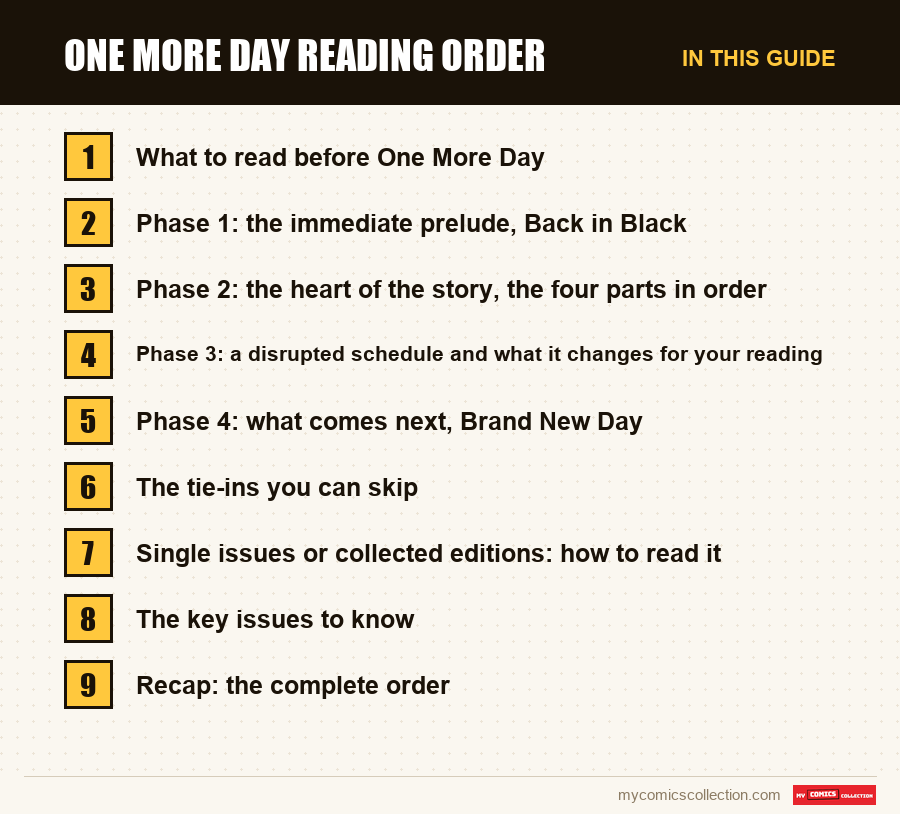
What to read before One More Day
One More Day does not work cold. The four issues pick up a situation set up by two specific bodies of work, and without them the stakes of #544 stay abstract. Heads up, context spoiler: this section describes the starting situation without revealing how the story ends.
- Civil War (2006-2007): the miniseries and its tie-ins are the source of Peter Parker's public situation. This is the event where Spider-Man unmasks in front of the world. If you want the source material without getting lost in the tie-ins, our guide to the key issues of Civil War gives you the landmarks, and the guide to the French editions of Civil War helps you choose a format.
- Back in Black (2007): the immediate prelude, covered in the next section. It follows Civil War directly and leads into One More Day.
- The Amazing Spider-Man from the Straczynski era, in the issues before #539: they establish the relationships between Peter, Mary Jane and Aunt May as the four parts pick them up.
If you only have one evening, remember the rule of economy: Civil War in the main series, then all of Back in Black, then the four parts. A reader who skips Back in Black can follow the plot of One More Day on paper, but loses the reason behind its tone and the urgency driving the hero.
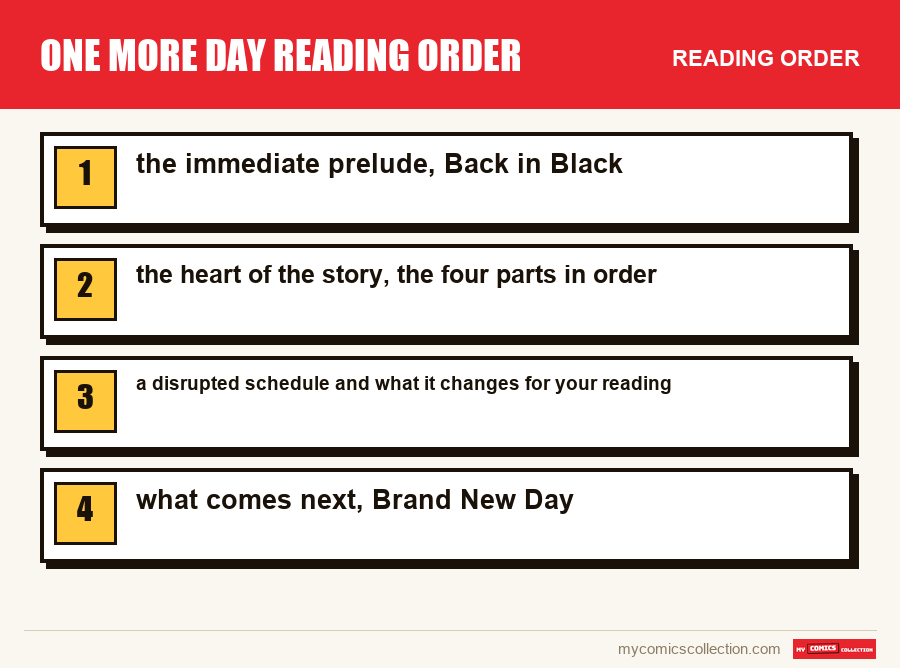
Phase 1: the immediate prelude, Back in Black
Back in Black is a 2007 story that takes place right after Civil War. Its main series runs through The Amazing Spider-Man #539 to #543, published from April to October 2007. The team is the book's team at that point: J. Michael Straczynski writing, Ron Garney on pencils, with Bill Reinhold on inks, Matt Milla on colors and Joe Quesada as editor.
The story spills over into the two sister series. The published tie-ins are Friendly Neighborhood Spider-Man #17-23 and The Sensational Spider-Man (second series) #35-40, along with the two issues of Spider-Man Family #1-2. It is a typical case of parallel reading: three monthly series, each telling a fragment of the same period. The black costume of this period draws on the Venom symbiote suit; if that connection interests you, our Venom reading guide traces the other story of the costume.
Light spoiler: Aunt May is hit by a bullet in #538, just before this prelude, which follows the hunt for those responsible for the shooting; and that wound is the starting point of One More Day. That is why the prelude is not optional for anyone who wants to feel the stakes of the first issue.
A simple way to pace it: read the main series (Amazing #539-543) straight through, then, if you want the full picture, go back to Friendly Neighborhood #17-23 and Sensational #35-40 in monthly order. The two issues of Spider-Man Family are best read separately, once you are done.
Phase 2: the heart of the story, the four parts in order
The sequence was designed as a rotation among three series, which is exactly the architecture of the big crossovers of the era, but in only four issues. Here is the reading order, part by part. Joe Quesada draws all four chapters, and J. Michael Straczynski writes them all:
- Part one: The Amazing Spider-Man #544. J. Michael Straczynski writes, Joe Quesada draws, Danny Miki inks; Richard Isanove is credited on colors and Chris Eliopoulos on lettering. Miki and Isanove stay on inks and colors through the third chapter.
- Part two: Friendly Neighborhood Spider-Man #24, again drawn by Quesada.
- Part three: The Sensational Spider-Man (second series) #41, same art team.
- Part four and finale: The Amazing Spider-Man #545. Joe Quesada co-writes the issue with J. Michael Straczynski, draws it and inks it himself; Dean White is credited on colors.
What stands out right away is the unusual balance: the two Amazing issues bookend two issues from secondary series. The art, meanwhile, never changes hands from one series to the next: it is Quesada from start to finish, which gives the four issues a visual unity that the rotation between titles could have broken.
In practical terms, do not change the order: chapters 2 and 3 do not read well swapped, and the conclusion of #545 assumes you have been through all four stages. If your collection keeps the three series in separate boxes, set the four issues in a stack before you start: #544, Friendly #24, Sensational #41, #545, in that order.
Phase 3: a disrupted schedule and what it changes for your reading
Originally, the four issues were planned for a weekly release starting in August 2007. Delays pushed back the third part, Sensational Spider-Man #41, first to late October and then to November 28, 2007, and the final chapter, Amazing Spider-Man #545, to December 27, 2007.
For anyone organizing long boxes, the effect is concrete: the four chapters of One More Day carry cover months that run from November 2007 to January 2008, without matching their actual on-sale dates. If you file your single issues by on-sale date, you recover the reading order; if you file them by series, you have to pull them out by hand to read the story in one sitting.
This gap also affects the reading experience: those who discovered the story when it came out waited several weeks between chapters. Today, you can read all four issues back to back in an hour or two, which changes how the pacing feels. Take a break after the second chapter: reading straight through tends to flatten the build-up of tension.
Phase 4: what comes next, Brand New Day
One More Day ends in The Amazing Spider-Man #545, and the direct follow-up is Brand New Day, which starts with The Amazing Spider-Man #546, cover-dated January 2008. A penciled two-page spread by John Romita Jr., titled "Spider-Man: The New Status Quo!", introduced the new situation before the release.
Brand New Day opens with issues #546 to #564, published from January to July 2008. Several artists are credited there, including Steve McNiven, Salvador Larroca, Phil Jimenez, Chris Bachalo, Marcos Martin and Barry Kitson; the issue-by-issue attribution is found on each credits page.
The publication rhythm changes too: The Amazing Spider-Man moves to three issues a month, and both Friendly Neighborhood Spider-Man and The Sensational Spider-Man are discontinued. For the collector, this is a numbering milestone: the series becomes the main backbone of the single issues. Our guide to the Amazing Spider-Man volume numbering helps you avoid getting lost in the relaunches, and the guide How many issues does Amazing Spider-Man have gives the overall picture.
For a continuous read, follow One More Day with Brand New Day starting at #546 without a pause: the break reads better in a single sweep. For the wider chronology, the general Spider-Man reading guide extends the route, and the Superior Spider-Man reading order shows what comes further down the line.
Do you collect this series?
Track what you own, what you are missing and what your collection is worth. 7-day trial.
Start my trial →
The tie-ins you can skip
The list is deliberately short, because One More Day has no sprawling crossover: the story reads entirely within the four issues. What is optional mostly concerns what surrounds it.
- Spider-Man Family #1-2: the two issues tied to Back in Black are read after the prelude, as a supplement. The main story does not depend on them.
- The Back in Black tie-ins in Friendly Neighborhood Spider-Man (#17-23) and The Sensational Spider-Man (#35-40): useful for the full 2007 picture, but the main Amazing series #539-543 is enough to understand what the four parts pick up.
- Marvel Spotlight: Spider-Man - One More Day/Brand New Day: this special issue is included in the collected edition of the story; you can read it after the four parts as an editorial supplement.
Nothing here is being put down: these issues provide context, detail or an editorial viewpoint. They are optional because the story does not need them to stand on its own, not because they lack value.
Single issues or collected editions: how to read it
Two ways to read, two logics. In single issues, the order has to be rebuilt from three distinct series: four issues to pull from three boxes, which is a filing exercise before it is a reading pleasure. In a collected edition, the story arrives in one piece.
A collected edition titled One More Day, 112 pages with an afterword by Stan Lee, gathers Amazing Spider-Man #544-545, Sensational Spider-Man #41, Friendly Neighborhood Spider-Man #24 and the Marvel Spotlight issue devoted to the move to Brand New Day. It is the most direct way to read the four parts in order without digging through boxes.
If you keep your Amazing Spider-Man single issues bagged and boarded, read the 112-page volume instead and leave #544 and #545 untouched in their place. Our guide to collecting Amazing Spider-Man details this approach to shelving. This guide only cites the volume we were able to confirm, without claiming to list every edition.
The key issues to know
A reading-order article is not a pricing guide, but certain landmarks help place the issues that matter most in the chronology. No figures here: a price moves, a reading landmark stays.
- The Amazing Spider-Man #539: the opening of Back in Black, from April 2007, with the black costume inspired by the symbiote.
- The Amazing Spider-Man #544: part one of One More Day, drawn by Joe Quesada, with Danny Miki on inks, as for the next two chapters.
- Sensational Spider-Man #41: the issue whose delay (rescheduled to November 28, 2007) got people talking, the third link in the rotation outside the main series.
- The Amazing Spider-Man #545: the conclusion, rescheduled to December 27, 2007 and drawn by Quesada.
- The Amazing Spider-Man #546: the opening of the Brand New Day era, with the January 2008 cover to look for in your boxes.
Before appraising any of these Spider-Man issues, identify its exact cover, check the condition of the spine and corners, then compare it with several completed sales. Our free appraisal tool gives you a starting point.
One note on the subject: the editorial choice that closes the story has been widely debated by readers. Here we stick to the reading logic, to what each issue contains and when it came out.
Recap: the complete order
- Civil War (2006-2007), the miniseries and the tie-ins of your choice.
- The Amazing Spider-Man #539-543 (Back in Black, April to October 2007).
- Optional: Friendly Neighborhood Spider-Man #17-23 and The Sensational Spider-Man #35-40, in monthly order.
- Optional: Spider-Man Family #1-2.
- The Amazing Spider-Man #544 (part one of One More Day).
- Friendly Neighborhood Spider-Man #24 (part two).
- The Sensational Spider-Man #41 (part three).
- The Amazing Spider-Man #545 (part four).
- Optional: Marvel Spotlight: Spider-Man - One More Day/Brand New Day.
- The Amazing Spider-Man #546-564 (Brand New Day, January to July 2008).
Frequently asked questions
Start with The Amazing Spider-Man #544, follow with Friendly Neighborhood Spider-Man #24, then The Sensational Spider-Man #41, and finish with The Amazing Spider-Man #545. This order alternates among three series and reads in one go in the 112-page collected edition.
It is strongly recommended. Back in Black, meaning Amazing Spider-Man #539-543, follows Civil War and sets up the situation the four parts pick up. You can read One More Day without it and follow the plot, but the urgency of the first issue loses a lot of its force.
Read The Amazing Spider-Man #546, cover-dated January 2008, which opens Brand New Day. This arc covers issues #546 to #564, published from January to July 2008, and the series then goes to three issues a month while two sister series end.
Yes, a 112-page collected edition titled One More Day gathers Amazing Spider-Man #544-545, Sensational Spider-Man #41, Friendly Neighborhood Spider-Man #24 and the Marvel Spotlight issue on the move to Brand New Day, with an afterword by Stan Lee.
The four issues were meant to ship weekly starting in August 2007. Delays pushed Sensational Spider-Man #41 to November 28, 2007 and Amazing Spider-Man #545 to December 27, 2007, hence cover dates spread from November 2007 to January 2008.
Do you own an Amazing Spider-Man single issue from the One More Day or Brand New Day period? Get its condition and value appraised.
Appraise my comic