
How many Amazing Spider-Man comics are there? The series The Amazing Spider-Man reached issue #1000 on September 30, 2026, across seven volumes launched since March 1963. The legacy count adds up to one thousand regular issues, and the volume boundaries line up with no gaps: 441 for volume 1, then runs of 58, 201, 33, 23, 32, 13, 93, 70, 35 and finally #1000. The physical total still exceeds one thousand single issues, because annuals and off-count issues come on top.
The question looks simple and is not. A collector who asks "how many issues of Amazing Spider-Man" gets three different answers depending on whether they ask a bookseller, a database or a seller who sorts his boxes by volume. All three are correct, because they are not counting the same thing.
As always in this guide, we only state verified information (creators, issue numbers, dates); the analysis is our own, with no reproduction of panels or protected dialogue.
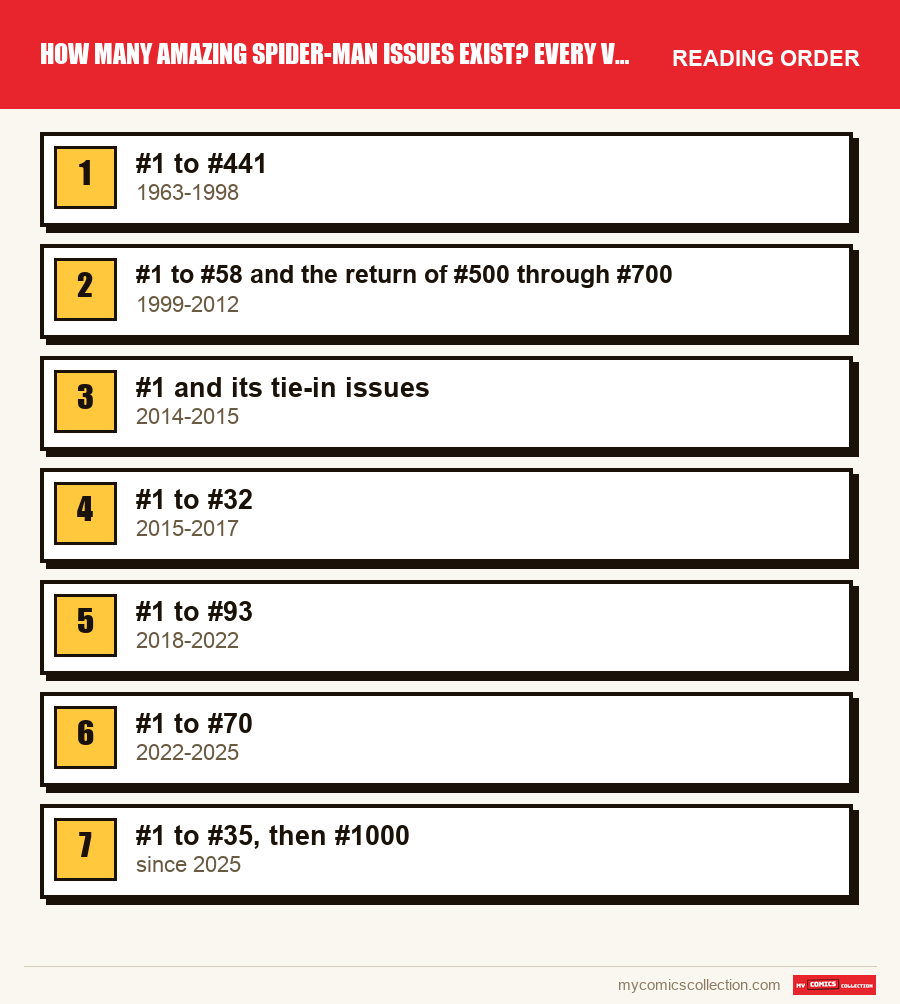
Volume 1: #1 to #441 (1963-1998)
Volume 1 is the backbone of the series. The series was born with a March 1963 cover date. Lee writes, Ditko draws. #441, the last step of the volume, is dated November 1998. In between, 441 issues follow one another with no break in numbering, which makes it the longest continuous stretch in the title's history.
Almost everything that built the character's historical reputation is in it. Steve Ditko leaves the series after #38 (1966) and John Romita Sr. takes over starting with #39. #50, "Spider-Man No More", dates from 1967; #121 tells the death of Gwen Stacy in 1973. #300 from 1988 puts the full first appearance of Venom on the cover. Each of these landmarks has its own entry in our guide to Amazing Spider-Man #1 and in the series on centennial issues.
One special case weighs on the count: #-1, dated July 1997, an issue from an editorial initiative in which every Marvel series offered a "before the beginning" story. It sits in volume 1, but databases leave it out of the count, because it falls between no two whole numbers. If you want a "complete" volume 1, it therefore comes to 441 regular issues plus this off-count single issue.
Volume 2: #1 to #58 and the return of #500 through #700 (1999-2012)
The new #1 reached stores in November 1998 with a January 1999 cover date; Howard Mackie writes it, John Byrne draws it. Volume 2 runs to #58, in November 2003. Translated into the historical count, these issues occupy spots 442 to 499, or 58 issues.
This is where dual numbering first appears. With #30 of June 2001, where J. Michael Straczynski and John Romita Jr. take over, the cover shows two numbers: the volume number, and #471 of the historical count. After #58, Marvel drops volume numbering and publishes #500 directly, dated December 2003.
No further relaunch cuts the road until #700, on sale December 26, 2012, which closes the "Dying Wish" arc. From #500 to #700, that is 201 issues; many online listings still file them under volume 2, simply out of publication continuity. Fractional issues slip in: #654.1, #679.1, #699.1 and five titles numbered #700.1 to #700.5. They do not enter the legacy count, but they very much exist in stores.
Right after, the title changes its name. Superior Spider-Man takes the place of the main series from March 2013 to November 2014, from #1 to #33, written by Dan Slott. These 33 issues are folded into the historical count between #701 and #733. A collector who sticks to "Amazing" covers will therefore have a 33-issue hole in the run.
Volume 3: #1 and its tie-in issues (2014-2015)
Volume 3 starts on April 30, 2014 with a #1 that matches #734 of the historical count. It is surrounded by many interstitial issues, notably #1.1 to #1.5 and then #16.1 to #20.1. Since volume 4 restarts at #757, everything between the two arithmetically belongs to volume 3: 23 spots in the count, from #734 to #756.
This stretch is the most misleading for the count. A volume 3 "without the .1s" looks short, while the historical count gives it 23 spots. Note also that the last issues of Superior Spider-Man come out after the launch of this volume: the count follows the logic of the story, not the order of release.
Volume 4: #1 to #32 (2015-2017)
After the Secret Wars event, Marvel launches volume 4 on October 7, 2015, with a #1 that equals #757. Its last issue, #32, comes out September 13, 2017 and is worth #788 on the count: 32 spots filled, from 757 to 788.
A month later, the Marvel Legacy initiative puts the series back on its original count. The next single issue is labeled #789. From one copy to the next, the cover therefore jumps from 32 to 789, even though nothing was lost along the way. The title continues under this count up to #801, which is 13 more issues that belong to no numbered volume.
Volume 5: #1 to #93 (2018-2022)
Volume 5, written by Nick Spencer, launched on July 11, 2018. Its #1 is #802, and its #93 is #894: 93 regular issues. For the first time, Marvel systematically prints both numbers on the cover, which makes reading a label simpler than in the days of volume 2.
This volume is also the one that best illustrates the gap between "issues in the count" and "single issues that exist". Beside the 93 regular issues, it has about ten suffixed issues (.HU, .LR, .BEY, #92.1) that carry their own barcode but stay outside the count. A "complete" volume 5 can therefore include 93 issues or more, depending on the rule you set yourself.
Do you collect this series?
Track what you own, what you are missing and what your collection is worth. 7-day trial.
Start my trial →
Volume 6: #1 to #70 (2022-2025)
Zeb Wells and John Romita Jr. inaugurate volume 6 on April 27, 2022. Numbering restarts from #895, and the sixth single issue, dated August 2022, is already #900. The nine-hundredth issue of the historical count therefore appears in 2022, more than four years before the thousandth.
The volume ends at #70, which is #964 of the historical count: 70 issues, from spot 895 to spot 964.
Volume 7: #1 to #35, then #1000 (since 2025)
On April 9, 2025, volume 7 opens at #965 with Joe Kelly writing and Pepe Larraz drawing. It has 35 issues under its own numbering, and #35 matches #999, put on sale August 26, 2026. Instead of a #36, the series then publishes #1000, which comes out September 30, 2026.
After that the historical count takes over: #1001, #1002 and onward still file under volume 7, just as #500 to #700 did for volume 2. As long as the series continues, the series total keeps rising, and any numerical answer has an expiration date.
Legacy numbering: the arithmetic of the total
To answer "how many", all you need to do is add up the runs. Here is each segment of the historical count, with the issues it contains:
- Volume 1: #1 to #441, or 441 issues;
- Volume 2: #442 to #499, or 58 issues;
- Return to the count: #500 to #700, or 201 issues;
- Superior Spider-Man: #701 to #733, or 33 issues;
- Volume 3 and its tie-in issues: #734 to #756, or 23 issues;
- Volume 4: #757 to #788, or 32 issues;
- Return to the count: #789 to #801, or 13 issues;
- Volume 5: #802 to #894, or 93 issues;
- Volume 6: #895 to #964, or 70 issues;
- Volume 7: #965 to #999, or 35 issues, then #1000.
The sum gives 1000, which matches issue #1000 of September 2026. Each boundary lands on the next with no gap, and it is this fit that lets us say confidently that the historical count is missing no issue between 1963 and 2026.
The total changes as soon as you step outside this perimeter. If you add #-1, the fractional issues like #654.1 or #700.1, the suffixed issues of volume 5 and the tie-in issues of volume 3, the list of single issues grows by several dozen entries, without it being reasonable to announce an exact figure. The right reflex is to give two answers: the number of issues in the count, and the number of single issues including off-count ones, stating the rule used.
Annuals and parallel series
Annuals are separate single issues that fit into none of the runs above. The first Amazing Spider-Man Annual dates from 1964 and features the Sinister Six, before the annual series accompanied volume 1 for many years. Each relaunch then had its own annuals, sometimes as a single issue; we therefore do not claim to draw up an exhaustive inventory.
Around the main series, Marvel also published neighboring titles that each have their own numbering: Marvel Team-Up (1972), The Spectacular Spider-Man (1976), Web of Spider-Man (1985) or the 1990 Spider-Man series drawn by Todd McFarlane. They do not count toward the Amazing Spider-Man total, but they belong to the same reading universe, and some key moments take place in them.
To know where to stop, keep this hierarchy in mind. The historical count is the main series. The off-count issues and annuals are supplements to the same series. The parallel titles are other series, which deserve their own list.
Completing the run: where to start
A project to complete a thousand-issue run is won by method, not by momentum. Here is the order that avoids duplicate purchases and regrets.
- Choose the sort key. The historical number places each single issue in one unique spot, from #1 to #1000. Keep it as your key and note the volume number as secondary information.
- Decide the scope. Do the off-count issues, annuals and Superior Spider-Man issues belong in your project? Set the rule before buying, not after.
- Start from the end. The recent runs (volumes 5 to 7) are easy to find and give a base of several hundred issues. They serve to validate your list.
- Handle the keys separately. The pivotal issues of volume 1 call for attention to condition and authenticity. Do not mix them with the lot purchases for the rest of the run.
- Buy the runs in blocks. A stretch of volume 1 between #100 and #200, for example, is often bought more efficiently as a consistent lot than one at a time. Then cross-check duplicates against your list.
- Check the printings. Some recent issues exist in several printings; reread our guide to recognizing the second printing of #1000 before you pay.
To keep the list over the years, you are better off with a spreadsheet with one row per historical number and three columns: owned, condition, note on the volume. It is more readable than drawing up a thousand entries by volume title.
Frequently asked questions
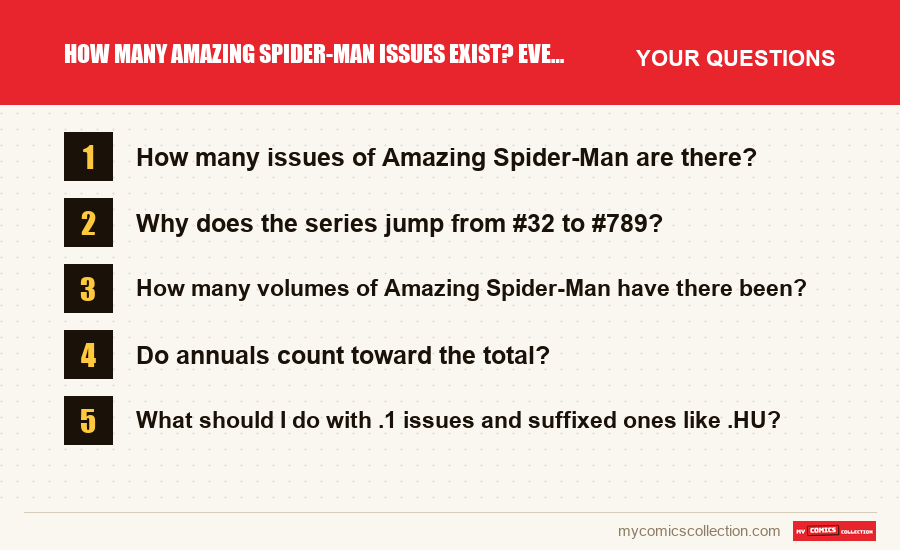
The historical count runs from #1 (March 1963) to #1000 (September 30, 2026), or one thousand regular issues, and it continues with #1001. This total includes neither the annuals nor the off-count issues like #-1 or #700.1 to #700.5, which add to it if you count single issues.
Volume 4 ends with its #32 of September 2017, equivalent to #788. The following month, the Marvel Legacy initiative restores the historical numbers and the next single issue carries #789. No issue is missing in between.
Seven volumes, from 1963 to volume 7 launched on April 9, 2025. Volume 1 has 441 issues, volume 2 has 58 before the return to the count, then come volumes 3 to 7. Superior Spider-Man occupies spots 701 to 733 without being a numbered volume of Amazing.
Not in the historical count. The first annual dates from 1964 and the later relaunches had their own annuals, which are distinct single issues. For a complete collection, you need to add them to your list as a separate scope, to be decided before buying.
They are real single issues, with their own barcode, but they have no place in the historical count. Note them on a separate row of your list, right after the issue that precedes them, and decide once and for all whether you collect them.
Do you have an issue of Amazing Spider-Man whose volume leaves you puzzled? Appraise it with both numbers in hand.
Estimate my comic