
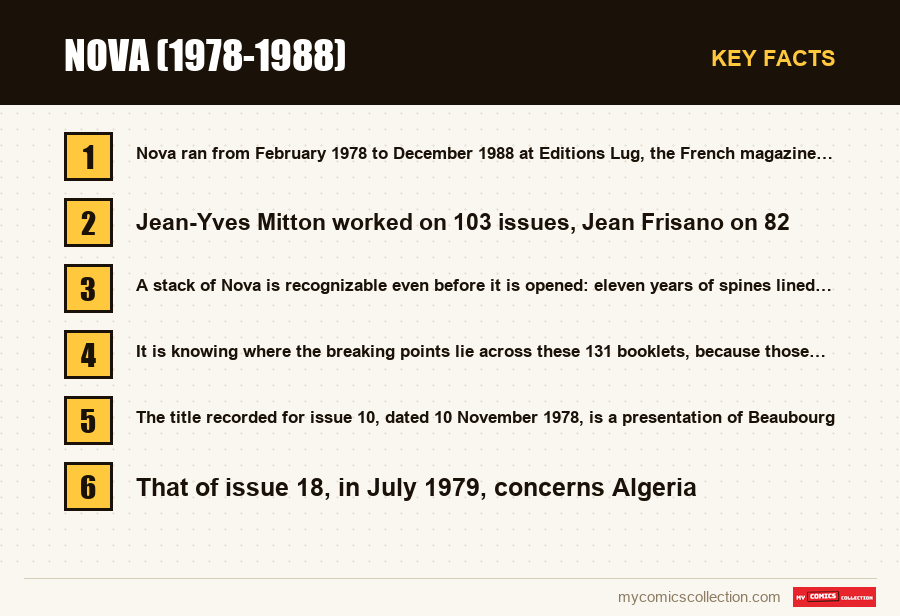
Nova ran from February 1978 to December 1988 at Editions Lug, the French magazine, for 131 issues. Its schedule was strictly monthly from start to finish, without a single skipped month. The printed publication day changes twice, and those two switches are often enough to date a copy whose cover is unreadable. Jean-Yves Mitton worked on 103 issues, Jean Frisano on 82.
A stack of Nova is recognizable even before it is opened: eleven years of spines lined up, from issue 1 dated 10 February 1978 to issue 131 of December 1988. The French collector's problem is not knowing that the series is long, that is obvious. It is knowing where the breaking points lie across these 131 booklets, because those points decide what you are still looking for, what you can resell and what you keep without a second thought.
As always on this guide, only verified information (creators, issue numbers, dates) is asserted; the analysis is our own, with no reproduction of protected art or dialogue.
What the catalog says about Nova, and what it does not
The catalog records, for each issue, a date, a story title, writers and artists. It is valuable and insufficient, and it is better to know that before using it to buy. A booklet of this format stacked several episodes, plus features; the record keeps only one title, and in the case of Nova that single title very often misses the stories.
The examples jump out from the first year. The title recorded for issue 10, dated 10 November 1978, is a presentation of Beaubourg. That of issue 18, in July 1979, concerns Algeria. Issue 7 is assigned a game consisting of getting a ping-pong ball out of a funnel. These are not errors: they are the magazine's documentary and recreational pages, which were indexed like any other content.
The consequence is direct. You cannot deduce from a record what an issue actually contains, and above all you cannot conclude that a copy holds the first French printing of a character, or that it matches a given American booklet. This check is done with the booklet in hand, page by page. Claiming otherwise would be selling a certainty the data does not support.
Eleven years, 131 issues, not one month missed
The most remarkable fact about the series is also the most discreet, because it only shows if you line up all the dates. From February 1978 to December 1988, exactly 131 months elapse. The series has exactly 131 issues. In other words, not a single month is skipped across the whole run: no double issue, no summer break, no emergency quarterly.
For a collector, this regularity has a practical value that is easy to underestimate. Numbering and calendar are interchangeable: if you know the issue number, you know the month. A lot sold as "the complete year 1983" must contain twelve booklets, from issue 60 to issue 71, and nothing else. Any listing that offers eleven issues for a calendar year has either a gap or a misidentified issue.
The 10th, then the 5th, then nothing: dating a copy by its day
The day printed on the cover shifts twice, and these two switches are the best dating markers for the series. From issue 1 to issue 57, the magazine is dated the 10th of the month, the last being 10 October 1982. From issue 58, dated 5 November 1982, it moves to the 5th of the month and stays there until issue 122, in March 1988.
The third phase is even more useful to know because it runs against intuition. From issue 123, in April 1988, the day disappears: the last nine booklets carry only a month and a year. If a seller gives you a precise day for an issue from the end of the run, they reconstructed it, they did not read it.
Remember the rule in the right direction: a copy dated the 10th necessarily belongs to the first half of the series, a copy dated the 5th to the second, and a copy with no day to the last nine months. This does not replace the issue number, but it lets you immediately rule out a fanciful label on a lot photographed from a distance.
Mitton and Frisano, the two names that hold the magazine together
If you were to remember only two creators of Nova, they would be these two, for different reasons. Jean-Yves Mitton appears in the artist credits of 103 of the 131 issues, close to eight in ten, from issue 1 through the last months of 1988. Jean Frisano appears on 82 issues, but almost never at the beginning: he arrives in force from issue 29, in June 1980, and then holds the top spot in the credits for years.
This distribution tells a story about a collection. The very first issues of 1978 and 1979 are the only ones where the pairing is not yet in place, and that is partly what sets them apart visually from the rest of the stack. Anyone looking for "Frisano" has no reason to pay for the first year; anyone who wants to see the magazine before him should aim for the first twenty-eight.
On the writing side, American writers dominate as expected, Bill Mantlo and Marv Wolfman appearing, along with Stan Lee, among the most regular bylines in the first two-thirds. The interest lies elsewhere: Mitton also appears as a writer, but on only four issues, numbers 24, 29, 30 and 32, all concentrated between January and September 1980. These four records mark a precise moment in the magazine, not a habit.
The 1980 interlude: in-house production and cross-references between magazines
These four issues where Mitton writes fall exactly on the most interesting stretch of the series. The title recorded for issue 25, in February 1980, is "Prélude à la guerre des univers"; that of issue 26, the following month, is "La Guerre Des Univers (suite) : La charge des Skrulls !". The credits include signatures that are not American at all, among them J. K. Melwyn-Nash, an in-house pen name, and that of Eric Privat.
In the same vein, the title of issue 28, from May 1980, promotes another magazine from the publisher, and that of issue 30 is entirely devoted to it. The magazine thus uses its own pages to push its catalog, and this 1980 sequence is where it is most French both in its pages and in its announcements. For a thematic collector, it is an identified segment, short and easy to assemble: six to eight booklets, not a decade.
Do you collect this series?
Track what you own, what you are missing and what your collection is worth. 7-day trial.
Start my trial →
1986 to 1988: the shift and the end of the run
The last third changes its face. John Byrne appears in the credits of 33 issues as writer and of 31 as artist, and these appearances are not scattered: they cluster almost entirely from issue 101, in June 1986, then become near-systematic through issue 131. The magazine of 1987 no longer has the same contents as that of 1980, and a lot sold as "Nova" without specifying the issues therefore says very little about what is inside.
The titles recorded for this final stretch are also more clearly tied to stories than at the start: "La Panthère Noire" for issue 107 of December 1986, "Docteur Fatalis" for issue 111 of April 1987, "Fatalis Imperator" on issues 119 and 120 straddling 1987 and 1988, "Mantis" for issue 123. Issue 130, in November 1988, simply bears the title "Nova". The last one, dated December 1988, is called "Le non-humanoïde !".
A stop in December, on an issue that has nothing of an anniversary about it, reads as a decided ending. That is also why the very last booklets are harder to find than the middle of the series.
The issues that really matter in a Nova stack
Four blocks deserve separate treatment, and none corresponds to a list of "rare" issues copied from elsewhere. The first is obviously issue 1 of 10 February 1978, which opens the series and on which the demand of buyers who want a single piece concentrates. The second is the 1980 sequence around issues 25 and 26, for the in-house production reasons already seen.
The third is the hinge at issue 58, in November 1982, less for its content than because it marks the change of publication day: it is the booklet cited to settle a date. The fourth is the end of the run, the nine issues with no printed day from April to December 1988, which most often sell in lots because they are rarely complete in inherited stacks.
Everything else is a matter of volume, and that is what makes the series accessible to anyone who completes it patiently, provided they do not pay the common issues at the price of the hinges.
Condition: what to check on a booklet of this format
On a monthly magazine of this thickness, the defects always recur in the same places. The spine is the first judge: reading creases, fading, rusted or missing staples. Next comes the lower edge of the cover, which shows the marks of vertical storage, then the corners.
Two points are specific to a long series like this one. First, the early issues have ten more years of storage behind them than the late ones: at equal apparent condition, a 1979 issue 12 has not had the same life as a 1988 issue 125, and that shows in the price. Second, inherited stacks have almost always been stored by year, so defects arrive in batches: if issue 60 is faded, the eleven that follow often are too.
The central signature deserves a separate check: it is the first to come loose, and a copy with a flawless spine whose central pages have been removed is no longer complete.
The traps at purchase, including the one in the catalog
The first trap comes from the data itself. The catalog contains entries visibly damaged during data entry: a credit line for issue 67 where the word "uncredited" lingers with an orphan parenthesis, a name that appears as "Cyrus Tota" on issue 92 and as "Ciro Tota" on issues 124, 127 and 128, a writer reduced to a single surname on issues 125 and 130. If you rely on a record to justify a price, check it against the copy itself rather than against a second record.
The second trap is the listing that sells "a complete series" without giving the upper bound. Complete, for Nova, means 131 issues, from February 1978 to December 1988, and any collection that stops in 1987 leaves out precisely the booklets that are hardest to find later. Ask for the last issue present before discussing the rest.
The third trap concerns the contents. Since a story title can point to a games page, a seller acting in good faith may copy a record and describe contents that are not those of the booklet. Ask for the actual contents to be described, or request a photo of the contents page: it is more telling than a photo of the cover.
Completing the series, and what moves the price
Completing 131 issues is done in blocks, not one at a time. The calendar year is a useful tool here, since each full year corresponds exactly to twelve consecutive issues: building 1979, then 1981, then 1984 costs less in fees and time than chasing the missing issues one by one. Keep the single-issue approach for the hinges and for the end of the run, where a well-targeted lot saves years of searching.
On value, there is no price to remember, only ratios. Issue 1 trades at a multiple of the common issues, and the gap narrows as soon as the condition is no longer well above average. Mid-run issues in fine condition often cost more than an issue reputed "key" in worn condition, and that is the most useful lesson for anyone buying stacks. Finally, a truly complete set is worth more than the sum of its booklets, because it removes the most costly part of the work: the search.
For tracking, keep your list by issue number and date, and note the day printed on the cover: that is what will let you spot, when you reread your notes, that a supposed issue 60 dated the 10th is not what you were sold. The other blog guides and entries such as the Spider-Man one then help identify what you have in front of you.
Frequently asked questions
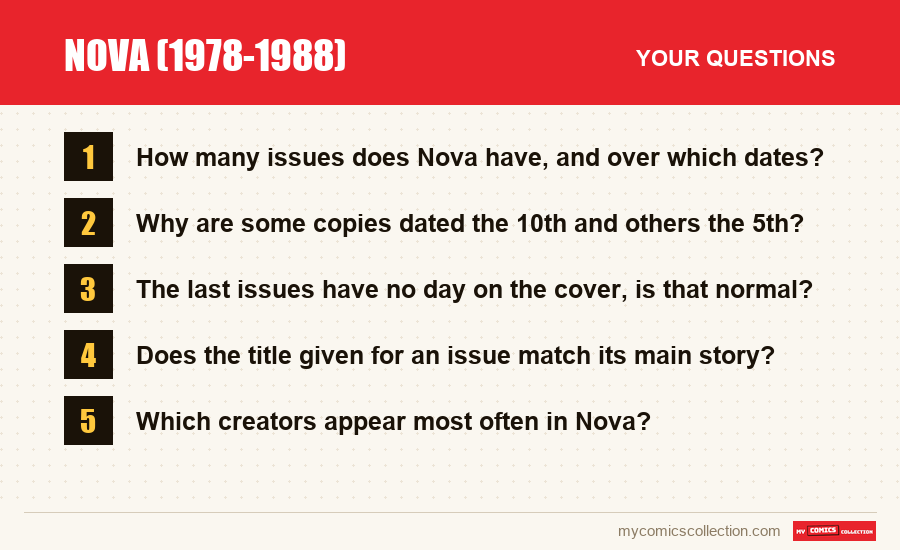
The series has 131 issues. The first is dated 10 February 1978, the last December 1988. The schedule is monthly throughout, and the number of issues corresponds exactly to the number of months between those two dates: no month was skipped, which makes the numbering and the calendar perfectly superimposable.
Because the publication day changed during the run. Issues 1 to 57 carry the date of the 10th of the month, the last being 10 October 1982. From issue 58, dated 5 November 1982, the magazine moves to the 5th of the month. This detail lets you place a copy within the series even without seeing its number.
Yes. From issue 123, in April 1988, the date is reduced to the month and year, and this applies to the last nine booklets through December 1988. A seller who announces a precise day for one of these issues has deduced it themselves. The absence of a day is therefore not a sign of a reprint or a foreign edition.
Not always, and this is especially true here. The title recorded for issue 10 concerns Beaubourg, that of issue 18 Algeria: these are documentary pages of the magazine, indexed like the rest. Only one title is kept per issue although the booklet contained several, so the actual contents must be checked on the copy itself.
Jean-Yves Mitton appears in the artist credits of 103 issues out of 131, and Jean Frisano of 82, the latter mostly from issue 29 in June 1980. Toward the end, John Byrne becomes omnipresent from issue 101 in June 1986, as writer and as artist. Mitton also signs four scripts, all in 1980.