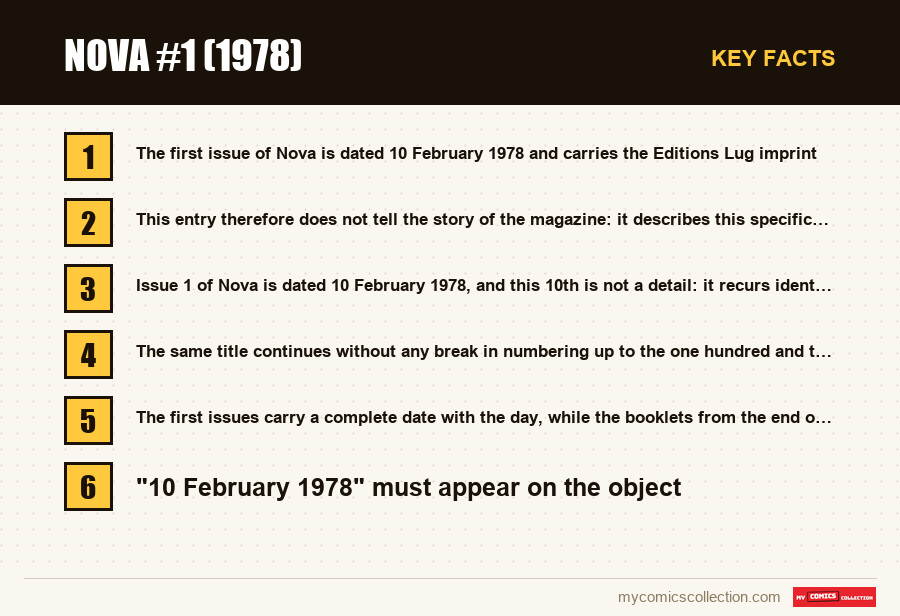
The first issue of Nova is dated 10 February 1978 and carries the Editions Lug imprint. The catalog credits Stan Lee, Marv Wolfman and Gerry Conway on writing, and Jean-Yves Mitton, John Buscema and Jean Frisano on art. The only contents entry recorded for this booklet points to a Spider-Man album, a sign that the rest of the content has to be read off the copy itself.
A first issue is not a chapter of publishing history, it is an object you hold, pay for and sometimes regret. The Nova first issue regularly turns up at flea markets, collector fairs and online sales, and it almost always comes with a description too short to decide on. This entry therefore does not tell the story of the magazine: it describes this specific booklet, dated 10 February 1978, and what you need to know before saying yes.
As always on this guide, only verified information (creators, issue numbers, dates) is asserted; the analysis is our own, with no reproduction of protected art or dialogue.
What the catalog says about this booklet
The record is short, and that is already a lot. Issue 1 of Nova is dated 10 February 1978, and this 10th is not a detail: it recurs identically on the dozens of issues that follow, 10 March 1978, 10 April 1978, 10 May 1978. A seller who announces a "Nova number 1" dated another day of the month is describing something else, or copying a date they did not read on the object.
The publisher recorded is Editions Lug. This is the most useful piece of information for a purchase, because it fixes a production family: format, paper, cover layout, logo. A collector who already has a stack of monthlies from the same house recognizes the silhouette before reading the title, and that is the reflex to cultivate, rather than trusting the heading of the listing.
Finally, the catalog records for this issue a single contents entry: "Album l'Araignée numéro 2 : la nuit du Lézard". This line should be read for what it is, one of the pieces of the booklet among others, and not as the full program of its pages.
Why the contents must be checked on the copy
French monthlies of this generation stacked several episodes, plus features, plus advertisements for the house's albums. The data we have records only one title per issue, and on Nova that recorded title is very often a feature or an advertisement rather than a serial: neighboring issues bring up crosswords, a file on model aircraft, a page on the Beaubourg cultural center. In other words, what we read for issue 1 tells you about the magazine's atmosphere, not about the list of its episodes.
The practical consequence is simple: no one can tell you from memory what this booklet contains page by page, and you should treat any listing that asserts it as a hypothesis. Ask for a photo of the contents page or of the first interior page. It is the only document that settles the question, and a serious seller has no reason to refuse it.
The names credited on this issue
The catalog associates three writers with this first issue, Stan Lee, Marv Wolfman and Gerry Conway, and three artists, Jean-Yves Mitton, John Buscema and Jean Frisano. The mix is typical of this kind of magazine: American writers for the translated episodes, and French artists for what was produced here, covers and in-house pages included.
The two French names deserve attention, because they explain part of the demand for these booklets. Jean Frisano and Jean-Yves Mitton appear in the credits of this first issue just as they will later appear across a long run of issues, and fans of French covers buy as much for that signature as for the translated episodes. A buyer who does not know this does not understand why some copies sell faster than others in comparable condition.
Be careful, however, about what these names do not say. A list of creators attached to a booklet does not assign roles page by page, and it does not allow you to assert who signed what inside. If you are looking for a specific page by a specific author, it is the open copy that answers, not the record.
What sets this issue apart from the ones that follow
The first issue of a newsstand monthly almost never has the same fate as the second. It goes into a sales network that does not yet know the title, it has no established readership, and it is bought out of curiosity. Those who pick it up often read it without care, because nothing yet indicates that a series will last more than ten years.
Yet this one lasted. The same title continues without any break in numbering up to the one hundred and thirty-first booklet, dated December 1988, and it is these ten years of publication that give issue 1 its particular position: it opens a long collection, so many people look for it to start their own. The relative scarcity of this booklet owes less to its print run, which we do not know, than to this gateway effect.
A second difference is material. The first issues carry a complete date with the day, while the booklets from the end of the run only carry a month, "September 1988" for example. An issue advertised as the first issue but dated with a month alone is therefore not the first issue: it is a dating clue that you can check on a photo, with no special expertise.
Recognizing a real first issue in a listing
Start with the date, because it is the element hardest to fake by accident. "10 February 1978" must appear on the object. If the photo does not show it, ask for a picture of the area where it appears rather than reasoning from the cover alone.
Next, check the number itself, and be wary of listings that write "number 1" in the title and show something else in the image. This mismatch is common and rarely dishonest: a seller clearing out an attic describes a lot, highlights the most desirable item, and does not notice that the photo does not match. Three polite questions almost always settle the misunderstanding.
Third check, the publisher's name. Editions Lug is printed on this booklet; a different company name in the same place signals a different object, which must then be identified before you negotiate. This check matters because the same magazine title has continued to be exploited after 1988 by another company, with a different layout.
Do you collect this series?
Track what you own, what you are missing and what your collection is worth. 7-day trial.
Start my trial →
The most common confusions
The first comes from reprints and collected editions. A house that publishes a monthly readily republishes its content in other forms: bound albums, special issues, compilations. A collection that contains the material from the start of the series is not the first issue, and it is generally recognized by its spine, its thickness and the absence of the monthly date. Check the edge in a photo before buying at a distance.
The second confusion is the supposed relaunch numbered again from 1. For this title, it does not exist: the numbering continues without resetting after the end of the Lug period, the booklet following the one hundred and thirty-first carrying number 132 in January 1989 under another publisher. For this publication, there is therefore only one possible "number 1", and any listing that speaks of a second first issue describes a different product or is mistaken.
The third concerns namesakes. "Nova" is a short and common word, used as a title by several publishers and in several languages, for magazines that have nothing to do with this one. Faced with a short listing, look at the language of the cover, the publisher's name and the format before concluding, and treat the word alone as proving nothing.
What to look at on the object before buying
On a stapled monthly from the late 1970s, three areas tell almost the whole story. The spine first: staples rust, and the rust stains the paper on both sides, leaving a halo that does not come out. Then the corners, which blunt in storage and split when flipped through. Finally the back cover, more exposed than the front in stacks, and often the real reason for a downgrade.
Add two checks specific to this kind of magazine. Interior completeness, because the games pages and detachable features were designed to be cut out, and a copy missing a grid or an order form is no longer complete even if it looks intact from the outside. And flatness, because a booklet stored rolled or folded in two keeps the memory of its deformation.
Ask for photos taken flat, without direct flash, of the cover, the spine and an interior double page. This set is enough to rule out most unpleasant surprises, and it works far better than a debate over a condition adjective chosen by the seller.
What makes it relatively scarce
We do not know the print run of this booklet, and sources disagree on the volumes printed by French monthlies of this period. Reasoning from an unknown figure helps no one. Three mechanisms, however, explain why a first newsstand issue is harder to find in good condition than its successors.
The first is unsold returns: what did not sell at the newsstand did not stay on the shelf, and a title unknown at launch suffered this mechanism more harshly than an established one. The second is use: a booklet bought before the series was recognized as a collection was read, lent, sometimes cut up, rarely protected. The third is continuous demand from everyone who wants to start at the beginning.
What moves the value of a copy
For the same issue, the gap between two copies is decided by condition, and condition here amounts to cumulative defects rather than a single overall grade. A fresh cover and healthy staples place a copy in a different category from one with rounded corners, even if both are advertised as very good.
Three other factors matter, and they are often underestimated. Interior completeness, already mentioned, which makes all the difference in a magazine that offered pages to handle. Documented provenance, meaning the seller's ability to say where the copy came from and how it was stored. And the sales context: the same booklet offered alone, in a lot of a hundred, or at a specialist fair does not get the same result, because the buyers present are not the same.
To form a sound idea, compare sales that were actually concluded rather than listings still running, and compare copies described with the same level of detail. An asking price says nothing; a price paid for a copy whose spine you can see in a photo says a great deal.
Recording this issue in a tracked collection
A first issue deserves a record of its own, not a line in a global inventory. Note there the date printed on the object, the publisher's name, the defects observed zone by zone, and above all the contents you have checked yourself. This last piece of data is the one missing everywhere, and you are the only person able to write it for your copy.
Add a photo of the cover and one of the spine at the time of acquisition. Defects evolve, paper yellows, memories get rewritten: a dated photo settles discussions in advance, whether about insurance, resale, or simply whether a stain was already there. Keeping this record takes a few minutes and serves for the hundred and thirty numbers that follow.
Finally, resist the urge to buy the first copy available. For a title that ran monthly for ten years, opportunities come back, and patience pays off in quality. Set a minimum condition level, write it down, and refuse anything below it.
Frequently asked questions
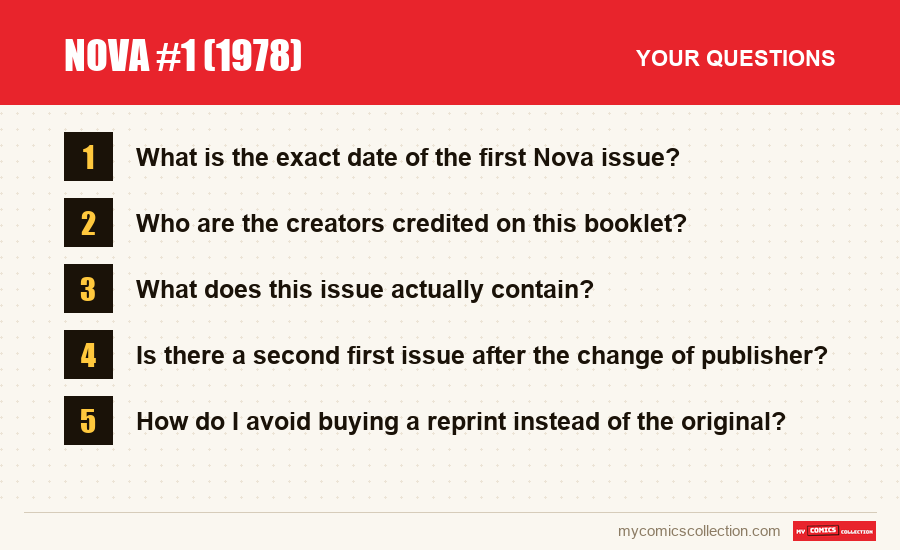
The catalog gives 10 February 1978, and this date appears on the object. The following issues carry the same day of the month, 10 March 1978 then 10 April 1978, which makes it a reliable dating marker. A copy advertised as the first issue without this date should be checked on a photo before any commitment.
Three writers are recorded, Stan Lee, Marv Wolfman and Gerry Conway, and three artists, Jean-Yves Mitton, John Buscema and Jean Frisano. This list does not assign roles page by page: it says who takes part in the booklet, not who signed a given episode. Only the open copy allows you to establish that precisely.
A single contents entry is recorded, "Album l'Araignée numéro 2 : la nuit du Lézard", and it does not cover all the pages. Magazines of this format stacked several episodes and features, including games and documentary files. The full content has to be read off the copy, and a photo of the contents page is what you should ask for.
No. The numbering continues without resetting: after the one hundred and thirty-first booklet, dated December 1988, the series goes on as number 132 in January 1989 under another publisher. A listing offering another "number 1" of this title therefore describes a collection, a reprint or a namesake publication.
Look at the spine and the thickness. A bound collection or an album gathering several booklets has neither a stapled spine nor the monthly date of 10 February 1978. Also check the Editions Lug mention in the same place as on the house's other monthlies, and ask for a flat photo of the spine before concluding at a distance.