The Nightcrawler comics history begins in May 1975, the cover date of the special Giant-Size X-Men #1, where Nightcrawler (Kurt Wagner), known in France as Diablo, makes his debut. Dave Cockrum, who designed the character, draws it for a script by Len Wein. A German mutant with a demonic look, he teleports and melts into shadows. He has been a pillar of the X-Men ever since: from Excalibur to his death in Second Coming (2010), then his recent returns, he remains a believer at the heart of a world of fighters.
On a team of mutants brought together by fear and anger, Kurt Wagner stands out as an exception: his blue face, prehensile tail and yellow eyes clash with the rest, yet he is the one who embodies kindness, humor and faith. This gap between appearance and character is the key to the character, and it is what successive creators have dug into from 1975 to today.
As always in this guide, we only state verified facts (creators, issues, dates); the analysis is our own, with no reproduction of protected artwork or dialogue.
His first appearance
The character was born well before he reached Marvel. Dave Cockrum first imagined him during his service in the U.S. Navy, on Guam. He then pitched him to DC, for a team concept called the Outsiders in the Legion of Super-Heroes universe, and the publisher turned it down. When Cockrum arrived on the X-Men in 1975, the character came with him; since editor Roy Thomas wanted a multinational team, the blue demon became German.
This special issue runs 68 pages, with Len Wein on script. Dave Cockrum pencils the interior and inks the cover, while Gil Kane pencils the cover; Cockrum and Peter Iro ink the interior. Chris Claremont contributed to the script without credit, notably by coming up with the idea of using Polaris's powers to propel Krakoa into space. The plot is simple: Professor Xavier recruits a new team to save the original X-Men, who have vanished on Krakoa, and that team also includes Storm in her first appearance.
Our page on this special issue details the team; the lineup also includes Storm, Colossus, Thunderbird, Sunfire, Banshee, Wolverine and Cyclops, and Kurt Wagner settles in as one of its most recognizable faces.
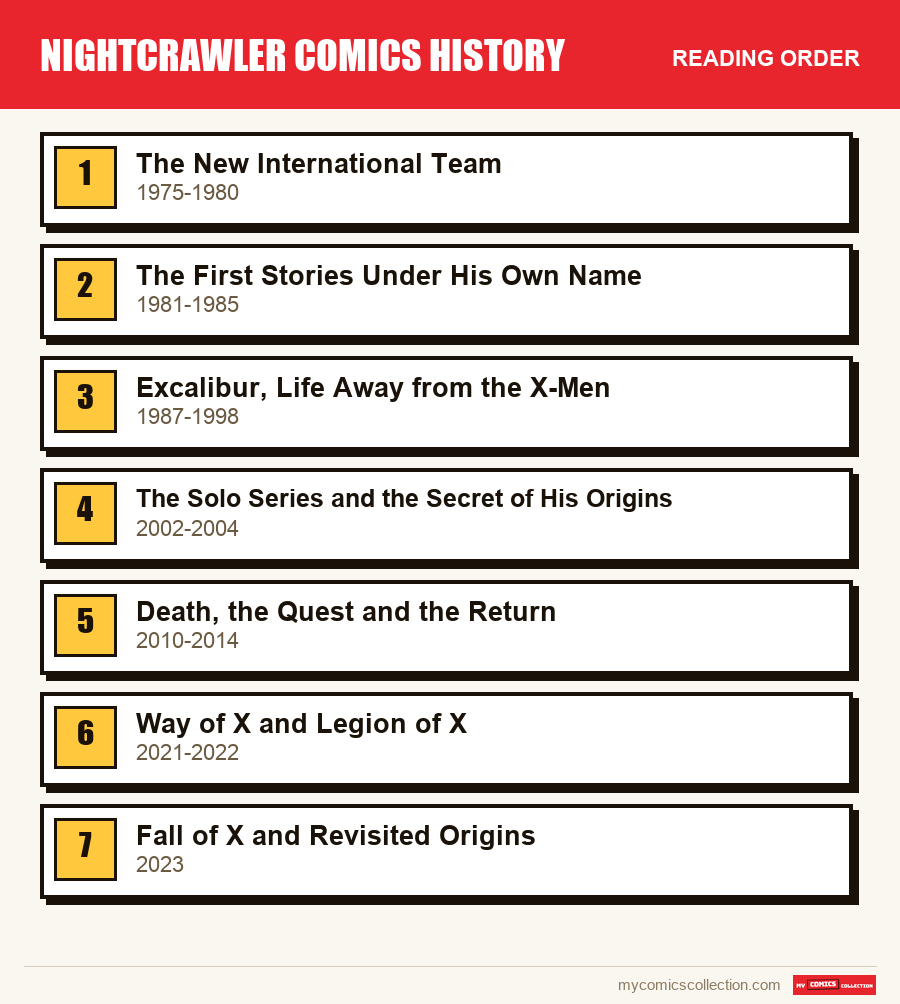
Era 1: The New International Team (1975-1980)
After the special issue, Marvel resumes new X-Men stories with issue #94, cover-dated August 1975. It is the first issue written by Chris Claremont: most of the original members leave and Cyclops stays. Issue #101 sees Marvel Girl become Phoenix, and from issue #108 John Byrne replaces Cockrum on pencils and becomes co-plotter. The series, still called X-Men at this point, becomes The Uncanny X-Men starting with issue #114, in October 1978.
On this team, Kurt Wagner plays a specific role. Next to Wolverine, Colossus or Storm, he is the character with the most striking appearance and the warmest attitude. The Claremont and Byrne years also set up the big arcs: the Dark Phoenix saga in 1980, in which Phoenix dies, and the arrival of Kitty Pryde in issue #129, cover-dated January 1980. To place the work of these two creators, see the John Byrne hub and our page Chris Claremont: where to start.
Issues #141 and #142 (January and February 1981), Days of Future Past, extend this era into a dystopian future where Kitty Pryde, a time traveler, tries to prevent a disaster. Our page on issue #141 gives the collector's reference points.
Era 2: The First Stories Under His Own Name (1981-1985)
The character gets his own stories a few years after his debut. His first solo story appears in Bizarre Adventures #27, cover-dated July 1981, penciled by Dave Cockrum and written by Jo Duffy. It opens a phase in which Kurt Wagner stops being merely a team member and becomes a character who carries his own stories.
The strongest signal arrives in November 1985, with a four-issue miniseries titled Nightcrawler, which Dave Cockrum writes and draws himself. Seeing his creator return to the character changes the perspective: the artist who imagined him on Guam writes and draws a story devoted to him. For a collection, this miniseries is the piece to hunt for when you want to document the character's life outside the team's pages.
Era 3: Excalibur, Life Away from the X-Men (1987-1998)
Convinced that their comrades are dead, Nightcrawler and Shadowcat (Kitty Pryde) form a new team with Captain Britain, Meggan, Rachel Summers (Phoenix) and Lockheed. The team is born in 1987 in Excalibur Special Edition, a 48-page ad-free album written by Chris Claremont and drawn by Alan Davis.
The regular Excalibur series launches in October 1988, with an Alan Davis cover for issue #1. Claremont writes it through issue #34; Davis then takes on the dual role of writer and artist from issue #42. The series ends with issue #125 in October 1998. In this setting, Nightcrawler leaves the main X-Men team and joins a series with an identity of its own: a smaller team, an adventurous tone, and a character whose affable nature takes up a lot of space.
If this series interests you, see our selection of the best Excalibur runs, which helps you choose which issues to read first.
Era 4: The Solo Series and the Secret of His Origins (2002-2004)
In the early 2000s, Marvel gave him series of his own again. A four-issue miniseries appeared in November 2002, written by Chris Kipiniak and penciled by Matthew Dow Smith. A regular series launched in September 2004 under Roberto Aguirre-Sacasa, with covers and pencils by Darick Robertson; it ends at issue #12.
Spoiler alert: a 2003 story makes Azazel the father of Kurt Wagner, which roots the character's demonic appearance in a lineage. This is a page worth knowing, because the question of Nightcrawler's parents will change again twenty years later. The Mystique hub is useful for following this family link.
For the reader, this period matters mostly as a hinge: the character leaves the team to exist on his own, with creators who don't belong to the X-Men's historic creative team. The miniseries and solo series of these years are best shelved apart from the classic X-Men issues, because their creative teams and periods differ.
Do you collect this series?
Track what you own, what you are missing and what your collection is worth. 7-day trial.
Start my trial →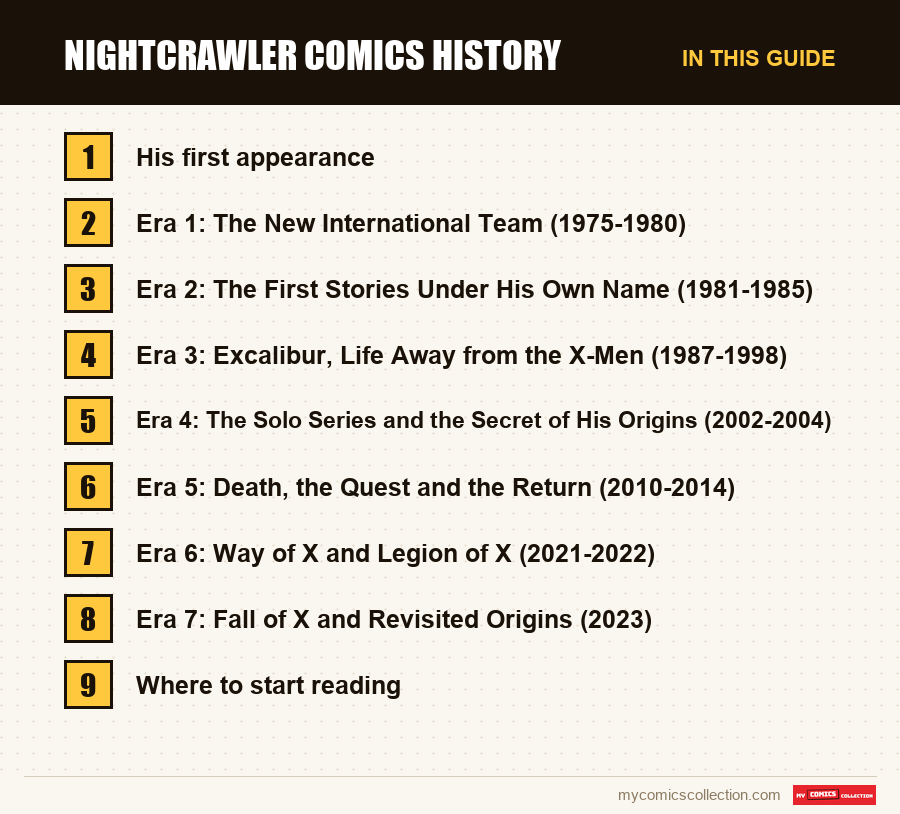
Era 5: Death, the Quest and the Return (2010-2014)
Spoiler alert: Nightcrawler dies in the crossover X-Men: Second Coming, published from March to July 2010. Bastion, the main antagonist, tries to kill Hope Summers; as he heads toward her, Nightcrawler teleports between them, is impaled, then teleports Hope to Utopia before dying. Craig Kyle and Christopher Yost steer this crossover with Matt Fraction, Mike Carey and Zeb Wells on script, while Greg Land, David Finch, Mike Choi, Terry Dodson and Ibraim Roberson handle the pencils.
For collectors, the main series X-Men: Second Coming runs two issues, the first dated March 2010 and the second July 2010, and the hardcover collection came out in October 2010. This death then weighs on all the stories of 2013 and 2014, which revolve around his absence and then his return.
The follow-up arrives in November 2013 with Amazing X-Men, a series whose issues #1 through #6 are written by Jason Aaron and drawn by Ed McGuinness. A team searches for Nightcrawler in the afterlife: the arc is collected under the title The Quest for Nightcrawler. The Jason Aaron hub gathers his other issues. In 2014, a Nightcrawler series written by Chris Claremont and drawn by Todd Nauck opens; it ends at issue #12.
The Amazing X-Men series continues with Kathryn Immonen on issue #7, then Christopher Yost and Craig Kyle for issues #8 through #19, where the series ends. Nightcrawler is among the protagonists of several of these issues, including #13 with Anole and Northstar, and #14 with Mystique. These are issues to read after the quest, if you want to follow the character after his return.
Era 6: Way of X and Legion of X (2021-2022)
After several years, the character returns to the foreground. Way of X launches in April 2021 as part of Reign of X, written by Si Spurrier and drawn by Bob Quinn, and puts Nightcrawler at the center of the series.
The follow-up, Legion of X, launches in May 2022, again written by Si Spurrier, with Jan Bazaldua on art. For a reader who knows the character from the 1970s, this phase shows that he can carry an entire series under his own name, and not just a role on a team. The same writer, Si Spurrier, signs both series, which makes them easy to read back to back.
Era 7: Fall of X and Revisited Origins (2023)
In 2023, two publications extend the character. The five-issue miniseries Uncanny Spider-Man, written by Si Spurrier and drawn by Lee Garbett, is part of Fall of X; our page on the Fall of X reading order helps place it. The one-shot X-Men Blue: Origins, from November 2023, is written by Si Spurrier and drawn by Wilton Santos, with a cover by Francis Manapul.
Spoiler alert: X-Men Blue: Origins #1 changes Nightcrawler's parents, who become Mystique and Destiny (Irene Adler). This version replaces the Azazel one for recent continuity, which obliges the collector to keep track of both versions: the same question of parentage reads differently depending on the year of publication.
Where to start reading
- The reader curious about origins: Giant-Size X-Men #1 (May 1975), followed by the X-Men issues written by Chris Claremont starting with issue #94.
- The art lover: the 1985 Nightcrawler miniseries, written and drawn by Dave Cockrum, to see the character through his creator's eyes.
- The reader who prefers light adventure: Excalibur from issue #1 (October 1988), by Claremont and then Alan Davis.
- The reader of modern stories: Amazing X-Men #1 to #6 (2013), by Jason Aaron and Ed McGuinness, for the quest arc.
- The reader of recent series: go straight through Way of X (2021) and Legion of X (2022), both written by Si Spurrier.
The key issues to know
- Giant-Size X-Men #1 (May 1975): the character's debut, by Len Wein and Dave Cockrum.
- X-Men #94 (August 1975): Chris Claremont's first issue as writer.
- Bizarre Adventures #27 (July 1981): a solo story, by Jo Duffy and Dave Cockrum.
- Nightcrawler (November 1985): Dave Cockrum's miniseries.
- Excalibur Special Edition and Excalibur #1 (October 1988): the team of Claremont and Alan Davis.
- X-Men: Second Coming (2010): the character's death.
- Amazing X-Men #1 (November 2013): the quest.
- X-Men Blue: Origins #1 (November 2023): the new parentage.
For a collection, the most reliable method is to split the character into three blocks. The first covers the 1975 debut and the issues that follow it; the second brings together Excalibur and the series under his name; the third focuses on the death, the return and the publications from 2021 to 2023. Work on one block at a time, compare copies in the same grade and always note the cover date. Our page on the key issues of Uncanny X-Men rounds out this roadmap.
Frequently asked questions
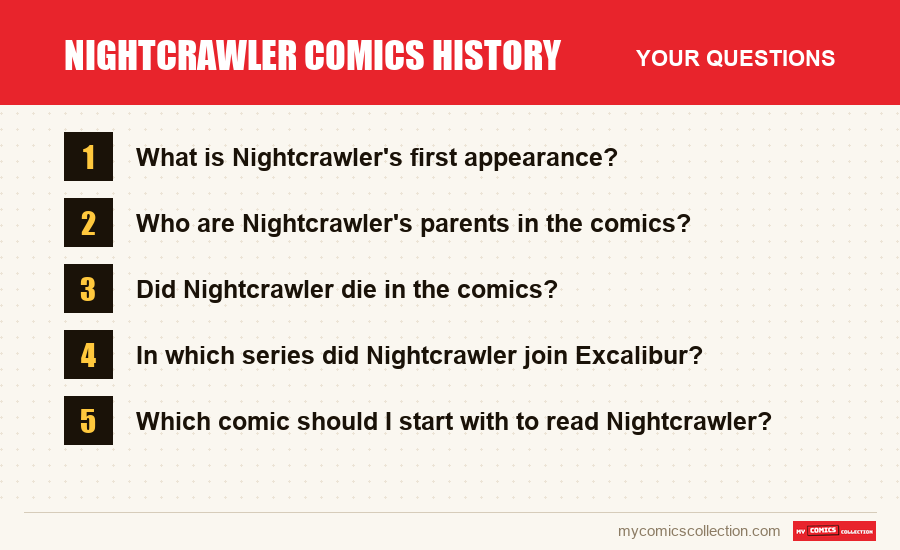
Kurt Wagner first appears in the special issue Giant-Size X-Men #1, May 1975. Len Wein writes it; Dave Cockrum, who designed the character, pencils it. He is part of the new team recruited by Professor Xavier to save the original X-Men.
It depends on the era. A 2003 story makes Azazel his father; X-Men Blue: Origins #1 (November 2023) gives him Mystique and Destiny (Irene Adler) as parents. Recent continuity keeps this second version.
Yes: he dies in X-Men: Second Coming (March to July 2010), protecting Hope Summers from Bastion. He then returns: Amazing X-Men (November 2013), by Jason Aaron and Ed McGuinness, tells the quest to find him in the afterlife.
The team is born in Excalibur Special Edition, by Chris Claremont and Alan Davis. The regular Excalibur series launches in October 1988 and runs 125 issues until 1998, with Nightcrawler on the original team.
For the origins, Giant-Size X-Men #1 then X-Men #94 and following. For a story centered on him, the 1985 Nightcrawler miniseries by Dave Cockrum, or Amazing X-Men #1 to #6 (2013) for a modern arc that puts him front and center.
Own a Giant-Size X-Men #1 or an Excalibur #1? Get it appraised before deciding how to store it.
Estimate my comic