The Nick Fury comics history starts in May 1963 with Nick Fury, a World War II sergeant who leads the Howling Commandos from issue #1 of Sgt. Fury, created by Stan Lee and Jack Kirby. His modern-day version, a CIA agent, shows up in Fantastic Four #21 (December 1963), and Strange Tales #135 (August 1965) makes him the head of S.H.I.E.L.D. Today the name covers two characters: the original, and Nick Fury Jr. (Marcus Johnson), introduced in 2012.
Few Marvel heroes have changed jobs as often as Nick Fury: platoon leader in World War II, spy in the 1960s, agency director, then a shadowy figure watching over the Earth. Following his path means following how the publisher looked at the military, espionage and the Cold War over six decades.
As always in this guide, we only state verified facts (creators, issues, dates); the analysis is our own, with no reproduction of protected artwork or dialogue.
His first appearance
By 1963, Marvel had already launched its costumed heroes; the publisher then took a different gamble with Sgt. Fury and His Howling Commandos #1, cover-dated May 1963: a war comic following a squad of sharply contrasting characters. Sergeant Nick Fury commands the Howling Commandos, whose roster includes Dum Dum Dugan, Izzy Cohen, Gabe Jones, Dino Manelli and Rebel Ralston. The whole concept was created by Stan Lee and Jack Kirby, and Kirby penciled the first issues before Dick Ayers took over.
In the early 1960s, the war genre was a staple of American newsstands, and Marvel entered it with a squad of varied backgrounds. The series ran 167 issues, from May 1963 to December 1981, and its last issue, #167, reprints the first. As early as issue #3, cover-dated September 1963, Reed Richards crosses paths with the Howlers: the link to the rest of the Marvel universe was woven almost immediately.
For the same year, the date to remember on the contemporary side is Fantastic Four #21 (December 1963): that is where Nick Fury, now a CIA agent, appears in the superhero era. A collector hunting for "the" first appearance therefore has to specify which one they mean: the 1963 sergeant or the CIA man from the same year.
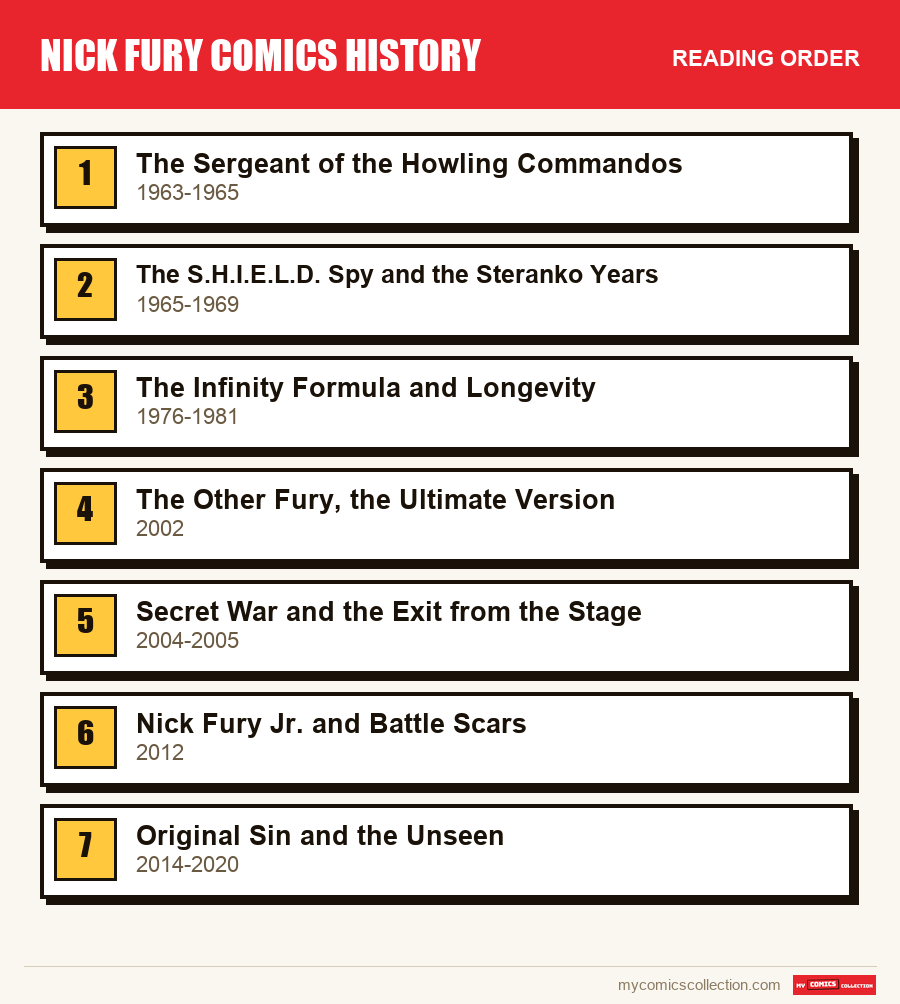
Era 1: The Sergeant of the Howling Commandos (1963-1965)
Sgt. Fury and His Howling Commandos was first written by Stan Lee, who scripted issues #1 through #28 as well as the first Annual. Roy Thomas succeeded him for issues #29 through #41, and then Gary Friedrich wrote many of the later issues. On the art side, Jack Kirby led the way, but Dick Ayers became the signature artist: he penciled 95 issues, annuals included, with inks by George Roussos and John Severin.
What this era establishes is the character's grammar. The Fury of the 1960s is a soldier in the field before he is a strategist, and his squad comes first. The Howlers themselves make up a richer cast than they might seem. Junior Juniper dies in issue #4, Pinky Pinkerton replaces him in issue #8, Eric Koenig joins the squad in issue #27 (February 1966), and Jim Morita, whose Nisei squad appears in issue #38 (January 1967), later serves alongside the Howlers. With Juniper killed off as early as November 1963, the death of a squad member gives the series a sense of real danger.
For collectors, two families of issues stand out: the 1963 first issue, and the ones where the superhero universe crosses paths with the soldiers, such as Reed Richards' appearance in issue #3. Our guide to the history of Captain America shows how World War II serves as the common ground for these two characters, even though their publishing paths diverge very quickly.
Era 2: The S.H.I.E.L.D. Spy and the Steranko Years (1965-1969)
With Strange Tales #135 (August 1965), Nick Fury, now a colonel, becomes a Cold War spy in the spirit of the James Bond films and takes charge of S.H.I.E.L.D. The feature is born under the direction of Lee and Kirby, and that same issue also introduces Hydra, the agency's enemy organization. The feature shares the magazine with Doctor Strange and runs until Strange Tales #168.
The artistic turning point arrives with Strange Tales #151 (December 1966): Jim Steranko starts out drawing over Kirby's layouts, then writes and draws the feature himself. He is the one who turns a spy series into a visual laboratory: collages, double-page spreads, pop geometry. Our page on where to start with Steranko details this approach, and the Jim Steranko hub gathers his issues.
When the feature leaves Strange Tales at #168, the colonel gets his own title. Nick Fury, Agent of S.H.I.E.L.D. ran fifteen issues between June 1968 and November 1969, followed by three reprint issues between November 1970 and March 1971. Steranko writes and draws issues #1 through #3 and issue #5, and he does the covers for issues #1 through #7. Strange Tales #135 remains the benchmark entry on the S.H.I.E.L.D. side, which our article on that issue #135 covers in detail.
Era 3: The Infinity Formula and Longevity (1976-1981)
A continuity problem arises quickly: how can a man who fought in 1942 run an agency in the following decades without growing old? The answer arrives in Marvel Spotlight #31 (December 1976), in the story "Assignment: The Infinity Formula," written by Jim Starlin and drawn by Howard Chaykin. This story explains the treatment, developed by Dr. Berthold Sternberg, that slows Fury's aging, a mechanism that will become central much later: the character now depends on a product he has to keep renewing.
This period also sees Sgt. Fury and His Howling Commandos approach its end: it stops with issue #167 in December 1981, which reprints the first issue. The 1963 sergeant thus closes his publishing cycle just as the S.H.I.E.L.D. spy has already become the dominant image of the character.
Era 4: The Other Fury, the Ultimate Version (2002)
In the early 2000s, Marvel launched the Ultimate imprint, which rewrote its characters in a modern setting. The Ultimate version of Nick Fury is African American, born in Huntsville, Alabama, a veteran of World War II and Kosovo, and his look and personality are modeled on the actor Samuel L. Jackson.
He holds a central place in The Ultimates, whose issue #1 is dated March 2002 and which was written by Mark Millar and drawn by Bryan Hitch. We cover this series on our page about The Ultimates #1. The key point for a collector: the Ultimate universe is a separate continuity, with its own issues, and the first appearances of this version don't follow the same logic as those of the mainstream Fury.
Do you collect this series?
Track what you own, what you are missing and what your collection is worth. 7-day trial.
Start my trial →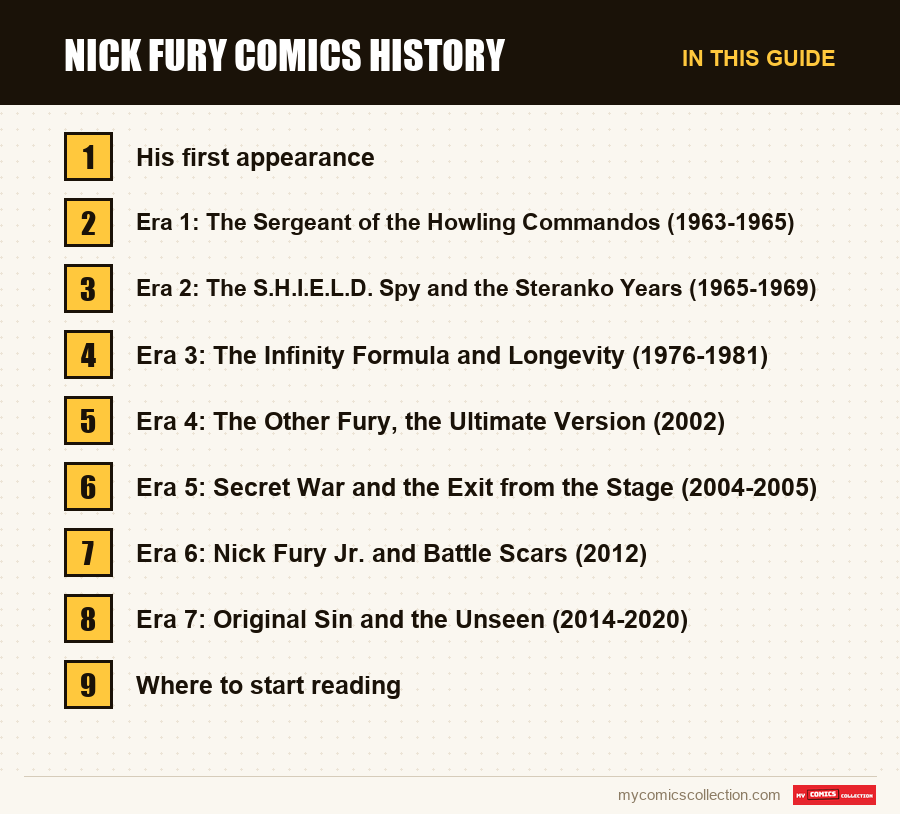
Era 5: Secret War and the Exit from the Stage (2004-2005)
Secret War runs five issues, written by Brian Michael Bendis and drawn by Gabriele Dell'Otto: the agency's director takes action. Issue #1 came out in April 2004 and issue #5 closes the series in December 2005, after publication delays. The story rests on a dilemma: Fury learns that Latveria's Prime Minister, Lucia von Bardas, is funding second-tier supervillains with cutting-edge technology, and the American government refuses to authorize toppling the Latverian regime.
He then recruits Captain America, Spider-Man, Daredevil, Black Widow, Luke Cage, Wolverine and Daisy Johnson for a covert strike on Latveria. Spoiler alert: a year later, retaliation in New York leaves Luke Cage in a coma; Daisy Johnson destroys von Bardas, who has become a cyborg, and then a Life Model Decoy of Fury reveals that the heroes were mind-wiped after the mission. Fury slips away, and Maria Hill succeeds him as head of S.H.I.E.L.D.
The aftermath is explored in The Pulse, and Bendis reuses many of these characters in his New Avengers books: you can follow that chain in the Brian Michael Bendis hub. As a read, this miniseries is the point where you shift from the institutional Fury to the clandestine Fury, a figure who acts outside the rules.
Era 6: Nick Fury Jr. and Battle Scars (2012)
Here you have to distinguish between two men. Nick Fury, born during World War II, is the hero of 1963. Nick Fury Jr. is a different character, Marcus Johnson, introduced in the six-part series Battle Scars in 2012 as Fury's secret son. He is a sergeant there, he loses an eye over the course of the story, and then he takes the name Nick Fury Jr. when he joins S.H.I.E.L.D. Phil Coulson appears on the last page.
For a collector, this distinction translates into two separate search logics. The 1963 Fury points to the war issues and to Strange Tales, while Fury Jr. is found in the 2012 issues and the ones that follow. Our page on Agents of S.H.I.E.L.D. versus the comics compares the TV series with the printed books.
Era 7: Original Sin and the Unseen (2014-2020)
Original Sin ran from April to September 2014 at Marvel, with Jason Aaron writing and Mike Deodato drawing, in a run of issues from #0 to #8. The starting point is the murder of Uatu, the Watcher, on the Moon. Our guide to the key issues of Original Sin covers the event in detail; here, what matters is Fury's role.
Spoiler alert: the Nick Fury beheaded by the Winter Soldier is actually a Life Model Decoy. The real Fury, now elderly, resurfaces later: he has been defending the Earth in secret since 1958, the year Howard Stark recruited him, and since his Infinity Formula is running out, he has picked the heroes able to replace him. Fury then absorbs Uatu's powers, becomes the Unseen, the Earth's new watcher, and the Winter Soldier takes over the role of Man on the Wall. You can find that character in the Winter Soldier hub.
After the 2015 Secret Wars miniseries, he reappears as the Unseen, and then, during Empyre in 2020, a resurrected Uatu makes him his herald. The evolution is consistent: the sergeant of the trenches, then the spy, then the director, becomes an observer.
Where to start reading
- The reader curious about the history of the war genre: Sgt. Fury and His Howling Commandos #1 (May 1963), then the issues written by Stan Lee up to #28. The war tone and the setup of the squad read in a single sitting.
- The art and espionage fan: the Strange Tales chapters drawn by Jim Steranko from #151 on, then the series under his name, issues 1 to 3. This is the entry point for anyone who wants to understand what changed in American comics.
- The reader of recent crossovers: Secret War (Bendis and Dell'Otto, 2004-2005), which stands on its own and shows the shadowy Fury.
- The reader coming from the Ultimate universe: The Ultimates #1 (March 2002), by Mark Millar and Bryan Hitch, for the Jackson version.
- The reader who wants the modern thread: Battle Scars (2012) for Nick Fury Jr., then Original Sin (2014, Jason Aaron and Mike Deodato) for the transition to the Unseen.
The key issues to know
For a collection, you can sort the character's issues by function. In order, the following pieces make up a coherent set:
- Sgt. Fury and His Howling Commandos #1 (May 1963): the sergeant's debut, created by Stan Lee and Jack Kirby.
- Fantastic Four #21 (December 1963): the contemporary version, a CIA agent.
- Strange Tales #135 (August 1965): the S.H.I.E.L.D. Fury, with Lee and Kirby behind the feature's origin.
- Strange Tales #151 (December 1966): Jim Steranko's arrival on the series.
- Nick Fury, Agent of S.H.I.E.L.D. #1 (June 1968): the launch of the series under his name, with Steranko at the helm.
- Marvel Spotlight #31 (December 1976): the Infinity Formula, by Jim Starlin and Howard Chaykin.
- Secret War #1 (April 2004): Bendis and Dell'Otto, Fury's departure from the director's chair.
- Original Sin (2014): the character's fate.
The method: first choose the era that appeals to you, then look for that era's entry issue and nothing else. A copy of Original Sin doesn't serve the same function in a collection as a 1965 Strange Tales: one documents a recent event, the other a historical milestone. Always compare copies in the same grade, note the exact condition and keep track of the cover date. Our page on first appearances covers this method in detail.
Store Nick Fury Jr. issues separately: mixed in with those from 1963 to 1969, they make the inventory unreadable.
Frequently asked questions
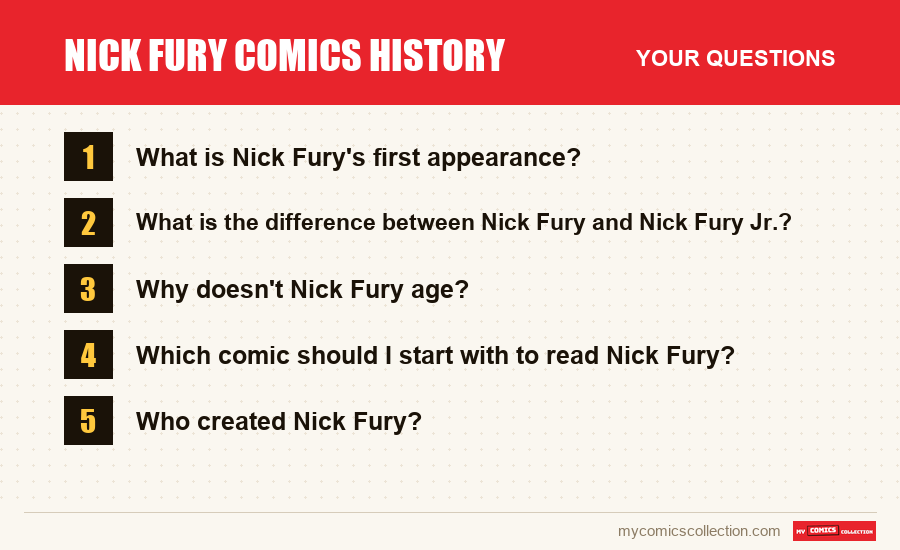
The sergeant debuts in issue #1 of Sgt. Fury and His Howling Commandos, cover-dated May 1963 and dreamed up by Stan Lee and Jack Kirby. His contemporary version, a CIA agent, appears in Fantastic Four #21 (December 1963). The Fury who heads S.H.I.E.L.D. debuts in Strange Tales #135 (August 1965).
Nick Fury is the World War II sergeant who became head of S.H.I.E.L.D. Nick Fury Jr. is Marcus Johnson, introduced in 2012 in Battle Scars as his secret son, who takes that name when he joins the agency. They are two distinct characters, with different entry issues.
The answer is given in Marvel Spotlight #31 (December 1976), by Jim Starlin and Howard Chaykin: a treatment called the Infinity Formula slows his aging. The treatment has to be renewed, which becomes a major issue much later, in the 2010s.
It all depends on what you're after. For war, Sgt. Fury and His Howling Commandos #1; for espionage and art, Strange Tales from #151 with Jim Steranko; for a complete, recent story, Secret War by Brian Michael Bendis and Gabriele Dell'Otto, in five issues.
Stan Lee and Jack Kirby created the sergeant in Sgt. Fury and His Howling Commandos #1 (1963), and they are also behind the S.H.I.E.L.D. feature in Strange Tales #135 (1965). Jim Steranko then redefined the character visually, starting with Strange Tales #151 in December 1966.
Found a 1960s Strange Tales or Sgt. Fury in your boxes? Get it appraised before you file it away.
Estimate my comic