
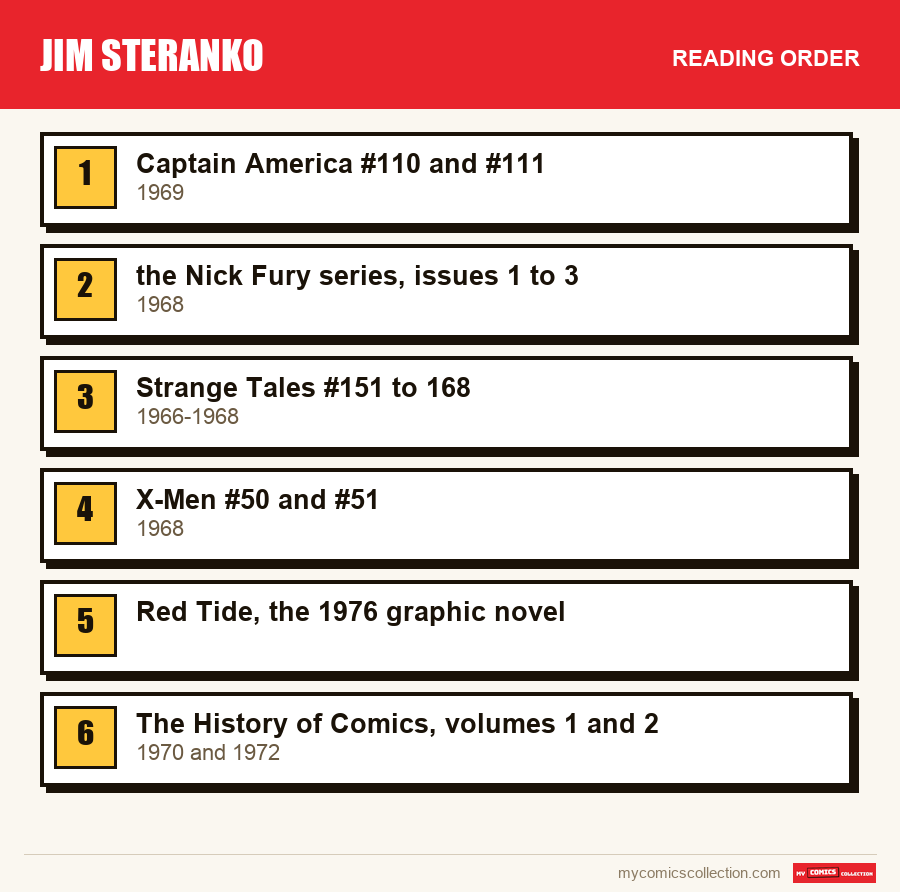
To read Jim Steranko, start with Captain America #110 and #111 (1969), two issues that stand on their own. Then move on to the 1968 Nick Fury series, its first three issues, and go back up the Strange Tales run from #151 to #168, where the style is born. The two issues of X-Men #50 and #51, the 1976 graphic novel Red Tide and the two volumes of the History of Comics close the path, from the most direct to the most demanding.
Jim Steranko did not leave an abundant body of work: a few dozen comic issues, concentrated in barely three years, between 1966 and 1969. This scarcity changes how to read the artist. With a prolific creator, you choose a period; with Steranko, you choose an order, because each episode pushes the techniques of the previous one a little further: collage, op art, the double page designed as a single image, layouts that play with symmetry.
As always in this guide, only verified information (creators, issues, dates) is stated as fact; the analysis is our own, with no reproduction of protected pages or dialogue.
No life story here: this page is an itinerary. It starts from the episodes you can understand without knowing anything about the Marvel universe of the 1960s, then climbs toward those that ask you to accept a visual grammar more than half a century old. Captain America, our entry point, is by no means a second choice: it is probably the read where the Steranko effect is measured fastest, because the reader does not have to follow thirty years of continuity. To place the character over the long run, the Captain America hub remains the best landmark.
Step 1: Captain America #110 and #111 (1969)
Steranko draws these two issues in early 1969, with a February cover date for the first. The hero operates in the shadow of S.H.I.E.L.D., Nick Fury's agency, which naturally extends the work of the next step. The interest is twofold. First, the two episodes form a two-parter: there is no need to look elsewhere for the sequel. Second, the layout seems more legible here than in the creator's earlier work, because the action stays centered on a single character in a very recognizable costume.
Why start there? Because it is an immediate pleasure: the poses are dynamic, the full-page panels do not try to lose you, and you quickly sense why artists of the following decades copied Steranko's Captain America framings rather than those of any other Marvel hero of the time.
Effort level: low. Two single issues, or one section of a collected edition. The original single issues exist in large numbers, but the paper of the era ages badly; if reading is your first goal, a collected edition is safer.
Step 2: the Nick Fury series, issues 1 to 3 (1968)
The series carries a June 1968 date for its first issue. Steranko writes and draws the first three episodes: Nick Fury, a former World War II sergeant turned director of a spy agency, faces Hydra in a style that owes as much to the spy cinema of the day as to contemporary painting. The covers are already posters: they are what made the series' reputation among collectors.
What this step brings that the previous one does not: a story where Steranko holds all the controls alone. The script, the layout, the art and the covers come from the same hand, producing pages in which no detail is gratuitous. The reader sees how an action sequence is built on the double page rather than on the panel.
Effort level: medium. The three episodes read in one sitting, but the vocabulary of 1960s espionage (agencies, codes, military jargon) takes a moment to adapt to. A tip: read each episode's subplot first, then reread the images alone, without text, to measure the share of the layout.
Step 3: Strange Tales #151 to 168 (1966-1968)
This is the step that lets you understand how Steranko becomes Steranko. Strange Tales then publishes, in half an issue, the adventures of Nick Fury, and it is in this frame that Steranko arrives from issue 151, dated December 1966. At first inking another artist's sketches, then taking over the full art, then the script. The serial ends with issue 168, dated May 1968, and is reborn the following month in a magazine under its own name, the one from the previous step.
In this period, one creation deserves a mention: Valentina Allegra de Fontaine, countess and future S.H.I.E.L.D. figure, whose entrance is marked by issue 159 of August 1967. She will become a lasting character of the S.H.I.E.L.D. universe, but her first appearance is not the point of this read: the point is to see the progression of the line over eighteen issues.
Why is this not the first step? Because the Strange Tales episodes do not read as easily. Each chapter is only a few pages long, plots continue from one issue to the next, and a reader who does not yet know Steranko's manner may see only a classic drawing here. You have to have read what follows to appreciate the metamorphosis. Effort level: medium to high. A chronological collected edition is almost indispensable: gathering eighteen single issues just to read would be a collecting job, not a reading one.
Step 4: X-Men #50 and #51 (1968)
Steranko draws these two issues, dated November and December 1968. It is a parenthesis in the career: the artist steps in on a series that is not the artist's own, at a time when X-Men was going through a phase of commercial fragility. The reader finds the mutant heroes seen by an artist more at ease with shadows and tilted angles than with group dynamics; the silhouettes are elongated and the framings oblique.
This step is useful less for the plot than for the contrast: you watch a spy artist transpose those techniques into a team superhero register. If you already collect the X-Men, it fits naturally into your path; consult the X-Men hub to place these two issues in the series.
Effort level: medium. Two single issues, a two-part plot, but a series whose conventions of the era you have to accept: thoughts in balloons, next-issue teasers at the bottom of the page, a tight script.
Do you collect this series?
Track what you own, what you are missing and what your collection is worth. 7-day trial.
Start my trial →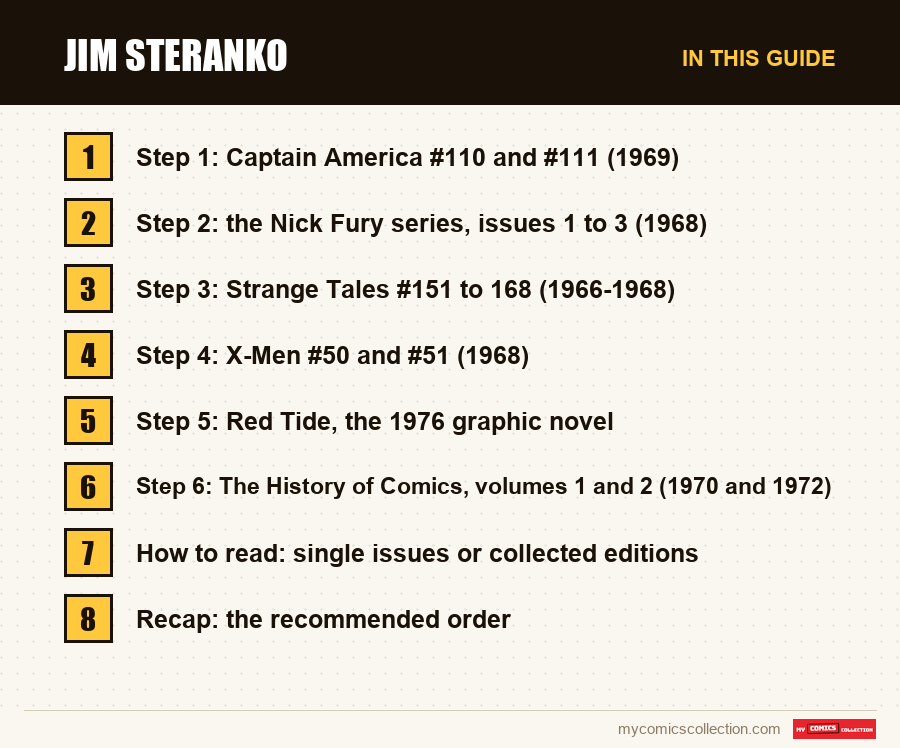
Step 5: Red Tide, the 1976 graphic novel
Outside the Marvel frame, Steranko adapts in 1976 a crime story titled Chandler: Red Tide. The book is often cited as one of the first American graphic novels, for its book format and adult tone. The detective conducts an investigation in a nocturnal city, with a film noir narration and a very carefully worked layout.
This is another Steranko: slower, darker, without costumes. For the reader of crime comics, this step is a fascinating detour; for the superhero reader, it measures the distance traveled since Strange Tales. It means accepting that a half-century-old album does not look like a modern graphic novel.
Effort level: high. The volume is scarcer than the Marvel collected editions, and the available editions differ in format; check the dimensions before buying if reading the pages matters to you.
Step 6: The History of Comics, volumes 1 and 2 (1970 and 1972)
The last milestone is not a comic but a reference work: Steranko writes, lays out and illustrates an illustrated history of the genre, in two volumes published in 1970 and 1972. The first covers the beginnings of the comic book, the heroes of the 1930s and 1940s; the second continues with the publishers and creators who shaped the industry.
You read it for its design as much as for its text: the book shows how the same sense of composition as in Nick Fury applies to a book. The angle is that of a creator recounting the creator's own world, with the biases of an era: some claims have since been corrected, and it is best to cross-check against more recent studies.
Effort level: high, because the object is mainly intended for those interested in the history of the medium. It belongs on a collector's shelf more than on a bedside table.
How to read: single issues or collected editions
Steranko poses a particular problem for anyone who wants to read in original single issues: the bulk of the work dates from 1966 to 1969, on acidic paper that browns quickly and on which the printing colors of the era tend to dull. An original copy in good condition can be found, but it is paid for in condition-hunting, not in a simple add to cart. For reading, collected editions (Nick Fury omnibuses, volumes devoted to Captain America of the period, oversized formats) do more justice to the double pages than the original single issues.
Our method is therefore simple: read the whole sequence of steps 1 to 4 in collected form; keep single issues for the numbers whose physical copy you want, checking the exact cover, the condition of the spine and any restoration. Artist's editions, which reproduce the original pages at their working size, exist for this creator and appeal to art lovers; they are mainly for those who have already read the stories.
As for the general trade-off between bound volume and period issue, you will find it in our feature omnibus or original single issues.
Recap: the recommended order
- Captain America #110 and #111 (1969): two self-contained issues. Low effort.
- Nick Fury, Agent of S.H.I.E.L.D. #1 to 3 (1968): Steranko alone at the controls. Medium effort.
- Strange Tales #151 to 168 (1966-1968): the genesis of the style. Medium to high effort.
- X-Men #50 and #51 (1968): a detour among the mutants. Medium effort.
- Chandler: Red Tide (1976): the noir graphic novel. High effort.
- The History of Comics, volumes 1 and 2 (1970 and 1972): the reference work. High effort.
If time is short, keep steps 1 and 2: five issues that give the full measure of the creator. If the reading wins you over, work down in order. If it leaves you cold, there is no point pushing: the following steps push in the same direction.
Frequently asked questions
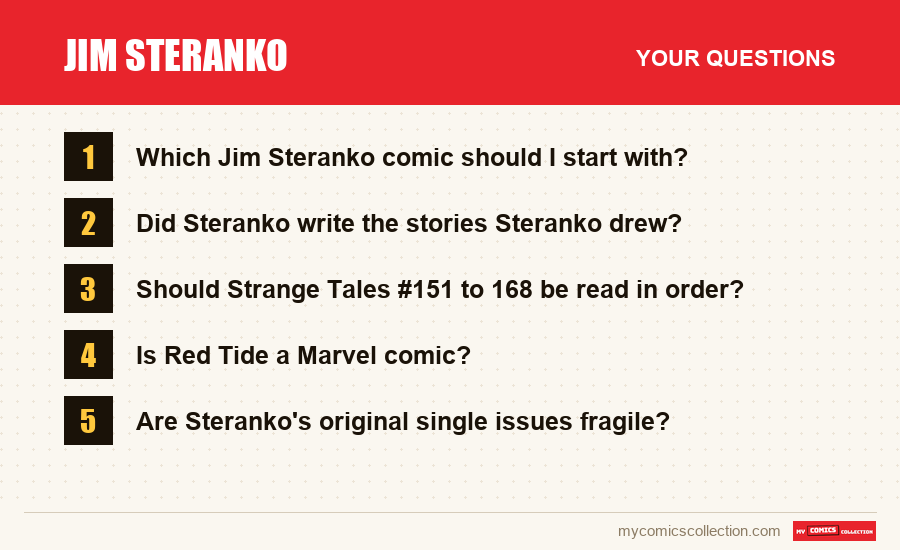
With Captain America #110 and #111, dated early 1969. The two issues form a complete two-parter, with a hero you identify effortlessly. Follow up with the first three issues of the Nick Fury series (1968): the writing and the art there are by Steranko alone.
Yes, on Nick Fury: in Strange Tales, Steranko gradually slides from inking to full art and then to writing, before signing the first three issues of the 1968 series alone. On Captain America and X-Men, other pens hold the script.
Yes, because the chapters are short and continue from one issue to the next. The serial ends at #168, in May 1968, then continues in a magazine named after Fury. A chronological collected edition spares you from gathering eighteen single issues just to read.
No. Chandler: Red Tide appeared in 1976 outside the Marvel universe: it is a crime story in graphic novel form, signed by Steranko alone. It is darker and slower than the superhero work, and it reads independently of any other title by the creator.
Yes, like many 1960s comics: acidic paper, colors that dull, spines that wear. For reading, prefer a collected edition. For collecting, judge the spine, the corners and the cover of a period Nick Fury or Captain America before trusting an asking price.
Do you own a single issue of Nick Fury or Captain America from the Steranko period? Get a free appraisal before deciding.
Appraise my comic