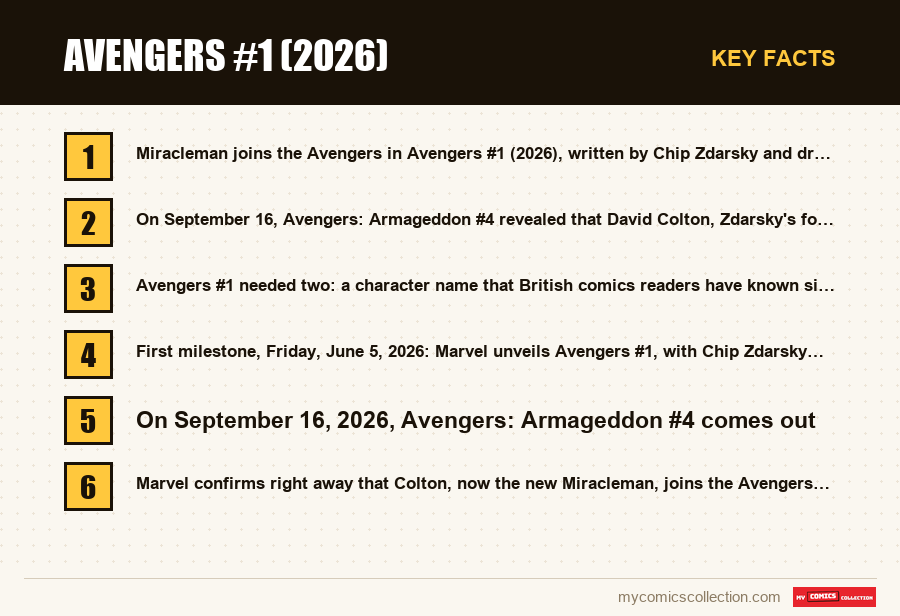
Miracleman joins the Avengers in Avengers #1 (2026), written by Chip Zdarsky and drawn by Marco Checchetto, which went on sale November 4, 2026. Marvel announced the series on June 5 with five names and one masked hero still unrevealed. On September 16, Avengers: Armageddon #4 revealed that David Colton, Zdarsky's former Captain America, inherits Miracleman's powers. He becomes the sixth member of a team called "Earth's Mightiest Survivors."
Sometimes a series relaunch fits in a single press-release sentence. Avengers #1 needed two: a character name that British comics readers have known since the 1950s, and an editorial path several months long to bring Marvel readers there. Between the June announcement and the November release, the sixth seat on the team went from a mystery to the most talked-about hero of the season.
As always on this guide, only verified information (creators, issues, dates) is stated as fact; the analysis is our own, with no reproduction of protected artwork or dialogue.
What happened
The timeline comes down to four dates, all public. First milestone, Friday, June 5, 2026: Marvel unveils Avengers #1, with Chip Zdarsky writing, Marco Checchetto on art and the cover, and an on-sale date of November 4. That day, the official roster lists only five names, Luke Cage, Daredevil, Captain Marvel, Wolverine and Spider-Man, and holds one seat for a new recruit whose identity stays secret. The series tagline is "Earth's Mightiest Survivors," and the publisher positions it as the follow-up to the Avengers: Armageddon miniseries.
On September 16, 2026, Avengers: Armageddon #4 comes out. In the fight against Red Hulk, David Colton, presented as the 21st-century Captain America of Zdarsky's Captain America run, inherits the legacy and power of Miracleman. The issue reveals that the origin box behind his abilities was tied to that character. Marvel confirms right away that Colton, now the new Miracleman, joins the Avengers #1 team.
On September 17 and 18, the trade press details the cover program for issue #1, including a full-page Kaare Andrews variant that now features Miracleman. The publisher's official description warns that the "unpredictable" Colton may not be trustworthy with his new abilities. On October 21, Avengers: Armageddon #5 wraps up the miniseries and shows what becomes of Colton after his transformation.
Finally, on November 4, 2026, Avengers #1 reaches comic shops. Marvel brings six characters together under a clear editorial brief: a team built on personality rather than raw power, in a world scarred by catastrophe and wary of masked vigilantes. Wil Moss edits the series.
The schedule has a concrete consequence for readers: the reveal is not in Avengers #1 but in the miniseries that precedes it. Anyone who opens issue #1 without having read Armageddon #4 meets a character who has already been transformed, with a recent history the issue does not recount in detail.
Point 1: From Marvelman to Miracleman, a hero with fragmented rights
The name Marvel is placing in the Avengers was not invented in 2026. Marvelman was born in 1954 from the pen of Mick Anglo, for the British publisher L. Miller & Son. The hero filled British newsstands until 1963, when the publisher stopped publishing.
In 1982, Alan Moore and Garry Leach brought him back in the magazine Warrior. That dark, adult reworking of the superhero genre was picked up in the United States by Eclipse Comics, and the character was renamed Miracleman to avoid a conflict with Marvel. The rest of the series was then carried by Neil Gaiman and Mark Buckingham, before Eclipse folded and the question of rights became a lasting legal knot.
That dispute is why the character was so hard to read for years: several parties claimed what they had created, bought or inherited. Marvel announced in 2009 that it had acquired the rights from Mick Anglo, which opened the door to reprints and then to using the character in the Marvel universe. For the complete bibliography, our guide Who is Miracleman? details the editions, from the Eclipse issues to the Marvel volumes.
For a collector, this heritage is the starting point to absorb. A 2026 issue of Avengers that puts Miracleman front and center does not make the character a newcomer: it brings into a mainstream title a figure whose older publications belong to another era, other publishers and other numbering conventions.
Point 2: David Colton, from Captain America to Miracleman
The Miracleman of Avengers #1 is not Moore's. Under the mask is David Colton, a hero who first appeared in the Captain America that Chip Zdarsky writes. Sources describe Colton as the 21st-century Captain America, the former shield-bearer, who receives his abilities from an origin box that Armageddon #4 reveals to be linked to Miracleman.
The reveal follows a building logic. Zdarsky presented Armageddon #4 as a major issue carrying a large-scale revelation. For his part, Wil Moss, who edits the Avengers, states that Miracleman will leave a mark on the Avengers and on the whole Marvel universe. These are public statements, to be read for what they are: intentions, not yet published facts.
The nuance matters directly to anyone following Captain America. Colton is no longer identified by the costume he wore, but by a name borrowed from another comics tradition. The issues of Zdarsky's Captain America in which he appears therefore become stages in a journey, and no longer just episodes of a previous title.
This approach also changes the meaning of the word "new" in the announcements. The 2026 Miracleman is new in face, old in name and powers. A reader who asks for "Miracleman's original appearance at Marvel" is therefore asking the wrong question: you have to specify whether you mean the character, Colton's version or the 1954 series, and the answer is not the same in each case.
Point 3: Avengers: Armageddon, the bridge between the two series
Avengers: Armageddon runs five issues, all written by Chip Zdarsky. Issues #4 and #5 are drawn by Delio Diaz and Frank Alpizar, with Ario Anindito added on #5. Issue #4 came out on September 16, 2026 with a cover by Dike Ruan and a "spoiler" variant by Michael Cho; #5 came out on October 21, 2026, with a variant by John Romita Jr.
In the editorial chain, this miniseries plays a precise role: it leads the reader from the rewriting of the world order, as the publisher describes it, to a team of survivors. It stages a clash with Red Hulk, in which Colton takes the step that makes him Miracleman, and then it sets up this new hero's entry into Avengers #1.
For reading purposes, the consequence is simple: Armageddon #4 is the issue where the change happens, and Armageddon #5 shows the result of the transformation. Anyone who wants to understand issue #1 with full context starts with those two issues. Our guide Zdarsky's Avengers: what to read first lays out the complete order, with the optional reads.
A collector will also notice that the miniseries and the new series share the same writer but not the same artist. That stylistic break separates the two products: the Armageddon issues belong to the Diaz and Alpizar team, those of Avengers to the Zdarsky and Checchetto team. The two series therefore sit side by side on the shelf, but under different title banners.
Do you collect this series?
Track what you own, what you are missing and what your collection is worth. 7-day trial.
Start my trial →
Point 4: Zdarsky and Checchetto, a team that came out of Daredevil
Chip Zdarsky and Marco Checchetto reunite on Avengers after their long shared run on Daredevil. That reference matters to the reader: the team is not a marriage of convenience, but a duo that has already proven its method on another Marvel title. Zdarsky writes, Checchetto draws and does the main cover.
For anyone following the writer's work, the Chip Zdarsky page gathers his releases, and our guide Chip Zdarsky: where to start helps you pick an entry point. For this series, the duo gives a simple reading marker: the issues carrying both their names on the cover form the core of the series.
The team itself is a compositional choice. Alongside Miracleman, the five other members form a group whose human dimension, more than its power, is what critics highlight. Paired with a Miracleman the publisher describes as unpredictable, they form a roster whose tension comes as much from personalities as from powers.
The series also arrives on the eve of a film. Marvel presented its launch as coming before Avengers: Doomsday in theaters, and issue #1 includes a variant tied to the film in the cover program. For the movie context, see Avengers: Doomsday: release date, cast and comics.
What this means for a collector
The useful reflex is to separate three objects: Avengers: Armageddon #4, which holds the reveal, Armageddon #5, which shows the aftermath, and Avengers #1, which sets up the team. Each has its own collecting life, its own covers and its own print run. Mixing them up leads to poor filing, to poorly describing an issue for sale, and to paying for a variant that is not the one you are after.
The second point is the cover program of Avengers #1. It is broad: variants by Skottie Young, Jim Cheung, Julian Totino Tedesco, Kaare Andrews, Alan Davis and a variant by Chip Zdarsky himself, a "True Believers" blind-bag series (David Nakayama, Clayton Crain, Adi Granov, Alex Maleev, Peach Momoko, Simone Bianchi, Artgerm as a blank version), a film-tied variant, a blank hand-drawn variant and an exclusive Mark Spears cover in the 20-copy display box. For every purchase, check the exact variant name, the artist and the packaging (bagged or not).
Third point: blank and hand-drawn variants call for special care. A copy drawn by an unannounced contributor should not be described as a copy by a known artist. It is better to describe such a copy precisely: note "blank" or "hand-drawn," the original bag and photos of the actual cover.
Fourth point, condition. A modern-title issue is first judged by its corners, its spine and the flatness of the cover. If you are thinking of having a copy certified, first read our Avengers grading guide, which explains what the grade measures and what it does not tell you about a recent release.
Fifth point, buying method. No figures or forecasts here: an editorial announcement does not tell you how a single issue will behave later. Your room to maneuver is how you keep your inventory, with the exact variant, the print run and the condition noted at unboxing for each copy. The issues easiest to find again in six months are the ones whose record is complete today.
Finally, think about reading order. If you collect to read, Zdarsky's Captain America, Armageddon and Avengers form a chain. If you collect for the history of the medium, the issues of Warrior and Eclipse deserve a place of their own on the shelf, separated from the 2026 releases by a divider.
What remains to be confirmed
The information below comes from publisher announcements and the trade press. A release date can move. Here is what is not yet established or that we could not verify:
- The release date of Avengers #2 and the schedule of the following issues: none of the sources consulted gives it.
- The direction Miracleman will take in the series: the remarks from Zdarsky and Wil Moss announce consequences without describing their content.
- Colton's role in the Marvel universe beyond the team: no official announcement spells it out.
- The names of the colorist and the letterer: the announcements consulted do not give them.
- The cover price of Avengers #1 and its page count: the sources read do not mention them.
- The content of the hand-drawn variants, whose contributors have not been named.
Until the publisher speaks, these points remain open questions. This guide will be revisited with each new announcement.
Frequently asked questions
It is David Colton, presented as the 21st-century Captain America in Chip Zdarsky's Captain America series. Colton takes on Miracleman's power against Red Hulk in Avengers: Armageddon #4 (September 16, 2026), then sits on the Avengers #1 team released November 4, 2026.
The issue came out on November 4, 2026. The announcement dates from June 5, 2026. The creative team brings together Chip Zdarsky on script and Marco Checchetto on art and the main cover, under the editorial direction of Wil Moss. It continues Avengers: Armageddon, which wrapped in five issues.
Miracleman, that is, David Colton, therefore sits at the table with Luke Cage, Daredevil, Captain Marvel, Wolverine and Spider-Man. Marvel presents the team under the tagline "Earth's Mightiest Survivors." The five names revealed in June were announced on June 5, 2026; the sixth was confirmed after the release of Armageddon #4, on September 16, 2026.
It is recommended to understand Colton's transformation. Issue #4 holds the reveal and issue #5, released October 21, 2026, shows the result. Chip Zdarsky's Captain America series introduces Colton before his turn. Nothing requires this path, but it gives you the full context for issue #1.
Marvel has presented covers by Skottie Young, Jim Cheung, Julian Totino Tedesco, Kaare Andrews, Alan Davis and Chip Zdarsky, "True Believers" blind bags with artists such as Nakayama, Crain, Granov, Maleev, Momoko, Bianchi and Artgerm, a variant tied to the film Avengers: Doomsday and a Mark Spears exclusive in a display box.
Just shelved an issue of Avengers or Armageddon and want to pin down the exact copy? Have it examined.
Estimate my comic