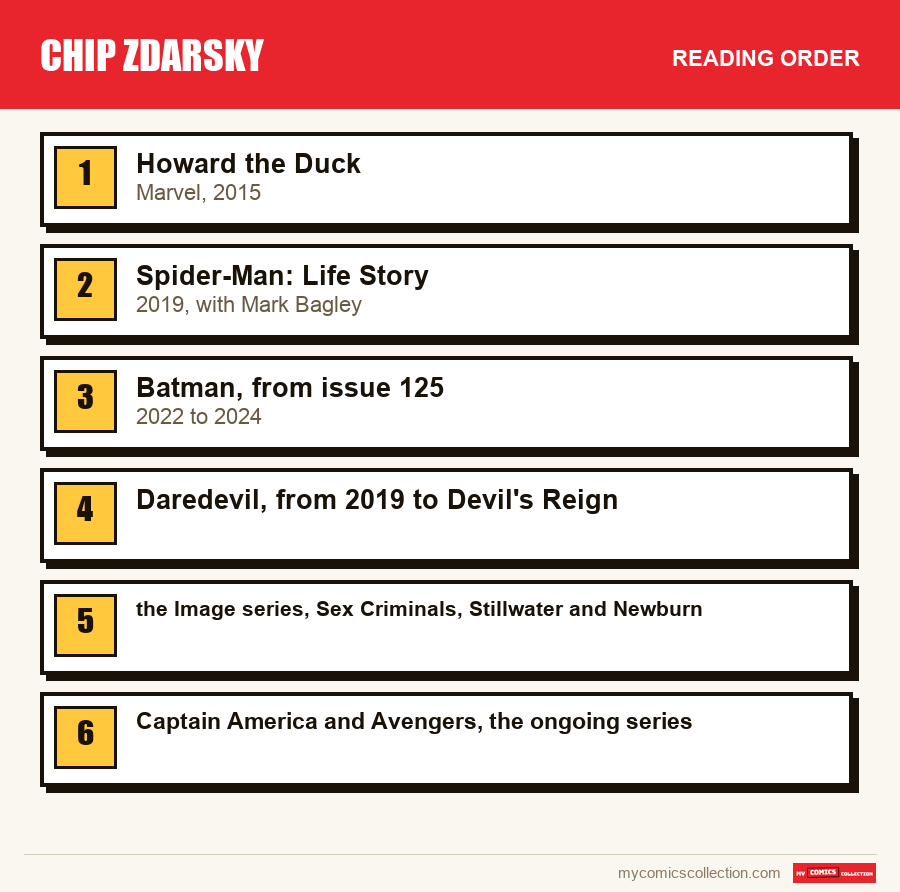
To read Chip Zdarsky, start with Howard the Duck (Marvel, 2015) or Spider-Man: Life Story (2019, with Mark Bagley). Move on to the Batman run (issues 125 to 150, 2022 to 2024), then the Daredevil run (from 2019, through Devil's Reign). Save the adult Image series Sex Criminals, Stillwater and Newburn for last, followed by the ongoing Marvel titles.
Chip Zdarsky holds a rare spot in comics: a creator who can write a cynical duck comedy, a sixty-year Spider-Man epic, an anxious Batman and a Daredevil on trial, then pick up the pencil on an Image series where biting humor sits next to intimate storytelling. The path laid out here runs from the most approachable title to the most demanding, for a reader who has not yet opened anything by Zdarsky.
As always in this guide, only verified facts (creators, issue numbers, dates) are stated as fact; the analysis is our own, with no reproduction of protected pages or dialogue.
What to look for in Zdarsky, and what changes from title to title
Zdarsky almost always writes from a mechanism of pressure: a character is placed in a situation that forces them to justify themselves, lose a support or admit a mistake. On Daredevil, it is the trial and life in hiding. On Batman, it is the debt owed to the people around Bruce Wayne. In Sex Criminals, it is shame as a comic engine. The subject changes, the tension stays the same.
A second landmark is the art. Zdarsky is not only a writer: on Sex Criminals, a series written by Matt Fraction, Zdarsky draws the pages. That double practice explains the sense of visual rhythm in the scripts, which leave plenty of room for silences and reaction shots. For a comics reader, that is an asset: the series read quickly but reread well.
The site does not yet have a biographical article on Zdarsky. To place the move to Marvel, the most useful piece is our history of Daredevil, which explains where the character Zdarsky takes over in 2019 comes from. The rest of the guide follows the logic of a progression: enter through what reads on its own, finish with what assumes an established taste.
Step 1: Howard the Duck (Marvel, 2015)
The easiest title to open is also the one where Zdarsky is at their lightest. The 2015 Howard the Duck series, drawn by Joe Quinones, brings back Marvel's sarcastic duck in adventures where realism is a joke. The duck dates from the 1970s; the 2015 series drops him into today's world, and a reader who has never opened a Marvel comic can dive in without a safety net.
What this step teaches about Zdarsky: a taste for mockery does not stop the construction of gags that have an internal logic. The issues are short and the series does not drag, so you can judge the writing without committing. If deadpan humor works for you, the rest of this path will make sense; if not, skip to step 2, which draws on a different vein.
Who is it for? The reader who wants an entry point with no continuity at stake, or who enjoys Marvel in a parody register. On the collecting side, a 2015 series weighs little on the market: pick it up for the pleasure of reading.
Step 2: Spider-Man: Life Story (2019, with Mark Bagley)
Life Story is the best demonstration of Zdarsky's method. Six issues drawn by Mark Bagley tell the life of Peter Parker in real time: each issue covers a decade, from the 1960s to the 2010s, so the hero ages from one to the next. The great episodes of Spider-Man's mythology are revisited through that lens, and you can see how already familiar events change meaning when they are placed end to end.
The reading does not require detailed knowledge of the character, but it is richer if you have skimmed a bit of his history. Our Spider-Man reading guide gives the useful landmarks, and the ranking of the best runs places the periods that Life Story flies over. The series does not replace those readings, it comments on them.
It is an excellent entry point for a reader curious about a more ambitious Zdarsky without having to commit to dozens of issues. Six single issues or one collected edition are enough, and the series reads in one sitting. For a collector, it is a recent Marvel miniseries: its value depends on demand and reprints.
Step 3: Batman, from issue 125 (2022 to 2024)
Zdarsky's Batman begins with issue 125, dated July 2022, and runs into 2024; check the contents of the collected editions for the exact issue that closes the cycle. The art is by Jorge Jiménez and Mike Hawthorne. The first cycle introduces Failsafe, a robot designed by Bruce Wayne to take on Batman himself, which sets up the theme of distrust from the start: the hero is his own opponent. The follow-up develops longer storylines around the Dark Knight's allies and former partners.
Twenty-six issues, more than the two previous steps combined: a little familiarity with Gotham helps. It reads in continuity with what came before in the series, that is, the James Tynion IV cycle. The ranking of modern runs explains where Zdarsky fits in that sequence, and the Batman reading guide helps you find the entry points. The art by Jorge Jiménez is worth a detour on its own.
For a collector: the first issue of the cycle, number 125, is the one the market follows most, because of Failsafe's first appearance. It is a recent issue, and its value is still to be built. Three factors will move it: what happens to Failsafe in the coming years, possible reprints, and possible variant covers, none of which we cite for lack of certainty.
Step 4: Daredevil, from 2019 to Devil's Reign
Zdarsky's Daredevil, launched in 2019 with Marco Checchetto on art, is the most cited work. Matt Murdock faces the consequences of past choices, and the series stages a trial, a criminal organization and a difficult relationship with faith. The cycle culminates in Devil's Reign, in 2021 and 2022, in which Kingpin becomes mayor of New York and bans masked vigilantes. That storyline gives the series a rare coherence: everything set up at the start pays off later.
We cover this period in several guides. The Daredevil reading guide gives the order of the series, the ranking of runs compares Zdarsky with Frank Miller and Brian Michael Bendis, and the best Daredevil arcs go through the stories one by one. For anyone who already knows one of the other two, Zdarsky reads as an extension that embraces the legacy.
This step is demanding: several dozen issues, tie-ins, an event. Read the first arc, called "Know Fear", first; if it hooks you, keep going without worrying about the spin-offs. It is perfectly possible to stop before the final event and come back to it later if the urge strikes.
Do you collect this series?
Track what you own, what you're missing and what your collection is worth. 7-day trial.
Start my trial →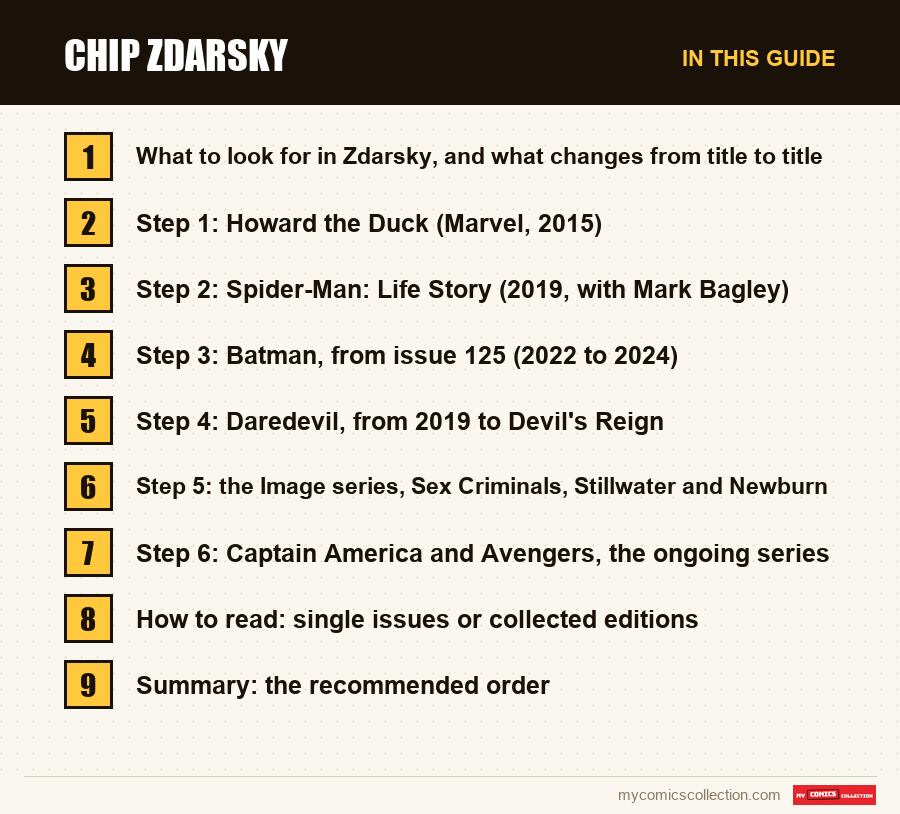
Step 5: the Image series, Sex Criminals, Stillwater and Newburn
The Image series are best read last, not because they are weaker, but because they are aimed at an adult audience and rest on different registers. Sex Criminals, launched in 2013, is written by Matt Fraction and drawn by Zdarsky. It blends comedy, romance and talk about intimacy, with a graphic inventiveness that draws on the artist's double role. It is the best door for seeing Zdarsky as an artist.
Stillwater (2020), with Ramón K. Pérez, and Newburn (2021), with Jacob Phillips, are series where Zdarsky writes the script. The first sets up a town where nobody dies, in a tone of suspense and fable; the second is a crime story led by an investigator in a city where the mob families share power. Both leave more room for ambiguity than the Marvel and DC titles, and Zdarsky is not held back there by any character brief.
These series read separately, in any order. They are meant for a reader already won over by Zdarsky's writing and ready to follow it beyond superheroes. Our guides to thirty years of Image Comics and to the key Image issues give the publishing context for these books.
Step 6: Captain America and Avengers, the ongoing series
The last step is the one that is not finished. Zdarsky has been writing Captain America since July 2, 2025, where Zdarsky brings in David Colton, followed by the new Avengers series, whose issue 1 is announced for November 4, 2026, drawn by Marco Checchetto. That is why this step stands apart: the whole cannot be judged yet, and each new issue changes how the previous one reads.
Our article Zdarsky's Avengers in 2026: what to read first details the lineup and the two readings that prepare the launch. If you follow this whole path, you will reach that series knowing Zdarsky's techniques, which lets you read the stakes rather than discover them. It is also the only step where you can take part in the release as it happens.
One piece of advice: do not draw conclusions too fast from an ongoing series. Zdarsky's stories pay off over several issues, and many effects only show in hindsight.
How to read: single issues or collected editions
The question plays out differently depending on the title. For Spider-Man: Life Story, a six-issue miniseries, the collected edition is the obvious choice: it gathers everything, shelves easily and saves you from chasing single issues. The same goes for Howard the Duck. The Image series, for their part, exist in bound volumes that reprint the single issues without changing the order, and they read comfortably that way.
The Batman and Daredevil cycles are longer. If you simply want to read, take the collected editions by arc. If you collect, the single issues of the launch numbers, 125 for Batman and 1 for the 2019 Daredevil, are the most sought after. Those launches date from 2019 and 2022: the market has not yet settled their level, which will depend on the lasting reputation of the two cycles and on future reprints. Do not buy a single issue hoping for a quick revaluation.
In every case, check in the catalog what a volume contains before buying it, because editorial groupings vary from one edition to another. For French editions, the split does not always follow that of the American single issues.
Summary: the recommended order
- Howard the Duck (2015): the comedy, with no continuity at stake.
- Spider-Man: Life Story (2019): six issues, one life across six decades.
- Batman, 125 to 150 (2022 to 2024): Failsafe and the cycle that follows.
- Daredevil (since 2019, through Devil's Reign): the most ambitious work.
- Sex Criminals, Stillwater, Newburn: the Image series, for adults.
- Captain America then Avengers: the ongoing series, to read without drawing conclusions.
If you only have one evening, read Spider-Man: Life Story. In six issues you will see Zdarsky's method: very familiar material, a simple rule of the game, and an emotion that comes from the passage of time.
Frequently asked questions
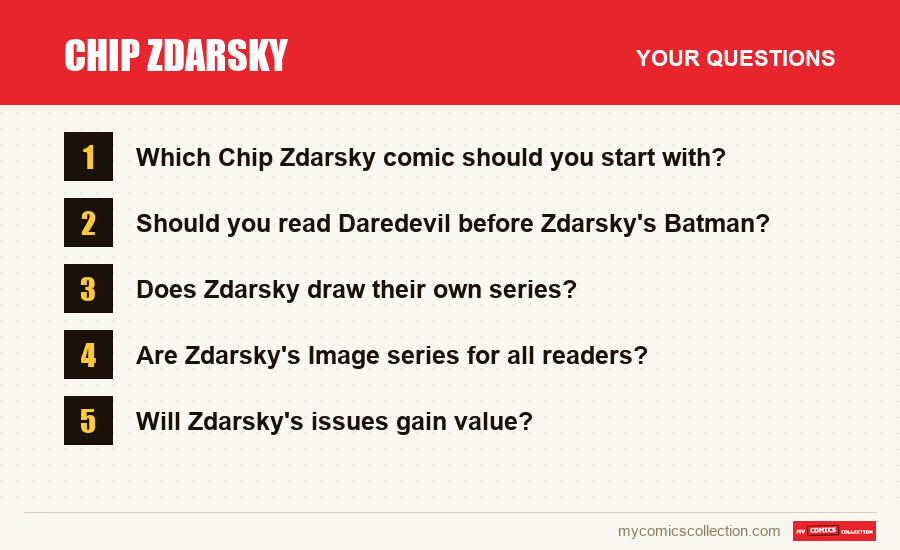
Start with Spider-Man: Life Story, six issues drawn by Mark Bagley in 2019, or with the lighter Howard the Duck. Both read without preparation, in a single sitting, and give a clear idea of Zdarsky's writing without requiring you to know the other series.
No, the two are independent. The Batman run, launched at issue 125, assumes a general familiarity with the character, not with Daredevil. Choose according to the character that draws you in. Readers of Matt Murdock will go to the 2019 Daredevil first, the others to the Dark Knight.
Sometimes. On Sex Criminals, launched in 2013 from a script by Matt Fraction, Zdarsky draws the pages. For Daredevil, Batman, Stillwater or Newburn, Zdarsky writes and other artists draw: Marco Checchetto, Jorge Jiménez, Ramón K. Pérez or Jacob Phillips depending on the title.
No. Sex Criminals, Stillwater and Newburn are aimed at an adult audience, with themes and language that do not suit young readers. Check the content before giving them as gifts or shelving them next to the youth titles in your collection.
There is no established value for these 2019 to 2025 single issues. Everything will depend on how long the series last, successive printings, variant covers and the demand around the Avengers series. Cycle launches attract the most buyers, while middle issues remain easy to find.
Do you own a Daredevil or a Batman signed by Zdarsky? Get a starting point for its value.
Estimate my comic