On the French market, the first adventures of Miles Morales do not appear in a magazine that bears his name: they are diluted in anthology magazines with generic titles, such as “Ultimate Universe” or “Ultimate Saga”. A statement carried out on August 30, 2026 on a French general auction site, in euros and not in dollars like most of the figures published here, shows 42 advertisements for the query “Miles Morales Panini”: minimum €5.00, median €16.00, maximum €172.90, and no copy verified by an independent organization. The five cheapest ads are all anthology booklets whose title does not contain the character's name: it only appears later in the wording, when the seller thought to write it. These amounts are asking prices on a single date, not completed sales.
There is a category of buyers who leave empty-handed after a fruitful search: those who type in the name of a recent character and conclude that their French editions do not exist, or that they cannot be found. The case of Miles Morales is telling, because the gap between perception and reality is maximal. The episodes exist in French, there are many of them, and they cost the price of a sandwich. They are simply not placed where intuition seeks them. The title of the French publication is neither the translation of the American title, nor the name of the hero: it is an anthology title, chosen by the French publisher to bring together several series in the same monthly issue.
This particularity is not a seller anomaly nor a cataloging defect. This is a direct consequence of the French newsstand editorial model, where a single magazine carries several American serials in a row. The French reader in the years concerned did not buy “the Miles Morales series”: he bought an issue of the magazine, and found this character among others. Fifteen years later, this logic turns against the second-hand buyer, whose search tool works by words in the title. Understanding this gap means accessing an abundant and cheap supply that most searches miss.
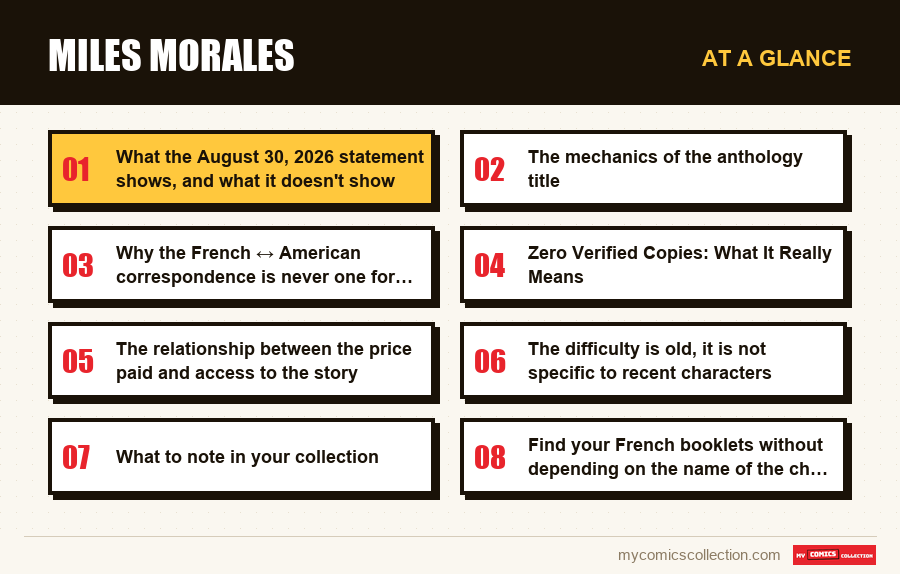
What the August 30, 2026 statement shows, and what it doesn't show
Let's start by framing the measurement, because it's out of the ordinary on this site. The statements published here almost always relate to the American market and are expressed in dollars. This relates to the French market and is expressed in euros. The two markets do not have the same depth, nor the same sales habits, nor the same price expectations: no direct comparison between an amount recorded here and an amount recorded across the Atlantic would make sense. The reader who compares must keep this boundary in mind in each line.
The query “Miles Morales Panini” returns 42 ads. The lowest amount requested is €5.00, the median value is €16.00, and the highest amount is €172.90. These three figures describe a wide distribution: between the floor and the ceiling, the ratio exceeds thirty. Such a spread is the usual sign of a heterogeneous whole, where very different objects coexist under the same request: isolated fascicles, lots, bound editions, various states of conservation.
The maximum of €172.90 deserves an explicit warning. A single amount at the top of a listing is not a market price: it is what a single seller hopes to get, posted with no guarantee that anyone will ever come close to it. It says nothing about the value of other copies and should never be used as a reference. The median at €16.00 is much more resistant to extreme values: it describes the real middle of the offer.
Finally, a point that this type of survey cannot cross: the measurement was taken only once, on August 30, 2026. A single photograph does not record any movement. It would therefore be wrong to write that these prices rise, fall or stabilize: the data necessary to assert this, that is to say a second measurement on another date, simply does not exist. And these amounts are those claimed in the advertisements, not completed transactions: between the two, there is the negotiation, the unsold item, and the advertisement which remains online for months.
The mechanics of the anthology title
The title of the magazine does not name the hero
“Ultimate Universe”, “Ultimate Saga”: these titles designate an editorial line, not a character. Miles Morales is inside, never on the cover in the sense of the publication title. A search engine that compares words cannot therefore make the connection alone.
The name survives in the body of the wording
In the advertisements noted, the name of the character appears after the title and the number: “ULTIMATE UNIVERSE # 2 July 2012 SPIDER-MAN MILES MORALES NEW GENERATION X-MEN”. It was the seller who added it, on his own initiative. Nothing forced him to do so.
Several series in the same issue
The labels list franchises side by side. A single French issue therefore contains several distinct American serials. The purchased item is not an episode: it is a periodical collection.
The title changes, the subject continues
Two different titles appear in just the five cheapest ads. The name of the magazine evolved over the years while the content continued in the same vein. How many titles followed one another and in what order, this statement does not say, and one should not guess.
The most instructive detail lies in a simple observation: of the five cheapest ads in the survey, four explicitly carry the name “MILES MORALES” in their wording. In other words, search by name works here, but it works by accident, thanks to the diligence of sellers who took the time to detail their content. The fifth ad, that of "ULTIMATE SAGA #1", also mentions the character, which gives a high mention rate in this sample. There is no guarantee that this rate will be maintained elsewhere. A rushed seller who simply wrote "Ultimate Universe 4 Panini" would offer exactly the same content, and would remain invisible to any search by character name.
This phenomenon is not specific to a character or an editor. As soon as a publication bears a collection title rather than a series title, the search index loses the link between the object and its contents. The practical consequence is always the same: the offer appears rare even though it is simply poorly labeled.
The solution consists of searching by the title of the magazine and its number, not by the name of the hero. This requires knowing this title: which is precisely the knowledge that searching by name does not provide. Hence the interest in noting the exact title from the first purchase, and never again starting from the name of the character afterwards.
Why the French ↔ American correspondence is never one for one
A query by name misses the offer
The character's name does not belong to the title of the French publication. Any search based on this name therefore depends entirely on the seller's description, not the item's metadata.
Two superimposed calendars
The advertisements noted bear French dates (July 2012, November 2012, January 2013, May 2013) which are those of the French magazine, not those of the original American publication. Confusing the two distorts any chronological identification.
Two titles for the same subject
“Ultimate Universe” and “Ultimate Saga” coexist in the same statement. A collector who only knows one of the two titles believes he has looked at an offer of which he has only seen part.
One booklet, several franchises
The labels cite several series in the same issue. We do not buy an isolated episode but a whole, only part of which is of interest to those who follow a specific character.
The numbering does not transpose
The number carried by the French review belongs to this review and to it alone. It does not refer to any American number in particular, since the same issue aggregates several from different series.
Reading continuity is broken
Following a serial requires purchasing consecutive issues of the magazine, each of which provides a few pages of the story in question and many pages from other series. The reading pace is not that of the original series.
This list outlines a broader rule than the present case: as soon as a national market republishes under its own titles, the identity of an issue ceases to be portable. The only reliable reference becomes the pair “title of publication + number”, completed by the local publication date. Any reasoning that starts from the American number to deduce a French equivalent produces false connections, and these false connections then propagate into personal inventories, where they are very difficult to detect after the fact.
Zero Verified Copies: What It Really Means
Of the 42 announcements in the survey, none concerns a copy passed into the hands of an independent verification body. This figure of zero is not a deficiency, it is information in itself: at this price level and in this segment, certification is not current. The cost of the process would far exceed the amount requested for the object, and the question therefore does not arise: neither for the seller nor for the buyer.
A practical consequence must be drawn from this. In a market without verified copies, the condition is described by the seller, with his words and photos. The assessment remains subjective on both sides. This is nothing dramatic for a newsstand issue purchased for five or six euros: no one expects a 2012 magazine to be impeccable, and the price already takes into account this uncertainty. This becomes more difficult as we approach the top of the distribution, where the difference between two state assessments weighs a significant part of the sum requested.
Another point deserves to be made clear: 42 announcements is not a huge number, but it is enough for a median to make sense. On the other hand, as soon as we divide this whole into subgroups (by journal title, by year, by state) the numbers become too small to support the slightest conclusion on a price level. The survey provides five low announcements identified by name; five listings do not constitute a deal, they constitute an example. They serve to illustrate the mechanism of the anthology title, not to establish a reference price for this or that issue.
Collecting this series?
Track what you own, what you are missing and what your collection is worth. 7 day trial.
Start my trial →The relationship between the price paid and access to the story
Five to six euros: this is the entry ticket observed in this statement for a French booklet containing these episodes. For a reader whose goal is to read, the proposition is hard to beat. The story is in French, the review contains several others, and the amount remains in the order of an inconsequential expense. The comparison with the original American booklet is not even of the same order of magnitude: the latter comes from another market, another currency, and a demand for collection which has no equivalent here.
This dissociation between the price of the collectible and the price of access to the text is one of the most useful things to understand when starting out. Many collectors are convinced that you have to own the original edition to know a story. This is to confuse two distinct needs, which have two distinct markets and two unrelated price scales. The curious reader does not need the rare booklet; he needs a readable edition in his language. On this point, French anthology journals provide a considerable service, and their invisibility in research is precisely what prevents us from seeing it.
This reasoning is found, in another form, in everything that was distributed in large numbers and then forgotten: what circulated widely at the time is found today in abundance and at low prices, while what was rare remains the same. The subject is developed elsewhere on this site about this character, in what was free is resold today, and the logic extends far beyond a single hero.
The difficulty is old, it is not specific to recent characters
One might believe that this matching problem mainly concerns creations from the last fifteen years, which are still poorly indexed. This is incorrect. Old French publications posed exactly the same difficulties, and often with greater intensity: titles invented locally, order of publication rearranged, episodes cut up or grouped differently than in the original version. Anyone who has tried to reconstruct continuity from old French editions knows this feeling of a puzzle where the pieces do not come from the same box.
For the reader who wants to find their way in the long history of the spidery character and its variations, two background resources help to separate the American series from its local presentations: the history of the Amazing Spider-Man series for the overall plot, and the Silver Age numbers guide for the period when the differences between original edition and national reissues are the most marked. These two benchmarks allow you to know what you are looking for before wondering under what title to look for it.
The transversal lesson is simple to state: the identity of a booklet must always be established from the object in hand, never from the story it contains. The same story can exist under five different guises in five countries; a given object has only a title, a number and a date. Recording the object, not the story, is the only method that stays true over time.
What to note in your collection
The exact title of the French magazine and its number.“Ultimate Universe” No. 2 and “Ultimate Saga” No. 1 are two distinct objects, even if they publish related material. Note the spelling as it appears on the cover, without translating or abbreviating it, and the number as it is printed. This is the only key that will allow you to find the object in a future search, since the character's name does not appear there.
The list of American series contained in the booklet. The labels noted cite several franchises side by side in the same issue. Record them all, not just the one that interests you: this is what will prevent you from accidentally repurchasing an issue you already have because it was presented to you under another franchise, and this is what will allow you to know which series you are really following.
The month and year of French publication. July 2012, November 2012, January 2013, May 2013: these dates appear on the booklets noted and belong to the French magazine. Save them as is, and above all never replace them with the American date of the story. It is the local date that orders your French collection, and that alone.
The French publisher of the publication. The query that returns these ads associates the name of the character with that of the French publisher, and it is this pairing that works best. Note this publisher for each issue: when the same content is reproduced later under another format, it is often the mention of the publisher which makes it possible to distinguish the first publication from a later reproduction.
The price actually paid, including shipping. On booklets costing €5.00 or €5.99, shipping costs sometimes weigh as much as the item. A purchase amount noted without shipping gives a false view of what the collection cost, and makes any honest comparison between an individual purchase and a lot impossible. Record the total charged, not the displayed price.
Because the French publication is not a series dedicated to a hero, but an anthology magazine which brings together several American series in each issue. Its title designates the entire editorial group, not one of its serials. The name of the character only appears in the description written by the seller, when he has taken the trouble to detail the content.
The statement of August 30, 2026 on a French general auction site gives, for 42 advertisements in euros, a minimum of €5.00, a median of €16.00 and a maximum of €172.90. These are amounts claimed on this date only, not sales concluded. The cheapest copies, all anthology magazines, cost between €5.00 and €5.99.
No. The labels noted show that the same French issue contains several American series at the same time. The correspondence is therefore never one for one, and the number printed on the French magazine only belongs to that magazine. You must think in terms of “title of publication + number + French date”, never by transposing an original number.
The question does not arise: of the 42 announcements in the statement, none concerns a copy passed by an independent verification body. At these price levels, the process would cost much more than the item itself. The condition is therefore described by the seller, and this is the accepted standard in this segment.
No, and you shouldn't try. This statement relates to the French market and is expressed in euros, while the majority of figures published on this site come from the American market and are expressed in dollars. The two markets do not have the same depth of offer, nor the same sales habits. Each amount must remain read in its original market.
Find your French booklets without depending on the name of the character
Recording the exact title of the magazine, its number, its French publication date, the series it contains and the price paid, including shipping, gives you the means to find an object that a search by name does not bring up. My Comics Collection allows you to keep this precise inventory, issue by issue, and spot at a glance the gaps in a series followed in anthology review.