The statement of August 30, 2026 on the request « Miles Morales Spider-Man 1 2016 » of an American general auction site reveals, among the five cheapest offers, a promotional preview whose wording bears the word « gratuit »: Marvel Free Previews Civil War II #1 (NM/MT 9.8) Spider-Man Miles Morales 2016, at $3.99. This amount is exactly that claimed for two booklets sold on newsstands and for an offer of your choice from stock. All of these values are amounts requested by sellers on a single date, not completed transactions: 149 unverified listings (minimum $3.99, median $20.00, maximum $600.00) and, counted separately, 31 listings of verified copies (minimum $29.95, median $175.00, maximum $1,500.00). Practical consequence: an object distributed without compensation has never had a cover price, therefore no reference to its origin, and it must appear in a collection with explicit mention of its method of distribution.
Publishers have long produced printed materials intended to be given away. Promotional previews, previews of an upcoming series, sample books handed out in specialized bookstores: these objects circulate without anyone going to the checkout. They are not gifts in the strict sense, since they serve a specific commercial objective, to raise awareness of a title before it goes on sale, but from the point of view of the person who takes them, they are free. Nothing materially distinguishes them from an ordinary booklet: same format, same paper, same stapling, same publisher logo on the cover. The only difference is the absence of a number printed in the upper corner.
Years later, these same objects reappear in advertisement statements, lined up in the middle of the issues sold on newsstands, without anything in the presentation signaling their particular status. Anyone who browses a list of results sees titles that all look the same and amounts that all look the same. This is exactly what the statement described here shows, and this is where the problem lies that this article aims to dismantle: an object without an original price is an object whose displayed value cannot be related to anything.
What exactly the August 30, 2026 statement says
A clarification of method is necessary before any reading. The figures cited here come from a snapshot of current listings on a single date, on a general auction site in the American market. These are sums that sellers hope to obtain. None are closed sales. The distinction is not theoretical: a seller can hold a listing at $600.00 for months without ever meeting a buyer, and that listing will continue to weigh on the showing maximum as long as it remains online. An isolated maximum expresses a person's expectation, it does not note a level of exchange.
Second clarification: verified copies are counted separately. The 149 unverified listings have a minimum of $3.99, a median of $20.00, and a maximum of $600.00. The 31 verified copy listings show a low of $29.95, a median of $175.00, and a high of $1,500.00. Mixing the two sets would produce a meaningless average, since an object passed by a verification body and sealed in a box is no longer the same commercial product as a booklet described by its sole seller.
Third clarification, and it is essential: thirty-one advertisements constitute a modest number. On such a volume, a few very high or very low offers move the median without any underlying phenomenon being involved. This value of $175.00 deserves to be cited, it does not deserve to be made a reference. And since the reading was only done once, it shows no movement: there is nothing here to say that anything is going up, down or stabilizing. A single measurement describes a state, never a trajectory.
Four types of objects, one and the same amount
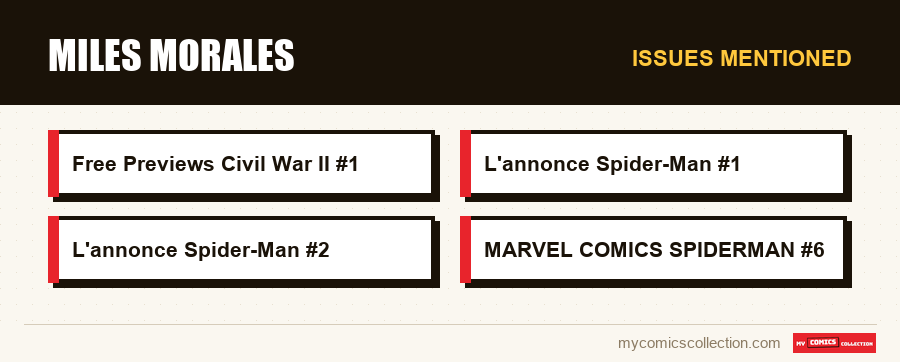
The most instructive fact in the survey is at the very bottom of the ladder, where no one is looking. Four ads are asking for exactly $3.99, and these four ads are for radically different things.
A promotional preview: $3.99
L'annonce Marvel Free Previews Civil War II #1 (NM/MT 9.8) Spider-Man Miles Morales 2016. The wording contains the word “free”, spelled out, in the very name of the publication. No one paid to get it originally; the object is no less resalable, and here it is on the market.
A booklet sold on newsstands: $3.99
L'annonce Spider-Man #1 Miles Morales (Marvel 2016). A serial opening number, distributed through the usual commercial channel, with a printed price and an original buyer. Perfectly ordinary object, and yet claimed at the same amount as the preview.
A second booklet: $3.99
L'annonce Spider-Man #2 VF+ 1st Printing […] 2016. The seller mentions a first printing and a declared condition. These mentions, which elsewhere serve to justify a price difference, produce none here: the amount remains stuck to the floor.
Access to stock: $3.99
L'annonce U Choose SPIDER-MAN related comics Part 1 […]. It is not an identified object but an offer of choice: the buyer designates what he wants in a lot. We no longer sell a number, we sell a direct debit right.
A fifth ad completes the picture at $4.64: MARVEL COMICS SPIDERMAN #6 & 9 […] (2016) 1ST PRINT, or two numbers grouped together. In other words, at this level of the scale, doubling the number of objects adds sixty-five cents. The conclusion is self-evident: what the buyer pays at $3.99 or $4.64 is no longer the content, it is the gesture of shipping. The price of the object was absorbed by the cost of handling it, and the market ceased to distinguish anything.
The floor of an ad statement is not the price of the least desirable items. This is the threshold below which a seller ceases to find any benefit in packaging, postage and tracking a package. Anything worth less than this threshold clumps there, whatever its nature.
This is why observing four categories of objects at the same amount does not indicate any market anomaly. On the contrary, it signals that we have fallen below the level where the market still makes differences. The lesson goes well beyond this character: it applies to any recent title whose print run has been widely distributed.
A free object has no origin marker
A sold booklet carries a cover price. This printed figure is anchor data: it says what the publisher estimated to be able to ask for at the time of going on sale, and it allows anyone to measure, later, the gap between this starting point and what is demanded today. We can debate the relevance of this comparison, but it exists and it is available.
A promotional preview is nothing like this. There is no number printed, because there was no initial transaction. The object entered the world without being valued. When it resurfaces in an ad listing at $3.99, that amount cannot be related to any previous point: there is no multiple, no percentage, no “times the cover price.” The displayed value floats alone.
We sometimes read that it would be shocking to resell an item received for free. This judgment has no basis. The free charge concerned the first discount, not the following ones; the publisher got what he was looking for-the attention of a potential reader-and the object eluded him the moment he walked through the bookstore door. What circulates next is a perfectly ordinary second-hand market. The problem is not moral, it is descriptive: no one knows what to compare the requested amount to.
This lack of benchmarks explains why promotional previews are particularly difficult to evaluate. On a sold booklet, a disagreement between buyer and seller concerns a margin around a known base. On a free object, there is no basis: the disagreement is total, and everyone defends a figure taken from their own reasoning. This is as true for old publications as for recent ones, and this is one of the reasons why the editorial history of a long series is always easier to read than its promotional annexes.
Why these objects are found in perfect condition
The preview ad is marked as very high condition, near mint. It would be tempting to see this as a rarity. It's the opposite.
A booklet purchased at a newsstand is purchased to be read. It is open, the spine is marked, the corners are rounded, the paper takes fingerprints. It is an object whose intended use degrades its condition. A promotional preview is taken because it is there. The reader slips it into his bag with his purchases, brings it back, and puts it away without necessarily opening it: since he did not choose it, he had no reading intention with regard to it. The object therefore goes directly from the library pile to the storage box, without going through the step that would have damaged it.
This results in a structural characteristic of this category of prints: copies in very good condition are abundant. Not because they were taken care of, but because they were never used. An exceptional condition which, on a booklet read and reread, would testify to careful conservation here testifies to nothing at all. It is the ordinary condition of the object, not a distinction.
The practical consequence is direct: the mention of a high condition in a promotional preview announcement provides almost no information and does not justify a price difference. It describes the general case. No diffusion figures are available here to quantify this phenomenon, and there is no question of inventing one; but the mechanism is deduced from the mode of distribution alone, and it applies to any printed matter given without compensation.
What happens to the median when you mix everything
The 149 unverified listings yield a median of $20.00. This figure has the reassuring appearance of a solid midpoint: half of the sellers ask for less, half ask for more. The problem is not in the calculation, it is in what we threw in the bag before calculating.
This median aggregates objects that have no common measure. It mixes a promotional overview without an original price, series opening numbers sold on newsstands, current issues of the same series, lots bringing together two issues and offers of your choice which do not designate any specific object. Adding all of this up and then finding the midpoint amounts to calculating the average size of a set made up of furniture and tools: the result exists, it doesn't provide information on anything.
The median only becomes usable again after sorting. We must exclude anything that is not a booklet sold individually: offers of choice, bundles, and promotional items. What remains can then be compared to itself. This cleaning operation precedes any encrypted reading, and it explains most disagreements between two people who look at the same screen and draw opposite conclusions: one has sorted, the other has not. This is exactly the mechanics described when two distinct segments produce the same median even though they have nothing to do with each other.
The same vigilance is required on the verified side. The 31 listings for copies passed by a verification agency show a median of $175.00, well above. This gap does not measure the intrinsic quality of the objects: it measures the cost and the filter of the verification itself, which is only undertaken on what the holder deems worthy of the expense. And out of thirty-one advertisements, the number remains too small for us to derive a reference price level. We have to say it, and stop there.
Collecting this series?
Track what you own, what you are missing and what your collection is worth. 7 day trial.
Start my trial →Six cataloging pitfalls specific to promotional items
The wording doesn't give anything away.
Nothing in the way an ad is written requires a seller to indicate that they are offering a promotional preview. Here the word “free” appears because it’s part of the publication’s name, luckily. Elsewhere it will not appear.
The year alone separates nothing
The overview and the booklets noted bear the same year. Filtering on a date therefore does not allow one to be isolated from the other: the promotional publication is contemporary with what it announces, this is even its reason for being.
High state misleads
Almost new condition on this type of object is the norm and not the exception. To credit a particular example is to highlight a characteristic shared by almost all survivors.
Lots confuse counting
An ad with two numbers at $4.64 enters the statistics as a single line. The actual unit price doesn't appear anywhere, and the median doesn't know it.
Choice offers have no subject
An ad that lets the buyer designate their part in stock does not include any identifiable number. However, it occupies a line in the statement, with an amount, as if it were describing a copy.
La numérotation se recouvre
A preview can bear a number 1 just like the booklet it announces. Two different objects with the same number on the cover, the same year and the same character: the confusion requires no effort to settle down.
What to note in your collection
Create a separate line for the promotional preview. An item distributed for free is not a variation of the number it advertises, nor a duplicate of it. It deserves its own recording, with its full title as it appears on the cover. Grouping it with the booklet sold destroys the information at the very moment it is entered, and it is never reconstituted afterwards.
Enter the distribution method in the form. This is the decisive mention, and it’s the one we forget. Without it, the line will say « Spider-Man, numéro 1, 2016, état quasi neuf »: a perfectly accurate description, and a perfectly misleading one. We will believe we have a serial number when we actually have an advertising item. The opposite error occurs just as much: classifying a real number 1 among promotional items out of an abundance of caution, and lastingly underestimating what you have.
Do not report an amount recorded without its label. If an indicative value is noted, it must come with its statement date, its source, and the clarification that it is an amount claimed by a seller and not a successful sale. The $3.99 and $20.00 quoted here are not prices: they are requests made on August 30, 2026. A note lacking these three attributes becomes, in a few months, a statement whose origin no one can anymore verify.
Separate the verified copies into a separate field. An object sealed after passing through a verification body does not align with an example described by its holder, and the two populations should never be averaged together. The sheet must therefore be able to say which of the two cases applies, otherwise any subsequent calculation on the collection will mix two distinct markets.
Mark lots and offers of choice as such. An entry resulting from a grouping of two numbers, or from an offer where the buyer has designated his part, has no known unit price. Recording the overall amount on each line mechanically inflates the declared value of the collection. It is better to enter the amount on a single line and mark the others as coming from the same group purchase.
A sorting method applicable to any statement
What the case described here teaches goes well beyond one character and one year. When faced with any list of announcements, four actions are required in this order.
First step: read the labels at the bottom of the scale, not those at the top. The top of a statement catches the eye because it bears the big numbers, but it is populated with unverifiable individual hopes. The bottom reveals the real composition of the offer: it is by going down that we discover that a promotional overview, two ordinary booklets and access to a stock coexist at the same amount.
Second gesture: classify each line by nature before looking at its price. Unique item originally sold, unique item distributed free of charge, lot, offer of your choice. This typology takes a few minutes and makes most hasty readings harmless.
Third action: count how many lines remain after sorting. If the number drops below ten, we must give up trying to derive a price level and say it frankly. A small number of ads becomes unreliable because the median is carefully calculated.
Fourth gesture: refuse to conclude on a trend. A single statement describes a situation at a given time. It says nothing of what comes before or what follows, and no amount of skillful wording will turn a photograph into a film. To compare, it would take two measurements separated in time, carried out in the same way. This caution is the same as that required when reading old series, where the landmarks of a founding period were built on decades of repeated observations, never on a snapshot.
What is the point, ultimately, of knowing all this?
A collector who correctly identifies their promotional items wins three things. He stops overvaluing his collection by counting prints that are not opening numbers as opening numbers. He symmetrically stops selling off pieces that he thought were secondary. And above all, it makes its inventory readable by someone else (an heir, a buyer, an insurer) without that person having to redo all the identification work.
Conversely, an inventory that does not distinguish between these objects produces a false declared value in both directions, and no one knows which way. This is the worst case: an error whose sign we don't even know. No spreadsheet, no software can correct this after the fact, because the missing information was never entered. It was only found on the object, when it was held in hand.
The useful gesture is therefore tiny and is done only once: open the card, write where the object comes from, close it. Thirty seconds at the time of recording saves lasting confusion. And this discipline, once taken from the promotional previews, is transposed as is to all other publications which are not chapters of history: supplements, reissues, special editions, anniversary issues. It's always the same questions: what exactly is it, how did it get there, and what can I compare it to.
Yes, and the question does not arise any other than for any second-hand item. The free charge covered the first delivery in bookstores; the publisher had then obtained what he was looking for, namely the attention of a potential reader. What happens next is a matter of ordinary secondary trading. The real subject is not the legitimacy of the resale but the evaluation: without a printed cover price, the amount requested cannot be compared to any starting point.
Because at this level, the value of the contents has become lower than the cost of handling. Wrapping, postage and tracking a package represents a fixed expense that does not depend on what the envelope contains. The amount requested then stops describing the item and starts describing the shipping. The statement also confirms this with a telling detail: going from one issue to two adds sixty-five cents.
Much less than you might think, because it is the most common state for this type of print. An object taken without having been chosen is rarely read: it passes from the bookstore to storage without the use which would have damaged it. A high state therefore describes the general situation here rather than remarkable conservation. No diffusion figures make it possible to quantify this phenomenon, but its mechanism arises from the mode of distribution alone.
No, and for a purely arithmetic reason: it is based on thirty-one announcements. On such a thin squad, two or three exceptionally high offers are enough to move the midpoint without any fundamental movement occurring. This value can be cited as an observation, never used as a benchmark. Added to this is a second limitation: the reading having only been done once, it says nothing about what this figure was worth before nor what it will be worth afterwards.
By reading the full title rather than the amount, and being wary of the mental shortcut that associates a number on the cover with a serial opening number. In the statement described here, the wording fortunately contained the word "free", but nothing requires a seller to be this transparent. When in doubt, the only reliable route is to check the exact title of the publication in the catalog, rather than relying on the character's name and year.
Keep track of what sets your copies apart
A file per object, the method of distribution recorded, the lots marked as such and the amounts recorded dated: this is what separates a readable inventory from a list of titles. My Comics Collection records each copy separately, with grades, condition and history, so you always know what exactly you own.