The Mephisto comics history begins with Marvel's demonic lord of Hell, who first appeared in Silver Surfer #3 (December 1968), created by Stan Lee and John Buscema and modeled on the Mephistopheles of the Faust legend. A tempter who bargains for souls, he is tied to the birth of Ghost Rider, to Infinity Gauntlet, to One More Day and to Damnation. He does not rely on brute force: he offers contracts, and that is what defines the character today.
In the gallery of Marvel's great villains, Mephisto holds a place of his own: he does not destroy worlds, he drafts clauses. That way of doing harm, through negotiation, lets him move through cosmic series, horror stories, Thor adventures and Spider-Man sagas without ever fully belonging to any of them. That is exactly what makes his bibliography hard to read in one sitting.
As always on this guide, only verified information (creators, issue numbers, dates) is stated as fact; the analysis is our own, with no reproduction of protected art or dialogue.
His first appearance
Mephisto bursts onto the scene in Silver Surfer #3, cover-dated December 1968. Stan Lee writes, John Buscema draws. The series, launched that same year, is still a testing ground: Lee has his silver hero speak as a philosopher in exile on Earth, trapped by the barrier Galactus raised around the planet. A character like that calls for someone who can talk to him about freedom, salvation and renunciation, and the demon arrives with exactly that function: he covets the Surfer's soul.
His name and silhouette come from the European tradition. His literary model is Mephistopheles, the tempter of the Faust myth, who trades knowledge for a soul. Marvel does not invent a monster here, it transposes a literary archetype into a superhero universe, with John Buscema's theatrical art. That origin explains his method: everything he gets comes through a deal, never through a simple fight.
For a collector, Silver Surfer #3 remains the reference for the character's entry into the Marvel universe. The issue sits within the 1968 series, so if you are completing that run, you pick up this first appearance without effort. Our page on the first issue of Silver Surfer describes the series that hosts it.
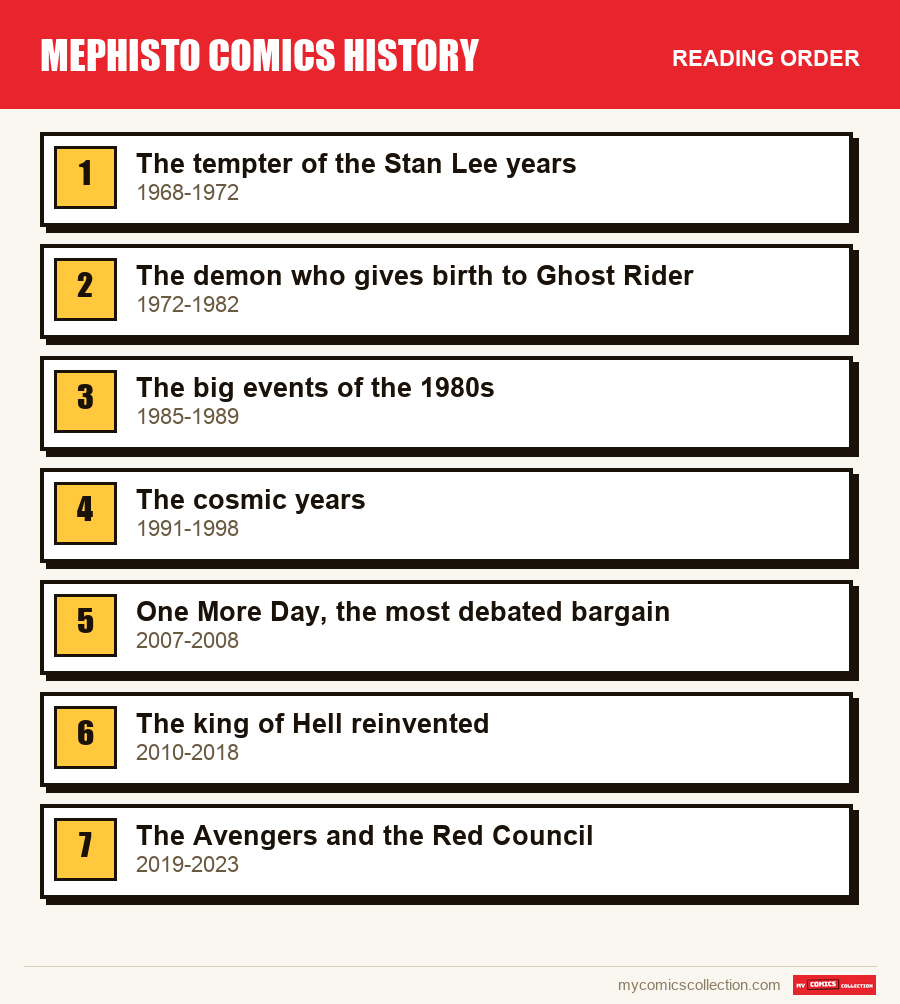
Era 1: The tempter of the Stan Lee years (1968-1972)
After his debut, Mephisto quickly returns to the series that introduced him. Two more rendezvous follow in the same title: issues #8 and #9, in the middle of 1969, then issues #16 and #17 in the spring of 1970, where the demon comes back for the Surfer. That fast recurrence shows Marvel understood the character's value: an antagonist who does not burn out in a single fight, because the stakes, the Surfer's soul, stay open from one appearance to the next.
The demon then leaves the cosmic setting to face the god of thunder. He appears in Thor #180 and #181 (September and October 1970), then in Astonishing Tales #8 (October 1971) and in Thor #204 and #205 (October and November 1972). This run of appearances sketches the character's first boundaries: Hell as a parallel realm where gods and heroes can be lured, a handy backdrop for Marvel to blend Norse mythology, horror and adventure.
Era 2: The demon who gives birth to Ghost Rider (1972-1982)
The decade turns in Marvel Spotlight #5, from August 1972, written by Gary Friedrich and drawn by Mike Ploog, with Roy Thomas among the co-creators. To pull Crash Simpson, his mentor, from cancer, the stuntman Johnny Blaze gives up his soul. The demon, who goes by the name Satan at this point, honors the letter of the pact: Crash escapes the disease but dies in a stunt. The soul broker then binds Blaze to the demon Zarathos, and Ghost Rider is born from that clause. Ghost Rider volume 2 #68 (May 1981) identifies this creditor as Mephisto, a reading Marvel later revisited.
For Mephisto, this is a change of scale. He is no longer just the tempter of established characters, he becomes the founder of a hero. The bond that ties him to Ghost Rider never breaks: every time the flaming biker returns to Hell, his creditor is waiting. Our page on Marvel Spotlight #5, the first Ghost Rider covers this issue from the collector's point of view.
Era 3: The big events of the 1980s (1985-1989)
Another field opens in 1985: the second The Vision and the Scarlet Witch series, twelve issues running into 1986, in which Mephisto is among the figures of the story. Steve Englehart handles the script, Richard Howell the art. The series follows a couple who stepped back from the Avengers to start a family; the demon's presence in those pages shows how far his reach now extends, all the way to intimate sagas.
The same period puts him in Secret Wars II, nine issues from July 1985 to March 1986. In 1987, the four-issue miniseries Mephisto vs. (April to July 1987), with art by John Buscema, gives him a title under his own name. Marvel entrusts the character to a short format, suited to an adversary you face for the length of one story.
Two other milestones of the decade deserve attention. In Daredevil #266 (May 1989), John Romita Jr. redraws Mephisto as a bloated, naked creature, far from the caped look of the Buscema years; this redesign goes with a darker tone. A few months later, John Byrne writes and draws Avengers West Coast #51 and #52 (November and December 1989), with Mike Machlan on inks. The demon returns there, proof that he now serves as a pivot for stories spanning several series.
Era 4: The cosmic years (1991-1998)
In early 1991, the Silver Surfer issues written by Jim Starlin, including #45 (January 1991), place Mephisto alongside Thanos, whom he feeds advice. These issues set up the Infinity Gauntlet miniseries, six parts running from summer to late 1991: Jim Starlin on the script, George Perez and then Ron Lim, who finishes it, on art. The demon plays the adviser who whispers in the Titan's ear rather than the main adversary. You will find this context in our guide to the history of Thanos in comics.
The Surfer remains his favorite opponent: in Silver Surfer volume 3, issues #133 to #137 (November 1997 to March 1998) show him defeated by the silver hero. The loop is symbolic: thirty years after Silver Surfer #3, the series that introduced him beats him, a sign that Marvel kept hold of the thread between the original tempter and the hero who refused the deal.
Do you collect this series?
Track what you own, what you are missing and what your collection is worth. 7-day trial.
Start my trial →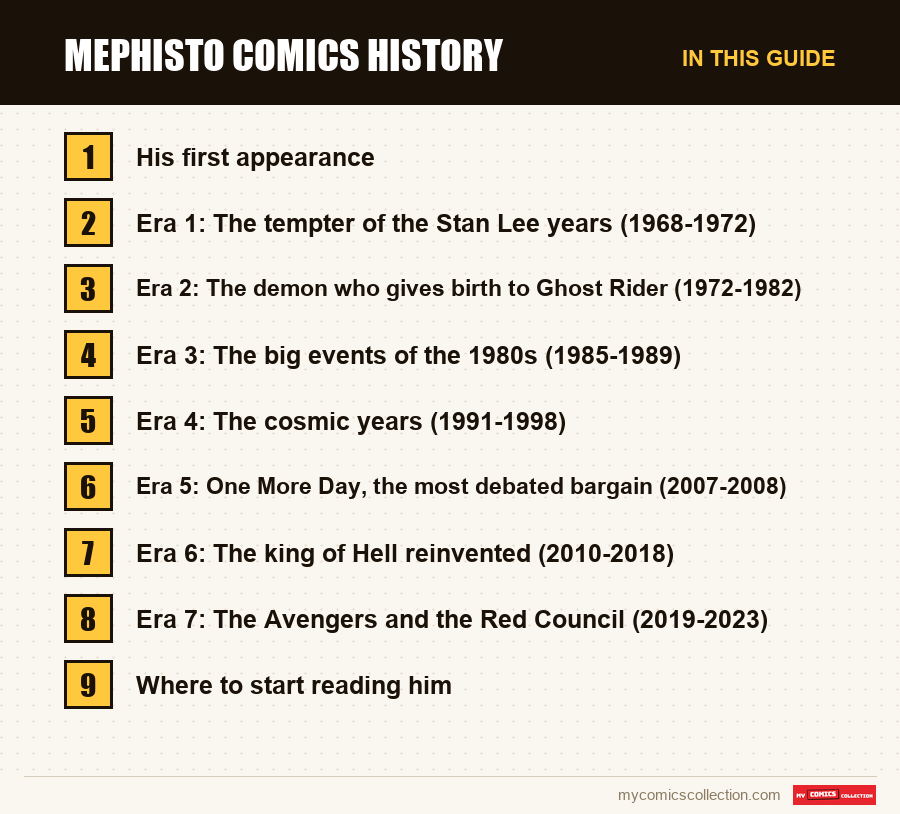
Era 5: One More Day, the most debated bargain (2007-2008)
Spoiler warning: what follows describes the ending of One More Day.
The arc runs through three series in four chapters. It opens in The Amazing Spider-Man #544, passes through Friendly Neighborhood Spider-Man #24 and The Sensational Spider-Man volume 2 #41, then closes in The Amazing Spider-Man #545, between late 2007 and early 2008. J. Michael Straczynski writes it, and Joe Quesada draws the whole thing and co-writes the final issue. Mephisto is the engine of the plot: he offers to save Aunt May's life, not in exchange for Peter Parker's soul, but for his marriage to Mary Jane Watson.
Peter and Mary Jane accept, and their union is erased from continuity. The demon also reveals that the little girl Peter met was their future daughter, who will therefore never be born. This is Mephisto's most famous intervention in the Spider-Man universe, and one of the most controversial in recent Marvel history: the deal touches neither a power nor a life, but an emotional bond that had structured the series for years.
For a collector, the arc is above all an editorial milestone: it opens the period of stories told after the marriage. Our guide One More Day: reading order lays out the four parts and what follows. To understand how the Peter Parker character evolves afterward, the history of Spider-Man in comics places this arc on the timeline.
Era 6: The king of Hell reinvented (2010-2018)
The 2010s put Mephisto back into major events. In the wake of Siege, he appears in Thor #611 and #612 (August and September 2010): he leases part of his realm to Hela, and Thor enters his domain to get the Eir-gram. With Fear Itself, he returns in Ghost Rider volume 7 #1 (September 2011) and then in Journey into Mystery #627 (November 2011), and his involvement continues in The New Mutants volume 3 #37 (April 2012), X-Factor #250 to #256 (March to July 2013) and Deadpool volume 4 #11 and #12 (August 2013). Our page on the Fear Itself reading order places these tie-ins within the event.
The high point of the period is Damnation (2018), a four-issue miniseries by Donny Cates and Nick Spencer, with art and colors by Rod Reis. After Las Vegas is destroyed in Secret Empire, Doctor Strange restores the city, and Mephisto claims it as part of his realm. He builds the Hotel Inferno, which corrupts its residents and turns several Avengers into creatures close to Ghost Rider, and he subjects Strange to the same transformation. The tie-ins are Doctor Strange #386 and following, Ben Reilly: Scarlet Spider #15 to #17, Iron Fist #78 to #80 and Johnny Blaze: Ghost Rider #1.
Spoiler warning: in this ending, Mephisto rips the Ghost Rider out of Johnny Blaze and throws him off a roof, which kills him; that death was part of Wong's plan. In Hell, Blaze claims the vacant throne and becomes king of Hell. The demon is beaten by Blaze and by Ghost Riders from across the multiverse, then chained at the top of the hotel under Wong's guard. This reversal makes Ghost Rider, a creature born of the demon's pact, the one who takes his place. Our page on Donny Cates collects his other work at Marvel.
Era 7: The Avengers and the Red Council (2019-2023)
The final cycle pushes the character toward Marvel's flagship team. In Avengers volume 8 #18 (June 2019), he strikes a bargain with Phil Coulson. The series is then written by Jason Aaron, and this return shows the demon remains useful to today's writers as a bargaining device: a team agent, an offer, a price to pay.
Between February and May 2022, Avengers volume 8 #51 to #54 feature the Red Council, where Mephisto takes part in the events. He also appears in Avengers Forever volume 2 #14 (April 2023), in Avengers volume 8 #66 (May 2023) and in the one-shot Avengers Assemble Omega (June 2023). You will find the writer of this run on our Jason Aaron page.
Where to start reading him
- The reader who wants the origin: Silver Surfer #3 (1968), then issues #8-9 and #16-17, to see how Lee and Buscema build a tempter out of a refused bargain.
- The Ghost Rider reader: Marvel Spotlight #5 (1972), then Damnation (2018), which makes Johnny Blaze the heir to the throne of Hell.
- The Spider-Man reader: the One More Day arc (2007-2008), in four issues, best read with the guide's reading order.
- The event reader: Infinity Gauntlet (1991), to see the demon as an observer of a cosmic saga.
- The Jason Aaron reader: Avengers volume 8 (2018-2023), for the character's latest period.
For a ranked selection of reads, our page on the best Mephisto comics offers another angle: here, the history follows the character's life, there, we rank reads.
The key issues to know
The safest collecting method relies on three tiers. The first is the first appearance: Silver Surfer #3 (December 1968), worth hunting down in good condition for its historical importance. The second is the group of issues that tie the demon to another hero: Marvel Spotlight #5 (August 1972), the foundation of Ghost Rider, and Thor #180 and #181 (1970). The third gathers the arcs that have become editorial landmarks: Infinity Gauntlet #1 to #6, The Amazing Spider-Man #544 and #545, and Doctor Strange: Damnation #1 to #4.
For each one, the rule is to compare several listings before buying, checking that the copy matches the right edition and reading the condition description. A first appearance is judged by its importance in the character's history; a recent arc is judged by its place in the continuity it opened. A tracking sheet of your purchases, issue by issue, prevents duplicates in a bibliography scattered across several series.
Frequently asked questions
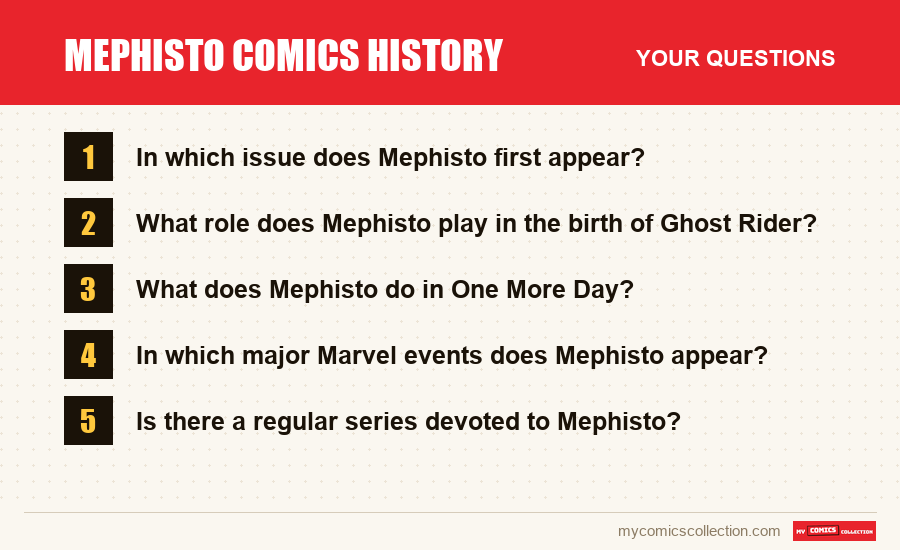
Mephisto first appears in Silver Surfer #3, cover-dated December 1968. Stan Lee wrote it and John Buscema drew it. The character is adapted from the devil of Faust. The issue belongs to the series launched in 1968, which many collectors complete in numerical order.
In Marvel Spotlight #5 (August 1972), Johnny Blaze sells his soul to save his mentor Crash Simpson from cancer. Mephisto, under the name Satan, honors the letter of the pact, then binds Blaze to the demon Zarathos, which gives birth to Ghost Rider. Gary Friedrich wrote this issue, Mike Ploog drew it.
Spoiler warning: the price of saving Aunt May is Peter Parker's marriage to Mary Jane Watson, not his soul. Both accept, and their union is erased from continuity. J. Michael Straczynski and Joe Quesada are behind the arc, published from late 2007 to early 2008.
You find him in Secret Wars II (1985-1986), in the Infinity Gauntlet lead-in in Silver Surfer #45, in One More Day (2007-2008), in Siege and Fear Itself in the early 2010s, then in Damnation in 2018, his most central role.
The character has had one miniseries under his own name, Mephisto vs., in four issues from April to July 1987, but he mostly appears as a guest in other titles: Silver Surfer, Thor, Ghost Rider, The Amazing Spider-Man, Doctor Strange, Avengers. To follow him, it is better to choose a reading thread than a single series.
Did you find Silver Surfer #3 or Marvel Spotlight #5 in your boxes? Get your copy appraised before deciding whether to keep it or sell it.
Appraise my comic