
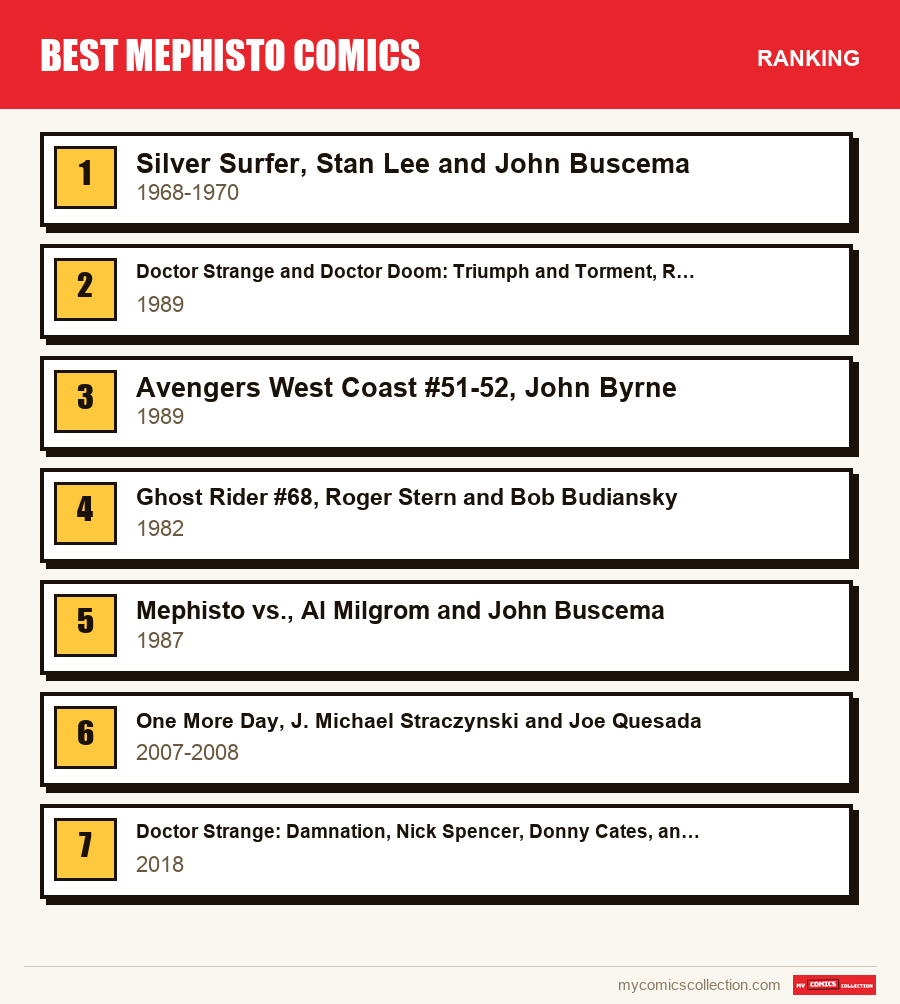
To read the best Mephisto comics, open the first Silver Surfer series (1968-1970), by Stan Lee and John Buscema: the demon makes his first appearance in issue #3, cover-dated December 1968. Continue with Doctor Strange and Doctor Doom: Triumph and Torment (1989), then Ghost Rider #68 (1982), which ties him to Johnny Blaze's pact, and One More Day (2007-2008) for his most debated version.
Mephisto is a demon who makes his mark without needing a series of his own: he moves from title to title, from Silver Surfer to Thor, from the Fantastic Four to Spider-Man, and each time he asks the same question, that of the price of a bargain. This scattering makes reading him bewildering, since no single run contains him entirely. Hence the value of a selection that isolates the stories where he truly weighs on the plot, and leaves aside those where he only appears in passing.
As always in this guide, only verified information (creators, issue numbers, dates) is stated as fact; the analysis is our own, with no reproduction of protected artwork or dialogue.
His first appearance
In the third issue of Silver Surfer (December 1968), Stan Lee writes and John Buscema draws the demon's arrival. The character is inspired by Mephistopheles, the devil of the Faust legend, and this literary lineage explains his vocabulary: souls, contracts, temptations. In this issue, he covets the Surfer's soul, kidnaps Shalla-Bal on Zenn-La, and tries to corrupt his adversary with wealth and pleasure. The Surfer resists, and Shalla-Bal is sent back to her planet.
On a reread, this first duel is surprising: facing the Surfer, Mephisto does not fight a battle of cosmic rays, he proposes a bargain, and the only possible answer is a refusal. This principle, a defeat that is not really one, will return in almost all of his later stories, because the demon often loses the battle without losing anything of what he is. To place this issue within the whole series, our page on the 1968 Silver Surfer series details its context.
1: Silver Surfer, Stan Lee and John Buscema (1968-1970)
Stan Lee writes all eighteen issues of the first Silver Surfer series, and John Buscema draws the pencils of the first seventeen. Mephisto returns in issues #8 and #9 (September and October 1969), then in issues #16 and #17 (May and June 1970). Taken together, these episodes sketch a long-running duel: the demon wants a soul, and the Surfer, exiled on Earth, has only his conviction as a defense. The series carries an unusual gravity for the Marvel of the late 1960s, and it is largely because of this adversary.
It is for the reader who wants to understand the foundations of the character rather than his modern versions. Read issue #3 first, then episodes #8-9 and #16-17 in order; the other issues shed light on the Surfer himself but are not essential for following Mephisto. The Silver Surfer reading guide offers a broader path.
2: Doctor Strange and Doctor Doom: Triumph and Torment, Roger Stern, Mike Mignola, and Mark Badger (1989)
This 1989 graphic novel, Marvel Graphic Novel #49, brings together two sorcerers who oppose each other more than they cooperate. Doom asks Doctor Strange for help in tearing his mother Cynthia's soul away from Mephisto's realm, where she is held. The story changes the usual balance of power: the demon is no longer the threat that comes to you, he is a soul owner whom you go and defy at home, in his own setting, with his rules.
The script is by Roger Stern, the art by Mike Mignola, with Mark Badger in the credits. For a collector, it is a standalone piece: a large-format volume, readable on its own, that shows Mephisto facing two characters equally proud. If you like stories where Marvel's antagonists are treated with moral stakes rather than simple fights, it is an excellent second choice after the Surfer. The artwork of Mike Mignola is worth a detour through his hub on its own.
3: Avengers West Coast #51-52, John Byrne (1989)
In this late-1989 two-parter, John Byrne writes and draws a story that goes to the heart of the Scarlet Witch. In the second issue, the West Coast Avengers go down into the underworld to save Billy and Tommy, the children of Wanda Maximoff, kidnapped by Master Pandemonium. Agatha Harkness channels a power through Wanda to push back Mephisto, and the story reveals that the two boys are made of fragments of the demon's soul. This revelation will have heavy consequences for the character of Wanda.
The two-parter is for the reader who already knows the Avengers and wants to see how an antagonist invites himself into a heroine's private life. It reads in the collected volume titled Vision Quest, which gathers issues #38 to #52 of the series. The Scarlet Witch hub places this episode in the character's trajectory.
4: Ghost Rider #68, Roger Stern and Bob Budiansky (1982)
Originally, Johnny Blaze's pact is presented in Marvel Spotlight #5 (August 1972) as concluded with the devil. It is Ghost Rider #68, cover-dated May 1982, that changes the game: Roger Stern, on script, rewrites that origin so that the other party is Mephisto, who supposedly passed himself off as the Christian devil. Bob Budiansky provides the pencils, Josef Rubinstein the inks. This issue is therefore the hinge between the demon of the Surfer's pages and the one who haunts the motorcyclist.
Who is it for? Anyone already following Ghost Rider who wants to understand why the character is tied to Mephisto. It reads in a single issue, without deep knowledge of the series, and it is worth as much for its role as a retcon as for the story it tells. The account of Ghost Rider's history places its importance within the series.
Do you collect this series?
Track what you own, what you are missing and what your collection is worth. 7-day trial.
Start my trial →
5: Mephisto vs., Al Milgrom and John Buscema (1987)
This four-issue miniseries, from April to July 1987, pits Mephisto against four teams: the Fantastic Four, X-Factor, the X-Men, and the Avengers. Al Milgrom writes, John Buscema, who had drawn his first appearance, provides the pencils and Bob Wiacek the inks. The setup is clear: one demon, four targets, a harvest of heroes' souls.
It is a lighter read than the previous ones, one that will appeal to the reader drawn to a short format and to Buscema's return. Fans of dense stories may find the premise a bit thin, but it has the merit of showing Mephisto as a crossover antagonist, usable by any team. It also shows a demon designed to take on several series at once.
6: One More Day, J. Michael Straczynski and Joe Quesada (2007-2008)
Four issues make up this arc: The Amazing Spider-Man #544, Friendly Neighborhood Spider-Man #24, The Sensational Spider-Man #41, then The Amazing Spider-Man #545. Aunt May is dying after being hit by a bullet; Peter Parker strikes a bargain with Mephisto, who saves her in exchange for his marriage to Mary Jane. J. Michael Straczynski writes the whole thing, and Joe Quesada draws the last chapter with Danny Miki on inks.
The arc is controversial, and you can read it without endorsing it: it is the moment when Mephisto leaves the cosmic and mystical universe to enter Spider-Man's daily life. The reader will find there the best-known version of the demon outside enthusiast circles, which makes it a possible entry point for anyone coming from Spider-Man. The Spider-Man hub offers the series to read before and after.
7: Doctor Strange: Damnation, Nick Spencer, Donny Cates, and Rod Reis (2018)
A four-issue miniseries, published from February to April 2018, Damnation is written by Nick Spencer and Donny Cates, and drawn and colored by Rod Reis. After the destruction of Las Vegas in Secret Empire, Mephisto claims the city's souls and builds the Hotel Inferno. He turns Doctor Strange into a creature close to Ghost Rider, possesses the Avengers, and tempts Ben Reilly. Johnny Blaze and Ghost Riders from several realities end up defeating him.
The series is the most recent of this selection, and it serves as the endpoint: it brings together Strange, Ghost Rider, and a demon who this time possesses an entire city. It is for the reader who knows these characters, and more particularly for fans of Donny Cates; the issues of Doctor Strange published in parallel extend the plot.
Where to start depending on your profile
You like Silver Age classics: read Silver Surfer #3 then issues #8-9 and #16-17, in order of publication. You come from Ghost Rider: start with Ghost Rider #68, then go back to Marvel Spotlight #5 to measure the gap between the 1972 origin and its rewrite. You mostly know Spider-Man: One More Day is the most direct door, but keep the Surfer for understanding where the demon comes from.
You prefer standalone stories: Triumph and Torment reads without preparation, like Mephisto vs., which fits in four issues. You follow the Avengers or the Scarlet Witch: John Byrne's two-parter in Avengers West Coast is made for you. You want a recent story: Damnation brings together Strange, Ghost Rider, and Mephisto in four issues. Whatever your profile, avoid reading the secondary appearances first: the character only reaches his full measure in the stories where he carries the plot.
The key issues to know
The obvious key is Silver Surfer #3 (December 1968), Mephisto's first appearance. Next come the turning points that change the character: Ghost Rider #68 (May 1982), which places him behind Johnny Blaze's pact, Mephisto vs. #1 (April 1987), Avengers West Coast #52 (December 1989), which ties the demon to the Scarlet Witch's children, The Amazing Spider-Man #545 (January 2008), and Doctor Strange: Damnation #1 (February 2018).
The method for ranking them rests on one distinction: a first appearance drives demand, a continuity turning point feeds the reading, and a recent arc is easy to find in a trade paperback. Compare the condition of the issue against completed sales, identify whether it is the original printing or a reprint, and read the indicia to spot a reprint; the scarcity of an issue depends as much on its original print run as on its role in the character's history. To estimate a specific copy, the estimate tool at the end of the page gives you a starting point.
Frequently asked questions
Mephisto makes his first appearance in Silver Surfer #3, cover-dated December 1968. Stan Lee wrote the issue and John Buscema drew it. The character is inspired by Mephistopheles, the devil of the Faust legend, and he covets the Surfer's soul there.
Start with Silver Surfer #3, then read issues #8-9 and #16-17 of the 1968 series. If you prefer a standalone story, take Doctor Strange and Doctor Doom: Triumph and Torment (1989), which reads on its own and shows the demon at the heart of his domain, with no prerequisites.
Yes, since Ghost Rider #68 (May 1982), written by Roger Stern. Originally, in Marvel Spotlight #5, the other party was presented as the devil. This issue rewrites the past: it was Mephisto, who passed himself off as the Christian devil.
In One More Day (2007-2008), Aunt May is dying after a gunshot wound. Peter Parker accepts a bargain with Mephisto: she is saved, but his marriage to Mary Jane is erased. The arc runs four issues, by J. Michael Straczynski and Joe Quesada.
It is not mandatory, but it is recommended. The 1968 series introduces the character and his logic, the bargain and the temptation, which the later stories pick up. Triumph and Torment, Mephisto vs., and Damnation can nonetheless be read without that prior reading.
Do you own a Mephisto key issue, like Silver Surfer #3? Estimate it with the free tool.
Estimate my comic