Silver Surfer #1, dated August 1968, launches the first series for Galactus's herald, with Stan Lee on script and John Buscema on art. It is not the character's first appearance: that dates to Fantastic Four #48, in March 1966. Collectors look for this issue because it gives the character a first starring role, in a giant-size format, and tells the origin in detail. The series ends at #18, in 1970.
The trap of a "number 1" often lies in what we project onto it: we assume it founds everything. Silver Surfer #1 does the opposite. It arrives more than two years after the character's birth, in a series that Marvel launches at a time when the publisher is multiplying solo titles, and it interests the collector for a reason other than discovery: this is the moment Stan Lee decides the Surfer deserves a story of his own, and hands it to one of the most powerful artists in the house.
As always in this guide, only verified facts (creators, issue numbers, dates) are stated as fact; the analysis is our own, with no reproduction of protected pages or dialogue.
Silver Surfer #1: August 1968, Stan Lee and John Buscema
Silver Surfer #1 carries a cover date of August 1968. Stan Lee writes the script, John Buscema draws the pages and the cover. The pairing matters: Buscema is then one of Marvel's most sought-after pencilers, able to give a character of polished metal the anatomy of a statue, where Jack Kirby had conceived it more angular and more mechanical. The Surfer of the 1968 series is the one many readers keep in mind: muscular, melancholy, often shown alone under a sky he can no longer cross.
The issue is published in a giant-size format, thicker than the usual comic of the day: sixty-eight pages according to the most common descriptions, which makes it a thing apart on a Silver Age shelf. It is devoted to the character's origin story, which Fantastic Four #48 to #50 had only brushed: Norrin Radd, an astronomer from the planet Zenn-La, who agrees to serve Galactus to spare his world. What was a background thread becomes the very subject of an issue.
What follows puts him in a very particular starting position: at the end of the 1966 trilogy, Galactus has closed a barrier around Earth that the Surfer cannot cross. The herald is therefore a prisoner of a planet that fears him, and it is this condition as a captive, more than his powers, that makes up the substance of the series. Stan Lee deploys a philosophical, grave tone there, far removed from the street fights of the same publisher.
The publishing context: Marvel multiplies solo series in 1968
1968 is the year Marvel multiplies solo series. Sub-Mariner, Captain Marvel and Iron Man each open their own series in May 1968, with a number 1 dated that month. Silver Surfer #1 arrives in that wave, three months later, with a more marked ambition: the giant-size format, a cover price higher than that of an ordinary issue, and the signature of Stan Lee himself, who will write the title until its end.
This publishing detail sheds light on the issue's relative scarcity. In 1968 the Surfer is not a front-of-the-rack character: he belongs to an author-driven series, read by a smaller audience than that of the Fantastic Four or the Avengers. Print run figures from the period are hard to establish with certainty and sources disagree: be cautious about any precise claim on how many copies survived in good condition.
Eighteen issues will appear in all, from 1968 to 1970. The last, #18, is drawn by Jack Kirby, which closes the loop: the character's visual creator takes up the pencils again for the farewell. In between, the title saw the arrival of Mephisto, whose first appearance is in Silver Surfer #3, and a clash with Thor in #4.
Why Silver Surfer #1 became a key
Three reasons add up, and none of them is a first appearance. The first lies in the issue's place in the character's bibliography: it is the first comic to carry his name in the title, and so the natural starting point for any collection devoted to the Surfer. A shelf that starts at Fantastic Four #48 and then jumps to the 1987 comics skips most of what made the character a symbol.
The second is narrative. The origin story published in 1968 is the reference version of Norrin Radd's youth, the one later writers will take up while modifying it. When an adaptation or a retrospective mentions Zenn-La and the deal struck with Galactus, it is to this issue that the editorial tradition points back.
The third is Buscema's name. The pencils of this early run are regularly cited as one of the peaks of Buscema's work at Marvel, in a series where Buscema holds the art alone for most of the period. That graphic reputation supports demand independently of adaptation rumors, which sets this issue apart from a purely speculative key.
That leaves the question of the label. Listings sometimes write "first appearance of the Surfer" to catch the eye. Yet the herald was born two and a half years earlier, in Fantastic Four #48, dated March 1966; Jack Kirby had slipped the character into the sequence unprompted. The guide to the character's key issues details this hierarchy.
A giant-size format: what it changes for preservation
The size of the comic has material consequences. A thicker spine splits more easily when the copy has been opened flat, and a high page count increases the strain on the staples. On a 1968 copy, look at the spine first: a split, even a short one, may not be visible from the front but runs on under the plastic of a bag.
The dark solid areas of the cover reveal creases, corner wear and ink cracks. Examine the corners in raking light, and do not rely on a flash-only photo, which flattens the shades of the paper.
What weighs on the value of this giant-size issue
The value of Silver Surfer #1 follows the logic of most Silver Age keys: it is highly sensitive to condition. One step on the grading scale can change the price twofold, sometimes more, once certain thresholds are crossed: a copy with no structural defect trades at a completely different level from one with a split spine, a partly detached cover or browned pages.
To set a value without being led by a single listing, the right method is comparative. For a few weeks, note the listings for the 1968 #1 within a single condition level, then set them against closed sales: it is the gap between asking price and price paid that tells you something. A certified copy and an uncertified copy can only be compared once the real condition of the latter is established.
The print run plays a less visible role. On a series that sold modestly, copies in excellent condition are scarcer than those of the headline titles of the same year. An issue's name, "first" or not, says nothing about its real scarcity: only the comparison of copies in the same condition, across several sales, lets you judge.
Do you collect this series?
Track what you own, what you're missing and what your collection is worth. 7-day trial.
Start my trial →
Recognizing the right Silver Surfer #1: year, volume, edition
The first risk of confusion is not counterfeiting but identical names. Marvel has relaunched the series many times since 1968, and each relaunch began with a "number 1": the 1987 one (Steve Englehart and Marshall Rogers), the 2014 one (Dan Slott and Michael Allred), and others. A listing that says "Silver Surfer 1" with no year describes an object you cannot evaluate. Always demand the cover year and check that it matches August 1968.
The second risk lies in reprints. The story has been collected several times, notably in the Marvel Masterworks line, in color, and in the Essential volumes, in black and white on cheap newsprint. Handy for reading the Lee and Buscema series, these volumes belong in the library next to the albums, not with the 1968 comics. Facsimile reprints also exist for certain Marvel issues: read the edition notice before concluding you have an original.
Finally, check the cover markings: the date, the publisher's logo, the printed price, the presence or absence of a barcode. In 1968 there is no barcode: if the copy has one, it is a reprint or a different object. A detail like that avoids most good-faith mistakes.
Buying pitfalls on a 1968 comic
Restoration is the classic Silver Age trap. It consists of repairing, rebleaching, recoloring or regluing a copy so that it looks better preserved. On a title with dark backgrounds like this one, ink touch-ups on the corners and along the spine are a particular suspicion. When a listing describes a copy as "no apparent defects" without giving any detail on the edges, ask for photos of the spine and corners, possibly of the back of the cover.
Then come the so-called "married" copies: a comic whose cover comes from another copy, or whose interior pages have been replaced. Count the pages if the seller allows it, and check that the issue's giant-size format is respected: missing pages, on a thick comic, easily go unnoticed in a scan.
The neighboring issues that matter too
Silver Surfer #1 is not read alone. The first neighbor is the Fantastic Four #48 to #50 trilogy, in 1966, which founds the character and locks him on Earth: without it, the situation of #1 makes no sense.
In the series itself, #3 is the most sought after beyond the first, because it contains the first appearance of Mephisto, the demon who will become one of the recurring adversaries of the Marvel universe. #4, with Thor's visit, is the issue the market talks about most when it comes to comparing values between comics of the same series: a dedicated article examines its gap with the launch.
#18, the last of the series and drawn by Jack Kirby, is another landmark, which Kirby collectors seek for its graphic signature. To place these comics in the character's overall path, the ranking of runs serves as a map.
Grading your copy and tracking the Surfer in your inventory
For a comic of this age, having the copy graded by a third party has two effects. The first is to fix a condition: the label states the grade, the serial number and any restoration notes, which protects you from a hidden defect. The second is to open resale to an audience that only buys certified copies. The downside is a shipping and grading cost, and a risk of a harsher verdict than expected: a copy advertised as "very good" can come back with a restoration note that divides its value.
If you buy a copy that is already graded, read the restoration note before the grade: on a dark-background 1968 comic, the presence or absence of touch-ups weighs more than a half-point gap.
In a collection, record this issue by series, by year and by number, not by character. The same Surfer appears in Fantastic Four, in several identically named relaunches and in collected editions: sorting by name mixes objects that have nothing in common. Note the edition, the condition, where you bought it and any label. To fill the gaps in a path running from 1966 to 1970, the guide to identifying and completing your missing comics offers the method.
Conclusion: a number 1 worth its place, not its novelty
Silver Surfer #1 is not the character's birth: it is the entrance onto the stage as the hero of a series, at a time when Stan Lee and John Buscema decide to make a grave statement in a format that suits it. For the collection, you should choose it for that: the first solo, the origin told, the Buscema art.
When it is time to buy: an August 1968 date, no barcode, an intact spine, sixty-eight pages. Compare several listings at the same condition level, and keep the neighboring issues as a reference, from Fantastic Four #48 to #18 of the series. It is this overall reading, more than the asking price of a single copy, that keeps you from paying for a promise the comic does not keep.
Frequently asked questions
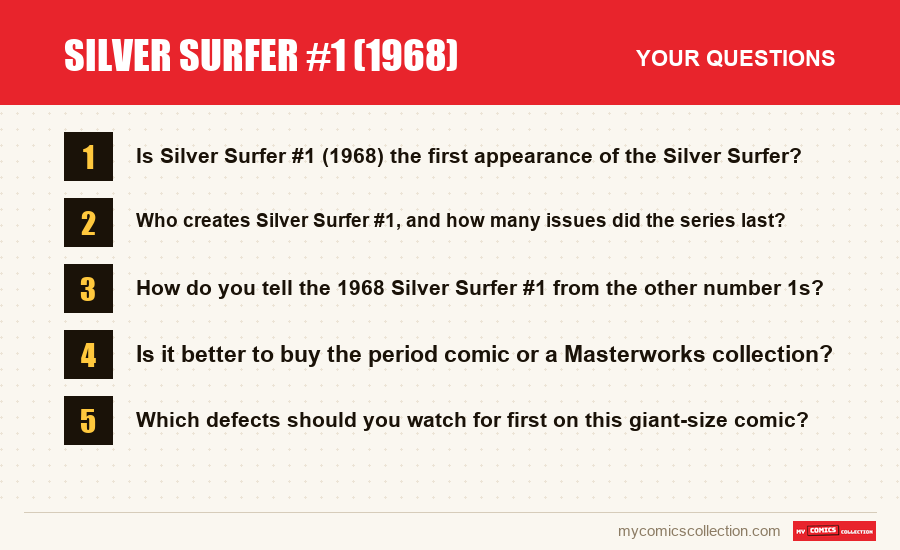
No. His birth dates to Fantastic Four #48, March 1966, alongside Galactus. Silver Surfer #1, dated August 1968, is the first issue of his solo series: it tells his origin and gives him his first leading role, but it does not contain his first appearance.
Stan Lee writes the script and John Buscema draws the pages. The series has eighteen issues, from 1968 to 1970, and Jack Kirby, the character's visual creator, draws #18. The usual sources agree on these points: if in doubt about a specific issue, check the credit printed in the copy.
Look at the cover year: August 1968 for the original, 1987 for the Englehart and Rogers relaunch, 2014 for the Slott and Allred one. A 1968 copy has no barcode. A listing that does not give the year makes it impossible to estimate the price, so ask for it first.
It depends on the goal. To read the 1968 to 1970 series in color, the Masterworks collection is enough and costs a fraction of the comic. To own the object from the period, only the original copy will do. The two belong on different shelves of the collection and cannot be compared.
The spine first, which splits on thick formats, then the corners and edges of the cover, where dark backgrounds reveal every bit of wear. Next check the staples, the complete pagination and any ink touch-ups. Ask for photos of the spine if the listing shows none.
Do you own a 1968 Silver Surfer #1 or another Silver Surfer comic? Estimate it with its condition and cover year.
Estimate my comic