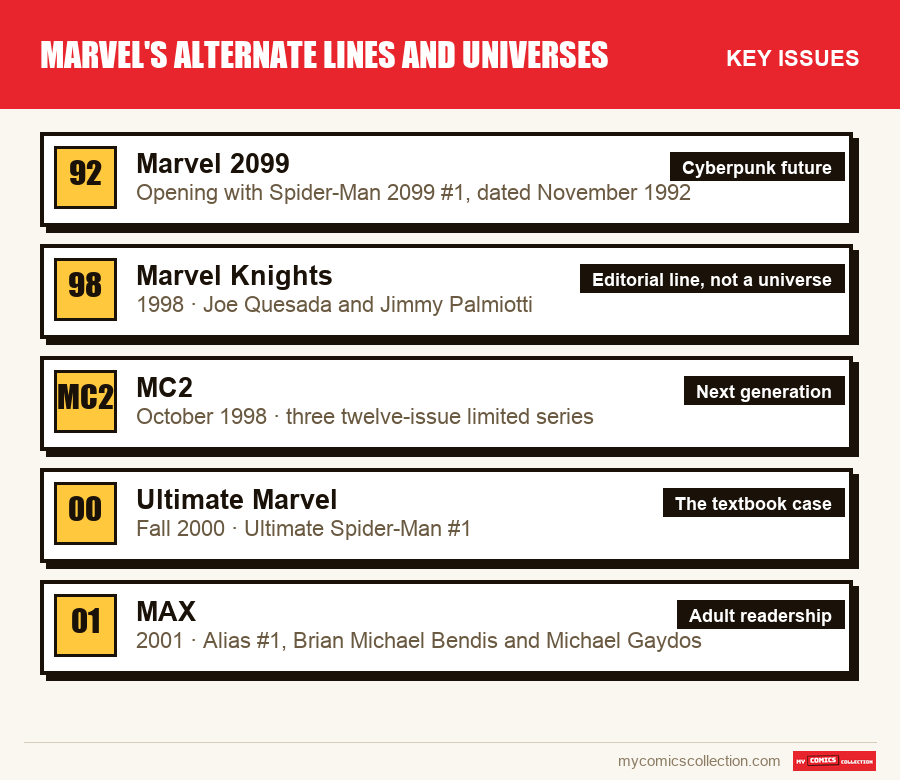
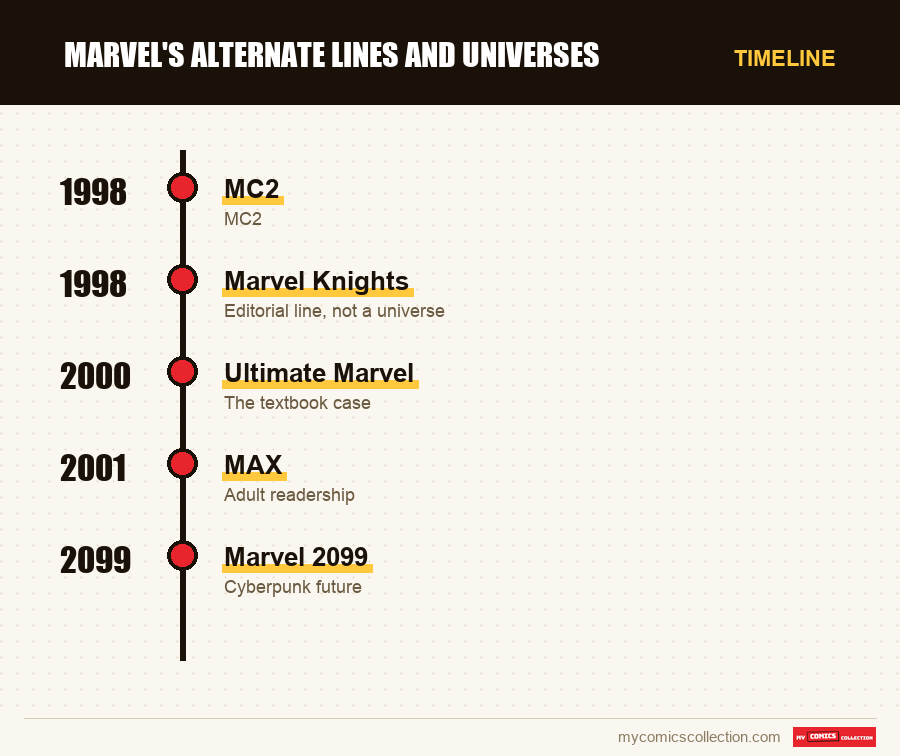
For thirty-four years, Marvel has regularly opened lines alongside its main continuity: 2099 starting with Spider-Man 2099 dated November 1992, MC2 and Marvel Knights in 1998, Ultimate in fall 2000 with Ultimate Spider-Man #1 by Brian Michael Bendis and Mark Bagley, MAX in 2001 with Alias #1, then a second Ultimate universe in 2024 after Ultimate Invasion (2023). This second Ultimate closed on June 24, 2026, and Marvel Midnight opens on October 7, 2026. On the secondary market, the verdict is constant: launch issue 1s are almost all common and cheap, because they were overprinted. What trades are the issues where a character appears for the first time and then survives elsewhere.
There is a lazy way to tell the story of Marvel's alternate universes: line them up as a list of curiosities, say it was pleasant, and move on. There is another, more useful when you own boxes of comics: treat them as dated commercial experiments, whose results are now known. Thirty-four years of archives, six major lines, hundreds of issue 1s. It is a sample wide enough to stop guessing.
The point of this exercise is practical. Every time the publisher opens a parallel door, the same reflexes reappear among buyers, and the same disappointments follow three years later. Knowing the trajectory of 2099, that of MC2 and that of Ultimate does not let you predict what a comic released tomorrow will be worth, but it lets you know where to look: not at the first issue's cover, but at the pages where something new enters the catalog.
What follows is therefore a chronology, line by line, with for each the same grid: the date, the editorial reason, what came out of it, and how the secondary market treats it today. The synthesis comes at the end, and it fits in one sentence you can apply this coming October 7.
Why a publisher opens a door beside its own continuity
The reasons vary, but they boil down to three families, and knowing which one a line belongs to already says a lot about its fate.
The first reason is accessibility. A forty or sixty-year continuity is a wall for a new reader: you have to know who died, who came back, and why the same character wears three different costumes depending on the series. Restarting from zero in a sealed universe removes this wall. It is the explicit logic of Ultimate in 2000.
The second reason is freedom of tone. As long as a character belongs to main continuity, what is done to them binds all the other series and all the merchandise. In a separate line, you can kill, maim, age, or simply write for adults. It is the logic of MAX in 2001, and partly that of Marvel Knights.
The third reason is commercial in the most direct sense: an issue 1 orders better than an issue 347. Each new line is an occasion to put a handful of titles back at issue one, thus reviving retailers' orders. This reason still exists, and it explains the oversized print runs we will discuss.
The lines that left a trace are those where the first two reasons dominated. The ones forgotten are those where the third was alone at the helm.
1992: Marvel 2099, the line born in the bubble
Marvel 2099
The line opens with Spider-Man 2099 #1, written by Peter David and drawn by Rick Leonardi, which sets up Miguel O'Hara in a future of all-powerful corporations. Three other titles follow in the coming months, Doom 2099, Punisher 2099 and Ravage 2099, then X-Men 2099 and an anthology, 2099 Unlimited, during 1993. In 1994 come Ghost Rider 2099 and Hulk 2099. The line's editor is Joey Cavalieri; his departure in 1996, during a budget cut, leads to that of several writers, including Peter David and Warren Ellis. The regular titles are canceled in 1995 and 1996, and briefly replaced by a single series, 2099: World of Tomorrow, which ends in spring 1997.
We must remember what 1992 was in this trade. The previous year, a single issue, X-Men #1, had sold more than eight million copies, thanks to five different covers bought in series by people convinced they were building an investment. Retailers ordered by the thousands, buyers bought by the dozens, and nobody read the copies set aside. The backlash followed: shop closures, distributor bankruptcies, a collapsed secondary market in the middle of the decade.
A line launched in this context inherits a structural handicap. Not of being bad, but of existing in too many perfectly preserved copies. Thirty years later, a 2099 issue 1 is still easy to find, often in very fine condition, and trades at modest levels on the secondary market. The only exception concerns copies graded in the highest grades, where scarcity becomes real again because few people had a comic graded that they thought common.
And yet 2099 left something, which makes the case interesting: Miguel O'Hara is still here. He crossed the decades, came back into main continuity, fed animated cinema. The character survived the line that invented him. The issue that introduces him, on the other hand, did not benefit from this survival as much as you might expect, because too many exist. Remember this dissociation: a character's value and the value of their first issue are two different things, and it is the print run that separates them.
1998: two opposite experiments in the same year
The year 1998 is a crisis moment for the publisher, just emerging from bankruptcy proceedings. Two very different answers come out the same year, and their respective trajectories are a lesson in method.
Marvel Knights
It is the case that escapes the category. Marvel Knights invents no parallel Earth: the stories take place in the usual continuity. What changes is the manufacturing regime. Four titles are entrusted to Joe Quesada and Jimmy Palmiotti, whose company Event Comics recruits the creative teams while the publisher publishes. The four starting series are Daredevil, Black Panther, Punisher and Inhumans. Quesada brings in writers from independent publishing, among them Brian Michael Bendis, David Mack, Michael Avon Oeming, Garth Ennis and Steve Dillon.
Marvel Knights demonstrates something that still holds today: you can durably transform a catalog without changing universe. The effect of this line is not measured in price but in careers and relaunched characters. The Black Panther of this period became a reference that steered the character for twenty years. Quesada became the house's editor in chief. Bendis, arriving through this door, wrote two of the following lines.
On the collecting side, Marvel Knights issue 1s are not rare pieces, and most of their interest is reading. It is good news for anyone wanting to build a coherent set without financial trade-offs: the complete runs of this period circulate regularly and are completed without difficulty.
MC2
MC2 imagines a near future where the heroes' children have taken over. Three titles start in October 1998: Spider-Girl, A-Next and J2. The starting point is not a strategy decision but a reader reaction: the appearance of May Parker, daughter of Peter Parker and Mary Jane Watson, in an isolated issue of the series What If, had provoked mail massive enough to convince the editorial office to make a series of it. Spider-Girl, written by Tom DeFalco and drawn notably by Pat Olliffe, was meant to last twelve issues. It held a hundred.
MC2 is the perfect counterexample to 2099. Discreet launch, print runs with no comparison to those of the decade's start, no speculation around the first issues. And yet, it is the line one of whose titles lasted longest. On the secondary market, the first issues of Spider-Girl are sought after by collectors of the character, and the trend is more favorable than for any 2099 issue 1, even though the initial hype was incomparably weaker. The reason is simple: fewer circulate, and demand comes from real readers attached to a character that lasted.
2000: Ultimate, the only line that changed the house
Ultimate Marvel
The idea comes from publisher Bill Jemas, convinced that main continuity had become unapproachable for a newcomer. The answer is a separate universe, restarting from the characters' origin, and the first title is Ultimate Spider-Man, written by Brian Michael Bendis and drawn by Mark Bagley. The eleven pages of the 1962 origin are redeployed there over seven issues. Ultimate X-Men follows in 2001 and will last a hundred issues. The Ultimates, by Mark Millar and Bryan Hitch, starts with an issue 1 dated March 2002 and rereads the Avengers in thirteen issues.
Ultimate succeeds where previous lines had failed, for a reason that is no calendar accident: its best titles were not conceived as variations on a known theme, but as series that would have been published even without the label. You find long-form writing, arcs built over dozens of issues, and art held by the same hands for years. This produces loyal readers, and loyal readers produce a living secondary market.
The most interesting issue of the whole line, from the point of view that concerns us, is however not its issue 1. It is Ultimate Fallout #4, dated August 2011, where Miles Morales first appears, created by Bendis and Sara Pichelli. This issue was not ordered like a launch: it arrives in the middle of an eleven-year line, in a transitional miniseries, with nobody able to anticipate what the character would become. It therefore came out at a normal print run. Fifteen years later, it is the piece everyone is looking for, and its public sales trend bears no relation to that of the same line's issue 1.
This comparison is the heart of the matter. Two issues, one line, one publisher. One was made to be bought in bulk, the other not. The one worth something today is the second.
2001: MAX, the line that moved a limit
MAX
MAX is not a parallel universe: it is a publishing regime, explicitly aimed at an adult audience. Its origin is anecdotal and revealing. Bendis wanted to write a crime story; his unfiltered manuscript led the house to create a label able to host it. Alias, drawn by Michael Gaydos, opens the line in 2001 and will last twenty-eight issues until 2004. It is the publisher's first comic to carry a content warning in place of the historic self-censorship seal. Garth Ennis would then write there the stories that redefined the Punisher, and a miniseries devoted to Nick Fury.
MAX interests the collector for an unexpected reason: it is the line whose starting print runs were among the lowest, because its audience was by definition narrow. Adult series were ordered cautiously. The first issues of this period therefore circulate less than those of the big contemporary superhero lines, and when a character from MAX gains importance elsewhere, the gap shows immediately in observed sales.
2023 to 2026: the second Ultimate, from opening to closing
Twenty-three years after the first, Marvel repeated the experiment, and this time we have the whole film, start and end included.
The project opens with Ultimate Invasion, a 2023 limited series written by Jonathan Hickman and drawn by Bryan Hitch. A November 2023 one-shot, Ultimate Universe, drawn by Stefano Caselli, sets up the starting situation. Then three titles start in 2024: Ultimate Spider-Man, by Hickman and Marco Checchetto, with a first issue dated January 10, 2024, presenting a married Peter Parker in his thirties; Ultimate Black Panther, by Bryan Hill and Stefano Caselli; and Ultimate X-Men, by Peach Momoko.
The line closed on June 24, 2026, with the simultaneous release of Ultimate Universe: Finale #1 and Ultimate Endgame #5. It had counted six regular series. It therefore lasted two and a half years, where the first version held fourteen.
This is valuable data, and it is not negative in itself. A line conceived from the start with an end date is a different collectible: it gets completed, it fits on a finite shelf, and it leaves no orphan series. On the other hand, it reduces the probability that a new character settles in long enough to become a reference elsewhere. Two and a half years is short for a creation to take root.
For the collector who bought in 2024, the lesson is immediately applicable: what was bought hoping for issue 1 scarcity did not have time to meet the long demand that creates value. What was bought to read is on the shelf, complete, and that was the right calculation.
October 7, 2026: Marvel Midnight, and what history lets us say
The next line opens in a few days. Three series the same Wednesday, the publisher's only releases that day: Midnight X-Men by Jonathan Hickman, drawn by Matteo Della Fonte, placing the X-Men in a New York haunted by vampires; Midnight Spider-Man by Phillip Kennedy Johnson, drawn by ScieTronc, where Peter Parker has become a hybrid; and Midnight Fantastic Four by Benjamin Percy, drawn by Kev Walker, treating science as a source of dread. The detail of the three series and the full calendar are covered in our Midnight launch guide.
What history allows us to say, and nothing more. First, the chosen genre is a rare asset. No previous alternate line leaned on a genre with its own audience independent of superheroes, and horror has one. Second, concentrating release day on three titles guarantees high orders, therefore an abundance of copies: these issue 1s will not be rare, whatever happens to the line. Third, the fact that it immediately succeeds a line closed after two and a half years says something about the house's current method, which seems to reason in short, bounded cycles rather than open universes.
What history does not allow us to say: what anything will be worth. As of October 1st, 2026, no copy has circulated and no sale has taken place.
What thirty-four years of experiments have in common
Lining up the six cases, three regularities appear, and they hold in both directions.
First regularity: the print run is the dominant factor, and it crushes everything else. Story quality, a creator's fame, the line's historical importance: nothing makes up for an overprint. 2099 produced good comics and an enduring character, and its issue 1s remain common. MC2 had a modest launch and its first issues hold up better. The secondary market does not assess merit, it assesses the ratio between available copies and the people who want them.
Second regularity: what is transmitted is the character, not the line. Three creations born outside main continuity entered it for good: Miguel O'Hara, Jessica Jones, Miles Morales. None of the three was born in a launch issue 1. Two appeared along the way, in issues nobody had ordered as a precaution. An alternate universe is judged by its capacity to export, and export is measured in years.
Third regularity: a line with no continuation disappears without leaving a tradable trace. Limited series of twelve issues that stop at twelve issues do not build demand. It takes duration for a readership to form, and a readership for a market to exist. Spider-Girl over a hundred issues created collectors; J2 over twelve issues did not.
From this follows the only rule these thirty-four years truly justify, and it is worth stating drily: a launch does not gain value, its survivors do. The issue that matters, in a parallel line, is almost always the one you had not identified on its release day. It is unpleasant to hear for anyone who likes buying on Wednesday, and yet it is what each of the six cases shows.
How to shelve a parallel line in a collection
Treat the line as an entity, not as isolated series
An alternate line is read and resold as sets. A coherent lot of titles from one line interests more than an accumulation of mismatched issue 1s from six different lines. In your inventory, group them explicitly: it changes how you spot the gaps.
Date your entries, especially on recent lines
On a line closed for twenty years, the purchase date no longer matters. On an ongoing line, it does: knowing that a copy was picked up at release, in first printing, with its original cover, is information that cannot be reconstructed later. Record it the same day.
Track first appearances, not first issues
This is the gesture that distinguishes an attentive collector. When a line introduces a new character, note the exact issue, even if nothing happened at the time. The three historical examples of characters exported out of their original line show that this information is worth more than any variant cover.
Complete the old lines now, not later
2099, MC2, the early years of Ultimate: these are affordable sets, available, whose complete lots circulate regularly on the secondary market. Completing a finished line costs little and is done without urgency. It is exactly the opposite of what a line that is starting demands.
Reserve grading for cases where it changes something
Grading an overprinted issue only makes sense in the extreme grades, where scarcity becomes real because few people bothered. On an average copy of an abundant line, the cost of the operation exceeds the gap it creates.
In the app, these five reflexes come down to one setup: grouping by line, an acquisition date filled in, and a note on appearance issues. The rest is patience.