
In short
J'onn J'onzz, the Martian Manhunter, makes his debut in Detective Comics #225 with a November 1955 cover date. The back-up story was written by Joseph Samachson and drawn by Joe Certa. A green-skinned Martian is pulled to Earth by a scientist's teleportation device, loses the only man who could send him home, and adopts the identity of detective John Jones in the fictional town of Middletown.
Most Detective Comics issues from the mid-1950s are remembered for the Batman story on the cover. Issue #225 is remembered for what sits further back in the book: a short science fiction tale that introduced a hero who would later stand among the founders of the Justice League.
Think of this page as a field guide to one 1955 newsstand comic: the credits on its pages, the premise it sets up, the traits of J'onn that later writers dropped, and the points worth inspecting on a copy for sale. Names, issue numbers and cover dates here were confirmed one by one; the verdict on importance and the inspection advice are my own reading.

The identity of the issue: cover date, story and credits
Detective Comics #225 carries a cover date of November 1955. It sits in the long stretch when the book was built around Batman and Robin, with the cover and lead story given to them. The Martian Manhunter is not the cover feature. He arrives in a supporting slot, as one of the shorter stories that filled out the rest of the book.
Joseph Samachson is credited as the writer and Joe Certa as the artist. These are the two names to expect on a first appearance of J'onn J'onzz, and they are the two creators credited with the character. If a listing names a different pair, check the issue before trusting the listing.
The date also settles a common mix-up. This is a 1955 comic, which places it in the stretch just before the period collectors call the Silver Age. That timing matters for the way the character was written, which the sections below explain.
How J'onn J'onzz is introduced in the Dr. Erdel story
The setup is compact. Dr. Saul Erdel, a scientist, has built an experimental teleportation beam. When he turns it on, it pulls a green-skinned Martian across space to Earth. Erdel explains that sending the visitor back will require the beam's robot brain to be recalibrated, which may take years. The Martian answers by changing shape into a human form, and the shock of the sight kills Erdel. The only person who understood the machine is gone, and the visitor is stranded.
What the stranded Martian does next is the hinge of the whole feature. Rather than hide, he decides to use his abilities against crime while he waits for Martian technology to advance far enough to bring him home. He takes the name John Jones and becomes a detective in the fictional Middletown, USA. That blend of a science fiction accident and a detective-comic frame suited the book it appeared in, because Detective Comics was already a home for crime stories with a costumed twist.
Notice what is absent from this first story. There is no team, no membership in a league, and no sense that he is the last survivor of a dead world. Those pieces came later, after the character had been redefined more than once. The debut presents a displaced visitor with a temporary mission, which is a smaller and more modest premise than the one that readers carry today.
Who created him, and in what editorial climate
Joseph Samachson (1906 to 1980) came to comics from science. He held a chemistry doctorate and had worked in medical research, and he also wrote science fiction under the pen name William Morrison. His DC scripts featured characters such as Batman, Sandman and Green Arrow. A scientist-turned-writer at the keyboard fits a story whose opening scene is a laboratory accident, and it is reasonable to read the Erdel premise in that light, though that is interpretation rather than documented intent.
Joe Certa drew the debut. He is the artist to expect on the original feature, and the green-skinned look of the 1950s Martian comes from his pages.
The market context is worth stating. The mid-1950s saw superhero titles shrink, and publishers experimented with science fiction and mystery material. A Martian detective who also had superhuman powers sat right at the crossing of those trends. The feature was a back-up, not a launch, and nothing about the first appearance suggests that anyone expected it to become a pillar of a later team book.
The Silver Age Martian: details that differ from the modern version
The J'onn J'onzz of 1955 is not quite the figure used in modern stories. Several differences are well documented and help in identifying what you are reading.
- He is not the last of his kind. Mars is not presented as dead, and early stories feature other Martians, including a younger brother named T'om J'onzz.
- His powers grow with the plot. Precognition appears in Detective Comics #226, and telepathy and flight follow soon after. He is not introduced with the full set of abilities.
- The fire weakness is narrower. In the original run it affects only his native Martian form, not the John Jones disguise.
- Contact with Mars is possible. Detective Comics #236, cover-dated October 1956, shows contact with Mars and his parents, which would sit awkwardly with the later tragic backstory.
These details explain why a modern reader who opens a 1950s issue may be surprised. The tone is closer to a lightly science fiction detective series than to the solitary, grieving figure of later decades. For a collector, it also means that the 1955 issues are a distinct chapter: the later origin retellings are separate publishing events, and a copy of #225 belongs to the earliest, simplest version.
Do you collect this series?
Track what you own, what you are missing and what your collection is worth. 7-day trial.
Start my trial →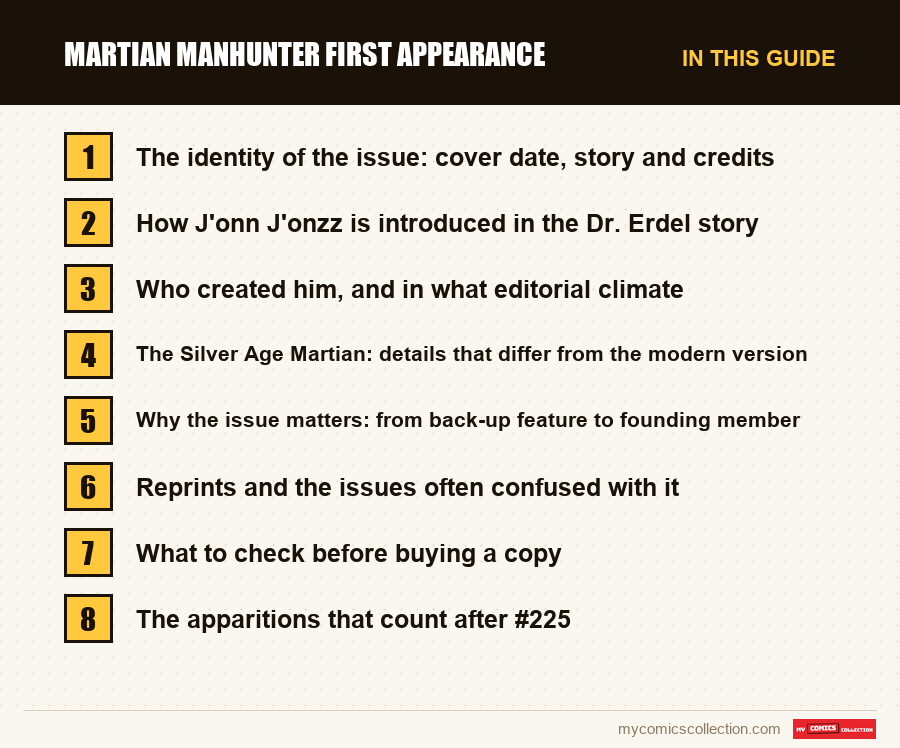
Why the issue matters: from back-up feature to founding member
A first appearance gains weight from the things that follow. The back-up feature continued in Detective Comics after #225, so the character was not a one-off. Years later he is among the seven heroes of The Brave and the Bold #28, the story that creates the League. The Martian Manhunter was one of the seven founding members, alongside Superman, Batman, Aquaman, the Flash, Green Lantern and Wonder Woman.
The Justice League then received its own series, Justice League of America, which began in 1960. Your sense of how important a first appearance is depends on how deeply the character is woven into the shared universe, and a founding seat in the main team puts J'onn J'onzz in that category. The character also later took the lead in a feature of his own: his back-up moved from Detective Comics to The House of Mystery, beginning with issue #143, cover-dated June 1964.
It is worth keeping the claim modest. Detective Comics #225 is the debut of the character; it is not the debut of the Justice League, and it is not the most famous issue of the series it appears in. Its significance is as a character debut, with the weight that gives a founding member of a major team.
For the full story of the character over seven decades, the editorial history of Martian Manhunter covers the long gaps and the relaunches, while this page stays on the single 1955 issue.
Reprints and the issues often confused with it
Several different numbers get tangled up with this one, and a few clarifications prevent expensive mistakes.
- The Brave and the Bold #28, dated 1960: the story that launches the League. The Martian Manhunter is in it, but it is not his first appearance. See the guide to that issue.
- Justice League of America #1 (1960): the start of the team's own title, not the character's debut. Details are in the guide to the first issue.
- The House of Mystery #143 (June 1964): where his feature moves after leaving Detective Comics. It is a milestone for the character's solo run, not for his creation.
- Detective Comics #226 (1955): the following issue, where precognition appears. It continues the feature but is not the debut.
- Modern miniseries and series: the 1988 miniseries and the series launched in 1998 are new stories, with their own first issues numbered #1.
Any later reprint, collected edition or facsimile of a 1950s issue is a separate product. If you are buying what is described as the original, confirm the cover price and printing marks, the paper and the staple condition, and the lettering of the cover date. A modern reprint will not carry the characteristics of a 1955 newsstand copy, and a seller who does not show the interior or the spine should be asked for more photographs.
What to check before buying a copy
Newsprint from the 1950s aged badly, and these comics were folded, traded and thrown away, so surviving copies of #225 differ widely in condition. Treat a purchase as a methodical inspection rather than a quick decision.
- Complete story pages. The Martian Manhunter story is in the interior, so confirm that the pages are all present and that none has been cut out or replaced. Count the pages against a known complete copy when possible.
- Spine and staples. Look for splits, stress lines, and rusted or replaced staples. An unusually bright staple on an old book is a reason to ask questions.
- Paper tone. Brittleness, browning and edge chips are normal at this age, but they shape the grade strongly. Ask for photos in natural light.
- Restoration. Color touch, pressing, spine repair and tape are all used on books of this age. A copy graded by a professional service should carry a label that states whether restoration was detected, and the label type tells you which way to read it. A notation of restoration is not a defect in the description; it is a fact that changes the way the copy should be compared.
- Graded copies. For a slabbed copy, read the label, not the plastic: it should show #225, November 1955, the grade, and a serial number you can look up with the grading company.
To compare a copy at the same grade and restoration status, rather than against asking prices, follow the method in the Detective Comics key issues guide, which keeps the focus on grade and provenance rather than headline results.
The apparitions that count after #225
Once you have the debut, there are a few follow-ups worth knowing.
- Detective Comics #226 (1955): the issue where precognition first appears among his powers. A small step, but it shows how the abilities grew.
- Detective Comics #236 (October 1956): the story that shows contact with Mars and his parents, a detail later versions of the character set aside.
- The Brave and the Bold #28, 1960: where J'onn appears with six fellow heroes in the League line-up.
- The House of Mystery #143 (June 1964): the start of the feature in its new home.
- Martian Manhunter #1 (1998): the first issue of the series that launched in December 1998, with John Ostrander as writer and Tom Mandrake as artist.
A collection built around the character usually grows in that order: the debut, the Justice League origin, the solo feature, then the modern series. The key numbers guide and the best runs guide map the same territory in a more general way.
If you already own copies of the characters who stand beside him in the League, the hubs for Batman and Superman list the related issues that share shelf space with Detective Comics #225.
Frequently asked questions
Detective Comics #225, cover-dated November 1955. The back-up story was written by Joseph Samachson and drawn by Joe Certa. It is a back-up feature, not the Batman cover story, which is why the issue is easy to overlook when scanning a long run of the title.
Joseph Samachson wrote the debut and Joe Certa drew it. Samachson was a chemist who also wrote science fiction under the pen name William Morrison, while Certa defined the character's look in the 1950s feature that ran in Detective Comics.
No. The Brave and the Bold #28 launches the Justice League in 1960 with seven founders, and he is among them. His own first appearance came more than four years earlier, in Detective Comics #225 in 1955.
No. In the 1950s stories Mars is not a dead world, he has relatives, and a younger brother named T'om J'onzz appears. The idea of a lone survivor came with later retellings, so a copy of #225 shows the earliest and simplest version of the origin.
Confirm that every story page is present, inspect the spine and staples, and look for restoration. For a slabbed copy, the label gives the grade and any restoration note; weigh it against sales at that same grade and status. Ask for interior photographs whenever a listing shows only the cover.
Holding a copy of Detective Comics #225 or another 1950s issue? Check where it stands before you decide whether to sell or grade it.
Estimate my comic