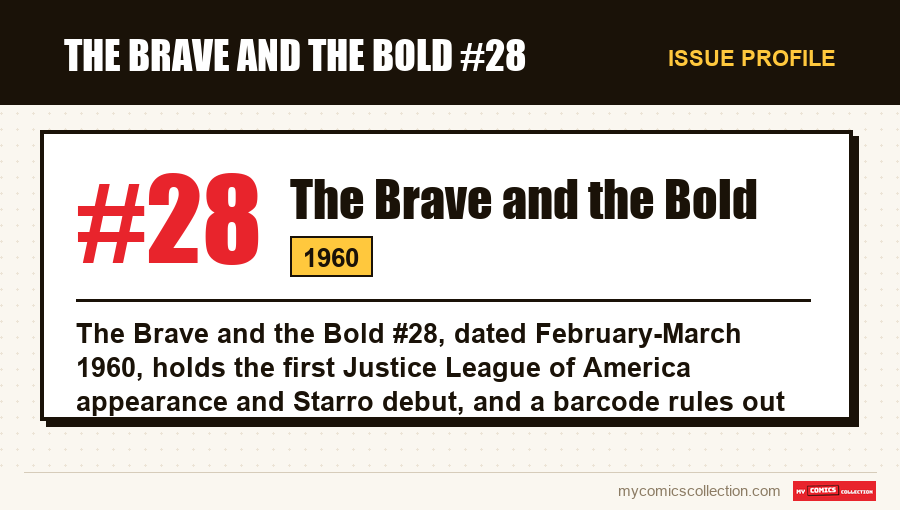
The Brave and the Bold #28, dated February-March 1960 from DC, contains the first appearance of the Justice League of America. The story is written by Gardner Fox, drawn by Mike Sekowsky and inked by Bernard Sachs, under the editorial direction of Julius Schwartz. Seven heroes already known to readers come together there to repel the invader Starro. Collectors seek this issue because it founds the first super-hero team of the Silver Age.
In a collection, this issue occupies an awkward place: it is as coveted as the first issue of a series, yet it carries the title of an anthology that few readers followed for that reason. As a result, the surviving copies are those of a 1960 newsstand print run that had no reason to be kept carefully. That is the whole stake of the purchase: you are not looking for an object that is rare in absolute numbers, you are looking for a copy whose spine, staples and corners have not endured sixty-five years of ordinary handling.
As always on this guide, only verified information (creators, numbers, dates) is stated as fact; the analysis is ours, with no reproduction of any panel or protected dialogue.
What issue 28 actually contains
The date printed on the cover is February-March 1960, a bimonthly rhythm the series had kept since its launch. The main story brings together seven characters: Superman, Batman, Wonder Woman, Flash, Green Lantern, Aquaman and the Martian Manhunter. Their adversary is Starro, a starfish-shaped entity that takes control of living beings, and it makes here its very first printed appearance.
The interior credits are stable from one source to another: script by Gardner Fox, pencils by Mike Sekowsky, inks by Bernard Sachs. The attribution of the cover inks varies between reference works, and this point has no bearing on the value of a copy; do not let yourself be sold a variant on that pretext.
One detail matters for identifying the issue on a shelf: the logo of the new team is already on the cover, in large letters, while the series title remains that of the anthology. A hurried seller may therefore file the copy under the team's name rather than under the series title. This is a source of confusion during searches, and sometimes a pleasant surprise in a poorly sorted bin.
What the series published before the team arrived
The Brave and the Bold had started in the mid-1950s as a historical adventure anthology, with heroes of cape and sword rather than of tights: the Viking Prince and the Silent Knight carried the longer stories. The shift to super-heroes had begun shortly before, with the first adventures of the Suicide Squad in the preceding issues. In other words, issue 28 does not arrive in a blank title; it arrives in a title that had been searching for several months for what might hook readers.
This lineage has a practical consequence. Earlier issues of the series can still be found at modest levels, because their content interests only a small audience. A complete lot of the early years will not cost you what issue 28 alone costs, and it will not carry the same value: do not build a continuous run in the hope that the whole set will follow the key.
Why this issue became a prized piece
The team returns in the next two issues of the anthology, then gets its own title, whose first issue is dated October-November 1960. This quick move from an anthology to an autonomous series is the sign of a clear commercial success, and that success is what makes issue 28 a starting point rather than a one-off experiment.
Added to this is a sequence often retold: at the rival publisher, the team's strong sales are said to have led management to ask its own writers for an equivalent group, the commission that produced the first Fantastic Four issue, dated November 1961. The anecdote has circulated for decades in interviews and accounts of the industry, but its details, the place, the conversation, the people present, are debated and sometimes contradicted by those involved. Keep the chronology, which is documented, and treat the staging with distance. None of this diminishes the issue's position: it opens a lineage of team stories from which, directly or indirectly, a good share of what you file in your boxes descends.
The issue therefore combines two arguments rarely found together: the first appearance of a group that still exists, and that of an adversary the writers have brought back regularly since. For a buyer, this is a demand coming from two different audiences: collectors of teams and fans of villains.
The factors that move the price
On a 1960 booklet, the dominant factor is not the edition, it is the condition. Paper of the period yellows, staples rust on contact with humidity, and the spine weakens at the first fold. Between a readable but worn copy and a copy still bright, the ratio is not a few tens of percent, it is counted in multiples, and each additional grade step at the top of the scale weighs more than the previous one.
Three specific points are checked by serious buyers on this issue: the state of the cover's white around the team logo, the sharpness of the right edge, often attacked by newsstand handling, and any distributor stamp or price rewritten in felt pen. This last point is negotiable: an old pencil inscription on the cover is common on booklets of this decade, it caps the grade without making the copy uninteresting.
The cover price is ten cents, printed at the top left. It plays no role in the value, but it serves as a reference point: a copy whose cover price does not match the year is, by definition, something other than an original print run.
Telling an original print run from a reissue
In 1960, booklets distributed in the United States carried no barcode; this identification box only appeared during the 1970s. A copy showing a barcode or a white block reserved for it is therefore not a 1960 print, however faithful the cover. It is the fastest check, and it can be done from a photo.
The second check concerns the interior pages. An original print run includes advertisements of its time, for mail-order products, and its paper has a uniformly warm tint. A facsimile reissue reproduces the cover and often the advertisements, but on a whiter, smoother and thicker paper, with distinctly denser ink. Facsimile editions have become common for the founding issues of this publisher; systematically check whether one exists for this issue before concluding on a lot bought online, and ask for a photo of the spine and of the edge.
The third case is that of collected volumes. The story has been reprinted in albums and bound reissues over the decades. These volumes are perfectly legitimate for reading the story, they have nothing to do with the booklet in terms of value, and they should be recorded as separate editions in your inventory.
Do you collect this series?
Track what you own, what you are missing and what your collection is worth. 7-day trial.
Start my trial →
The pitfalls when buying
The most common pitfall concerns the description. A listing that promises the first Justice League without specifying the issue number or title may be referring to the first issue of the autonomous 1960 series, which is another piece, sought after but distinct. Require a photo of the whole cover with the series title legible, not a close-up of the team logo.
Second pitfall: undeclared restoration. On a booklet of this age, reinforcing the spine, filling a small loss or chemical cleaning are operations that can be carried out and are sometimes invisible to the naked eye in a photo. They change the grade noted on a graded copy and weigh on the price. If the seller says nothing, ask in writing.
Third pitfall: a missing or detached centerfold. On the stapled booklets of 1960, the central section comes loose easily, and its absence is often discovered only after the purchase. Ask for a photo of the centre of the booklet opened flat, or at least an explicit statement that all pages are present.
Neighboring issues worth a look
The next two issues of the anthology directly extend the team and make a coherent purchase, at a level noticeably more accessible than that of issue 28. The first issue of the autonomous series, dated October-November 1960, is the other piece one naturally associates with it: it is also in high demand, and a collector who can aim for only one of the two should know that seniority favors issue 28.
Upstream, the anthology's Suicide Squad stories interest an audience that has grown since the film adaptations, without reaching the levels of the team's issues. Downstream, the series changes its format several times before becoming, in the mid-1960s, a title of duos built around Batman: those issues belong to another collecting logic, that of team-ups, and can still be found easily.
If your interest lies in the other branch of the tree, the first issue of the Fantastic Four and the run of team titles it opened form a parallel path, with its own keys and its own publishing pitfalls.
What grading actually changes
For a 1960 booklet, encapsulation by a grading service is not a luxury, it is what makes the object saleable at a distance. It fixes a grade, records any restorations or cleaning, and above all protects a paper that has become brittle. On this issue specifically, the price gap between two neighboring grades at the top of the scale largely justifies the cost and the waiting time of the operation.
This does not mean that an ungraded copy should be avoided. A copy bought in hand and examined under good light remains the best possible purchase if you know how to read a spine and a staple. The useful rule is that of the channel: the more distant and impersonal the transaction, the more grading weighs in the decision. For a purchase at a convention, your eye is enough; for an auction on the other side of the world, the mention of a grade assigned by a third party is what replaces handling.
Keeping this issue in a collection
Three pieces of information deserve to be recorded separately in your inventory for this item: the nature of the copy (1960 print, facsimile, collected volume), the grade with its source, and the acquisition date with the channel used. Without that last field, you lose track of what made you pay that price on that day, and any later reassessment becomes guesswork.
The built-in catalog lets you find the series record and attach your copy to the right number, which avoids the frequent confusion with the first issue of the autonomous series. Also note the first appearances this booklet introduces, the team and its adversary, in the field provided for first appearances: that field will serve you on the day you want to extract the list of your key issues for insurance or an estate. The guides gathered on the blog detail this organization issue by issue.
What to keep in mind before buying
The Brave and the Bold #28 is an issue whose value rests not on its raw scarcity but on its position: the first appearance of a team still in publication, in a title nobody collected for its sake in 1960. You will therefore be buying condition before buying the object. Set yourself a minimum grade before looking at listings, check for the absence of a barcode, obtain a photo of the full cover and a statement on restorations, and treat any copy without these elements as a blind purchase.
If you already own the copy, the question is no longer the purchase but the measurement: a booklet of this age moves at the pace of the Silver Age key-issue market, and a valuation several years old no longer tells you anything useful.
You own a copy of The Brave and the Bold #28 and want to know where it stands today according to its grade and its type of edition?
Estimate my comic
Frequently asked questions
Seven characters already established: Superman, Batman, Wonder Woman, Flash, Green Lantern, Aquaman and the Martian Manhunter. The first two play only a reduced role there, a feature of the group's very first stories that often surprises readers who came through recent adaptations.
For a collection of first appearances, yes: issue 28 precedes by several months the team's own series, whose first issue is dated October-November 1960. The second remains a very sought-after piece and is easier to find, which makes it a reasonable entry point.
Yes, the starfish-shaped invader debuts in this story of February-March 1960, written by Gardner Fox. That is an additional argument for the issue, since the character returned regularly afterwards and interests an audience distinct from that of team collectors.
First look for a barcode or the white space that houses it: it does not exist on American booklets of 1960. Then look at the whiteness of the paper and the thickness of the cover, distinctly higher on a facsimile reissue, and ask for a photo of the edge.
The chronology is clear: the team's success preceded by about a year and a half the first Fantastic Four issue, dated November 1961. However, the detailed account of that commission, often told as an anecdote, is debated, and its exact circumstances remain uncertain.