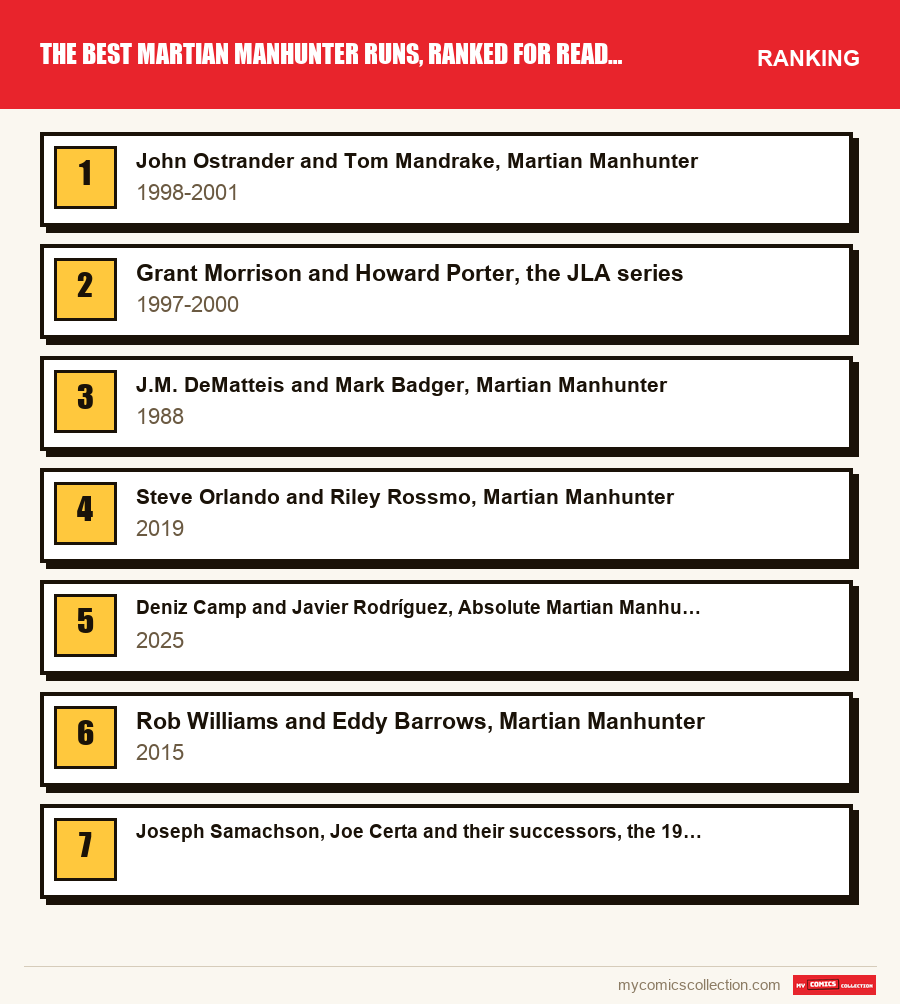
To read Martian Manhunter, start with the series by John Ostrander and Tom Mandrake, launched in December 1998, which gives the Martian his psychological depth. Then read Grant Morrison's JLA (1997), where J'onn J'onzz plays the heart of the team, followed by the miniseries by J.M. DeMatteis and Mark Badger (1988). The relaunches by Steve Orlando (2019), Deniz Camp (2025) and Rob Williams (2015) complete the picture, with the 1955 to 1968 stories as a preamble.
J'onn J'onzz is a special case in the ranking of DC heroes: a founder of the Justice League, he has never had a long, uninterrupted regular series. His "runs" are therefore islands, separated by decades of silence, written by creators who almost never answered one another. This guide ranks them from the most convincing to the most oriented toward the roots.
As always on this guide, only verified information (creators, issue numbers, dates) is stated as fact; the analysis is our own, with no reproduction of protected pages or dialogue.
How we ranked the Martian Manhunter runs
A character without a continuous series forces a change of method. Rather than following a numbering, we isolated seven distinct periods, each written by an identifiable creator or duo, then compared them on what they do with J'onn: do they treat him as an isolated alien, as a detective, as the moral pillar of a team? The rank depends first on the solidity of the portrait, then on ease of reading, and finally on ease of assembly.
A warning about the numbers: Martian Manhunter volumes are poorly numbered in catalogs (the 1998 series is sometimes called volume 2, the 2015 one volume 4, for example). We therefore cite the year with each title, and avoid fixing a final issue number when sources differ.
Top 1: John Ostrander and Tom Mandrake, Martian Manhunter (1998-2001)
The regular series launched in December 1998 is the only one that gave J'onn a space of several dozen issues. It has thirty-six regular issues, to which a few unnumbered episodes are added; sources differ on the exact count, and we fix no figure beyond those thirty-six. Ostrander, whose serious way of building a universe readers know, writes a hero who keeps asking what he came to do on Earth, while Mandrake, with an angular line and heavy shadows, gives Middletown and Mars a film noir atmosphere.
This run matters for the character because it takes advantage of what the 1950s had laid down without exploiting: the loneliness of a last survivor, the permanent usurpation of a human identity, the loss of a family. J'onn is a being who changes faces to approach others and who, paradoxically, struggles to show himself as he is. The whole forms the most complete reading of J'onn J'onzz's character outside the League.
Who is it for? The patient reader, who appreciates auteur-driven series and accepts a slower pace than the usual superhero. To collect it, the single issues of the late 1990s are easy to find: the print run of the time was large, and copies in good condition abound. For a collected edition, check the included issues in the catalog before paying.
Top 2: Grant Morrison and Howard Porter, the JLA series (1997-2000)
This is not a Martian Manhunter run strictly speaking, and the ranking acknowledges it: in the JLA series, launched in 1997, Morrison gives J'onn a role that his solo books had never dared to give him. Seven heroes make up the team, from Superman to Aquaman, and it is the Martian who becomes the group's connecting piece. The first arc, "New World Order," pits the team against figures who present themselves as saviors and whose nature touches the character directly, which makes J'onn a stake and not just a spectator.
Why it matters: it puts J'onn back at the center of the League, after three decades in which he passed through teams without weighing on them. Howard Porter's art makes a very large team readable, and the series durably marked the way DC stages its big lineups.
Who is it for? Anyone who wants to understand how the Martian is perceived across the whole DC universe, and who enjoys high-energy team stories. To collect it, the 1997 series exists in single issues, but JLA is a title where collected editions are often preferable: the first volumes neatly gather the arcs, and you will find in our Grant Morrison reading path the place of this series among the author's other major works.
Top 3: J.M. DeMatteis and Mark Badger, Martian Manhunter (1988)
In 1988, DC publishes the first miniseries devoted to the Martian alone, in four issues. DeMatteis, then writer of the Justice League at the same publisher, deepens J'onn's isolation and redraws part of the Martian mythology. Mark Badger, with a very distinctive graphic style, far from traditional adventure art, gives the whole a waking-dream look that still divides readers.
This run matters because it is the first to treat J'onn as a character to explore rather than as a supporting role. In our reading, it announces, ten years before Ostrander's series, the mourning of a world and the weight of secrecy: a starting point, more than a culmination.
Who is it for? The fan of experimental comics, who agrees to be guided by an unusual image. To collect it, this is a miniseries of four single issues: a short set, cheap to complete, to be bought as a lot rather than issue by issue. Sources differ on the existence of a recent collected edition; check it in the catalog before looking for a bound edition.
Top 4: Steve Orlando and Riley Rossmo, Martian Manhunter (2019)
Orlando and Rossmo sign a twelve-issue maxiseries, published from 2019, that tackles head-on what shapeshifting implies: if J'onn can become anyone, who is he when he has no form? Rossmo, whose distorted line recalls independent comics, puts this question into images with a style that does not seek wisdom.
It matters for the character because it puts the question of identity back at the heart of J'onn, after years when relaunches had mostly tied him to the Justice League. The series dialogues with the tradition of Ostrander's series without copying it, and it provides a modern entry point for anyone who knows nothing about 1955.
Who is it for? The current reader, used to short stories designed for collected editions. On the collecting side, the series is recent and has no established value. Both single issues and the bound volume are fine; only the reputation of Orlando and Rossmo, not an adaptation, could make it evolve. We put forward no print run or alternate-cover ratio, for lack of a reliable source.
Do you collect this series?
Track what you own, what you are missing and what your collection is worth. 7-day trial.
Start my trial →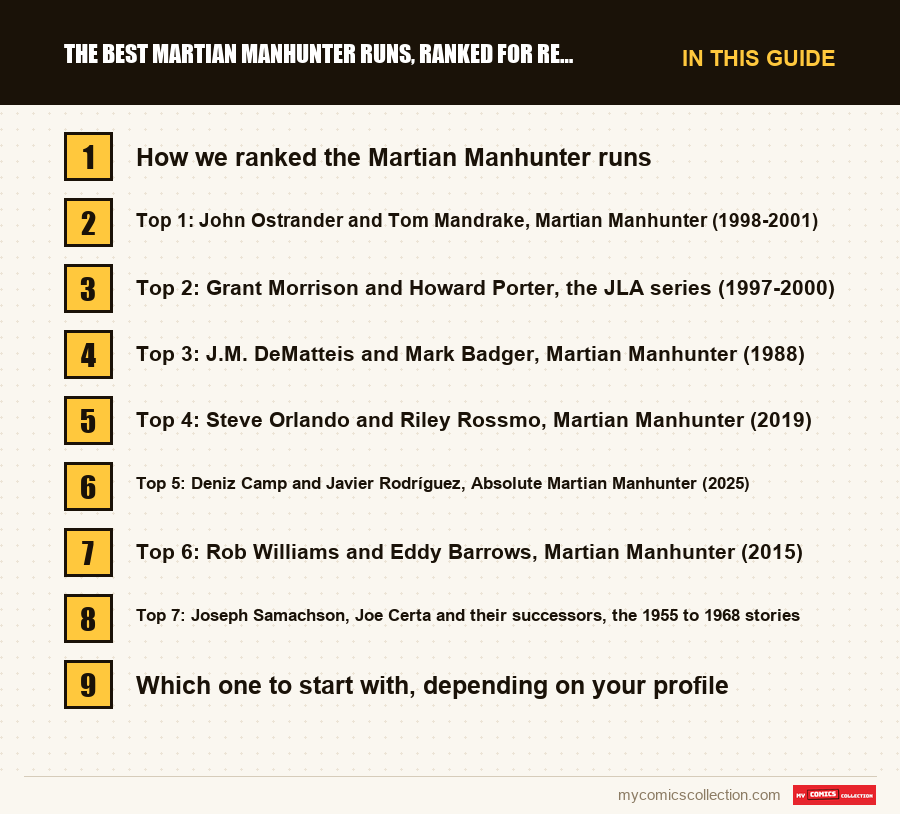
Top 5: Deniz Camp and Javier Rodríguez, Absolute Martian Manhunter (2025)
DC's "Absolute" line reinvents its heroes in a separate universe, and Martian Manhunter receives a psychological horror treatment there. Camp writes, Rodríguez draws: the duo turns the Martian's quest for identity into a nightmare, in an atmosphere far from the luminous hero of the League. Its rank reflects the distance that is still missing.
What makes it interesting is the bet of rereading the character from his darkness, which the 1950s had already sketched in the figure of a being who looks like everyone and no one. Who is it for? The reader who likes horror and crime fiction, and who prefers short miniseries to long-running serials.
To collect it, remember the rule for recent issues: the value is not established. What will move it is the lasting success of the Absolute line, how the miniseries ends and the possible use of the character in other series. We cite no alternate-cover ratio or print run: without a solid source, it is better to abstain.
Top 6: Rob Williams and Eddy Barrows, Martian Manhunter (2015)
In the editorial wave of 2015, DC entrusts Rob Williams with a solo series, drawn by Eddy Barrows. It has twelve issues according to our cross-checking, and it is an adventure story more than a character study, which brings J'onn face to face with his Martian past. Barrows, a very readable superhero artist, gives scale to the action scenes, at the price of a depth less pronounced than in the first two.
This run matters less for its ideas than for its role as a bridge: it recalls that after the 2011 overhaul, the Martian was still a character the publisher was trying to relaunch solo. Who is it for? The reader who wants an action-oriented J'onn, with no references to read first. To collect it, this is a short series, with no difficulty completing it; the single issues can be found at a modest cost, and the collected edition suits reading.
Top 7: Joseph Samachson, Joe Certa and their successors, the 1955 to 1968 stories
It all begins in Detective Comics #225 (November 1955), where Samachson and Certa create J'onn as a backup story. He stays in this format for nearly a decade, then the "Manhunter from Mars" series migrates to House of Mystery from #143 (1964) and continues there until 1968. This is the era when the hero acquires his famous weakness to fire and his companion Zook. Our history of Martian Manhunter tells this path in detail; here, the question is whether it is worth reading today.
It matters because everything that comes after feeds on it: the exile, the identity of John Jones, the shapeshifting. But the pace of the short stories is that of the 1950s and 1960s, which makes it better suited to the history buff than to the hurried reader. The list of writers who followed Samachson is uncertain in the sources, and we prefer not to draw it up.
To collect it, this is where the most sought-after single issues concentrate, notably Detective Comics #225, and reading goes rather through reprint volumes. To judge the stakes of an original copy, go through our key issues guide.
Which one to start with, depending on your profile
Anyone who wants a complete portrait of the character will open the Top 1, the series by Ostrander and Mandrake. Anyone coming from the Justice League, or who has seen the Martian in a team on screen, will prefer the Top 2: Morrison's JLA shows J'onn in collective action. The reader drawn to graphic experimentation will go to the Top 3, in four issues.
The fan of current series will find what they need in the Top 4 and Top 5, designed for modern reading, the second being the darkest. Anyone looking for an adventure story with no prerequisites will read the Top 6. The comics history buff will finish with the Top 7, once the character is familiar, to measure what the creators kept from the origins and what they set aside.
For a first purchase, prefer a short, complete series to an isolated single issue: a lone 1998 issue leaves you in the middle of a plot, whereas the 1988 miniseries reads in one go.
What these runs are worth in a collection
The Martian's market divides into two regimes. The single issues from 1955 to 1968 belong to the Silver Age and the beginnings of the following period: few in high grade, they are compared with one another by condition and by completed sales, never by a value read from a single listing. Before buying, gather several completed transactions for the same issue and the same condition level, discarding outliers.
By contrast, the periods from 1988 to 2019 were aimed at a wide audience: their single issues circulate easily, and the pleasure of reading far outweighs the effort of searching. For the 2015, 2019 and 2025 releases, the value is not established and what will move it remains uncertain; do not buy to speculate.
Is an old single issue sleeping at your place? Go through the free estimate to place it. And to put the Martian back in the team of which he is a founding member, our ranking of the best Flash runs shows how another founder from 1960 was treated.

Frequently asked questions
The series by Ostrander and Mandrake, launched in December 1998, is the most often cited. It deepens the loneliness of J'onn J'onzz over about thirty issues, with a dark crime fiction tone. If you prefer a short read, the miniseries by DeMatteis and Badger (1988) fits in four issues.
It is not essential, but useful. In JLA, launched in 1997, Morrison makes J'onn the heart of the seven-member lineup, and the first arc touches the Martian's nature directly. Read it after the Top 1 to measure the gap between the solitary version and the team version.
Yes, because the Absolute line starts from a blank page: no continuity to know. Deniz Camp and Javier Rodríguez offer a dark rereading there, but it does not replace understanding the basic character. A novice reader can read it first, then work back to 1998.
His publishing history alternates long silences and brief relaunches. After the end of his House of Mystery series in 1968, you have to wait for the 1988 miniseries and then the 1998 series to find him in the foreground. The publisher mostly used him as a team member, more than as a headliner.
Yes, but with a historian's eye. The Detective Comics and House of Mystery stories, from 1955 to 1968, have the short pace of the era. They read well in reprint, and their interest is in showing where the themes taken up by Ostrander and then by Orlando come from.
Is a Detective Comics #225 or a House of Mystery from the Martian's run lying around in your boxes? Have its condition estimated before deciding whether to keep or sell it.
Estimate my comic