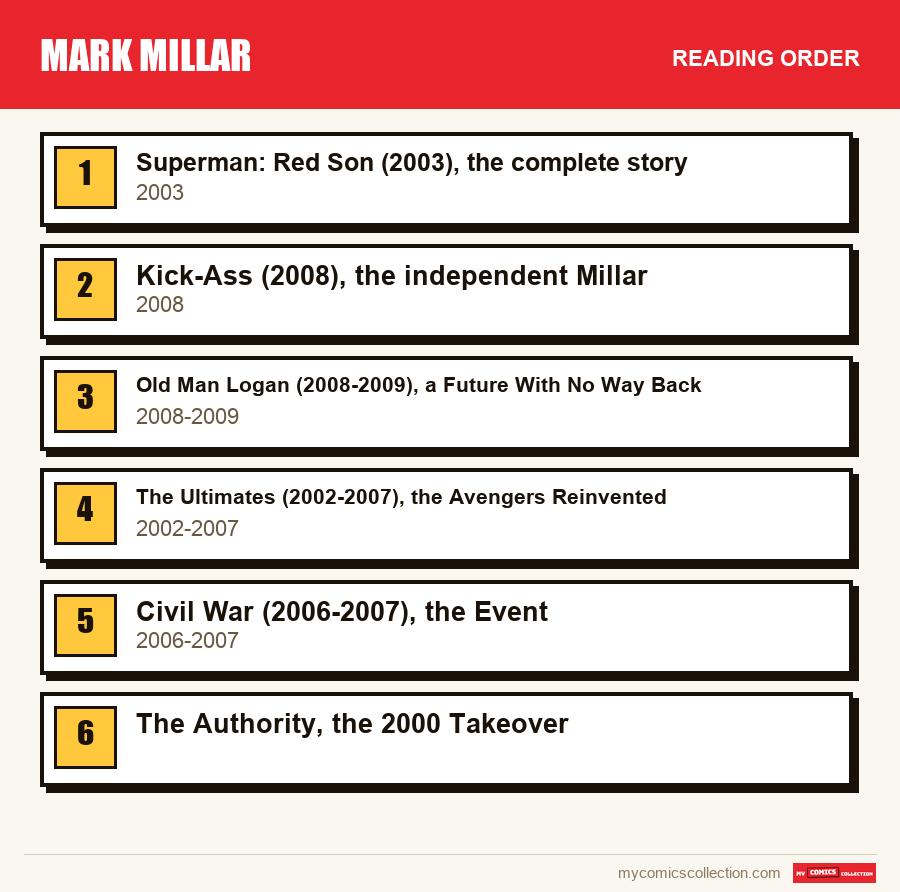
To read Mark Millar, start with Superman: Red Son (2003), a complete story in three issues, then move on to Kick-Ass (2008), Old Man Logan (2008-2009), The Ultimates (2002-2007) and Civil War (2006-2007). Finish with The Authority, which Millar took over at issue 13 in 2000. Each step spells out the format to favor, and the order runs from the story that stands alone to the one that needs context.
Mark Millar writes fast, loud and for the big screen of the page: shock ideas, double-page spreads, fights cut like movie shots. That efficiency makes the work easier to approach than that of many writers from the same generation, as long as you pick the right door. Some of these stories stand alone, while others assume a whole series behind them. Here is the route we suggest for someone opening a first Millar.
As always in this guide, only verified information (creators, issues, dates) is stated as fact; the analysis is ours, with no reproduction of artwork or protected dialogue.
What sets Millar apart from other writers
One point of method comes before the choice of title: Millar sells an idea first. Millar builds series around a pitch that fits on one line: what if Superman had grown up in the USSR, what if a powerless teenager played vigilante, what if Wolverine were an old man in a conquered America. The rest follows that idea with the rigor of a movie script, which explains the number of adaptations. Fans of fine-grained continuity will find less to enjoy here than readers who love strong ideas.
The stories usually run from three to eight issues, except when Millar takes over an ongoing series. That is an advantage for the collector: you buy a closed set, with no need to chase a monthly release for years. It also sets the reading method. Each step below is chosen so that you can stop after it with no regrets.
Keep in mind, too, that Millar writes for several artists with very different styles, from the precision of Bryan Hitch to the energy of John Romita Jr. The same writer can speak to you very differently depending on the book, which is one more reason to read at least one story from each artist before making up your mind.
Step 1: Superman: Red Son (2003), the complete story
Three issues published by DC in 2003, as an "Elseworlds" tale: Kal-El's rocket lands in Soviet Ukraine instead of Kansas. Millar composes a Superman in the service of the State and asks what becomes of a superhuman when his country is not the one you think it is. Dave Johnson draws the covers and Kilian Plunkett a large share of the interior pages.
It is the best first read, because everything sits in a single volume and no prior knowledge of continuity is required. You already find Millar's devices here: a bold starting point, spaced-out twists, and a final third that overturns the beginning. The 2020 animated film lets you compare, in our dedicated article. For collecting, the collected edition is the natural option; the three original single issues exist for anyone who wants the object.
Step 2: Kick-Ass (2008), the independent Millar
Eight issues drawn by John Romita Jr., published from 2008. A high schooler with no powers decides to put on a costume and take on the street; the story refuses to spare the character the consequences. This is a Millar who owns the rights, free of a big publisher's constraints, and the series marks the start of a catalog of personal works grouped under the name Millarworld.
This step complements the previous one with a rawer tone, less political and more rooted in daily life. It reads without knowing anything else, and prepares you for the logic of the personal series Millar created next, such as Wanted (2003-2004, with J.G. Jones) or Kingsman: The Secret Service (2012, with Dave Gibbons). Our comparisons on Kick-Ass, on Wanted and on Kingsman show what the films kept. For collecting, the first issue of Kick-Ass is the benchmark, and the collected editions are enough for anyone who just wants to read.
Step 3: Old Man Logan (2008-2009), a Future With No Way Back
In Wolverine #66 to #72 and an associated Giant-Size issue, Millar and Steve McNiven imagine a world where the villains won and carved America into fiefdoms. Logan, now a farmer, accepts one last mission against his will. The story reads like a western, and its road-trip structure gives each episode a setting and an antagonist.
It sits here because it only asks for a basic knowledge of Wolverine, a few hero and villain names, and then stands on its own. We devoted a complete reading guide and a ranking of the character's runs to it, which detail the sequels and spin-offs. On the copies side, the 2008 Wolverine series circulates widely as single issues, while the Old Man Logan collected editions differ in the extra material they include.
Step 4: The Ultimates (2002-2007), the Avengers Reinvented
With Bryan Hitch on art, Millar published The Ultimates in 2002-2004, then The Ultimates 2 in 2005-2007. The team is brought back to a military structure, led by a movie-style Nick Fury, with characters more at odds with each other than in the classic version. Hitch's widescreen work gives these pages a scale that set a trend.
The difficulty goes up a notch: two series in a row, the Ultimate universe to get used to, and allusions to news from the early 2000s that call for a little distance. Read it at the right moment, once Millar's style feels familiar. Its influence on the team's movie adaptations is regularly pointed out, with no need to detail it here. The return of the title is analyzed in our entry on The Ultimates #1 from 2024. For a collection, the two series fit into two collected volumes, and the single issues are easy to find.
Do you collect this series?
Track what you own, what you're missing and what your collection is worth. 7-day trial.
Start my trial →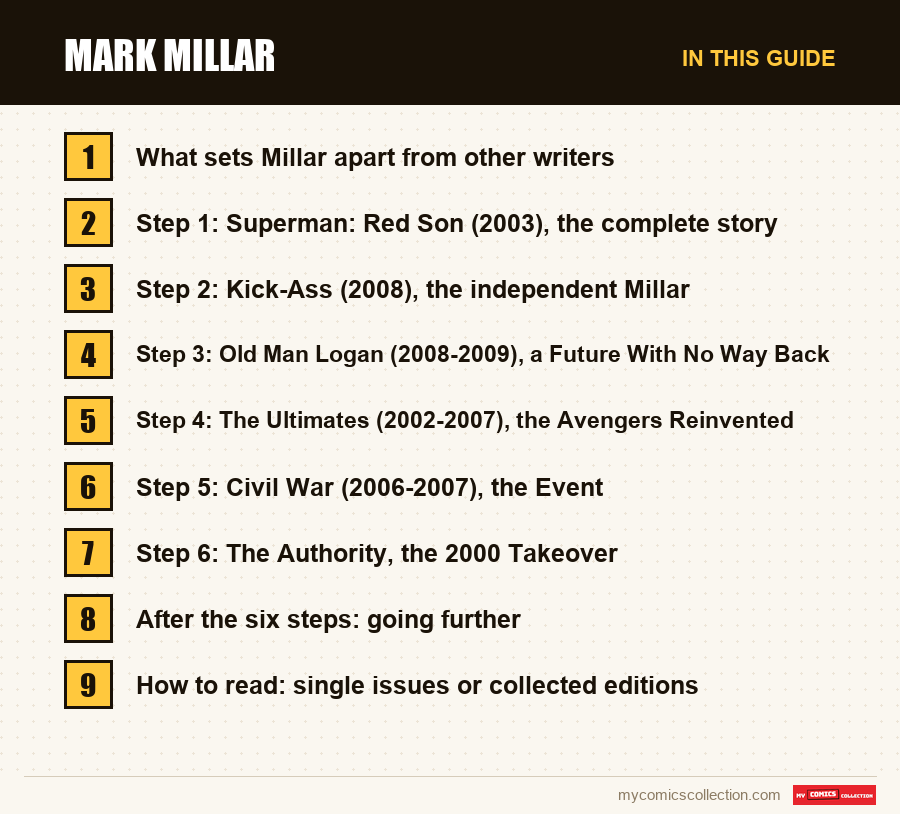
Step 5: Civil War (2006-2007), the Event
Seven issues drawn by Steve McNiven, at the heart of the main Marvel universe: a hero registration law splits Iron Man and Captain America. The story is Millar's most ambitious piece for the main continuity, and it is only fully appreciated with its tie-ins, that is, dozens of issues from side series.
That link to the rest of the universe is what puts it at number five. Reading it alone is possible, but you will miss what the other series tell. Collecting benchmarks are detailed in our file on the key issues of Civil War, and the 2016 adaptation is compared in the film versus comics article. The central collected edition is enough for reading; single issues are for anyone who wants to assemble the whole event.
Step 6: The Authority, the 2000 Takeover
Millar took over the series The Authority at issue 13, in 2000, after Warren Ellis, with Frank Quitely among the artists. The team of superhumans that allows itself to act as a parallel government becomes even more provocative here. The series is ranked last because it assumes you know the opening run by Ellis, accept a pronounced register of violence and put up with changing artists.
It is nonetheless the lab for many moves Millar would reuse later in The Ultimates: the team seen as a political power, the splashy set pieces. For a reader who has followed the five previous steps, it shows where those devices come from. For collecting, collected editions are better, because the single issues from that period are scattered across several collections.
After the six steps: going further
Once the route is finished, several paths open up depending on your taste. Wolverine fans can read the Enemy of the State arc, published in the Wolverine series in 2004-2005 with John Romita Jr. on art. Those who prefer team books have the Fantastic Four run written with Bryan Hitch starting at issue 554, in 2008. The curious about the personal universe will head to Nemesis (2010, art by Steve McNiven), Marvel 1985 (2008, Tommy Lee Edwards) or Jupiter's Legacy (2013, Frank Quitely).
These titles are less necessary than the first six: they extend a style more than they offer essential reading. Their place on a shelf depends on your taste for the paired artist more than on the writer's name. If you follow one illustrator in particular, that artist should guide your purchases, and the catalog lets you find everything signed with Millar.
Finally, a word on what is best avoided at the start: Millar's recent series published in successive small formats read better once the style is tamed, because they reuse the devices without introducing them. Begin with the closed stories, and keep the ongoing titles for the end.
How to read: single issues or collected editions
Millar's short stories read well in collected form: Red Son, Kick-Ass, Old Man Logan and Civil War gain their continuity there. Keep single issues for what you want to preserve as objects: the first issue of Kick-Ass, Wolverine #66, the first issue of The Ultimates. Each one is explained in the hub devoted to Mark Millar, which also holds the author's reference points.
One last organizational point: Millar's series are published by several publishers, and their French editions do not follow the same pace. Before buying a volume, check the catalog for the list of issues it contains, especially for the miniseries that appear in several collected editions.
Recap: the recommended order
- Step 1: Superman: Red Son (2003), three issues.
- Step 2: Kick-Ass (2008), eight issues, with John Romita Jr.
- Step 3: Old Man Logan (Wolverine #66-72, 2008-2009).
- Step 4: The Ultimates and The Ultimates 2 (2002-2007).
- Step 5: Civil War (2006-2007), seven issues.
- Step 6: The Authority, from issue 13 (2000).
Frequently asked questions
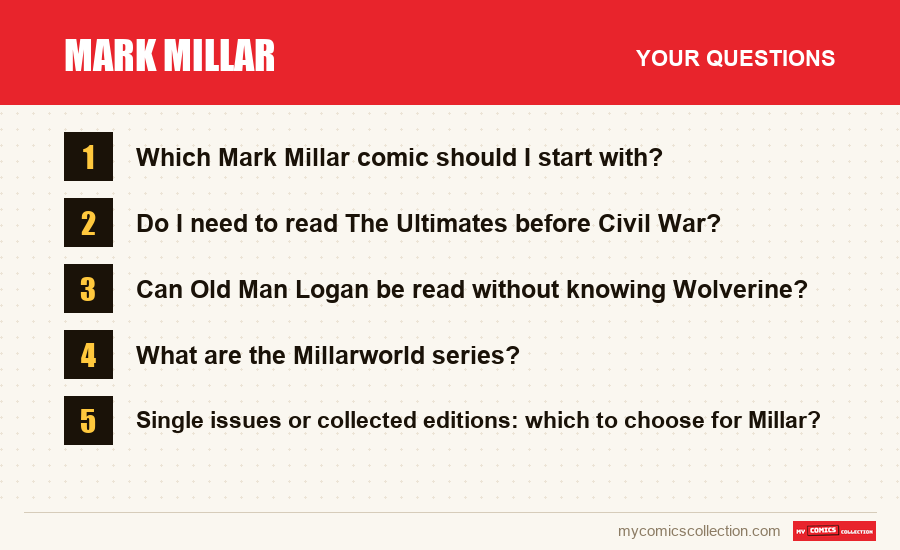
Start with Superman: Red Son (2003). The story runs three issues and assumes no earlier Superman reading. Kick-Ass (2008) is a good second read if you prefer a more contemporary tone and a world without established superheroes.
No. The two stories belong to different universes: The Ultimates takes place in the Ultimate universe, Civil War in Marvel's main universe. Reading them in any order changes nothing about understanding. Only familiarity with Millar's style makes the entry easier.
Yes, for the most part. The story introduces its hero, its world and its enemies along the way. A few nods go over the head of anyone who doesn't know the X-Men, but the plot by Millar and Steve McNiven stays understandable from the first episode, published in Wolverine #66.
They are the series Mark Millar created outside the major publishers, such as Wanted, Kick-Ass or Kingsman: The Secret Service. The whole catalog was bought by Netflix in 2017. They read separately, in no set order, and several have led to films.
For reading, collected editions: they gather the miniseries in the right order. For collecting, favor the single issues of the first numbers, like Kick-Ass #1 or Wolverine #66. In both cases, check the exact list of issues in the catalog before buying.
Your Mark Millar single issues, from Wolverine #66 to Kick-Ass #1, are valued according to the edition, the print run and the exact condition of each copy.
Estimate my comic