Kingsman: The Secret Service (2014) Matthew Vaughn , with Colin Firth and Taron Egerton , adapts the comic The Secret Service of Mark Millar and Dave Gibbons (Icon/Marvel, 2012). The film takes up the concept of the gentleman spy training a young man from the suburbs, amplifying it. Here is the detailed comparison, film versus comics.
A stylish adaptation of a spy comic by Mark Millar, Kingsman revisits the spy film with panache and second degree. Source-by-source decryption.
As in each article in this series, only verified information (creators, distribution, dates, publishers) is stated; the comparative analysis is ours, without reproducing dialogue or protected images.
Title : Kingsman: The Secret Service (2014)
Director: Matthew Vaughn
Actors: Colin Firth (Harry Hart), Taron Egerton (Eggsy), Samuel L. Jackson (Valentine)
Exit : December 2014
Studio: 20th Century Fox
The Secret Service (2012): Mark Millar & Dave Gibbons
icon: Marvel's creator-owned label
A gentleman spy: training his nephew
A tribute: to classic spy films
- L'gentleman spy recruiting a young person from the suburbs.
- The contrast elegance / street at the heart of the story.
- The spy agency independent and refined.
- The tribute to spy movies classics.
- The bad guy global plan disproportionate.
- The agency becomes the “Kingsman», names of the Round Table.
- The mentor is a friend, not Eggsy's uncle.
- The action is stylized to the extreme (Vaughn).
- The evil Valentine and his plan are amplified.
- The tone pushes it second degree.
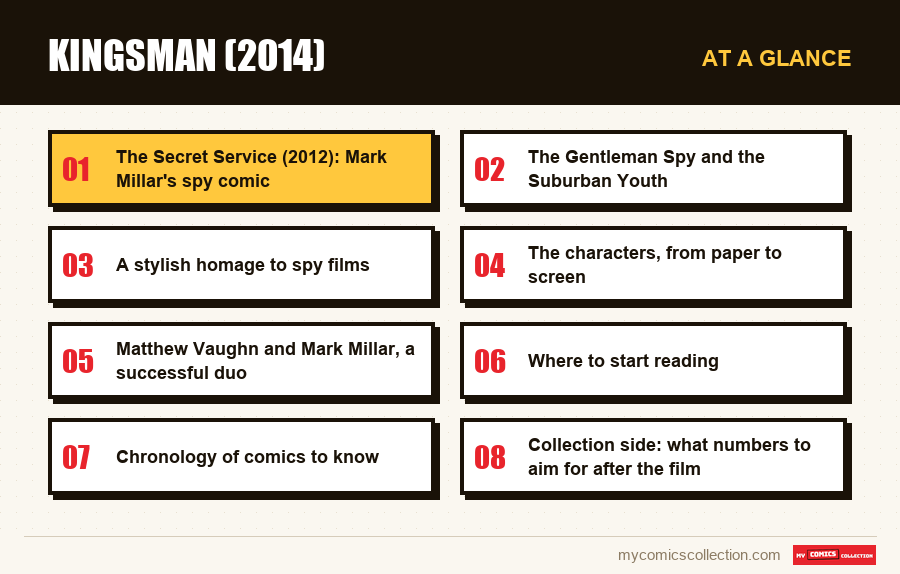
The Secret Service (2012): Mark Millar's spy comic
Kingsman adapts the comic book The Secret Service, written by Mark Millar and drawn by Dave Gibbons (famous for his work on Watchmen), published in 2012 under the Icon label, Marvel's creator-owned imprint. The comic is a modern homage to classic spy films, tinged with Millar's signature humor and violence. It features a stylish and sophisticated British spy who recruits his nephew, a young man from an underprivileged background, to introduce him to the world of elite espionage. The story plays on the contrast between the refinement of the seasoned agent and the popular origins of the young recruit, while facing a global threat orchestrated by a disproportionate antagonist. Millar displays his taste for spectacular action and the renewal of classic genres.
Matthew Vaughn's film takes up the central concept: a British gentleman spy, played by Colin Firth, recruits and trains a young suburban man, Eggsy, to join a secret and refined spy agency. The film maintains the contrast between the elegance of the agent and the popular origins of the recruit, the homage to classic spy films, the independent agency and the villain on a disproportionate global level. This fidelity to the fundamental concept anchors the film in the spirit of comics. Matthew Vaughn, already an adapter of Kick-Ass, however, considerably amplifies the style, the action and the second degree, while modifying certain elements such as the nature of the agency and the link between the mentor and the young hero.
The Gentleman Spy and the Suburban Youth
The heart of Kingsman, faithfully taken from the comic, is the relationship between the gentleman spy and the young suburban boy he trains. This contrast: between the refinement, tailored suits and impeccable manners of the seasoned agent, and the working-class origins, street language and raw potential of the young recruit: is the driving force of the story. It explores themes of social class, merit and inheritance, suggesting that nobility comes from deeds and not birth. This dynamic of mentor and protégé, where elegance meets the street, gives the story its thematic richness and charm, while renewing the codes of the classic spy film.
The film fully exploits this relationship, at the heart of its intrigue and its emotion. Colin Firth plays the gentleman spy with perfect elegance, while Taron Egerton brings to life Eggsy, a talented young man but marked by his environment. Their relationship, between transmission and affection, is the common thread of the film. This dimension, faithful to the comic strip, delicately addresses the question of social mobility and merit, under the guise of a stylish action film. The film, however, modifies the family bond: in the comics, the young recruit is the nephew of the spy, while the film makes him a friend of the family. For the reader, this mentor-protege relationship is the emotional heart of the work, to be discovered in the comics of Millar and Gibbons, where social contrast and transmission are explored with the intelligence and humor characteristic of their authors.
A stylish homage to spy films
Kingsman, both comic book and film, is above all a homage to classic spy films, particularly those featuring stylish British agents. The comic by Mark Millar and Dave Gibbons revisits this genre with a modern look, mixing respect for codes (costumes, gadgets, global villain, sophisticated agent) and offbeat humor. The film takes this homage further, fully assuming the second degree and stylizing the action to the extreme. Matthew Vaughn transforms action scenes into choreographed bravura pieces, filmed with remarkable energy and visual inventiveness. This homage, both reverential and parodic, renews the spy genre with panache, celebrating its codes while having fun with it.
This approach illustrates Matthew Vaughn's talent for revitalizing a classic genre. By amplifying the style, humor and action of the comics, the film creates spectacular entertainment that pays tribute to espionage while reinventing it. The agency, renamed “Kingsman” with its agents bearing the names of the Knights of the Round Table, embodies this mythologized British elegance. The evil Valentine and his disproportionate plan push the logic of the genre to exhilarating excess. For the reader, this homage is a celebration of the spy film, revisited by Millar and Gibbons then sublimated by Vaughn. He reminds us that comics know how to take classic cinema genres to reinvent them, and that Kingsman, both in comics and on screen, is refined and unbridled entertainment, mixing elegance, action and second degree with a typically British panache.
Collecting this series?
Track what you own, what you are missing and what your collection is worth. 7 day trial.
Start my trial →The characters, from paper to screen
- Harry Hart / Galahad: The gentleman spy, faithful to the concept of the comics.
- Eggsy: The young man from the suburbs recruited, nephew in the comics, friend in the film.
- Valentine: The global villain, amplified for the film.
- Merlin: The Kingsman agent trainer.
- The Kingsman agency: The refined spy organization.
Matthew Vaughn and Mark Millar, a successful duo
Kingsman marks Matthew Vaughn's second major adaptation of a Mark Millar work, following Kick-Ass. This duo between author and director proved particularly fruitful: Vaughn was able to capture the provocative energy, humor and stylized action that characterize Millar's works, while bringing his own visual inventiveness. With Kingsman, he transformed a spy comic into a successful franchise, confirming his ability to adapt Millar's universes to the big screen. This collaboration illustrates the appeal of the Scottish author's works for cinema, and Vaughn's role as one of his privileged adapters. The success of Kingsman spawned sequels, making the franchise one of the most profitable to come from a Millar work.
This success illustrates the vitality of creator-owned comics as a source of stories for Hollywood. Mark Millar, by retaining the rights to his creations, has built a catalog of properties adapted for cinema, of which Kingsman is one of the flagships. Matthew Vaughn's talent for restoring energy made these adaptations successful. For the reader, this duo reminds us that certain comic book works, through their style and cinematic ambition, have become major franchises. Kingsman is the fruit of this meeting between a prolific author and an inventive director, offering an adaptation that honors the comic strip while sublimating it. It invites you to discover The Secret Service by Millar and Gibbons, the work at the origin of a franchise that has become emblematic of modern and offbeat spy cinema.
Where to start reading
To discover the source, the comic strip The Secret Service by Mark Millar and Dave Gibbons (2012) is available as a collection. A complete and autonomous story, it offers the original version of the concept, tighter than the film. The drawing by comic book legend Dave Gibbons makes it a visually remarkable work. This comic reveals the foundations of a successful film franchise.
Chronology of comics to know
- 2012: The Secret Service: the mini-series by Mark Millar and Dave Gibbons at Icon.
- 2014: The film Kingsman adapts and amplifies the concept.
- 2015+: The success of the film led to cinematic sequels.
Collection side: what numbers to aim for after the film
Kingsman points to modern keys. The Secret Service #1 (2012, first issue of the comic at Icon) is the key sought by collectors, marking the origin of a successful franchise. Issues drawn by comic book legend Dave Gibbons are popular. The collections are accessible targets. These numbers cover generally affordable budgets. As always, condition and gradation determine value; relying on real recent sales is strongly recommended.
Its place in the saga and for the collector
Kingsman will remain as a stylish and successful adaptation of a spy comic by Mark Millar, revisiting the genre with panache and second degree. For the collector, it highlighted The Secret Service, work by Millar and Gibbons at Icon. It illustrates the fertility of the Vaughn-Millar duo and the appeal of creator-owned properties. Beyond the film, the original comic book is worth discovering for its concept and the drawing by Dave Gibbons. Kingsman reminds us that comics know how to reinvent classic cinema genres, and that the works of Mark Millar continue to inspire successful franchises.
The verdict: a faithful and amplified tribute
- Loyalty: the gentleman spy training a young man from the suburbs, the elegance/street contrast, the refined agency, the homage to spy films and the global villain come from comics.
- Freedoms: the agency renamed Kingsman (Round Table), the mentor becoming a friend and not an uncle, the action stylized to the extreme, Valentine and his plan amplified, the second degree pushed.
- Collectible numbers: The Secret Service #1 (2012, Icon/Marvel).
Kingsman adapts the spy comic by Mark Millar and Dave Gibbons, taking the concept of the gentleman spy training a suburban youth and amplifying it with style and second degree. Faithful to the concept and the homage to the genre while stylizing the action to the extreme, the film is successful entertainment. For both the reader and the collector, it is an invitation to discover The Secret Service.
Frequently asked questions
From The Secret Service (2012), written by Mark Millar and drawn by Dave Gibbons (of Watchmen fame), published under Marvel's Icon imprint. The comic, a homage to spy films, features a gentleman spy training a young person from a disadvantaged background. The film adapts it by amplifying it.
In its concept, yes: the gentleman spy, the recruited suburban youth, the elegance/street contrast, the homage to espionage and the over-the-top villain. Matthew Vaughn, however, amps up the style, action, and second-degree, and changes things like the nature of agency and the mentor-hero bond.
In the comics, the young recruit is the nephew of the gentleman spy. The film modifies this link: Eggsy is the son of a former colleague of Harry Hart, who takes him under his wing out of loyalty to his deceased father. Social contrast and transmission remain at the heart of the relationship.
Dave Gibbons, a comic book legend, most famous for his work on Watchmen with Alan Moore. His design makes The Secret Service a visually remarkable work, at the origin of the Kingsman film franchise.
The Secret Service #1 (2012, first issue at Icon) is the key sought after, marking the origin of a successful franchise. The issues drawn by Dave Gibbons are popular, and the collections are accessible targets for readers.
Does the film make you want to collect? Estimate the value for free of your numbers (The Secret Service #1…) with our tool based on current eBay listings.