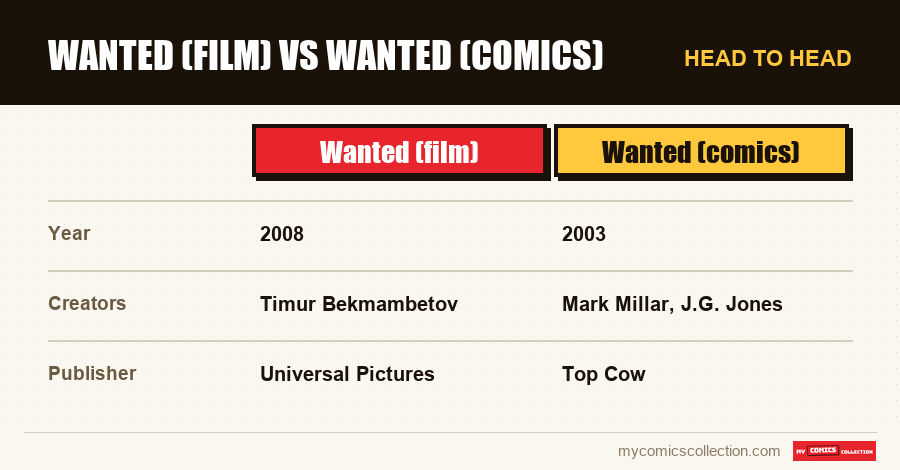
Wanted (2008) Timur Bekmambetov , with James McAvoy and Angelina Jolie, adapts the comic book of Mark Millar and Jones (Top Cow, 2003). The film radically transforms the story: the comic book supervillains become a brotherhood of assassins. Here is the detailed comparison, film versus comics.
A very free adaptation of a provocative comic book, Wanted illustrates how a film can maintain a concept while changing everything else. Source-by-source decryption.
As in each article in this series, only verified information (creators, distribution, dates, publishers) is stated; the comparative analysis is ours, without reproducing dialogue or protected images.
Title : Wanted (2008)
Director: Timur Bekmambetov
Actors: James McAvoy (Wesley), Angelina Jolie (Fox), Morgan Freeman (Sloan)
Exit : June 2008
Studio: Universal Pictures
Wanted (2003): Mark Millar & Jones
Top Cow: the publisher (Image Comics label)
A brotherhood of supervillains: having killed the heroes
Wesley Gibson: the employee turned assassin
- Wesley Gibson, mediocre employee with a dull life.
- La revelation of his secret heritage.
- Her recruitment by a hidden organization.
- Sa transformation as an exceptional killer.
- Le ultraviolent tone and provocative.
- THE supervillains become a brotherhood of assassins.
- THE "Loom of Destiny» replaces the superhero theme.
- THE curved balls replace superpowers.
- The end is reversed morally.
- Comic book satire disappears.
Wanted (2003): Mark Millar's super-villain satire
Wanted adapts the comic book created by Mark Millar and drawn by J.G. Jones, published in 2003 by Top Cow, an Image Comics imprint. A provocative and ultraviolent work, the comic proposes a radical concept: in a world where supervillains have secretly defeated and exterminated all superheroes, they now reign in the shadows, even erasing the memory of the heroes from collective memory. The story follows Wesley Gibson, a mediocre and cowardly employee, who discovers that his late father was a legendary supervillain, the Assassin. Recruited by a brotherhood of criminals with superpowers, Wesley embraces this heritage and transforms into a ruthless killer. Millar delivers a cynical satire of the superheroic genre and a critique of mediocrity, driven by his provocative style and graphic violence.
The film takes up the skeleton of the story: Wesley Gibson, a mediocre employee with a dreary life, discovers his secret heritage, is recruited by a hidden organization and transforms into an exceptional assassin. James McAvoy embodies this evolution, from self-effacing man to fearsome killer. The film maintains the ultraviolent tone, the provocation and the theme of the revelation of unsuspected potential. However, it carries out a radical transformation of the central concept: the supervillains of the comics become a brotherhood of non-supernatural assassins, guided by a mysterious “Loom of Destiny”. This rewriting, one of the most significant of the genre, retains the energy of the comic strip while abandoning its superheroic satire.
From supervillains to a brotherhood of assassins
The most radical transformation between the comic and the film concerns the central concept. In Mark Millar's comics, the universe is populated by supervillains with superpowers, who have eradicated superheroes and secretly dominate the world. This premise, a satire of the superheroic genre, is the heart of the work. The film completely abandons this dimension: there are no supervillains or superpowers, but a brotherhood of elite assassins, "the Brotherhood", guided by a mystical artifact, the "Loom of Destiny", which designates the targets to be eliminated. The superhuman abilities of the comics are replaced by extreme talents: such as the ability to bend the trajectory of bullets -, closer to the action thriller than to the story of supervillains.
This rewriting is explained by commercial and rights considerations: faithfully adapting a superhero satire would have been legally and thematically complex. The film therefore chooses to preserve the energy, violence and structure of the story, the ordinary man revealing extraordinary potential, while radically changing its universe. The result is a spectacular action thriller, very different from comics in its subject matter. Where Millar criticized the superhero genre and mediocrity, the film delivers pure action entertainment. For the reader, this gap illustrates an adaptation which preserves the skeleton of a work while changing its soul. The film invites you to discover the original comic book, whose cynical satire and the concept of triumphant supervillains offer a story much more provocative and subversive than the action thriller that was based on it.
Wesley Gibson, from mediocrity to power
The heart of the story, preserved in the film, is the trajectory of Wesley Gibson. A mediocre office worker, dominated by his superiors and deceived by his partner, Wesley leads a life of frustration and powerlessness. The revelation of his heritage, his father was a legendary assassin, and his recruitment turn his life upside down, transforming him from a self-effacing man into a powerful and assured killer. This evolution, from mediocrity to mastery, is the common thread of the comics and the film. It carries a universal theme: the fantasy of the ordinary man discovering that he is destined for something greater, and freeing himself from his mediocre life to embrace his potential.
The film fully exploits this trajectory, making Wesley's transformation the emotional and spectacular driving force of the story. James McAvoy embodies this metamorphosis with conviction, from the dim character at the beginning to the controlled killer at the end. This theme of revealed potential, faithful to the comics, resonates with the public. The film and the comics, however, diverge on the meaning of this evolution: where Millar leans towards a provocative cynicism, the film offers a more heroic trajectory and a morally different ending. For the reader, this difference illustrates the choices of an adaptation seeking a balance between provocation and general public entertainment. Wanted invites you to discover the original comic strip, where Wesley's transformation is part of a much darker and more disturbing satire, offering an uncompromising look at power, mediocrity and fantasies of omnipotence.
Collecting this series?
Track what you own, what you are missing and what your collection is worth. 7 day trial.
Start my trial →The characters, from paper to screen
- Wesley Gibson: The mediocre employee turned assassin, faithful to the comics.
- Fox: The assassin who recruits Wesley, adapted for the film.
- Sloan: The leader of the brotherhood, reinvented for the film.
- Wesley's father: The legendary assassin he inherits.
- The Brotherhood: The organization of assassins, replacing the supervillains.
Mark Millar, story provider for cinema
Wanted illustrates Mark Millar's place as one of the most cinematic comic book writers. With Wanted, Kick-Ass, Kingsman and other works, Millar has built an entire catalog of creator-owned properties, designed with a sense of spectacle and provocation that appeals to Hollywood. His stories, often violent, cynical and high-concept, offer studios rich cinematic material. Millar has made adaptation a real strategy, creating universes designed for the big screen. Wanted is one of his first successful adaptations, confirming the appeal of his works for action cinema.
This dynamic illustrates the evolution of creator-owned comics as a source of stories for Hollywood. Authors like Mark Millar, by retaining the rights to their creations, can sell them to the cinema, where their energy and originality find a new audience. Wanted, despite its radical rewriting, testifies to the ability of Millar's works to inspire spectacular films. For the reader, this success reminds us of the vitality of author comics and its growing influence on cinema. It invites you to discover the original works of Mark Millar, often more daring and subversive than their adaptations. Wanted is an example of this bridge between independent comics and blockbusters, where a provocative concept born in the pages of a comic becomes global action entertainment, even if it means losing its original satirical charge.
A reflection on mediocrity and power
Beyond the action, Wanted carries, in the comics as in the film, a provocative reflection on mediocrity and the desire for power. Wesley Gibson initially embodies the alienated modern man: a featureless employee, crushed by his work, his hierarchy and a life without perspective. His transformation into a powerful killer is presented as a liberation from this mediocrity, a fantasized revenge against a frustrating existence. This theme resonates with a wide audience, playing on the universal fantasy of escaping a dull life to embrace an extraordinary destiny. Mark Millar's comic strip pushes this idea to the point of disturbing cynicism, while the film offers a more consensual and heroic version.
This difference in treatment reveals the opposing intentions of the two works. Where Mark Millar uses Wesley's trajectory to deliver a dark satire of society and fantasies of omnipotence, the film makes it a more classic story of emancipation, where the hero finds meaning in his life. Comics question, provoke and disturb; the film entertains and exhilarates. This divergence illustrates how the same theme can serve radically different purposes depending on the treatment. For the reader, this reflection on mediocrity and power is at the heart of Wanted's appeal, developed with much more bite in the comics. It invites us to discover the work of Millar, whose cynical look at human nature and power fantasies offers a much more subversive and disturbing reading than the action thriller that was drawn from it, revealing the satirical depth of a work that the film has largely watered down.
Where to start reading
To discover the source, the comic strip Wanted by Mark Millar and J.G. Jones (2003) is available in collection. A complete and self-contained story, it offers a radical counterpoint to the film, with its satire of superheroes and its concept of triumphant supervillains. This short and provocative work can be savored in one sitting, revealing all the darkness of the original material.
Chronology of comics to know
- 2003: Wanted: the mini-series from Mark Millar and J.G. Jones at Top Cow.
- 2004: The publication in a collection confirms the success of the comic strip.
- 2008: The film freely adapts the concept, transforming it.
Collection side: what numbers to aim for after the film
Wanted points to modern keys. Wanted #1 (2003, first issue of the comic at Top Cow) is the key sought after by collectors, marking one of Mark Millar's first successful adaptations. The issues of the mini-series, drawn by J.G. Jones, are popular. The collections are accessible targets. These numbers cover generally affordable budgets. As always, condition and gradation determine value; relying on real recent sales is strongly recommended.
Its place in the saga and for the collector
Wanted will remain as an example of very free adaptation, retaining the concept of an ordinary man revealing extraordinary potential while abandoning the superheroic satire of the comics. For the collector, it highlighted Wanted #1, the key to a work by Mark Millar at Top Cow. It illustrates the power of cinema to rewrite a source. Beyond the film, the original comic book deserves to be discovered for its provocation and its darkness. Wanted reminds us that an adaptation can preserve the energy of a work by radically changing its subject and its universe.
The verdict: a concept preserved, a universe rewritten
- Loyalty: Wesley Gibson, the revelation of his heritage, his recruitment, his transformation into a killer and the ultraviolent tone come from the comics.
- Freedoms: supervillains turned assassins, the “Loom of Destiny,” curveballs replacing superpowers, the ending reversed, the comic book satire gone.
- Collectible numbers: Wanted #1 (2003, Top Cow).
Wanted very freely adapts the satire of Mark Millar and J.G. Jones, retaining the trajectory of Wesley Gibson while transforming the comic book supervillains into a brotherhood of assassins. Staying true to the energy and structure of the story but abandoning its superheroic satire, the film is a spectacular action thriller. For both the reader and the collector, it is an invitation to discover the Wanted comic strip.
Frequently asked questions
From Wanted (2003), created by Mark Millar and drawn by J.G. Jones, published by Top Cow (Image Comics label). The comic imagines a world where supervillains have exterminated the heroes and reign in secret. The film takes its structure but radically transforms this concept.
Partially. It retains the trajectory of Wesley Gibson, the mediocre man revealing extraordinary potential, and the ultraviolent tone. But he abandons the satire of superheroes: the supervillains become a brotherhood of assassins guided by a “loom of destiny”.
For commercial and rights reasons, faithfully adapting a superhero satire was complex. The film maintains the energy and structure of the story while replacing the supervillains with elite assassins, transforming a satire of the genre into a pure action thriller.
One of the comic book authors most adapted to cinema. With Wanted, Kick-Ass, Kingsman and other creator-owned works, he has built a catalog of properties made for the big screen. His violent, high-concept stories seduce Hollywood with their provocative energy.
Wanted #1 (2003, first issue at Top Cow) is Wanted, marking one of Mark Millar's first successful adaptations. The issues of the mini-series, drawn by J.G. Jones, are popular, and the collections are accessible.
Does the film make you want to collect? Estimate the value for free of your numbers (Wanted #1…) with our tool based on current eBay listings.