In short
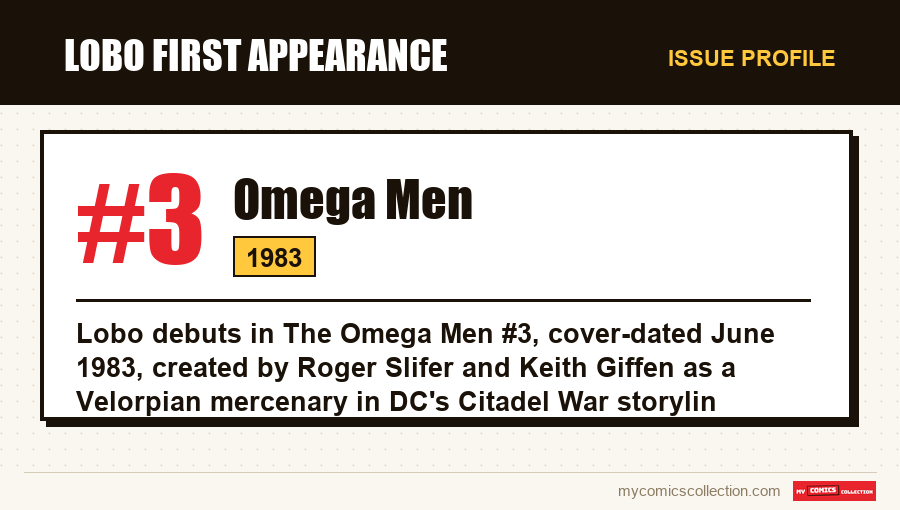
The debut of Lobo is The Omega Men #3, a DC book dated June 1983 on its cover. Roger Slifer and Keith Giffen created him in the second-tier space series they were producing together, where he arrives during the Citadel War storyline as a Velorpian mercenary partnered with Bedlam. That version of the character was rewritten in 1990, when he became the last Czarnian. The issue is a chronology piece rather than a reading starter: it is the debut copy, not the story that made Lobo famous.
Few debut issues sit as far from the character's later fame as The Omega Men #3. The cover of that June 1983 comic belongs to a team of rebels fighting a fortress-moon regime, and the figure who would later carry his own miniseries, an ongoing series and a long run of guest spots is a newcomer inside someone else's war. For a collector, that gap between the modest debut and the loud afterlife is exactly what makes this number worth a careful look.
What was verified here: the June 1983 date, the two credited creators, Lobo's first species and partner, and the later series that fix the issue in the chronology. The buying advice is analysis of our own, and no dialogue or artwork is reproduced.
The identity of the issue: cover date and credits
Number 3 of The Omega Men carries a June 1983 cover date and a DC Comics imprint. The series had launched with an April 1983 cover date, so the third issue is the third month of a monthly title, not a late-run surprise. Roger Slifer wrote the series and Keith Giffen drew it; the two men are credited as the creators of Lobo. We name only the writer and the artist for this issue, and no inker, letterer or colorist.
That caution is useful at the shop counter. A seller who quotes a full credit list for a single early-1980s issue is often reading it off a catalog entry that describes the series, not the book in hand. The two names that matter for the character are Slifer and Giffen, and both appear in every serious account of the debut.
The cover date matters for a second reason. In the early 1980s, a cover date ran ahead of the actual release, so June 1983 on the masthead does not mean the comic reached stands in June. A listing that reads "June 1983" quotes the masthead, which is what catalogs can pin down.
The series around it: the Omega Men and the Citadel
To understand why Lobo is easy to overlook in this issue, look at what surrounds him. The Omega Men ran monthly for 38 issues, from April 1983 to May 1986. The team's premise is a band of rebels from different worlds opposing the Citadelians, a warrior race cloned from the First Citadelian, who ruled the Vega system from a fortress moon called the Citadel. Founding members include Tigorr, Broot, Doc, Kalista and Nimbus, and Primus, the telepath and telekinetic, who dies during the Invasion! storyline.
The team had been introduced earlier, in Green Lantern vol. 2 #141, cover-dated June 1981, so by the time the 1983 series opened the Omega Men were not new; the book was a fresh start for an existing cast. That is worth noting for anyone who assumes the whole franchise begins with Lobo's debut. It does not. Lobo is an addition to an ensemble that was already a few years old, and he is introduced in a storyline called the Citadel War.
The ensemble structure explains the tone of the issue. Nothing about the series was built around a single breakout. Readers of the day followed the rebels, the politics of the Vega system and the fate of individual members, and a mercenary appearing in issue #3 would have read as one more colorful figure on a crowded page. Later collectors read the same page with hindsight.
How Lobo is introduced
In The Omega Men #3, Lobo arrives as a regular element of the Citadel War storyline. He is a Velorpian, a member of a species described as exterminated by the Psions, and he is partnered with a character named Bedlam. Later stories show Lobo killing Bedlam, which turns the pair into a short-lived association rather than a lasting duo. We stay at the level of premise here and do not retell the issue panel by panel, both because the facts we can confirm stop at the premise and because the point for a buyer is who he is on the page, not the choreography of one scene.
What a reader who knows only the later Lobo will notice is how much is missing. The biker silhouette, the chain and the signature humor come later, with the 1990 miniseries Lobo: The Last Czarnian, which Giffen plotted, Alan Grant scripted and Simon Bisley drew. The version in issue #3 belongs to a different continuity: another species, another past, another partner. When people say Lobo debuted "as a mercenary," this is the character they mean, and the label fits the role even though the portrait does not.
Who made him, and in what editorial setting
Roger Slifer and Keith Giffen are the credited creators. Giffen is the thread that runs through the character's life. He drew the debut and plotted the 1990 miniseries. A guest spot in Justice League International that went over well led to regular work for Lobo in L.E.G.I.O.N. and then in its successor R.E.B.E.L.S. The L.E.G.I.O.N. team itself debuted in Invasion! #1, cover-dated December 1988, and in the series that grew out of it Lobo is a Czarnian bounty hunter whom Vril Dox turns into a valued ally.
The editorial setting is a second-tier DC space title of the early 1980s, a book aimed at readers who liked ensemble science fiction rather than capes. That setting is why the debut sits quietly in the middle of a run and not at the front of a new line. Our guide to the history of Lobo in comics follows that thread through the later eras, while this page stays on the single number.
Do you collect this series?
Track what you own, what you are missing and what your collection is worth. 7-day trial.
Start my trial →
Why a quiet debut became a key issue
The issue became a key number because of what came after it, not because of what it contained. The sequence runs like this. After 1983, Lobo moved to the Justice League book, then to L.E.G.I.O.N., then to the 1990 miniseries that reworked his origin and look, and then to a long run of miniseries, specials and his own ongoing series, which ran for 64 issues from 1993 to 1999. By the time a reader wanted to see where it all began, the debut was already a back-issue from a book that had ended in 1986.
The seven years between the debut in 1983 and the breakout in 1990 also mean that readers arriving in the 1990s looked backward, and that backward glance is why the issue is still searched for as a first appearance more than four decades later.
There is a counterpoint worth stating plainly: a key issue is a market label, not a quality judgment. If you want to read the best Lobo, start with the 1990 miniseries. If you want the earliest printed appearance, this is the book. Our guide to the best Lobo comics sorts the reads, and this one sorts the debut.
Reprints, collected editions and numbers often confused
The debut issue is reprinted in a collected volume: Lobo Big Fraggin Compendium Book One lists The Omega Men #3 among its contents. A collected edition gives you the story, but it is not the debut copy, and it should never be described as one. For a reader who wants the story and not the artifact, a reprint volume is the practical route; for a collector who wants the artifact, the original newsstand or direct-market comic is the item.
Several nearby numbers are easy to mix up. The first is the 1990 miniseries, Lobo: The Last Czarnian, four issues launched in 1990, which is where the modern character was built. It is not the debut, even though many readers meet Lobo there first and assume the story starts there. The second is the Justice League appearance that led to his regular role; it is a notable early guest spot, not the first appearance. The third is the 1993 ongoing series, whose opening issue sells on its own merits as a series debut.
A fourth confusion involves the Omega Men themselves. The team's earlier appearance in Green Lantern vol. 2 #141 is a team debut, and it is unrelated to Lobo. A listing that mixes the two is wrong about which character is being introduced. When you search a catalog, confirm that the entry is for The Omega Men vol. 1 #3 of 1983, and not a later volume of the series that carries the same title.
What to check before buying a copy
Start with identification. The cover must read as the 1983 series, number 3, with the June 1983 date, and the interior should be complete. Condition varies widely from copy to copy for a mass-produced monthly of that period.
The details that matter most are physical. Run a finger along the spine for stress lines, then examine staples for rust, corners for blunting and the glossy cover for scuffs. A copy that looks too perfect for its age deserves a second look at the margins and the spine, because pressing and restoration exist in this market. The article on restoration and value lists telltale signs of cleaning, color touch-up and spine repair.
Next, think about edition. Copies of this period circulated both through newsstands and through direct-market comic shops, so when two listings of this number differ in price, read each description for the distribution channel before concluding anything. Our direct versus newsstand guide explains how to tell them apart.
Then decide between raw and certified. A third-party graded copy comes in a sealed holder with a numeric grade, a label and a certification number; the number can be checked against the grader's database before you pay. A raw copy costs you the work of assessing it yourself but gives you the pages in hand. The choice depends on how you plan to keep the book. If you want to learn how a grade moves a price, read how a grade affects value, which explains the mechanism in ratios rather than amounts.
Finally, be wary of descriptions that stretch the facts. A listing that calls the book the "first Lobo" is fine; a listing that calls it the "origin of the last Czarnian" is wrong, since that origin was written years later. A listing that credits the 1990 creative team to this issue is also wrong. The debut belongs to Slifer and Giffen and to a Velorpian mercenary.
The later appearances that complete the picture
A collector who buys the debut usually wants three or four later books to give it context. The most useful ones, all verified, are these.
First, the Justice League guest appearance that brought him to a wider audience. It is the bridge between the space title and the company-wide shared universe, and it explains why a character from a second-tier book reached new readers. Our Justice League key issues places the book in its series.
Second, Invasion! #1 (December 1988), where the future L.E.G.I.O.N. cast is introduced, and the L.E.G.I.O.N. series launched in 1989 with Giffen among its co-creators. It is where Lobo ends up working alongside Vril Dox, and it shows how the character functions in a team. Our Invasion! reading order shows where the crossover fits.
Third, the four-part Last Czarnian miniseries of 1990: Giffen supplied the plot, Alan Grant the script and Simon Bisley the art. This is the mini that turns Lobo into the character the public knows.
Fourth, the ongoing series launched in 1993, and the March 2026 relaunch that proves the character still has commercial life more than four decades after the debut. Those two are optional for a collector of the debut, but they mark the endpoints of the arc.
Frequently asked questions
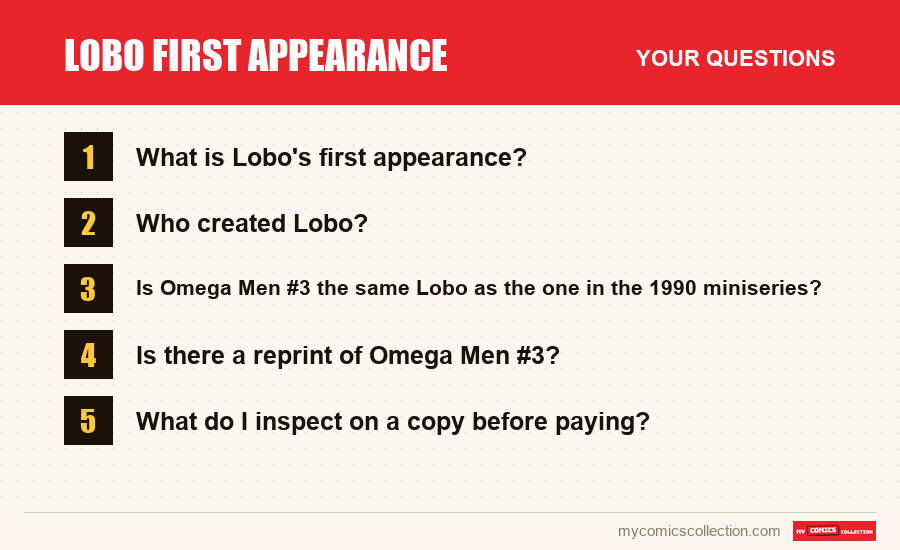
He debuts in The Omega Men #3, whose cover reads June 1983. Roger Slifer and Keith Giffen created him in that DC space series, where he enters during the Citadel War storyline as a Velorpian mercenary partnered with a character named Bedlam. His modern origin as the last Czarnian came later, in 1990.
Roger Slifer and Keith Giffen are the credited creators of Lobo. Slifer wrote The Omega Men and Giffen drew it. Giffen later plotted the 1990 miniseries Lobo: The Last Czarnian with Alan Grant as scripter and Simon Bisley as artist, which reshaped the character into the version most readers know.
Not exactly. In 1983 he is a Velorpian, partnered with Bedlam, and his past is tied to the Psions. The 1990 miniseries rewrites that origin so that he is the last Czarnian, and Simon Bisley's art fixes the look associated with the character today.
Yes. The story appears in the collected volume Lobo Big Fraggin Compendium Book One. A collected volume gives you the story but not the original comic, so a listing should never describe it as the first-appearance copy. Check the contents list of any collection before you buy it for this issue.
Confirm the 1983 series, number 3, June 1983 cover date, and a complete interior. Then check the spine, staples, corners and cover gloss for wear, signs of pressing or restoration, and whether the copy is a newsstand or direct-market edition. For graded copies, verify the certification number in the grader's database.
Holding a copy of The Omega Men #3 and unsure of its grade or edition? Run it through the free estimate.
Estimate my comic