
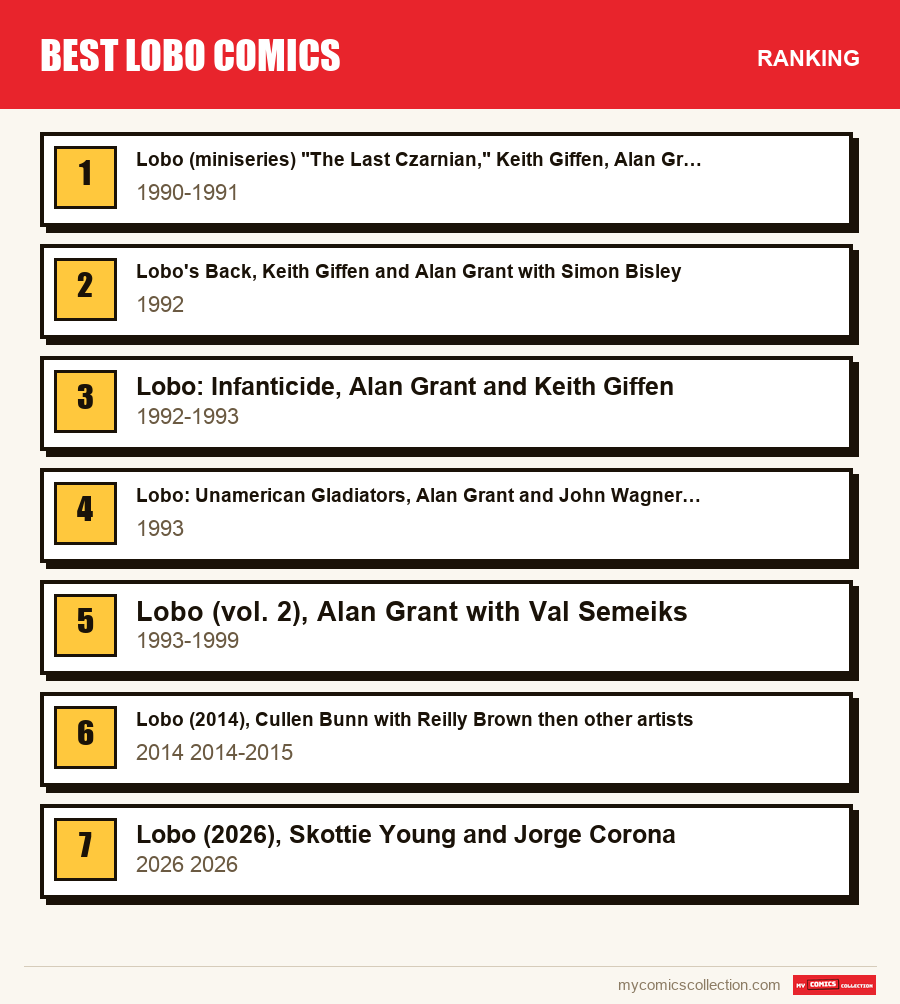
To find the best Lobo comics and know where to start, open the 1990 Lobo miniseries, "The Last Czarnian," conceived by Keith Giffen, written by Alan Grant and drawn by Simon Bisley: four issues, one complete story. Follow it with Lobo's Back (1992), then the ongoing series launched in December 1993. His debut is The Omega Men #3 (June 1983), by Roger Slifer and Keith Giffen.
Lobo is a bounty hunter from the planet Czarnia, and everything about him is excessive, from the violence to the black humor, to the point that the word hero fits him poorly. Yet the character has spanned four decades, from the mercenary of 1983 to the 2026 relaunch. Seven reads are ranked below, each with what it brings to the bounty hunter, its audience and its order of entry.
As always in this guide, we only state verified information (creators, issue numbers, dates); the analysis is ours, with no reproduction of protected artwork or dialogue.
His first appearance
June 1983: The Omega Men #3 introduces Lobo to readers. The series, launched in April 1983, is written by Roger Slifer and drawn by Keith Giffen; the two men are the character's creators. He debuts there as a mercenary, in the conflict that pits the Omega Men against the Citadel, a regime installed on a fortress moon.
This Lobo is not the one readers know today. He belongs to another species, the Velorpians, and has a partner named Bedlam, whom he ends up killing. His past was reworked later: the 1990 miniseries makes him a descendant of the Czarnians and the last of his people. For a collector, this means that Omega Men #3 remains the chronology piece, while the reading starts in 1990.
The character grows in stature elsewhere. A notable stint in Justice League International then sends him toward other series, before Giffen and Alan Grant give him his own issues. If you want to place that league within the whole DC universe, our history of the Justice League gives the thread.
1: Lobo (miniseries) "The Last Czarnian," Keith Giffen, Alan Grant and Simon Bisley (1990-1991)
Four issues, from November 1990 to February 1991, whose chapters are titled "Portrait of a Psychopath," "Lord of the Dance," "Spell or Die" and "The Last Last Czarnian." Giffen plots and does the layouts, Grant writes, Bisley handles the art and colors. Each role matters: this team sets the tone of the series.
The miniseries makes the character the last Czarnian, and rewrites in passing the origin born in Omega Men. Lobo escorts a mysterious prisoner, which serves as the through line for a succession of brawls, cruel jokes and reversals. Bisley redesigns the character in a lasting way: biker boots, skull-shaped kneepads, a hook and chain wrapped around his arm, a much more muscular silhouette. He also creates Lobo's dog, Dawg, who was absent from the original script.
This is the read to open first, with no preparation. It speaks to the reader who wants to know why Lobo exists, and four issues can be read in one evening. Be warned, however: the humor is brutal and deliberately excessive. The 2018 collection Lobo by Keith Giffen & Alan Grant reprints it along with other stories from the same period.
2: Lobo's Back, Keith Giffen and Alan Grant with Simon Bisley (1992)
The character's second miniseries, four issues published from May to November 1992. Its chapters are titled "The Final Fragdown," "Heaven Is... a 4-Letter Word," "If the Jackboot Fits...!" and "The War in Heaven." Giffen and Grant write; Bisley draws, and the last issue is handed to Giffen and Christian Alamy.
The starting point is simple and absurd: Lobo dies, passes through heaven and hell, and fights to come back to life. What it brings to the character is scale: the antihero becomes a problem for the entire afterlife, and the authors take the opportunity to push the satire of religion and bureaucracy.
It follows logically from the 1990 miniseries and reads better after it, because it assumes you know its hero and the way he reacts. Between the two, there is the Paramilitary Christmas Special, by Giffen, Grant and Bisley: a standalone story, with no obligatory follow-up, which you will mostly hunt down for completeness.
3: Lobo: Infanticide, Alan Grant and Keith Giffen (1992-1993)
Four issues, from the October 1992 cover to the January 1993 cover. Grant writes, Giffen plots and draws. This time Bisley is not there: a useful proof for anyone who believes the character depends on a single art style.
The story opens with an odd family reunion. Lobo's illegitimate children, outcasts of the galaxy, resent him; one of his daughters, Su, gathers a hundred of them to prepare her revenge, and arranges things so that their father ends up in a specific place at a specific time. The subject is the flip side of the series: if Lobo feels free of everything, his actions have consequences, which come back to him in the form of descendants.
It is for anyone who has already read the first two miniseries and wants to see what happens when Giffen also takes up the pencil. The line is more angular, less painted, and the effect is that of a war farce on the scale of a clan. Since it reads in four issues, it asks for no lasting commitment.
4: Lobo: Unamerican Gladiators, Alan Grant and John Wagner with Cam Kennedy (1993)
A four-issue miniseries, from June to September 1993, with covers by Mike Mignola. Alan Grant and John Wagner write; Cam Kennedy draws. The Grant and Wagner partnership goes back to their Judge Dredd years, and the artist was already working alongside them back then.
The story sends Lobo into a dystopian television arena, where he meets a certain Johnny Caesar, convinced he has found a brilliant scam. The interest lies in the media satire more than in the action: the character serves as a sounding board for authors who are aiming at the society of the spectacle.
This story suits the reader curious to see Lobo without Giffen or Bisley. It is not essential to understand the others; you open it for its lineup of creators, and for its covers by Mike Mignola.
Do you collect this series?
Track what you own, what you are missing and what your collection is worth. 7-day trial.
Start my trial →
5: Lobo (vol. 2), Alan Grant with Val Semeiks (1993-1999)
The ongoing series starts with issue #1 dated December 1993, titled "The Qigly Affair, Part One." Alan Grant writes, Val Semeiks draws, John Dell inks, Gloria Vasquez colors. It runs sixty-four issues and ends in July 1999. So this is not a weekend read.
What it brings is longevity. The miniseries told self-contained adventures; here, the character becomes a regular on the newsstand, with plots that vary, from an investigation to a mission, from a two-issue story to a humor episode. The result is a less dense portrait than the 1990 one, but a more complete one.
Read it if you enjoyed the miniseries and want to go deeper. Do not expect a continuous through line: the whole thing is best taken by sampling, and the first issues are enough to get an idea. For a collector, issue #1 of 1993 serves as a benchmark, since this title is the second series to bear the character's name.
6: Lobo (2014), Cullen Bunn with Reilly Brown then other artists (2014-2015)
In the 2011 relaunch, a Lobo with altered features appears in Deathstroke (vol. 2) #9 to #12, scripted by Rob Liefeld, from July to October 2012. The publisher then chooses to return to a more faithful version, introduced in Justice League (vol. 2) #23.2, in September 2013. The series that follows debuts in October 2014 and ends with the December 2015 issue.
Cullen Bunn writes, Reilly Brown draws issue #1, then other artists, including Cliff Richards, take over. The first collection, Targets, gathers issues #1 to #6. This series adopts a more contemporary humor and the pace of serialized comics.
It is for anyone who wants an entry with no prior reading: the character is introduced from scratch. It has the advantage of being short, with a starter collection that is easy to find. It is often set against the 1990s for the contrast in style, but it is read for its own sake.
7: Lobo (2026), Skottie Young and Jorge Corona (2026)
The most recent relaunch begins with issue #1 on March 18, 2026, as part of the "DC Next Level" initiative. Skottie Young writes and Jorge Corona draws. Early reviews are favorable; issue #2 is announced for April 15, 2026.
Readers of the previous series will find the bounty hunter again in a new series, with a creative team that is new to him. To judge what follows, we will have to wait for the next issues: you do not rank a series higher when its story is not finished.
It suits a reader who prefers to start with current books rather than the archives. To place it among the publisher's new releases, our page on the best DC comics of 2026 covers the year.
Where to start based on your profile
You want to understand the character. Take the 1990 miniseries, "The Last Czarnian," then Lobo's Back: two short stories, the same creative team, a tone that sharpens.
You like stories told in few issues. Infanticide and Unamerican Gladiators each fit in four issues, with different creators. They are good samples for gauging how many variations Lobo can take.
You are looking for a series to follow over the long haul. Start with issue #1 of 1993, by Grant and Semeiks, and stop when the tone wears on you. The title runs sixty-four issues, and the framework stays the same from one issue to the next.
You are a reader of current books. Open the 2014 series, then the 2026 one. They require no prior reading and speak to an audience used to recent series.
You collect above all. Look for Omega Men #3 for the chronology, issue #1 of 1990 for the reading, and keep in mind that Lobo is only one part of the DC collection: the index of DC key issues lets you place him.
The key issues to know
Chronological landmarks for Lobo, from oldest to most recent. No price guide here: a search method is enough for these titles.
- The Omega Men #3 (June 1983): the first appearance, by Roger Slifer and Keith Giffen. The character is a mercenary there; the issue is worth having for the chronology.
- Deathstroke (vol. 2) #9 (July 2012): the start of the Rob Liefeld arc in which an altered version of the character appears. The series carries the name Deathstroke, and this is the entry issue of that arc.
- Lobo #1 (November 1990): the opening of "The Last Czarnian," chapter "Portrait of a Psychopath."
- Lobo Paramilitary Christmas Special: the Christmas story by Giffen, Grant and Bisley, to be shelved between the 1990 miniseries and Lobo's Back.
- Lobo's Back #1 (May 1992): the character's return after his death, the same creative team as the first miniseries.
- Lobo (vol. 2) #1 (December 1993): the start of the sixty-four-issue ongoing series.
- Justice League (vol. 2) #23.2 (September 2013): the introduction of the 2013 version, which sets up the 2014 series.
- Lobo (vol. 3) #1 (October 2014): the start of Cullen Bunn's series.
- Lobo #1 (March 2026): issue #1 of the Skottie Young and Jorge Corona series.
To value a copy, first check that the title matches the series you want, because four series bear the character's name. Then note the cover year and the printing, and compare at least three closed sales for an identical condition, setting aside the two extremes. The free estimate completes this cross-check.
Frequently asked questions
Lobo first appears in The Omega Men #3, dated June 1983. Roger Slifer is the writer and Keith Giffen the artist, and the two created him. This Lobo is a mercenary, whose origin would later be reworked: it is the 1990 miniseries that makes him the last of the Czarnians.
Start with the 1990 miniseries, "The Last Czarnian": four issues, from November 1990 to February 1991, by Keith Giffen, Alan Grant and Simon Bisley. It is enough to understand the character and requires no prior reading. Continue with Lobo's Back if the tone suits you.
No. Omega Men #3 introduces a character whose origin has since been rewritten, and the recommended reads start in 1990. Look for this issue if you collect first appearances; read it only out of historical curiosity, without expecting it to explain the current version.
Four series bear the character's name: the 1990 miniseries, the 1993 to 1999 series (sixty-four issues), the 2014-2015 one and the one that begins in March 2026. Each starts with an issue #1. Note the cover year and the creative team before shelving or valuing a copy.
No. Bisley draws the 1990 miniseries and most of Lobo's Back, but Infanticide is drawn by Keith Giffen, Unamerican Gladiators by Cam Kennedy and the 1993 series by Val Semeiks. His line fixed the character, without being present in every read.
Do you have a Lobo issue by Giffen, Grant and Bisley or one of its relaunches? Have its condition and value assessed.
Estimate my comic