Lobo is a brutal, loudmouthed, nearly indestructible alien bounty hunter whom DC presents as the last survivor of a species he exterminated himself, and this Lobo comics history runs from his first appearance in The Omega Men #3, cover-dated June 1983, created by Roger Slifer and Keith Giffen, to today. At first a simple mercenary in a space series, he became in the 1990s the star of a miniseries drawn by Simon Bisley, then of an ongoing series, and has remained ever since a character of parody and unapologetic violence.
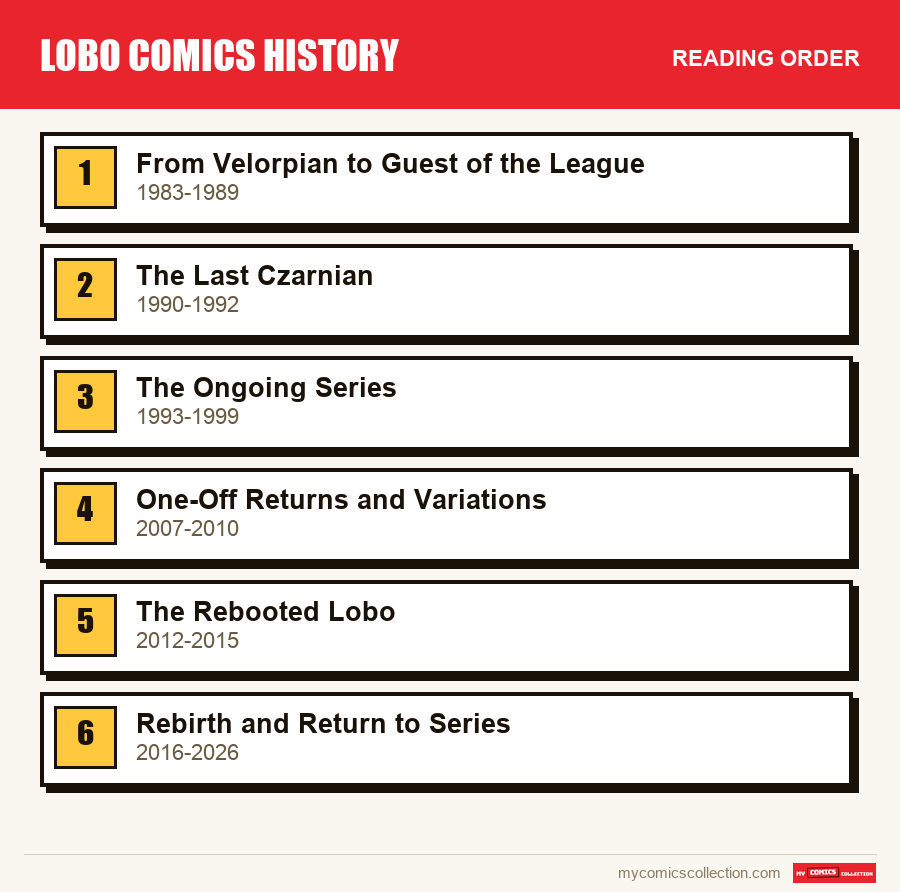
Lobo is not a hero, nor really a villain: he is a caricature of the 1980s antihero, pushed so far that it becomes a genre of its own. This journey takes him from his birth in a DC space series to the 2026 series, in six eras.
As always in this guide, only verified facts (creators, issue numbers, dates) are stated as fact; the analysis is our own, with no reproduction of protected pages or dialogue.
His first appearance
The Omega Men #3, cover-dated June 1983, introduces Lobo for the first time. The character was created by Roger Slifer and Keith Giffen, in an ensemble science-fiction series following a group of rebels in space. At this stage he does not yet have the look we know: he is a Velorpian, partner to a character named Bedlam, in a mercenary role that gives no hint of the star he will become.
This initial low profile matters to a collector. Unlike characters whose first appearance is an editorial event, Lobo was born in a second-tier title, whose readers at the time could not have guessed it would spawn such a recognizable figure. Spoiler warning: Lobo ends up killing Bedlam, which makes their duo a brief association rather than a lasting partnership, and his origin would later be entirely rewritten.
Keith Giffen is the thread of continuity here: co-creator of the character, he remains tied to Lobo in the 1990 miniseries, where he plots the story.
Era 1: From Velorpian to Guest of the League (1983-1989)
After The Omega Men, Lobo makes a notable appearance in Justice League International, the team-comedy series of the day. The appearance is well received, and it opens the door for the character to series that give him more room.
Lobo becomes a regular in L.E.G.I.O.N., then in its follow-up R.E.B.E.L.S., two space series that extend his presence after Justice League International. These titles are a useful stage to know: they show the character in team stories, before the 1990 miniseries places him alone at the center.
What changes for the character in this era: he goes from the status of mercenary in a space series to that of recurring guest star in the DC universe. He is not yet the hero of his own stories, but he has left the shadow of Omega Men.
Era 2: The Last Czarnian (1990-1992)
Everything changes with Lobo: The Last Czarnian, four issues, the first of which is dated November 1990. Keith Giffen plots it, Alan Grant scripts it and Simon Bisley draws it. The character is reinvented there: he is no longer a Velorpian but the last Czarnian, which rewrites his origin. Bisley's pages, saturated with muscle, chrome and excess, turn a supporting character into a brand.
Spoiler warning: this version of the story rests on the fact that Lobo himself killed every other member of his species. That idea is the core of the character's modern legend, and it explains his paradoxical status: a survivor who is also an executioner. It is the element to remember if you are looking for what defines the character today.
In the wake of it, DC publishes several special titles: Lobocop, Blazing Chain of Love, Paramilitary Christmas Special, Infanticide, Convention Special and Unamerican Gladiators. This period establishes the formula: short stories, flashy covers and an antihero who subverts the conventions of the genre.
For today's reader, this miniseries raises a useful question about how to read it: should it be taken as a serious story or as a farce? The answer lies in the dosage. Grant writes violence so outrageous that it tips into satire, and Bisley draws it with an attention to detail that keeps it from being just a gag. It is this tension, more than the plot itself, that made The Last Czarnian a benchmark for readers of the time, and that explains why it still serves as a point of comparison for every new version of the character.
Era 3: The Ongoing Series (1993-1999)
Lobo gets his own ongoing series, published by DC for 64 issues from 1993 to 1999. It is the most lasting form of his solo existence, and the one that lets us gauge his real popularity: a regular title for six years for a character created as a secondary mercenary. For the collector, it is a coherent set that is easy to define.
This series is also when the character's dark humor sets in. Among his companions is Dawg, a bulldog that Lobo often disowns; issue #58 of the series sees this dog crushed, which illustrates the series' tone. The issue dated November 1998, numbered #1,000,000, is also among the curiosities of the series.
Lobo also crosses paths with Superman, for example in Superman: The Man of Steel #30. The pairing is natural: a character of absolute morality facing another who has none, two opposing visions of strength. Readers of Superman will find a natural entry point into the character there.
What this era changes: Lobo now has a graphic style (Bisley), a mythology (the last Czarnian) and a series in his name. The writers who take him up afterward inherit these elements.
Era 4: One-Off Returns and Variations (2007-2010)
After the series ends in 1999, Lobo reappears in touches. In August 2007, Deadly Serious, a two-part story that crosses him with Batman, is written and drawn by Sam Kieth. For a reader who knows Batman, it is an entertaining way into the character: the space bounty hunter facing the Gotham detective, as in the Batman gallery.
In 2010, Lobo returns in Green Lantern (vol. 4) #54 and #55, dated July and August, at the time of the Brightest Day event. Another issue, Adventure Comics (vol. 2) #9, dated 2010, belongs to the same period. These issues are variations more than turning points, but they keep the character in the DC spotlight.
This period is useful to the collector for one reason: it shows that Lobo is not tied to a single generation of writers. A character who returns without a fixed team is a character whose identity rests on his concept, more than on any one hand.
Do you collect this series?
Track what you own, what you are missing and what your collection is worth. 7-day trial.
Start my trial →
Era 5: The Rebooted Lobo (2012-2015)
DC's reboot offers a reinvented version of the character. In Deathstroke (vol. 2) #9 to #12, from July to October 2012, Lobo makes his debut in the rebooted universe, written by Rob Liefeld. This Lobo is a Czarnian slave trader who killed his race with the exception of Princess Sheba. Find the writer on the Rob Liefeld page.
A second version appears in Justice League (vol. 2) #23.2, released on September 11, 2013. The series devoted to the character begins in October 2014 and ends with the December 2015 issue. This phase offers a revised origin, distinct from the 1990 one.
What this era changes: the character receives an origin different from the 1990 one, which shows that his concept survives the rewriting of his past.
Era 6: Rebirth and Return to Series (2016-2026)
With Rebirth, Lobo takes part in Justice League vs. Suicide Squad, published from issue 1 to issue 6 between December 2016 and January 2017. Issue 12 of Hal Jordan and the Green Lantern Corps (January 2017) shows him locked in a bottle that Hal Jordan keeps shut.
More recently, DC scheduled a new series for March 2026 under the DC Next Level label, entrusted to Skottie Young on script and Jorge Corona on art. It arrives more than thirty years after Bisley's miniseries.
One trait sums up the character: Lobo is arrogant, loves violence and drunkenness, and while he honors the letter of an agreement, he does not hold back from betraying its spirit. He also has an accelerated healing factor that makes him nearly immortal. These traits let writers of different generations pen him.
To sum up the character's path, three milestones are enough: the birth in The Omega Men in 1983, the 1990 rewrite by Giffen, Grant and Bisley, then the reboot version launched by Liefeld in 2012. Between these markers, each appearance counts less for its plot than for the way it reuses the concept of the unscrupulous bounty hunter. A reader who knows these three stages can approach any other issue without getting lost, which also makes it easier to sort a collection: you know right away which continuity a copy belongs to.
Where to start reading
- Lobo: The Last Czarnian (Giffen, Grant and Bisley): the entry point for the reader who wants the character as he established himself in 1990.
- The Omega Men #3: for the reader curious about the origin, who wants to compare the Velorpian of 1983 with the Czarnian of 1990.
- Lobo (1993 series): for the reader who prefers the long run, with its dark humor and companions.
- Deadly Serious (Sam Kieth): for the reader coming from Batman who wants a short crossover.
- Deathstroke (vol. 2) #9 to #12 (Rob Liefeld): for the reader who wants the 2012 reboot version.
If you then want a broader selection, the best Lobo comics offers a ranking of reads; this page tells the character's life story, the other says what to read first.
The key issues to know
- The Omega Men #3 (June 1983): the first appearance, by Slifer and Giffen.
- Lobo: The Last Czarnian #1 (November 1990): the opening of the miniseries that makes the character a star.
- Lobo (1993), issue 1: the start of the 64-issue ongoing series.
- Deathstroke (vol. 2) #9 (July 2012): the rebooted Lobo.
- Justice League (vol. 2) #23.2 (September 2013): the second version of the reboot.
Before buying any of these five issues, weigh the condition of a copy against those circulating for the same title, then ask yourself whether a higher grade really changes how you will use it. 1990s issues are protected with the habits described in this preservation guide, and this page on grading labels helps you understand a grade before buying it.
A note on method: The Omega Men #3 is compared with other issues of the original space series, whereas Lobo: The Last Czarnian #1 is compared with other copies of the miniseries. Do not mix the two markets in a single appraisal.
Frequently asked questions
In The Omega Men #3, cover-dated June 1983. The character was created by Roger Slifer and Keith Giffen. At that date he is a Velorpian partnered with Bedlam, not the last Czarnian: that origin would only be established later, in the 1990 miniseries.
Simon Bisley is the artist. The plot is by Keith Giffen and the script by Alan Grant. The miniseries runs four issues, the first dated November 1990, and it makes Lobo the last survivor of his people, the Czarnians.
Yes. DC published a title in his name for 64 issues, from 1993 to 1999. Later, a reboot series began in October 2014 and ended in December 2015, and a new series, entrusted to Skottie Young and Jorge Corona, was scheduled for March 2026.
The reboot version begins in Deathstroke (vol. 2) #9, in July 2012, written by Rob Liefeld. This Lobo is a Czarnian slave trader. A second version is presented in Justice League (vol. 2) #23.2, in September 2013.
Neither in the strict sense: he fights for money, loves violence and hardly cares about morality, but he honors the letter of his agreements. Depending on the era, DC uses him as an adversary, as an ally of convenience or as a parody.
Do you own a copy of The Omega Men, of Simon Bisley's miniseries or of the 1993 series? Get its condition and its place in your collection appraised.
Appraise my comic