The last issues of a French magazine are almost always the most time-consuming segment to complete: the print run had dropped, readers had left before the end, and the lots resold today stop where the original collection stopped. Before spending months on it, learn to read the end of a run: a rhythm that comes apart, issues that start to double up, contents that no longer come from the same stock. Then start with the final booklet.
You have a stack of magazines at home and the tail of the series is missing. This is not a flea-market accident: it is the rule. A magazine does not go out overnight, it empties out first, and the booklets from that ebbing period were printed for an audience that had become narrow, then kept by even fewer people. Knowing how to recognise that moment in the catalogue changes how you search: you do not complete the end of a series the way you complete its middle.
As always on this guide, only verified information (creators, issue numbers, dates) is stated as fact; the analysis is our own, with no reproduction of panels or protected dialogue.
Why the end of a series is harder than the beginning
A first issue is hard to find, but it can be found. It was printed in large numbers, given away, kept out of curiosity, and the market keeps putting it back into circulation. The last booklet of a magazine, by contrast, piles up three handicaps: a reduced print run, a distribution already disorganised at the end of its life, and above all a readership that had dropped away before the stop. Nobody carefully keeps a magazine they have stopped buying.
On top of this comes a resale effect that decides what you will see come past. The lots that reach the market are dismantled personal collections. They reflect the period when their owner was reading, not the total length of the publication. The result: the lots are heavily weighted toward the strong years, and they thin out exactly where you need help.
Finally, the end of a series is the only segment where the question "how many issues in total?" has no obvious answer. The count of recorded booklets and the number printed on the last cover do not always match, for publishing reasons we detail below. Searching without settling this question means risking chasing a booklet that never existed.
The most reliable sign: a rhythm coming apart
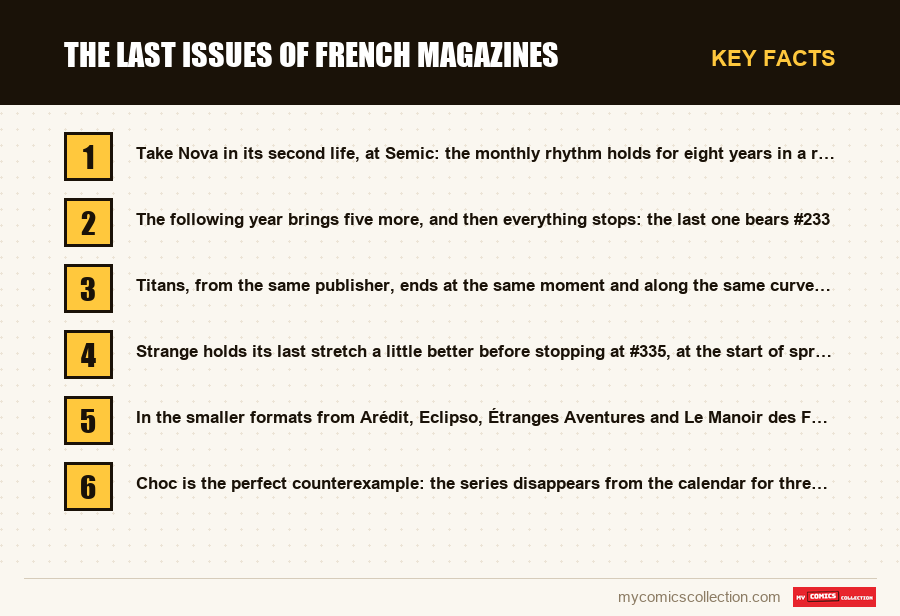
A magazine rarely dies in full health. It slows down, and this slowdown shows in the cover dates long before the stop. Take Nova in its second life, at Semic: the monthly rhythm holds for eight years in a row, then the catalogue records only a single booklet dated 1997.
The following year brings five more, and then everything stops: the last one bears #233. For a collector, this funnel shape is information of the highest value, because it points precisely to the difficult batch. It is not the final years that get stuck, it is the last handful of booklets, the ones printed after the break in rhythm.
Titans, from the same publisher, ends at the same moment and along the same curve, its final booklet bearing #221. Strange holds its last stretch a little better before stopping at #335, at the start of spring. Three sister magazines, one mechanism: once the rhythm breaks, the countdown has begun.
The phenomenon is not specific to the nineties. In the smaller formats from Arédit, Eclipso, Étranges Aventures and Le Manoir des Fantômes all stop in a single year, 1983, which accounts for only one booklet each, after runs of four or five issues. When an entire collection contracts like this, the last issues of several titles are sought at the same time, and they compete for the same rare lots.
The blank year: a warning, not a verdict
A gap of one or two years in the cover dates looks like an ending. It is not necessarily one, and confusing the two makes collectors abandon searches that are still feasible. Choc is the perfect counterexample: the series disappears from the calendar for three years in a row, then returns and still produces a good dozen booklets before stopping at #33 in spring 1983.
The Arédit version of Hulk tells the same story with a time lag: two years missing, a return, then a definitive stop. Its neighbouring series devoted to Thor follows the same pattern and ends in the same month. In other words, the blank year signals a collection in difficulty, not a finished one, and it is the full pattern that must be read: gap, shorter revival, then extinction.
A useful detail when buying: the booklets from the revival are often harder to find than those before the gap. The reader who had lost the habit during the interruption did not always come back, and the print run of the revival took that into account. If your gap falls in this zone, treat it as the end of a series, even if the numbering carries on afterwards.
When the contents no longer come from the same stock
The second signal, less well known, shows in the titles and in the names in the credits. A magazine in its final stretch draws on other material. At Semic, the last Titans on record no longer carry episode titles but labels such as "The tenth n°1" or "Divine Right n°1", and the final booklet is recorded under the title "JLA n°1". These are no longer stories from the stock that had opened the collection: it is different material, served in the same packaging.
The credits shift in the same way. The first Strange of 1970 carries the names of Stan Lee and Larry Lieber; the very last one, much later, cites Grant Morrison and Kelley Jones side by side, who belong neither to the same generation nor to the same studio. When the credits change register like this, you are no longer in the series you are collecting, you are in its transition period.
A final warning, which concerns your search method as much as the magazine: for many collection endings, the only title kept in the catalogue is not a story. The last Thor booklets from Arédit are recorded under "La diversité et la qualité à votre service...", and the last Spécial DC under "Chez le même éditeur". These are editorial advertising pages. Do not conclude from these labels that the booklet is empty: conclude that its actual contents must be checked on the copy, because the listing thins out precisely where you would need it to be rich.
Doubled issues, and what they change
Here is the most concrete sign, and the one most often missed. When a magazine can no longer keep up its frequency, it merges issues. Superman Poche provides the demonstration: in its final part, the covers carry doubled numbers, then doubled again, before a last booklet with a single number at the start of 1987.
The practical consequence: the number of booklets to gather is not equal to the number printed on the last one, since a single booklet can count as two issues. Anyone who keeps track of their gaps with simple arithmetic will search endlessly for a cover that never existed.
The same trap exists at Sagédition, in its collection shared between Superman, Batman and Robin, where a double issue appears near the end before a quick stop at the start of the following year. Working rule: before drawing up a list of gaps at the end of a series, note the numbers as they are printed, not as the logical sequence would have them.
Do you collect this series?
Track what you own, what you are missing and what your collection is worth. 7-day trial.
Start my trial →
A clean stop or a handover: two very different endings
Not all endings are alike, and the nuance decides how difficult the search will be. In December 1988, Lug wound up several of its monthlies at once. Strange stopped at its #228, and one might think the series was over.
It was not: three of these titles were relaunched at Semic without resetting the counters, and Strange picked up its numbering at #229. Spécial Strange did the same, halted at its fifty-ninth booklet and then relaunched at #60. In this case, the last issues of the Lug era are not the end of a series: they are the end of an editorial period, and a collector who wants to "finish" has to decide for himself where he places his boundary.
Conversely, some series stop without a sequel. Spidey ends on its #107 and nothing continues it under that title; Ombrax had ended earlier, after a very long career, on a March booklet. These endings are the true endings, and they are harder, because no later magazine reprinted, summarised or extended what the final issue contained.
Ending on a second part
The most frustrating case is the magazine that stops in the middle of a story. Nova closes on a booklet titled "Nouveau départ, 2ème partie", whose first part appeared in the previous month's issue. The irony of the title does not remove the problem: the collection ends on a continuation, not on a conclusion.
This is not an isolated case. Semic's Spider-Man stops on a booklet bearing the mention of a fourth part, and Facteur X on a second instalment of a story begun just before. You can therefore perfectly well gather the entire run of a series and still be left with an interrupted story. Better to know this before searching for a year for the next instalment.
Be cautious in the other direction too. A second-part label does not guarantee that the first part is in the booklet just before: French magazines published several episodes per issue, the listing keeps only one, and the continuation of a story could be served in a neighbouring collection. The right question is therefore not "which issue contains the continuation" but "did this continuation appear under this title".
In what order to tackle the end of a series
The method that works reverses the natural order. You do not work your way up toward the end, you start from the end. First buy the very last booklet, even if it seems expensive for what it is: it is the piece with the thinnest supply, and the one whose price will move most if someone else starts on the same series.
Then take the booklets of the final year, working backwards, because that is the slice that suffered the drop in print run. Keep the full years for last, the ones when the magazine was running at its normal pace: they come up regularly in lots, and they will continue to do so. This order costs you some comfort, since your stack stays full of holes for a long time, but it spares you the classic situation of the collector who is only missing the last five, which are unobtainable, after spending his budget on the middle.
When it comes to lots, be systematic in reading the listings. A lot described as "complete series" deserves a check of the last issue announced against the last issue actually published, and a lot "from #1 to #…" almost always stops before the zone that interests you. Sellers are not lying: they sell what the original reader owned, and that reader had stopped before the publisher did. For the final stretch, plan on buying single copies: that is the price of this scarcity.
What to ask the seller, and what not to search for
Four questions are enough, and all of them can be verified from a photo. Ask for the number exactly as it is printed on the cover, including any marks. Ask whether the cover carries two numbers. Ask for the printed date, because at the end of a series it becomes the only reliable reference once the numbering gets complicated. Finally, ask for a photo of the back and of the first inside page, which tell you about the period of publication better than any description.
Beware of stray marks, which lie at the heart of identification errors at the end of a collection. The original special issues from the Fantastic Four collection, and special numbers, carried numbers borrowed from the parent magazine, sometimes followed by "bis", sometimes by a special-issue mention. The direct consequence: the same number can designate two distinct booklets from the same publisher, released in the same season, in two different collections. The number alone identifies nothing; it is the combination of title, number and date that identifies.
Last, learn to tell apart two absences that are always confused. A missing number in a listing is not proof that it was never published: in the small-format series devoted to the Spider at Lug, one issue near the end is missing from the catalogue although the following ones are listed, and some issue numbers are even noted in square brackets, a sign of uncertain reading. On the other hand, beyond the last issue published, there is nothing to search for: no advert, no seller and no lot will ever produce the next number, because it was never printed. That is the only comfortable certainty in this work.
Frequently asked questions
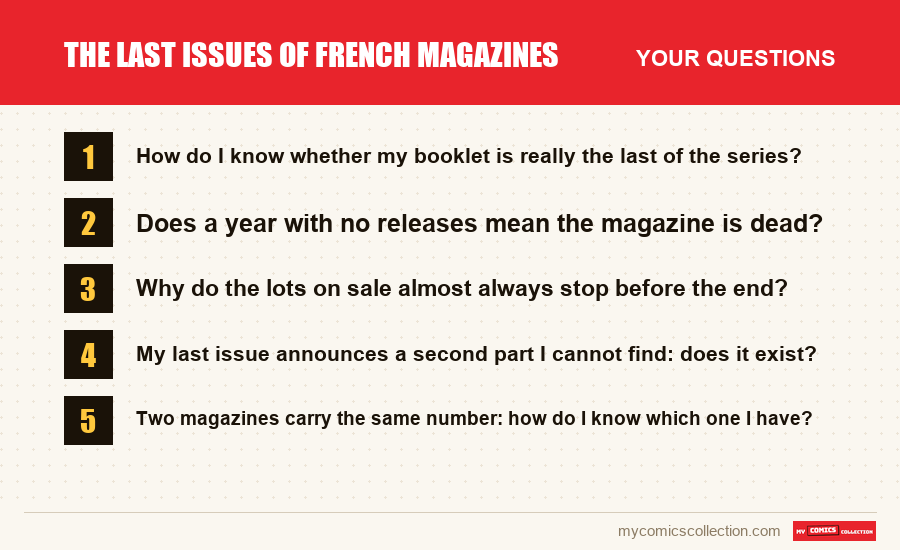
Compare three things: the printed number, the cover date and the rhythm of the preceding months. A booklet that arrives after a long pause, in a year that has almost no others, is very probably the final one. Also check that no magazine with the same title picked up the numbering at another publisher afterwards.
No, and this is a common mistake. Several small formats from Arédit disappeared from the calendar for two or three years before returning and publishing a good number of booklets again. Read the full pattern: interruption, shorter revival, then stop. The booklets from the revival are often the hardest to find.
Because a lot is a dismantled personal collection, and the original reader had stopped buying before the publisher stopped publishing. The lot therefore reflects his reading period, not the length of the magazine. For the final stretch, rely on buying single copies rather than hoping for a lucky lot.
Not necessarily under that title. Several magazines stopped on an intermediate instalment, the sequel never having been served in the same collection. It sometimes appeared elsewhere, under another heading. Before searching for an issue, check that it has a number and a date, otherwise you are looking for an editorial sequel, not an object.
This happens within a single publisher, between a parent magazine and its special issue, which borrowed its numbering, sometimes with an added mention. Rely on the full title printed on the cover, the printed date and the format. An isolated number is never enough to identify a booklet from this period.