A first issue is not worth much because of its number. It is worth what follows it, the certainty that it really is the first one published, and what it actually contains. The catalog shows checklists that open at a different number, titles that never carried No. 1, names that carried it twice, and first issues whose story starts in the middle. Here is the grid to apply before paying a premium.
At a flea market, the single character that pushes up the price of a French magazine is the issue number. The seller turns the issue over, points to the number printed at the top of the cover, and the discussion is supposed to end there. It should not. A collector who has been buying French magazines for a few years has already overpaid for a first issue that led nowhere, and let a third issue slip by that was harder to find than the first one.
As always on this guide, only verified information (creators, issue numbers, dates) is stated as fact; the analysis is our own, with no reproduction of panels or protected dialogue.
Why No. 1 is not a criterion
The number printed on a cover describes a position in a sequence, not a quality. It tells you that the publisher launched something. It does not tell you how long that something lasted, how many people bought it, or whether the issue you are holding really is the oldest one to carry that name.
On the French market, the opposite reflex is nonetheless entrenched: the first issue is treated as a separate piece, whatever the magazine. It is a habit imported from the American market, where series cataloging is old and stable. French magazines, for their part, were renumbered, split, taken over, and spun off into special issues, and their numbering often tells the story of a sales department rather than the story of a collection.
The practical consequence is simple: the premium you agree to pay has to be justified by something other than the number. The sections that follow propose six checks, each measurable in the catalog or on the copy itself, and each paired with what it should change in your offer.
Look at the end of the checklist before its beginning
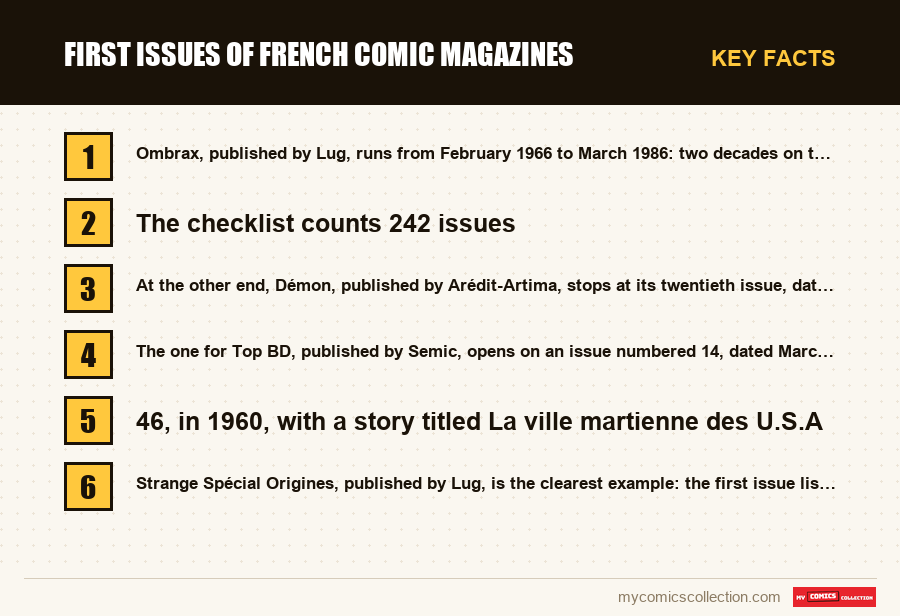
A first issue only has value as an entry point if it opens something long. Ombrax, published by Lug, runs from February 1966 to March 1986: two decades on the newsstands, carried by a title that almost nobody today cites among the superhero magazines.
The checklist counts 242 issues. That volume is what gives the starting point its interest: behind the first issue there is a collection that takes years to assemble, a secondhand market that stays alive, lots that keep circulating, and therefore lasting demand for the issue that opens the run.
At the other end, Démon, published by Arédit-Artima, stops at its twentieth issue, dated January 1983. The number is small, but the publication was quarterly: the title therefore occupied the newsstands for seven years, at four installments a year. A short checklist does not mean a short-lived series, and that is exactly the kind of nuance the number one will never tell you.
What to take from this before paying: ask yourself whether the title produced enough issues for a community of collectors to form around it. A series that stops quickly leaves few collectors, and therefore few buyers for its first issue, even if that issue is objectively rare.
Does the checklist really begin at No. 1?
Here is the most costly trap, and the least known. Several checklists in the catalog do not begin at No. 1. The one for Top BD, published by Semic, opens on an issue numbered 14, dated March 1989.
In other words, earlier installments may exist, but they are not documented. The same phenomenon affects Artima color superstar, whose checklist opens at No. 3, and the Thor published by Semic, which also opens at No. 3.
Big Boss gives the most spectacular case: at Arédit-Artima, one checklist opens at No. 46, in 1960, with a story titled La ville martienne des U.S.A. Forty-five issues are missing in front of it, and no public data will tell you what they looked like.
What to check: when a seller offers you "the first" of one of these titles, what he is really offering is the oldest one he has found. Ask for the date printed on the issue, compare it with the start of the checklist you know, and treat any gap as an area of uncertainty. A first-issue premium makes no sense on a title whose true beginning has not been established.
Titles that never carried No. 1
Some titles have no first issue at all, in the sense that no copy has ever carried No. 1. Strange Spécial Origines, published by Lug, is the clearest example: the first issue listed bears the mention 133 bis, and its story is titled L'incollable.
The reason is editorial: the special issue borrowed its number from the magazine it was an offshoot of. When Semic takes over the title, the first issue listed bears the mention 229 hors série, with a story titled Que la lumière soit. The counter never went back to one, because it had never been its own.
What to check: for these titles, "first issue" can only mean "first published". The only thing that determines it is the date, not the number. Note the exact mention printed on the cover, bis, hors série or otherwise, because that is what identifies the issue in a checklist, and it is what you will have to quote when you resell.
A change of publisher does not create a second first issue
The question comes up at every lot sale: if the publisher changes, is there a fresh start? For some of the major magazines, no, and the catalog is clear on this. The checklist for Spécial Strange under the Semic imprint opens at No. 60, with no return to one.
The same setup applies to Nova, whose checklist under its second imprint begins at No. 132. The name changes hands, the numerical sequence carries on, and there is therefore no second first issue to acquire for these titles.
What to check: if an ad presents "the first of the new series" for one of these names, the ad is describing a change of imprint, not a No. 1. That issue may be interesting for other reasons, for example a change of format or layout, but the first-issue premium does not apply. Check the printed number before discussing the price: if it is not one, the first-issue argument falls apart on its own.
Do you collect this series?
Track what you own, what you are missing and what your collection is worth. 7-day trial.
Start my trial →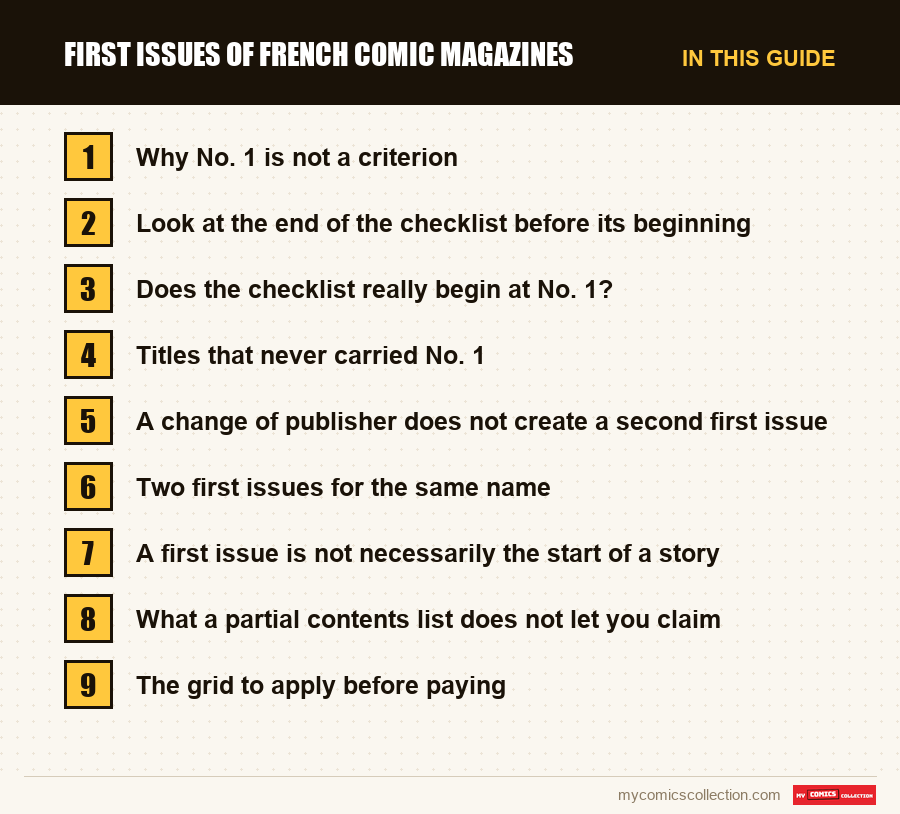
Two first issues for the same name
The symmetrical case is more common still. The same magazine name has sometimes been used twice, at different times, with the numbering starting again from zero. Hulk is the illustration: the first issue published by Arédit-Artima is dated December 1976, and the story listed is titled Hercule, written by Roy Thomas and drawn by Herb Trimpe.
At Semic, another first issue bearing the same magazine name is dated April 1992. The story listed is titled Exposition, written by Peter David and drawn by Dale Keown. Two issues, two No. 1s, one name on the cover.
The same publisher has also repeated the trick: Aventures Fiction, at Arédit-Artima, opens one checklist in 1958 with a story titled L'homme de deux mondes, and another in 1966 with Les collectionneurs de planètes. Neither the imprint nor the name settles it: only the year and the content do.
What to check: before any offer, get the date printed on the issue and, if possible, the French title of one of the stories. A date-plus-story-title pair identifies an issue without ambiguity, whereas a cropped cover photo identifies nothing. And know which of the two No. 1s interests you, because their audiences differ: Hulk fans looking for the oldest appearances and those aiming for the later stories are not competing for the same issue.
A first issue is not necessarily the start of a story
This is the check almost nobody performs, and it is the one that produces the worst surprises. The first Spider-Man issue from Semic, dated April 1991, carries a story whose listed title announces a fourth part. The reader who buys it to "start at the beginning" walks into the middle of a story.
The X-Men launched by the same imprint does the same: its first issue, dated December 1992, carries a story whose listed title mentions a second chapter. This is not a cataloging anomaly, it is an editorial practice: the magazine started where the translation had got to, not where the American series had begun.
What to check: if your purchase motivation is reading, ask for the title of the story before paying, and accept the idea that the previous issue in your pile may be more useful than the first one. If your motivation is collecting, the information disqualifies nothing, but it must appear in your inventory record, because a future buyer will discover it sooner or later.
What a partial contents list does not let you claim
One last warning, which applies to everything above. The catalog attaches a single story title to each issue, whereas a French magazine commonly published three or four per installment. The contents list we have is therefore incomplete by construction.
That rules out a sentence you read everywhere in ads: "this issue contains the first French appearance of such-and-such character". Nothing in the available data allows you to establish it, or indeed to rule it out. The only way to know is to open the copy and read its printed table of contents.
Far from weakening your position as a buyer, this uncertainty strengthens it: it is up to the person claiming the premium to provide proof, photo of the contents page included. A serious seller supplies it without argument. Others will tell you that "everyone knows", which is precisely the sign that you should check, whether the magazine is promoting the Fantastic Four or a forgotten crime hero.
The grid to apply before paying
Taken together, these checks come down to a series of short questions, which you can ask on the phone or at a stall. They need no tools, only the discipline of not settling for the printed number.
- Did the title last long enough for a secondhand market to form around it?
- Does the known numbering start at one, or further along, in which case the true beginning has not been established?
- Did the title ever have a No. 1, or did it borrow its counter from another magazine?
- Is this a new start, or the continuation of a counter taken over by another imprint?
- Has this name been used more than once, and which year are we talking about?
- Does the announced story begin, or does it continue a narrative started elsewhere?
- Can the seller show the printed contents page, not just the cover?
If a single answer is missing, the first-issue premium is not justified, and you can say so without aggression: you do not dispute the piece, you note that it is not documented. In most transactions between collectors, that simple sentence is enough to bring the price back in line with the actual condition of the copy, which remains the primary factor of value for a newsstand magazine.
Keep this grid up to date in your inventory rather than in your head. Noting, for each first issue you own, its date, the exact mention printed on the cover and the title of one of its stories will spare you from buying a duplicate under another year, and will give you, on the day you resell, arguments the buyer can check for himself. It is also what separates a pile of magazines from a tracked collection, including for titles devoted to Wolverine or to more obscure heroes.
Frequently asked questions
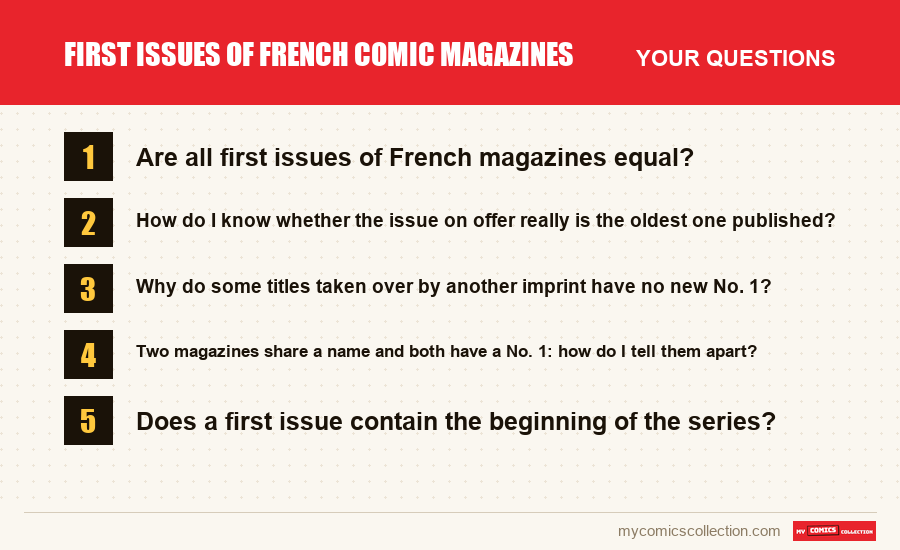
No, and the gap is considerable. The first issue of a title that lasted hundreds of installments opens a collection that many people try to complete. That of a title that stopped after a handful of issues only interests a small circle. The actual lifespan of the title, not its number, determines demand.
By the printed date, never by the number alone. Several checklists do not start at No. 1: Top BD starts at No. 14, and the earlier installments are not documented. Note the date, compare it with the start of the checklist you know, and treat any gap as an uncertainty for the seller to resolve.
Because the counter was carried on instead of being reset. The checklist for Spécial Strange under its second imprint opens at No. 60. There is therefore no second first issue for that name, and an ad offering one is in fact describing a change of publisher.
By the year and by the content. The first issue of Hulk at Arédit-Artima is dated December 1976 and lists a story titled Hercule. The one published by Semic is later and lists a story titled Exposition. Always ask for the date and the title of a story before making an offer.
Not necessarily. The first Spider-Man issue from Semic carries a story whose title announces a fourth part: the magazine started where the translation had got to. If you are buying to read, ask for the story title. If you are buying to collect, record the information in your inventory.