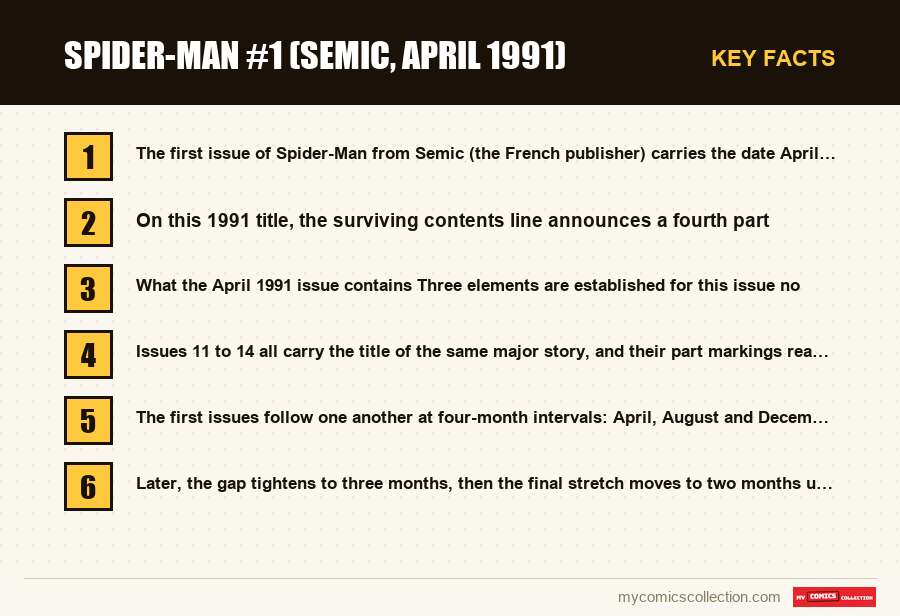
The first issue of Spider-Man from Semic (the French publisher) carries the date April 1991 and a title recorded in the catalogue as "Tourment, 4ème partie" ("Torment, part 4"). In other words, issue no. 1 does not open the story it contains: it presents a segment already well underway, credited to Todd McFarlane as writer and as artist. The following issues confirm the method, with a step of four parts from one issue to the next.
You open an issue no. 1 and expect a first page that begins something. On this 1991 title, the surviving contents line announces a fourth part. This detail is not a typo in the catalogue: it is the key to reading the whole series, and it explains why so many collectors who buy this issue first close the volume with the feeling that they arrived late.
As always on this guide, only verified information (creators, numbers, dates) is stated as fact; the analysis is our own, with no reproduction of panels or protected dialogue.
What the April 1991 issue contains
Three elements are established for this issue no. 1: its date, April 1991; the title of the recorded story, "Tourment, 4ème partie"; and a double credit to Todd McFarlane, as both writer and artist. That is all that can be stated without error, and it is already a great deal for settling a doubtful listing.
What is not established deserves to be stated just as clearly. The catalogue records only one story title per issue, whereas a French magazine of this format carried several. The full contents of issue no. 1 are therefore not documented here, and anyone who lists them to you from memory is offering a reconstruction, not a fact. Verification is done on the copy itself, with the contents page in front of you.
Keep the hierarchy in mind: the date and McFarlane's name are fixed points, the detailed content is an open question. A seller who knows this difference is a seller you can talk to.
A number one that begins nothing
The mention "4ème partie" on the very first issue has a disorienting effect. Someone who buys this issue because it bears the number one believes they are buying a beginning. In fact they are buying a volume that opens on an advanced segment of a story whose first three parts are not in front of them.
Two readings are possible and both need to be held together. Either the issue really does pick up the thread midway, or it contains several successive episodes and the catalogue has kept only the title of the last one. The second hypothesis is the more probable, and it is not a matter of principle that says so: it is the following issues, where the same phenomenon repeats with measurable regularity.
In both cases, the practical consequence for you is the same. Issue no. 1 does not stand on its own. It should be thought of as the entry into a setup, not as the first page of a story.
The step of four, measured on the following issues
The demonstration lies in a sequence of four consecutive issues. Issues 11 to 14 all carry the title of the same major story, and their part markings read in order: second, sixth, tenth, fourteenth. The gap is four parts at each step from one issue to the next, without exception across the sequence.
This constant step is information in itself. It indicates that a French issue of this series absorbs four segments of the story, and that the line kept in the catalogue is that of only one of them. Applied to issue no. 1, this reasoning gives a coherent reading of the famous fourth part: not a failed start, but the last step of a staircase that the issue contains in full.
A further clue points the same way. Several titles in the series carry a closing word rather than a number: "épilogue" (epilogue), "conclusion", "suite et fin" (continuation and end), "fin" (end). The listing therefore favours the closing segment of the issue. Once you understand this indexing habit, you will not mistake an indexing convention for a gap in the collection.
What this changes when you buy issue no. 1
First consequence: do not judge this issue by the sense of disorientation it leaves on reading. Many copies circulate at low prices because their owner concluded that they held a lopsided volume. The object is not lopsided; the reading grid was missing.
Second consequence: if your goal is to read a story from start to finish, the number one of this series is not the obvious entry point, and no later issue is any more so. The series is collected continuously or read elsewhere. Better to know this before building a stack.
Third consequence, the most useful when buying: the part marking becomes a control tool. If a listing presents a supposed number one whose title begins with a first part, something does not match the listing, and a photograph of the contents page is warranted before any commitment.
What sets this issue apart from the next ones
The signature is the clearest differentiator. On issue no. 1, a single name occupies both roles, writing and art. From the fourth issue onward, the recorded credits lengthen and mix several writers and several artists on the same line, which reflects a contents page that has become composite. The move from a single name to multiple credits is one of the few visible thresholds in the entire series.
The publication rhythm also changes, and it says something about the commercial health of the title. The first issues follow one another at four-month intervals: April, August and December 1991. Later, the gap tightens to three months, then the final stretch moves to two months up to the twenty-third and last issue, dated December 1996. A magazine that speeds up at the end is one whose unsold stock was considerable.
For you, this tightening has a concrete effect on relative rarity: the early issues of the series had different distribution conditions from the later ones. The number one benefits from launch curiosity, while the last ones suffered from an already eroded readership.
Do you collect this series?
Track what you own, what you are missing and what your collection is worth. 7-day trial.
Start my trial →
Recognising a genuine number one in a listing
Start with the date. April 1991 is the expected mention, and it should appear in the masthead or on the cover. A listing that gives no date is a listing to question, not to dismiss: many sellers do not think to record it.
Then ask for two precise photographs: the whole cover including the edges, and the contents page. On that page, you are looking for the word "Tourment" and a part marking. If the seller tells you the contents page carries a title with no part number at all, you are probably holding something else, and the rest of the discussion can stop there.
Third checkpoint, Todd McFarlane's name in both roles. On the inaugural issue, he does not share the writing or the art in the recorded credits. An issue listed as the first but crediting three artists belongs to the later part of the series, where multiple credits are the rule.
Possible confusions, and how to clear them up
The character had already been published in France under other magazine titles well before 1991, in different formats and by different publishers. A listing offering a "first issue" of this hero may therefore be referring to one of these earlier titles without any intent to deceive. The question to ask is simple: which title appears exactly on the cover, and which year is printed in the masthead?
Second trap, the number one gets reused. A title bearing the same hero's name may have been relaunched later with numbering starting again at one, and a relaunch issue looks very much like a 1991 issue in a small photograph. Here too, the date settles the matter without any room for argument.
Third trap, reprints and collected volumes. Sources disagree on what was reprinted and in which formats, which is one more reason never to settle for the issue number alone. A copy whose sections are glued into a card cover is not the April 1991 issue, whatever its content.
What to check on the object
This magazine format suffers mainly at the spine. Check the hold of the staples, the presence of rust around them, and the condition of the central fold, which whitens at the first handling. A spine whitened along its full height signals a copy that has been read and reread, which is common for a launch issue bought by young readers.
Then look at the four corners and the top edge. French magazine stock has lain flat for decades, and the top edge picks up dust and humidity first. A slight wave in the paper is not disqualifying; a brown halo running through several pages is more so.
Last check, internal completeness. Count the pages if the seller agrees, and make sure no advertising page or reader letters page has been cut out. On magazines of this period, competition cut-outs are common and drop the value by a full grade.
Completing the series and tracking your copies
The series has twenty-three issues, which makes it an achievable set for a patient collector, unlike long newsstand runs of several hundred issues. The obstacle is not the volume but the dispersion: issues spread from April 1991 to December 1996 almost never appear together in the same lot.
The sound method is to record, for each copy acquired, the date printed in the masthead and the exact title shown on the contents page. This double record serves you twice: to spot duplicates when you buy a lot, and to reconstruct the reading order yourself, which the part markings let you deduce once the step of four is understood.
Keep this list somewhere stable. A record within your collection dedicated to the character is worth more than a hunter's memory, especially in a series where two neighbouring issues can carry almost identical titles.
What to take away
A number one that announces a fourth part is not an anomaly to correct; it is information to use. It tells you how the magazine was built, it gives you an authentication criterion that few buyers know, and it spares you the disappointment of someone who thought they were opening a story.
Keep the three fixed points: April 1991, the title "Tourment" with its part marking, and Todd McFarlane's double signature. The rest of the contents can be checked on the copy, and you are right to ask for it.
Frequently asked questions
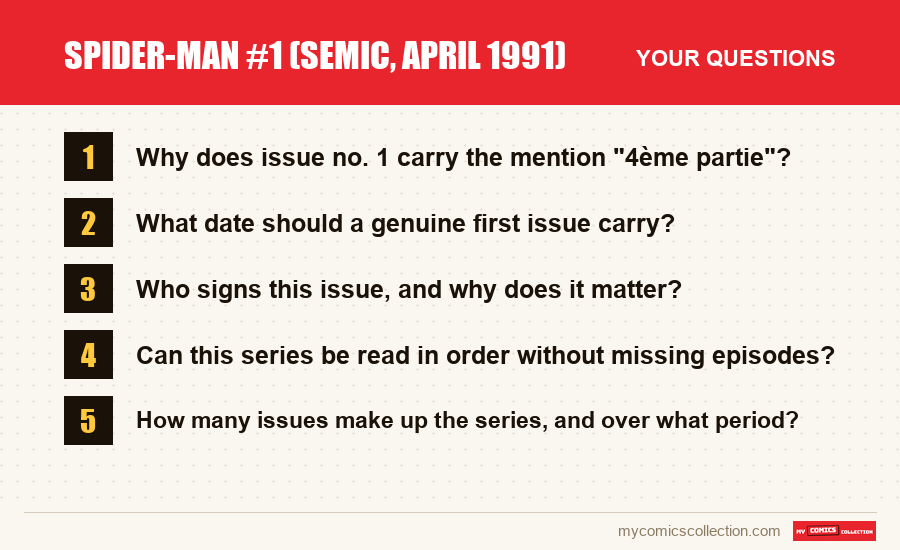
Because the listing keeps the title of an advanced segment of the story contained in the issue. The following issues show a regular gap of four parts from one issue to the next, which indicates that a French volume absorbed several segments and that the indexing often keeps the last one. The issue is therefore not incomplete for all that.
April 1991. It is the easiest fact for a seller to confirm and the most discriminating, since it rules out in one go the earlier titles devoted to the same character and the later relaunches that also start from a number one.
Todd McFarlane is credited as writer and artist on the recorded story. This single name in both roles does not appear again from the fourth issue onward, where the credits become plural. Three artists announced on a supposed number one therefore point to a later issue of the series.
Not by starting from issue no. 1 with the idea of a clean beginning. The part markings do, however, make it possible to reconstruct the internal sequence once the step of four is identified. For a continuous reading of a story from its start, it is better to look beyond the opening issue.
Twenty-three, published from April 1991 to December 1996. The pace tightens toward the end, moving from four months between two issues to two months, so the last numbers circulated among a smaller readership and turn up less often at flea markets.