The Kang the Conqueror comics history begins in September 1964 in The Avengers #8, a time traveler from the future written by Stan Lee and drawn by Jack Kirby. He is presented there as the older version of Rama-Tut, whom the Fantastic Four met in issue 19 of their series in 1963. His birth name, Nathaniel Richards, is given in 1992. What defines him today: a conqueror from the future, multiplied into variants, tied to Immortus, and able to turn the same defeat into a new campaign.
Kang does not have one history, he has several, and they overlap badly on purpose. A pharaoh from the thirtieth century, an emperor of the fortieth, a keeper of time, a teenager who refuses his destiny: all share the same face and the same hunger to dominate time. For a collector, the difficulty is the scatter: the character's turning points sit in Fantastic Four, Avengers, Giant-Size Avengers, Young Avengers and more recent series.
As always in this guide, only verified facts (creators, issues, dates) are stated as fact; the analysis is our own, with no reproduction of protected pages or dialogue.
His first appearance
Kang's publishing timeline begins under another name. Fantastic Four #19, dated October 1963, introduces Rama-Tut, a pharaoh from the year 3000 thanks to time technology. Stan Lee and Jack Kirby create him as an opponent for the Fantastic Four, in a story where ancient Earth serves as the backdrop for a traveler from the future. This issue is the true entry point of the character, even though the name Kang has not been spoken yet.
That comes a year later, in The Avengers #8, dated September 1964, again by Lee and Kirby. Kang is presented there as a conqueror from the fortieth century, and the issue establishes that Rama-Tut is a younger version of him. The effect is lasting: from the start, the character is written as a being who meets his own versions, which foreshadows the whole logic of variants.
For the collector, two entries therefore coexist: Fantastic Four #19 for Rama-Tut and The Avengers #8 for Kang. The Avengers issue is the one fans associate with his name; the Fantastic Four one is the starting point of his time-traveling identity. The context of the first Avengers series is detailed in our analysis of the first Avengers series.
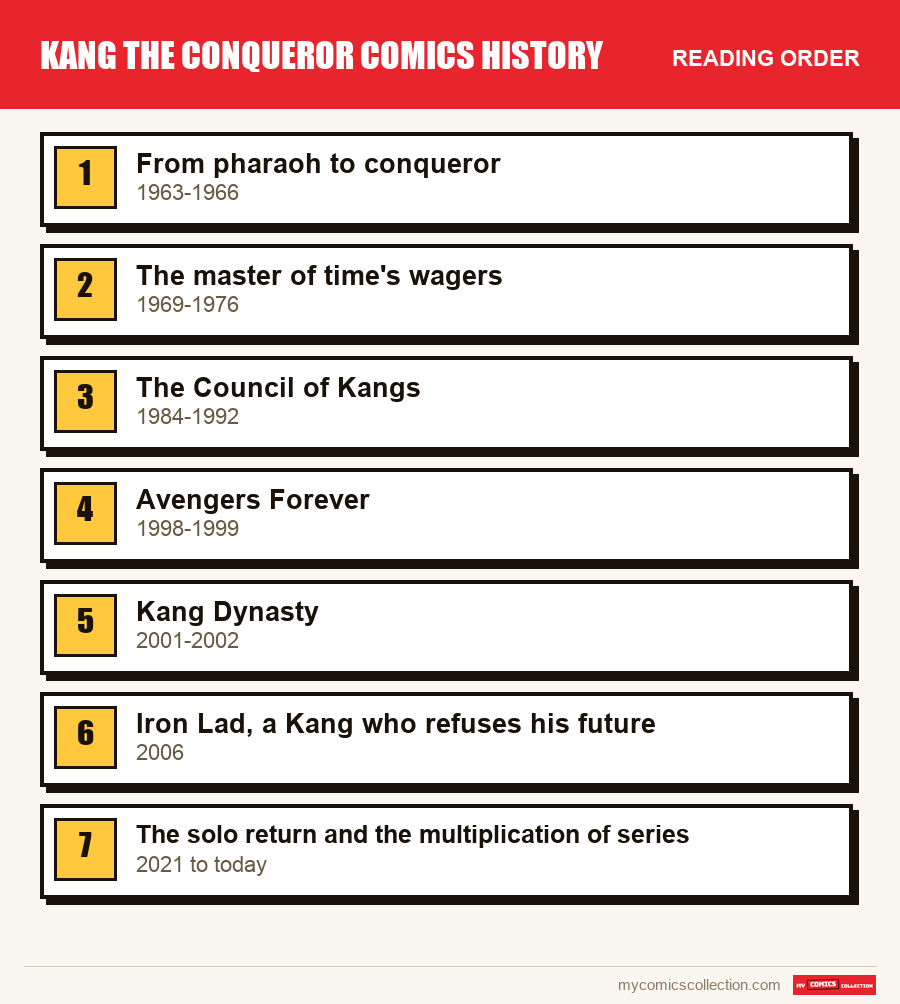
Era 1: From pharaoh to conqueror (1963-1966)
The first era sets up the character's three masks. Rama-Tut, beaten by the Fantastic Four in 1963, becomes Kang; an intermediate stage, the Scarlet Centurion, will only be added in 1968, in Avengers Annual #2. Under the name Kang, he returns in the pages of the Avengers and takes on the team with the mastery of a strategist who has time on his side. It would be wrong to think everything is settled, though: at this stage, no reader yet knows the name Nathaniel Richards, and the mechanics of variants are only implicit.
A second name appears in The Avengers #10, dated November 1964: Immortus. This character, who presents himself as a master of time, will later be tied to Kang. It is one of the most important threads of the character, and it takes until Giant-Size Avengers #3, in February 1975, for Immortus to be established as a future identity of Kang.
A romantic thread also enters the story. In The Avengers #23 and #24, dated December 1965 and January 1966, Kang falls for Ravonna, mortally wounded while shielding him from a shot; he places her body in stasis. This episode gives the conqueror a private wound that feeds his later obsessions, and it explains why Ravonna often returns at his side or in opposition to him in later stories.
Era 2: The master of time's wagers (1969-1976)
The second era widens the scale. In The Avengers #69 to #71, in 1969, Kang faces the Grandmaster, a cosmic being who loves games, in a wager where the Avengers are the pawns and the stakes are bringing Ravonna back to life. The character then moves from ordinary conqueror to player on a vaster chessboard, and the Avengers series opens up to stakes beyond the earthly threat.
What follows plays out around the Celestial Madonna. Kang pursues Mantis in The Avengers #129 and Giant-Size Avengers #2, in November 1974, while Rama-Tut, opposite his double, helps the Avengers. Giant-Size Avengers #3, in February 1975, establishes the link with Immortus there. Then, in The Avengers #141 to #143, from November 1975 to January 1976, Kang, sent to the American West by Hawkeye, destroys himself by overloading his armor, which apparently erases Immortus and Rama-Tut along with him.
This sequence matters for a collection: it brings together a giant-size annual and a regular series, two formats that are not found in the same places or in the same condition. It helps to keep these landmarks separate, because it is this combination that ties Kang to Immortus, more than any single issue.
Era 3: The Council of Kangs (1984-1992)
The third era is the era of multiplication. Fantastic Four #273, dated December 1984, strongly suggests that Kang descends from Nathaniel Richards, Reed Richards' father, through one of Reed's half-brothers. After his part in Secret Wars, where the Beyonder recruits him, his time-displaced doubles are revealed; you will find the context of that event on our page Secret Wars #1.
Kang then forms a council with other versions of himself and eliminates rivals, in The Avengers #267 to #269, from May to July 1986. The Council of interdimensional Kangs returns in The Avengers #291 to #297, from May to November 1988, with Fred Kang and Nebula, who it will later turn out was Ravonna in disguise. Fred Kang is incinerated by the Human Torch, possessed by Nebula, in Fantastic Four #337 to #341, from February to June 1990.
In 1992, What If...? vol. 2 #39, dated July, finally gives Kang's birth name: Nathaniel Richards, a detail later folded into main continuity. This era installs the idea that is his strength today: killing one Kang settles nothing, since there are others.
Era 4: Avengers Forever (1998-1999)
With Avengers Forever, Kang becomes the subject of an entire series. This twelve-issue miniseries runs from December 1998 to November 1999, written by Kurt Busiek and Roger Stern, drawn by Carlos Pacheco, with Jesus Merino on inks. Its premise is to gather Avengers from different eras for an adventure that puts the character's past and future at stake.
Kang is destined to become Immortus there, and he rebels against that trajectory; he even helps the Avengers. Immortus, for his part, serves three entities called the Time Keepers, and sends Tempus to kill Rick Jones. In the final battle, Kang kills the Time Keepers. A temporal backlash then recreates Kang and Immortus as two separate beings. It is an inversion of the classic reading: instead of being merely an adversary, Kang takes the place of an actor trying to escape his fate.
For the collector, this is the reference miniseries as soon as you take an interest in Kang in depth. Issue 9, dated August 1999, also leaves open the question of his ancestry, between the family of Reed Richards and that of Doom. Readers of Roger Stern will find a standout contribution to Avengers mythology here.
Do you collect this series?
Track what you own, what you are missing and what your collection is worth. 7-day trial.
Start my trial →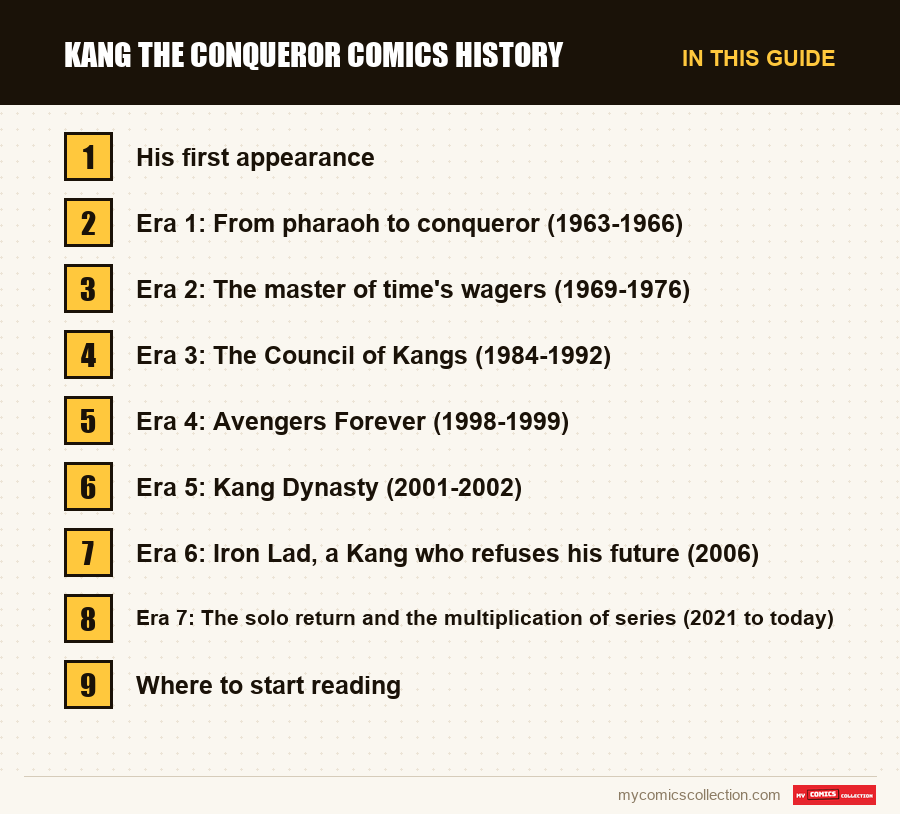
Era 5: Kang Dynasty (2001-2002)
The fifth era is the conquest of Earth. In The Avengers vol. 3 #41 to #55 and Avengers Annual 2001, from June 2001 to August 2002, Kang invades the world with his son Marcus, who will later turn out to be a clone. Spoiler warning: Kang kills Marcus for helping Warbird. After Kang destroys Washington, Captain America beats him in single combat.
The contrast with Avengers Forever is sharp: where the miniseries made Kang an almost tragic character, this saga puts him back in the role of the absolute tyrant. For readers, it is the planet-scale showdown, and it reads in the direct flow of the series. Our Avengers collecting guide helps place these issues within the whole series.
Era 6: Iron Lad, a Kang who refuses his future (2006)
The sixth era changes register. In Young Avengers #1 to #6, in 2006, a teenage Kang steals his future armor and forms the Young Avengers under the name Iron Lad. Spoiler warning: the team ends up killing the adult Kang, but changes to history force Iron Lad to return to his own time, where he will become Kang. The logic is tragic: a young man who sees his future and tries to flee it, without managing to.
This episode matters because it flips the image of the conqueror: Kang is no longer just an invader, he is a kid who refuses to become what history has decided. It is a reading that complements Avengers Forever and prepares the more recent rereadings of the character.
Era 7: The solo return and the multiplication of series (2021 to today)
In the recent period, Kang becomes a headliner. Kang the Conqueror #1, published on August 18, 2021, launches a miniseries devoted to him. A 2023 collection, Kang: The Saga of the Once and Future Conqueror, gathers material including Timeless #1 (December 2022). The same period also sees a second volume of Avengers Forever, fifteen issues long, written by Jason Aaron and launched in 2021.
The movies have also contributed to this visibility, as detailed on our page on Ant-Man and the Wasp: Quantumania and on the replacement of Kang with Doom. For collectors, the lesson remains the same: the 1963 and 1964 issues are the anchors, and recent releases are more or less independent follow-ups. The Jason Aaron hub gathers his work from this period.
Where to start reading
- To understand the origin: Fantastic Four #19 (1963) then The Avengers #8 (September 1964), to be read back to back.
- For the reader who wants time travel in a single story: Avengers Forever (1998-1999), by Kurt Busiek, Roger Stern and Carlos Pacheco.
- For those who prefer a large-scale invasion: the saga in The Avengers vol. 3 #41 to #55 (2001-2002).
- For the reader of young heroes: Young Avengers #1 to #6 (2006), for Iron Lad.
- For current events: Kang the Conqueror #1 (August 2021) and Jason Aaron's Avengers Forever series.
Each entry targets a profile, because Kang reads poorly in a straight line: his story is a set of layers, and it is better to pick an era before working back toward the origin.
The key issues to know
Kang's key issues follow the moments when the character changes nature.
- Fantastic Four #19 (1963): first appearance of Rama-Tut.
- The Avengers #8 (September 1964): first appearance of Kang.
- The Avengers #10 (November 1964): first appearance of Immortus.
- Giant-Size Avengers #3 (February 1975): Immortus becomes a future identity of Kang.
- Fantastic Four #273 (December 1984): a lead on Kang's ancestry.
- What If...? vol. 2 #39 (July 1992): the name Nathaniel Richards.
- Avengers Forever #1 (December 1998): start of the miniseries.
- Kang the Conqueror #1 (August 2021): solo return.
The collecting method is simple: separate the origin issues, the transition issues and the recent follow-ups. A giant-size annual like Giant-Size Avengers #3 is judged on its condition and on its format, never in comparison with a monthly issue from the same year. Our tier list of Avengers key issues offers a complementary reference.
Frequently asked questions
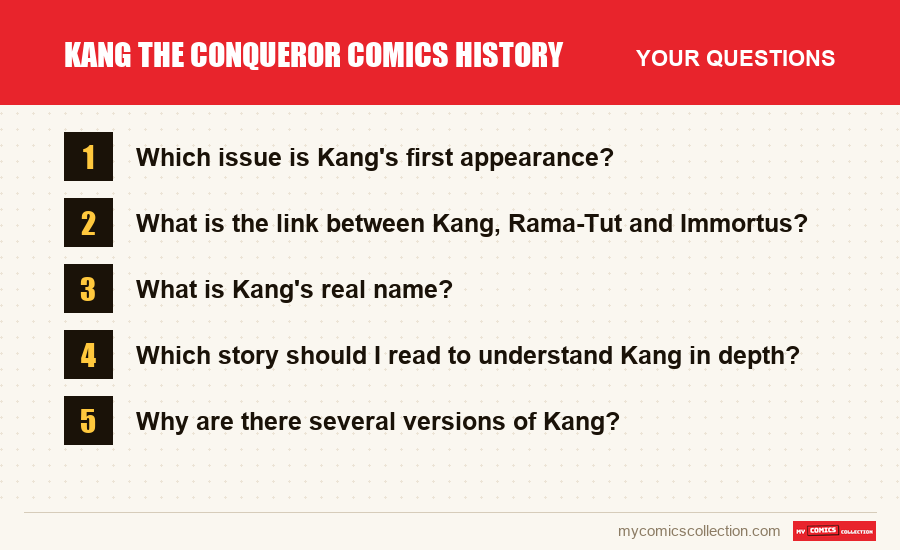
The conqueror from the future is born in September 1964, in The Avengers #8, by Stan Lee and Jack Kirby. His earlier identity, Rama-Tut, is introduced in Fantastic Four #19 in 1963. These two issues are the two origin landmarks to chase for a coherent collection.
Avengers #8 establishes that Rama-Tut is a younger version of Kang. Immortus appears in Avengers #10, in November 1964, and Giant-Size Avengers #3, from February 1975, makes him a future identity of Kang. The three names therefore point to a single being at different stages of his life.
His birth name, Nathaniel Richards, is given in What If...? vol. 2 #39, dated July 1992. Fantastic Four #273 had already hinted at a kinship with Reed Richards' father, and later issues keep his ancestry open. The name is that of Reed Richards' father.
Avengers Forever, a twelve-issue miniseries published from December 1998 to November 1999, is the reference read. It is written by Kurt Busiek and Roger Stern, drawn by Carlos Pacheco. It features Kang, Immortus and the Time Keepers in a story that crosses several eras.
The versions multiply mostly from 1986, with the Council of Kangs in Avengers #267 to #269, then the interdimensional Kangs in Avengers #291 to #297, in 1988. The idea is that beating one Kang is not enough: others exist elsewhere in time and the multiverse.
An Avengers #8 or a Fantastic Four #19 in your collection deserves an appraisal based on its actual condition.
Appraise my comic