The 2026 tier list of key Avengers issues ranks the numbers by valuation potential: Tier S blue-chip (Avengers #1 September 1963 Lee/Kirby, #4 March 1964 return Captain America, #57 October 1968 first Vision, #196 June 1980 first Taskmaster): central assets at €2,000-50,000 depending on rank. Tier A (Avengers #16 May 1965 Cap's Kooky Quartet, #66-67 1969 Adamantium/Ultron-6, #112 June 1973 first Mantis, #181 March 1979 first Scott Lang). Tier B solid sleepers (Avengers #221 July 1982 She-Hulk joins, New Avengers #1 January 2005 Bendis). Tier C speculative bets 2026-2027 (New Avengers #August 21, 2006 Illuminati, Young Avengers #1 April 2005, Doomsday/Secret Wars build-up).
Building a solid Avengers collection in 2026 requires a method: without a clear hierarchy of numbers, the collector disperses his budget on secondary issues while the blue-chips continue to appreciate out of reach. The tier list is the discipline tool that separates must-have from nice-to-have, defensive investment from calculated bet, purchasing urgency from opportunistic patience.
Ce guide tier list Avengers 2026 classifies major key issues into four tiers (S, A, B, C) according to three weighted criteria: narrative historical importance, market performance over five rolling years, and probability of MCU catalyst in the 2026-2030 window. Each issue is documented with exact date, creative team and price range by CGC grade. Objective: to allow the French-speaking collector to build a budgeted purchasing strategy, without wasting a euro on the classic traps of the Avengers catalog (false reprints, overpriced runs, minor first appearances inflated by rumor).
Avengers 2026 tier list methodology
A useful tier list doesn't just line up numbers in order of price: it prioritizes based on a coherent investment and collection thesis. For the Avengers in 2026, three methodological axes structure the ranking.
Tier S/A/B/C classification criteria
- Narrative historical significance (40%): first appearances of structuring characters, founding events (team formation, death/resurrection, major retcon), canonical runs cited by academic criticism.
- Market performance 5 years (35%): CGC price trend documented on GoCollect, Heritage Auctions, ComicConnect between 2021 and 2026. An issue that has doubled and then plateaued is not equivalent to an issue that progresses linearly.
- Probability of MCU catalyst 2026-2030 (25%): proximity of the character with Phase 6 Marvel Studios announcements, presence in confirmed Disney+ projects, traction of verifiable rumors about The Cosmic Circus and Murphy's Multiverse.
Definition of third parties
- Tier S: blue-chip: central numbers, globally recognized value, no risk of historical downgrading. These are the defensive assets of the collection. If you could only own four Avengers, these would be them.
- Tier A: fundamentals: historically critical issues with solid performance but without the absolute status of Tier S. Make up the backbone of a serious collection.
- Tier B: sleepers with conviction: numbers undervalued in view of their significance, with catalyst identified at 12-36 months. Moderate risk, documented re-rating potential.
- Tier C: speculative bets: numbers with a strong thesis but dependent on uncertain future events. Limited budget allocation recommended.
Voluntary out-of-scope
This tier list does not classify secondary annuals, event crossovers (unless directly influenced), nor modern post-2015 variants which have lost any lasting speculative premium. For the parallel market in reprints and fakes, consult the guide to fake Avengers reprints before any purchase of issues before 1970 from unverified eBay.
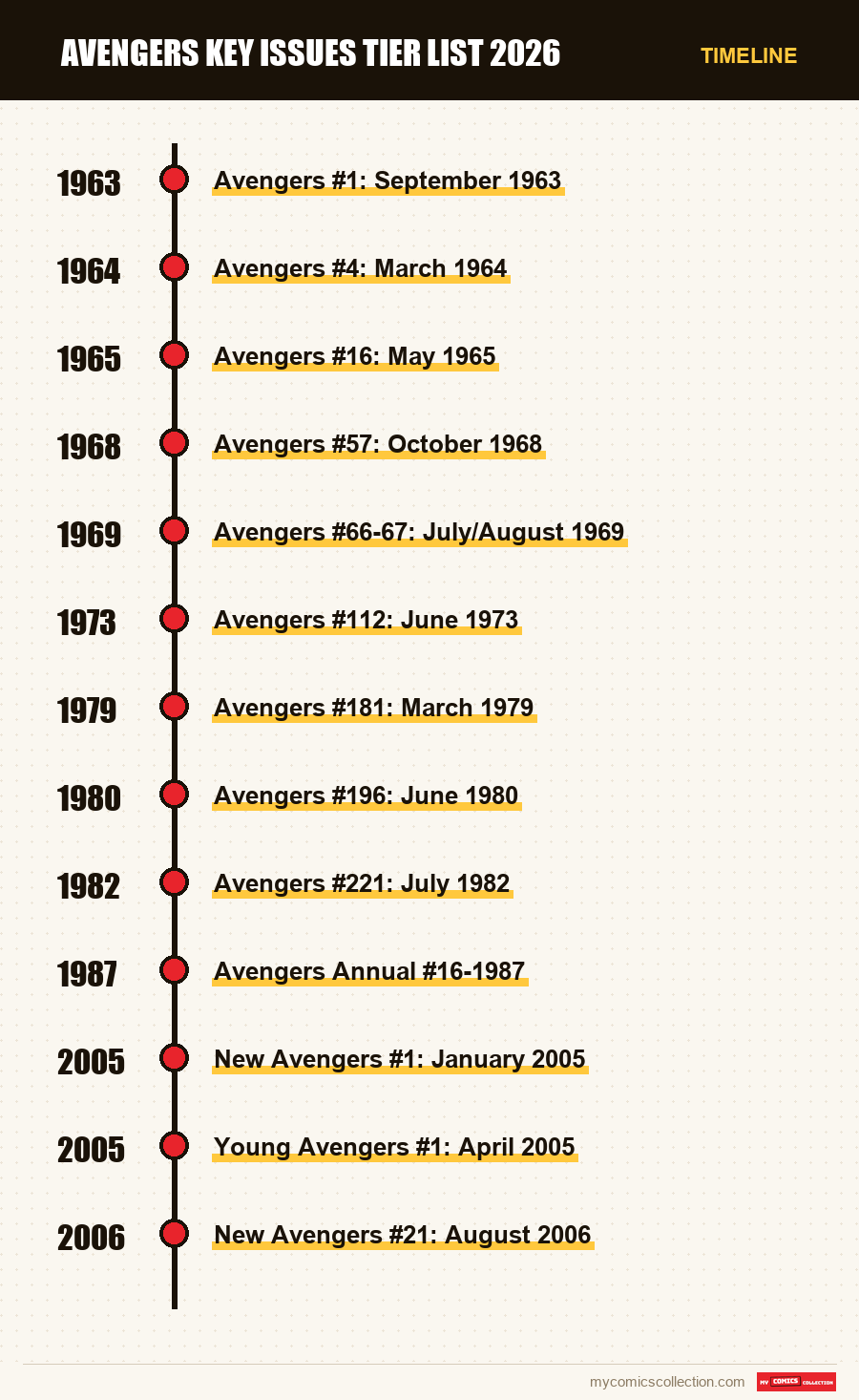
Tier S: the central Avengers blue-chips
Four issues absolutely dominate the Avengers catalog and constitute the defensive core of any serious collection. They combine absolute rarity in high grade, indisputable historical importance and maximum liquidity on major auction markets.
Avengers #1: September 1963 (Stan Lee / Jack Kirby)
The founding number. Published by Marvel Comics in September 1963 under the aegis of Stan Lee for the screenplay and Jack Kirby for the drawings (inking Dick Ayers), Avengers #1 introduces the original formation of the team: Thor, Iron Man, Hulk, Ant-Man and Wasp united to fight Loki. The initial pitch, a disparate team of heroes already established in their solo series, invents the concept of a monetizable shared universe that underpins the entire Marvel Studios strategy today.
- CGC 9.0: public sales 2024-2026 between €110,000 and €165,000. Census CGC 9.0 less than 30 copies.
- CGC 7.0: €35,000 to €55,000. This is the most accessible mid-grade for a high-end investment.
- CGC 6.0: €18,000 to €28,000. Institutional entry point.
- CGC 4.0: €6,500 to €11,000. The grade of serious collectors with a capped budget.
- CGC 2.0: €2,800 to €4,500. The minimum acceptable to preserve blue-chip status.
5-year trend: +180% between 2021 and 2026 in CGC 7.0, with a post-Avengers: Endgame acceleration which has never reversed. No documented market correction greater than 12% over 36-month rolling windows since 2010.
Avengers #4: March 1964 (Stan Lee / Jack Kirby)
The return of Captain America. Published March 1964, Avengers #4 chronicles the recovery of Steve Rogers frozen in a block of ice since the end of World War II. Lee and Kirby thus revive a character abandoned since 1954, creating the archetype of the superhero displaced out of his time which still structures the MCU. This is the first Silver Age Captain America, the first direct crossover between the Timely/Atlas legacy and the modern Marvel universe.
- CGC 9.0: €32,000 to €48,000.
- CGC 7.0: €9,500 to €14,000.
- CGC 6.0: €6,200 to €9,000.
- CGC 4.0: €2,800 to €4,200.
- CGC 2.0: €1,100 to €1,800.
5-year trend: +95% in CGC 6.0, with a recent plateau which could represent a tactical entry window. The catalyst Avengers: Doomsday (2026) indirectly pulls the rating upwards, Captain America remaining the emotional pillar of the Multiverse saga.
Avengers #57: October 1968 (Roy Thomas / John Buscema)
First appearance of Vision. Published October 1968 by Roy Thomas (screenplay) and John Buscema (art, inking George Klein), Avengers #57 introduces the synthezoid android created by Ultron from components of the original Human Torch. The issue launches a character who will become central in the Englehart, Byrne (Vision and the Scarlet Witch) arcs, then in WandaVision (Disney+, 2021) which propelled the rating to record levels.
- CGC 9.6: €18,000 to €26,000. Census limited to less than 50 copies.
- CGC 9.4: €8,500 to €12,500.
- GCC 9.2: €4,800 to €7,200.
- CGC 8.0: €1,800 to €2,800.
- CGC 7.0: €1,100 to €1,700.
- CGC 6.0: €700 to €1,100.
5-year trend: +220% in CGC 9.2 between 2021 and 2024, followed by post-WandaVision stabilization. The current window is neutral: no urgency to buy, no signal to sell. Any confirmed solo Vision project would trigger a new bullish wave.
Avengers #196: June 1980 (David Michelinie / George Pérez)
First appearance of Taskmaster. Published June 1980, written by David Michelinie and drawn by George Pérez, Avengers #196 introduces Tony Masters, a mercenary with photo-reflex memory capable of reproducing any observed combat technique. The character experienced a major return to relevance with her role in Black Widow (MCU, 2021) and remains one of the most exploitable antagonists of the second Avengers circle.
- CGC 9.8: €2,400 to €3,800.
- CGC 9.6: €800 to €1,300.
- CGC 9.4: €380 to €580.
- GCC 9.2: €220 to €340.
- CGC 8.5: €130 to €200.
Grade 9.8 remains the sweet spot for Taskmaster, with a census of less than 350 copies worldwide. The 5-year progression reached +160% in 9.8, and the number regularly appears in the speculative recommendations published by spec keys 2027 analyzes.
Tier A: solid Avengers fundamentals
Tier A brings together the issues that constitute the backbone of a serious Avengers collection. They combine documented narrative importance and continued market performance, without achieving absolute Tier S monument status. The budget weighting rule suggests that they represent 35-45% of the Silver/Bronze Age oriented collector's total allocation.
Avengers #16: May 1965 (Stan Lee / Jack Kirby)
Cap's Kooky Quartet. Published May 1965, Avengers #16 marks the first complete renewal of the team: Thor, Iron Man, Giant-Man and Wasp leave the Avengers, replaced by Hawkeye, Quicksilver and Scarlet Witch under the command of Captain America. This new team, ironically dubbed "Cap's Kooky Quartet" by fans, demonstrates the narrative mechanics of continuous rotation that distinguishes the Avengers franchise from all other teams of the Silver Age.
- CGC 9.4: €6,800 to €10,500.
- GCC 9.2: €3,800 to €5,800.
- CGC 8.5: €1,500 to €2,400.
- CGC 7.0: €580 to €850.
- CGC 6.0: €320 to €480.
5-year trend: +85% in CGC 7.0. Number undercovered by the speculative retail market but recognized as a cornerstone by institutional collectors.
Avengers #66-67: July/August 1969 (Roy Thomas / Barry Windsor-Smith)
First appearance of adamantium and first Ultron-6. Published July-August 1969 by Roy Thomas and Barry Windsor-Smith (first important contributions from the artist who would become legendary), this diptych introduces the indestructible metal that would later be grafted onto Wolverine and presents the sixth iteration of Ultron in definitive costume. Double first structuring appearances for two major franchises (X-Men and Avengers).
- #66 CGC 9.6: €3,200 to €4,800.
- #66 CGC 9.4: €1,400 to €2,100.
- #66 CGC 9.2: €700 to €1,050.
- #67 CGC 9.6: €1,800 to €2,700.
- #67 CGC 9.4: €750 to €1,150.
Buying the grade matching pair maximizes future resale liquidity. 5-year trend: +140% in CGC 9.4 for #66.
Avengers #112: June 1973 (Steve Englehart / Don Heck)
First appearance of Mantis. Published June 1973 by Steve Englehart (screenplay) and Don Heck (art), Avengers #112 introduces the cosmic priestess of Vietnamese origin who will play a central role in the Celestial Madonna Saga. Pom Klementieff popularized the character in the MCU via Guardians of the Galaxy Vol. 2 and 3, creating sustainable demand.
- CGC 9.6: €1,200 to €1,800.
- CGC 9.4: €480 to €720.
- GCC 9.2: €280 to €420.
- CGC 8.5: €140 to €220.
Number frequently cited in sleeper analyses, particularly in post-Secret Invasion spec calls where Mantis is among the cosmic characters to watch for Phase 7 MCU.
Avengers #181: March 1979 (David Michelinie / John Byrne)
First appearance of Scott Lang. Published March 1979 by David Michelinie and John Byrne, Avengers #181 introduces the future second Ant-Man in an initially secondary role (burglar seeking redemption to finance his daughter's treatment). The character became an MCU mainstay via Paul Rudd in the Ant-Man trilogy (2015, 2018, 2023).
- CGC 9.8: €2,200 to €3,400.
- CGC 9.6: €650 to €980.
- CGC 9.4: €320 to €480.
- GCC 9.2: €180 to €270.
- CGC 9.0: €110 to €170.
Grade 9.8 remains the only really liquid one for Scott Lang. The rating has tripled since 2018 but the potential remains limited as long as the MCU does not announce a fourth Ant-Man opus. To be monitored in the context of a beginner's Avengers collection Bronze Age oriented.
Tier B: Avengers sleepers to be convinced
Tier B is the favorite playground of informed collectors. The numbers are accessible there, their assessment thesis documented, and the potential/risk ratio favorable. They typically represent 25-35% of a diverse Avengers allocation.
Avengers #221: July 1982 (Jim Shooter / Bob Hall)
She-Hulk joins the Avengers. Published July 1982 by Jim Shooter (screenplay, then editor-in-chief Marvel) and Bob Hall (drawings), Avengers #221 marks the official integration of Jennifer Walters into the team. The issue was long underrated because She-Hulk didn't have a major adaptation: the Disney+ series She-Hulk: Attorney at Law (2022) changed that dynamic.
- CGC 9.8: €380 to €580.
- CGC 9.6: €140 to €210.
- CGC 9.4: €75 to €115.
- GCC 9.2: €45 to €70.
5-year trend: +210% in CGC 9.8 between 2021 and 2026. The issue remains accessible in mid-grade for French-speaking collectors with a modest monthly budget: see our Avengers collection guide for the accumulation strategy.
New Avengers #1: January 2005 (Brian Michael Bendis / David Finch)
The Bendis relaunch. Published January 2005 (cover dated January, actual release November 2004) by Brian Michael Bendis (screenplay) and David Finch (art), New Avengers #1 ushers in the modern era of the title after the events of Avengers Disassembled. The Spider-Man, Wolverine, Luke Cage, Iron Man, Captain America, Spider-Woman cast redefined the franchise for the next decade and remains a Modern Age cornerstone.
- CGC 9.8: €95 to €145.
- CGC 9.6: €35 to €55.
- CGC 9.4: €20 to €30.
- Variants Finch sketch: €250 to €450 in 9.8.
The regular issue in 9.8 has gradually become expensive but retains a significant upside if the MCU integrates elements from the Bendis-verse (Luke Cage Avenger, Spider-Woman). 5-year trend: +95% in 9.8.
Avengers Annual #16-1987 (Tom DeFalco / Ron Lim)
An often overlooked Tier B issue, Avengers Annual #16 (published 1987) features a Heart of Stone crossover story that establishes Kang/Immortus narrative elements later exploited by Hickman. Comparable to sleeper status reported in Avengers market analysis 2026.
- CGC 9.8: €130 to €200.
- CGC 9.6: €50 to €75.
Collecting this series?
Track what you own, what you are missing and what your collection is worth. 7 day trial.
Start my trial →Tier C: speculative bets 2026-2027
Tier C concentrates bets with a strong thesis but high uncertainty. Recommended budget allocation: 10-20% of total Avengers budget. Buying multiple copies of the same issue is sometimes relevant here if conviction is high and the entry price low.
New Avengers #21: August 2006 (Brian Michael Bendis / Leinil Yu)
First gathering of the modern Illuminati. Published August 2006 by Bendis and Yu, New Avengers #21 introduces Bendis' version of the Illuminati (Iron Man, Mr. Fantastic, Doctor Strange, Black Bolt, Namor, Professor X) in full Civil War continuity. The concept became central with Hickman then the MCU via Doctor Strange in the Multiverse of Madness (2022).
- CGC 9.8: €65 to €100.
- CGC 9.6: €28 to €42.
Potential catalyst: Avengers: Doomsday (2026) integrating a multiversal council with Illuminati sauce could propel the odds x3-x5 in 12 months.
Young Avengers #1: April 2005 (Allan Heinberg / Jim Cheung)
First appearances Wiccan, Hulkling, Patriot, Iron Lad, Kate Bishop. Published April 2005 by Allan Heinberg (screenplay) and Jim Cheung (art), Young Avengers #1 introduces five characters who are all candidates for MCU integration. Iron Lad is particularly crucial because he represents an alternate version of Kang, a sensitive subject after the Marvel Studios casting changes.
- CGC 9.8: €350 to €550.
- CGC 9.6: €140 to €210.
- CGC 9.4: €70 to €105.
5-year trend: +280% in 9.8. The ideal entry window has passed but the issue remains exposed to any Young Avengers MCU team announcements. See also the 2027 Marvel/DC spec keys which detail the confirmed projects.
Avengers: Doomsday / Secret Wars 2027 build-up numbers
Marvel Studios has confirmed Avengers: Doomsday (December 2026) and Avengers: Secret Wars (May 2027). Several numbers will benefit from halo effects:
- Fantastic Four #5 (1962): first Doctor Doom. Indirectly Avengers via Doomsday. Effect already partially integrated into the price.
- Avengers #2 (1963): exit Hulk, embryonic unstable roster. Underbid compared to #1 and #4.
- Avengers #8 (1963): first Kang. Volatile, linked to MCU casting decisions.
- Marvel Super Heroes Secret Wars #1 (1984): original reference to the cinema title.
For technical purchasing arbitrations, the investment strategy analysis 2027 offers detailed budget weighting grids.
Allocation strategy by collector budget
A tier list only has value when operationalized by a budgetary strategy. Here are three typical profiles adjusted to the 2026 market.
Budget €5,000: the Bronze Age heart collection
- Avengers #196 CGC 9.4 (€450): first Taskmaster, accessible Tier S anchorage.
- Avengers #181 CGC 9.4 (€400): Scott Lang, Tier A anchor.
- Avengers #112 CGC 9.2 (€350): Mantis, Tier A anchor.
- Avengers #66 CGC 9.0 (€650): adamantium intro, Tier A.
- Avengers #221 CGC 9.6 (€180). She-Hulk join, Tier B.
- Avengers #57 CGC 6.0 (€900): Vision, Tier S entry point.
- Avengers Annual #10 raw VF (€300): first Rogue, non-tier sleeper.
- Reserve €1,770: window opportunities + targeted Tier C (NA #21, YA #1 raw).
This allocation builds a base representative of the three ages (Silver-Bronze-Modern) while keeping a tactical reserve for MCU announcements.
Budget €15,000: the institutional collection
Suggested allocation: 60% Tier S, 25% Tier A, 10% Tier B, 5% Tier C.
- Avengers #1 CGC 4.0 (€8,500): cornerstone.
- Avengers #4 CGC 6.0 (€7,500): second pillar.
- Avengers #57 CGC 7.0 (€1,300): Tier S complete.
- Avengers #16 CGC 7.0 (€650): Kooky Quartet.
- Avengers #196 CGC 9.6 (€1,000): High grade Taskmaster.
- Avengers #181 CGC 9.8 (€2,800): Scott Lang final grade.
- Reserve €1,250: Tier B (NA #1, #221) and opportunities.
Budget €50,000+: the blue-chip wallet
At this level, the top priority is grade quality. Buy an Avengers #1 CGC 7.0 (€40,000) rather than ten mid-grade Tier B issues. Resale liquidity is paramount, and the Heritage/ComicConnect market concentrates its best performances on higher grades.
For continued arbitration, see Iron Man story in comics to understand the correlations between Avengers franchises and individual keys like Tales of Suspense #39.
Classic pitfalls to avoid in the Avengers franchise
The Avengers collection has specific pitfalls that can erode a well-planned budget. Three families of risks dominate.
False reprints and unauthenticated copies
Issues prior to 1970 are regularly falsified via Marvel Tales, Marvel Triple Action reprints or pirate copies. The price gap between the original Avengers #4 (€10,000+) and a Marvel Tales reprint (€15-30) creates a strong incentive for scams. Buy exclusively CGC slabbed for pre-1970 issues, or through trusted sellers with guaranteed authentication. THE guide to fake Avengers reprints details critical visual indicators.
Multiple roster relaunches and numbering confusion
The Avengers franchise has seen numerous volumes: volume 1 (1963-1996), volume 2 Heroes Reborn (1996-1997), volume 3 (1998-2004), volume 4 Heroic Age (2010-2012), volume 5 Marvel NOW! (2012-2015), volume 6 All-New All-Different (2015-2016), volume 7 (2016-2018), volume 8 Aaron (2018-2023), volume 9 MacKay (2023+). This inflation of relaunches creates multiple numberings (Avengers #1 exists seven times) which traps first-time buyers.
- Always check the year of publication AND the volume before purchasing.
- An “Avengers #1” without context means nothing: demand the precise date and publisher.
- The new #1 Heroes Reborn (1996) are only worth a fraction of the original 1963 #1.
Overvalued modern variants
Post-2015 variant covers (1:25, 1:50, 1:100, sketch covers) have massively lost their speculative premium. 90% of variants purchased for €200-500 in 2021 now sell for €30-80. Avoid variant ratios as a main strategy and favor pre-2013 live newsstand covers for their documented authentic rarity.
Premium for first minor appearances
The speculative market has sometimes inflated the first appearances of tertiary characters (Starfox, pre-retconization Drax, Living Lightning) on simple MCU casting rumors that have never been confirmed. Distinguish reliable sources (The Cosmic Circus, Murphy's Multiverse) from unverified Twitter feeds.
Avengers Portfolio Tracker 2026-2030
A tier list is not static. MCU catalysts, changes in editorial management at Marvel, and macro-economic cycles in the collecting market cause the rankings to evolve year after year. This is the recommended revision method.
Quarterly review cycle
- Q1: previous year report: Heritage Auctions and ComicConnect sales, calculation of progression by issue and by grade. Recalibration of budgetary weighting.
- Q2: analysis of San Diego Comic-Con / D23 announcements (July). Updated Tier C targets based on MCU confirmations.
- Q3: monitoring of Disney+ releases and price impact observed D+30, D+90, D+180.
- Q4: end-of-year tax arbitrage, opportunistic sales of positions that have achieved their objectives.
Re-classification indicators
Three signals can justify moving a Tier C number to Tier B, or Tier B to Tier A:
- Official Marvel Studios casting announcement on the issue's central character.
- Reduction of the CGC 9.8 census below a structural threshold (typically 50 copies in public circulation).
- Price progression greater than 100% over 18 rolling months with maintenance over 24 months.
Operational monitoring tools
To manage a diversified Avengers portfolio over 50-200 issues, manual tools (Excel, Google Sheets) quickly reach their limits. Dedicated applications like Comics Manager keep daily-updated eBay estimates in one place, to read alongside the CGC census and the MCU announcements calendar. See the complete guide Comics Manager for initial setup and free estimate for individual arbitrations.
Horizon 2027-2030: areas to monitor
Four major theses will probably structure the following decade on the Avengers franchise:
- Post-Secret Wars movie (2027): MCU reset announced, opportunity or correction depending on receipt.
- X-Men/Avengers MCU crossover: official reintegration of mutants would trigger a revaluation of Avengers vs. X-Men crossover keys (Uncanny X-Men #268, X-Men/Avengers Onslaught).
- Doctor Doom as multi-year antagonist: Fantastic Four #5 and its Avengers halo.
- Disney+ saturation: risk of market fatigue if the Marvel Studios cadence drops below 2 films/year.
For collectors wishing to actively track the global market, the overview of referenced comics and the index of key issues comics provide a systematic entry point. For the Avengers franchise specifically, the Avengers character archive centralizes resources.
Avengers 2026 tier list FAQ
Avengers #1 (September 1963, Lee/Kirby) remains the absolute foundational issue. If the budget only allows one Tier S acquisition, it is this one, ideally in CGC 4.0 minimum to preserve blue-chip status and resale liquidity. Avengers #4 (March 1964, Captain America returns) is the second central choice if the budget allows it.
Avengers #196 (June 1980, first Taskmaster) offers a better budgetary entry point (CGC 9.4 at €380-580) than Avengers #57 (Vision, CGC 7.0 at €1,100+). For a first Tier S Bronze Age purchase, #196 maximizes the importance/price ratio. #57 remains more prestigious and historically central, but requires a higher budget.
Young Avengers #1 (April 2005) in CGC 9.8 has already grown by +280% over 5 years. The initial speculative bet is largely consumed. Buying today assumes a strong thesis on an MCU Young Avengers announcement within 18 months. In the raw VF/NM version, the entry point at €80-120 remains defensible for long-term storage.
Three strict rules: buy exclusively CGC slabbed copies (or CBCS for constrained budgets), check the concordance of the CGC serial number on the official database, refuse any purchase of "raw originals" greater than €500 without third-party authentication. Marvel Tales and Marvel Triple Action reprints are the most common pitfalls for pre-1970 issues.
For Avengers #1 and #4: CGC 6.0 minimum is the institutional liquidity threshold. Below (4.0-5.5), resale remains possible but with a negotiated discount. For Avengers #57 and #16: CGC 7.0-8.0 offer the most relevant preservation/price ratio. For Avengers #196 Bronze Age: CGC 9.4-9.6 are the sweet spots, with 9.8 often overstating the census rarity.
Related articles
- Avengers Bronze Age key numbers: complete guide
- Avengers sleeper issues: the underrated ones to watch out for
- Avengers market trends 2026
- Spec keys 2027 Marvel/DC films and series
- CGC grading guide Avengers
Do you own Avengers comics? Estimate the value of your collection for free to know their current rating.