To start an Avengers collection with a budget of $200 to $500, focus on the accessible Bronze Age key issues (Avengers #181 Ant-Man at $80-$150 in CGC 9.0, #196 Taskmaster at $100-$200 in CGC 9.4) and the complete modern runs (New Avengers by Bendis, 51 issues for $100-$200 in CGC 9.4). singles).
Collecting the Avengers is an exciting adventure but can seem overwhelming: more than 700 issues in the main series, dozens of spin-off series, major crossovers and a market where prices range from $2 to $400,000. The key to success for a beginner is to define a clear strategy from the start.
This guide is designed for the collector who is starting from scratch. It covers the essential basics: how to define your goals, what budget to allocate, which numbers to prioritize, where to buy smartly and how to protect your investment from day one.
Defining your collecting approach
Before purchasing a single issue, determine your collecting philosophy. Each approach dictates radically different choices:
Collection per run (recommended for beginners)
Choose a specific run and complete it. This approach offers the quickest satisfaction and a controllable budget. Accessible examples:
- Avengers vol. 3 #1-84 (Busiek/Perez, 1998-2004): $150-$350 in VF+ singles. Excellent narrative quality.
- New Avengers #1-64 (Bendis, 2005-2010): $100-$200 in NM singles. Ideal modern entry point.
- Avengers #1-44 (Hickman, 2012-2015): $80-$150 in NM singles. The best cosmic run.
Collection by key issues
Target only key numbers (first appearances, pivotal moments). More expensive per issue but more rewarding for comic book history enthusiasts. Minimum budget: $500 for around ten significant Bronze/Modern Age keys.
Complete collection (full run #1-402)
The ultimate grail for the Avengers collector. Realistic but long term (5-15 years). Issues 100-400 can be found at $3-$15 each, making 70% of the collection very affordable. These are #1-20 which represent the bulk of the budget.
The first 10 numbers to buy
If you're starting today with a budget of $500, here's the recommended buying order:
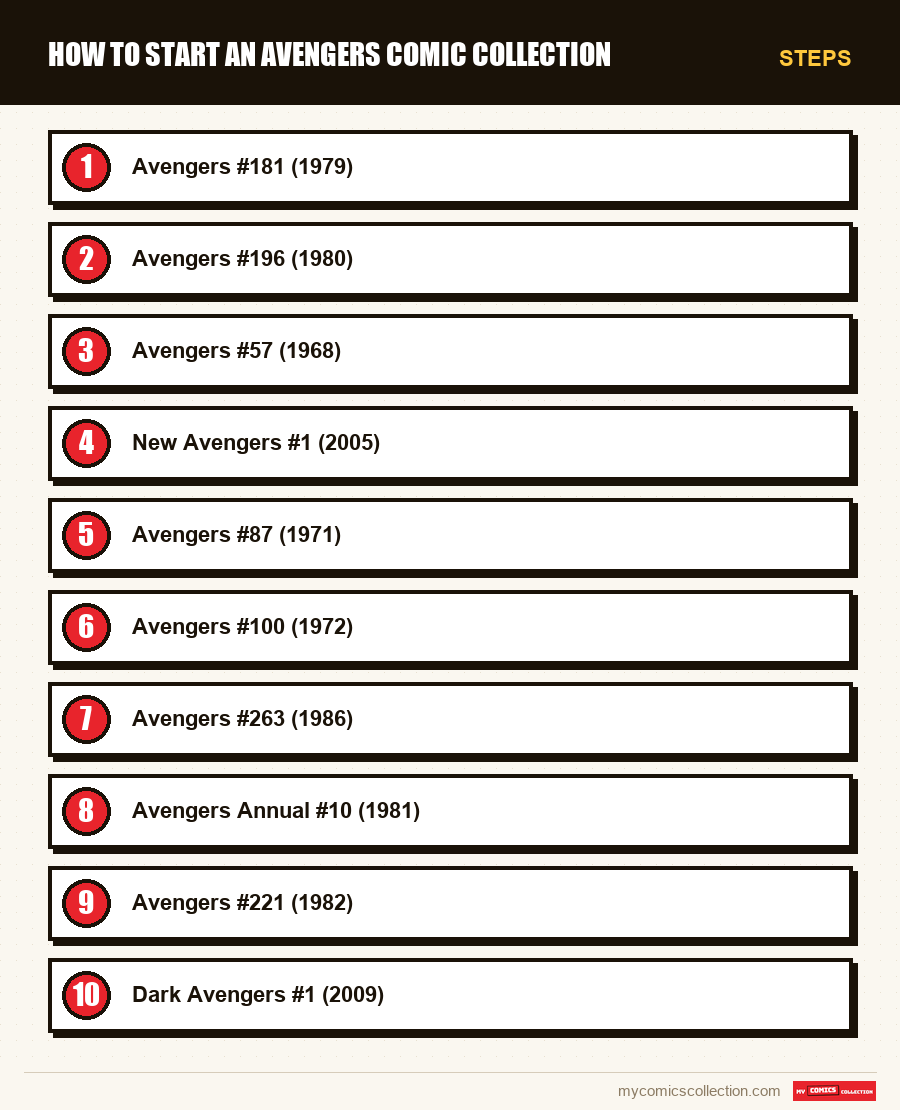
- Avengers #181 (1979): First appearance of Scott Lang (Ant-Man). CGC 9.0: $80-$150. Key issue accessible with high MCU potential.
- Avengers #196 (1980): First appearance of Taskmaster. Raw VF: $30-$60. Expanding character in the MCU.
- Avengers #57 (1968): First Vision. VG/FN raw: $80-$150. Grail accessible in mid-grade.
- New Avengers #1 (2005): CGC 9.8: $40-$80. Cornerstone of the modern era.
- Avengers #87 (1971): Origin of Black Panther. FN raw: $40-$80.
- Avengers #100 (1972): Anniversary number, all the Avengers together. FN: $20-$40.
- Avengers #263 (1986): Return of Jean Gray (X-Factor link). FN/VF: $10-$20.
- Avengers Annual #10 (1981): First Snape + first Madelyn Pryor. VF: $60-$120.
- Avengers #221 (1982): She-Hulk and Hawkeye join. VF: $8-$15.
- Dark Avengers #1 (2009): CGC 9.8: $30-$60. Potential Thunderbolts MCU.
Where to buy your first Avengers
Each purchasing source has its advantages and pitfalls:
- eBay: The largest global inventory. Use the “Buy It Now” + “Free Shipping” filters for the best deals. Always check the seller's feedback (99%+ minimum). Sunday evening auctions often offer prices 15-20% below market.
- MyComicShop.com: Reliable in-house grading, massive mid-grade inventory. Ideal for common numbers (#100-400).
- Local conventions: The $1-$5 bins often contain Avengers from the 80s-90s in good condition. Trade lots of 20+ for $1-2 each.
- Heritage Auctions: For CGC certified key issues. Buyer's commission of 20% to integrate into your budget.
- Specialized Facebook groups: “CGC Comic Book Collectors” and “Avengers Collectors” offer prices 10-20% below the eBay market.
Protect and store your collection
The essential basics from the first issue purchased:
- Pouches (bags): Mylar for the keys (0.50-1 $ each), polypropylene for the rest (0.05-0.10 $ each). Change the poly bags every 3-5 years.
- Cardboards: Acid-free obligatory. Current format for modern people, Silver Age for old people. 0.05-0.15 $ each.
- Storage boxes: Short boxes (150-175 comics) or long boxes (250-300). Store vertically, never stacked.
- Environment: Stable temperature (18-22°C), humidity 40-50%, away from direct light. Avoid attics and basements.
- Insurance: From $1,000 in value, take out specialized insurance (Collectibles Insurance Services, 1% of the value/year).
Beginner mistakes to avoid
- Buy impulsively after a movie: Prices inflate by 30-50% around MCU releases. Wait 6-12 months.
- Neglect the state: A “Fine” comic (6.0) is worth 3-5x less than a “Near Mint” (9.2). Learn the basics of grading before you buy.
- Grade everything CGC: Grading costs $30-$150 per number. Only grade key issues worth $100+ raw.
- Ignore variants: Some cover variants (ratio 1:25, 1:50) are worth 5-20x the cover price. Check before paying the standard price.
- Buy without checking prices: Use GoCollect, eBay sold listings and GPA to know the market value before any purchase.
Do you own Avengers comics? Estimate the value of your collection for free to know their current rating.
Frequently asked questions
The guide recommends collecting by run: pick a specific period and complete it, which gives the quickest satisfaction and a controlled budget. The alternatives are collecting key issues and the full #1-402 run, a long-term project.
Avengers #181 (1979, first Scott Lang), #196 (1980, first Taskmaster), #57 (1968, first Vision), #87, #100, plus New Avengers #1 (2005), the cornerstone of the modern era.
Avengers vol. 3 #1-84 (Busiek and Perez, 1998-2004), New Avengers #1-64 (Bendis, 2005-2010) and Avengers #1-44 (Hickman, 2012-2015). The guide presents New Avengers as the ideal modern entry point.
With bags (Mylar for keys), acid-free boards, and boxes stored upright and never stacked. The ideal environment is stable, between 18 and 22 °C, with 40 to 50% humidity and out of direct light, so no attic or basement.
Buying on impulse after a film release, neglecting condition, grading every issue, ignoring cover variants and buying without checking market value. It is better to wait a few months after a film so prices settle.