Doctor Doom vs Kang the Conqueror: two of Marvel's greatest conquerors oppose each other. Kang manipulates time and multiplies into variants across the multiverse; Doom rules through science, magic and strategy. We compare these two ambitious figures, with surprisingly similar profiles, and what really sets them apart.
Two conquerors, two geniuses obsessed with control: Doom and Kang are as much alike as they are opposites. Comparison of two titans of ambition. Decryption.
As always in this guide, only verified information (established character elements) is stated; the analysis and comparison are ours, without reproduction of plates or protected dialogue.
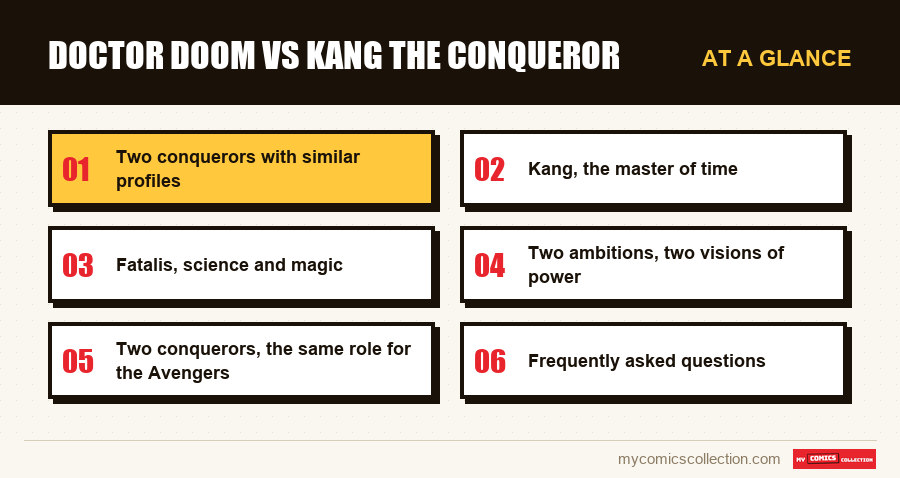
Two conquerors with similar profiles
Doctor Doom and Kang the Conqueror share a lot in common, which makes their comparison particularly interesting. Both are conquerors of exceptional genius, obsessed with power and control. Both aspire to dominate, convinced of their superiority and the legitimacy of their ambitions. This proximity of profiles makes Doom and Kang comparable figures, two archetypes of the ambitious conqueror in the Marvel universe. However, despite these similarities, the two characters operate according to different logics: Kang through time, Fatalis through science and magic. This combination of similarities and differences makes their comparison a rich subject, revealing the characteristics of each.
This proximity between Doom and Kang illustrates the wealth of Marvel's great conquering villains. Both characters embody the ambition for domination, but each with their own flavor and methods. This similarity also explains why the monarch of Latveria was able to replace Kang in the cinema as the big bad: the two figures share comparable issues. For the reader, comparing Doom and Kang allows them to appreciate the nuances between two close archetypes, and to understand what really distinguishes the monarch of Latveria from the master of time. This comparison, between two ambitious conquerors, highlights the strengths and specificities of each. The Doom hub brings together our guides to explore the monarch of Latveria alongside other great Marvel figures.
Kang, the master of time
Kang the Conqueror is distinguished by his mastery of time. A time traveler, Kang can move through eras, manipulate the timeline, and exploit the multiverse to his advantage. This ability makes it a unique type of adversary, capable of anticipating events, reversing its defeats and multiplying into variants from different realities. These countless versions of Kang, spread across the multiverse, are one of his most formidable assets: defeating one Kang is not enough, because others exist elsewhere. This mastery of time and this multiplicity make Kang a complex and difficult threat to understand, whose power rests on his ability to play with chronology and realities.
This temporal mastery is what defines Kang and sets him apart from Doom. Where the monarch of Latveria operates mainly in the present, Kang evolves through time and realities, which gives him a particular dimension. Its multiple variants make it almost impossible to eliminate permanently, a considerable advantage. This ability to manipulate time is at the heart of Kang's power, making him a unique type of conqueror. For the reader, understanding Kang's temporal mastery allows us to appreciate what distinguishes him from Doom: a power based on time and the multiverse, where the monarch of Latveria relies on science, magic and strategy. This difference is essential in the comparison. The Fatalis hub brings together our guides to explore these tricks.
Fatalis, science and magic
Facing Kang's temporal mastery, Doom opposes his unique combination of science and magic. The monarch of Latveria is not primarily a time traveler, but a genius who has mastered both technology and sorcery, making him an adversary of rare versatility. This duality allows him to face various threats and adapt to all situations. Fatalis can also manipulate time and travel through realities thanks to his genius and his magic, which brings him closer to Kang in this area. But its main strength lies in this combination of science and magic, which distinguishes it and gives it singular power. This duality is the major advantage of Doom in comparison with Kang.
This combination of science and magic makes Doom a particularly rich opponent. Where Kang relies on time, the monarch of Latveria has a more varied range of assets, mixing technology, sorcery and strategy. This versatility allows him to compete with Kang on his own territory, time travel, while having additional advantages. For the reader, understanding Doom's science-magic combination allows us to appreciate what sets him apart from Kang: a versatility and wealth of assets that make him a complete adversary. This dimension is essential in the comparison: if Kang excels in mastering time, Fatalis compensates with his versatility and his mastery of multiple areas. This opposition between specialization and versatility is at the heart of the confrontation. The Doom hub brings our guides together to explore the assets of the Latverian monarch.
Two ambitions, two visions of power
Beyond their abilities, Doom and Kang are distinguished by their vision of power. Kang, the temporal conqueror, seeks to dominate across the ages, building an empire that spans time and realities. Doom, the monarch of Latveria, yearns for more entrenched control, based on his kingdom and his vision of imposed order. Where Kang conquers time, Doom reigns over a territory and seeks to impose his vision on the world. This difference in vision illustrates two approaches to domination: one oriented towards temporal expansion, the other towards more concrete and ideological control. Doom, unlike Kang, is also convinced that he is acting for a greater good, which adds an idealistic dimension to his ambition.
This difference in vision sheds light on the specificities of each character. Kang is a conqueror in the classic sense, seeking to expand his empire; Doom is an idealistic monarch, convinced that his rule would benefit the world. This nuance distinguishes the two figures, despite their comparable ambitions. For the reader, understanding these visions of power allows us to appreciate what differentiates Doom from Kang beyond their abilities. The monarch of Latveria is not only a conqueror: he is a leader convinced of his legitimacy, which gives him a particular depth. This idealistic dimension, absent in Kang, is one of the characteristics that make Fatalis unique. This comparison of visions of power enriches the confrontation between the two titans of ambition. The Doom Hub brings together our guides to explore the psychology of the Latverian monarch.
Collecting this series?
Track what you own, what you are missing and what your collection is worth. 7 day trial.
Start my trial →So who wins?
The question “Fatalis or Kang, who is more powerful?” » does not require a simple answer, as the two characters are so close and different. Kang benefits from his mastery of time and his multiple variations, which make him difficult to eliminate. Fatalis has his versatility (science, magic, strategy) and can also manipulate time. In a confrontation, the outcome would depend on the circumstances: Kang could exploit time to his advantage, while Doom would rely on his versatility and cunning. And in his God Emperor Doom version, the monarch of Latveria outwits most threats. This lack of a clear-cut answer makes the comparison all the more fascinating, pitting two conquerors with similar profiles but different methods against each other.
This uncertainty illustrates the richness of the two characters. Fatalis and Kang, two titans of ambition, embody different approaches to conquest and power. Their comparison, without a definitive winner, invites us to think about what defines a great conqueror. For the reader, this debate is fascinating, pitting two major figures in the Marvel universe against each other. There is no absolute answer: it all depends on the versions and contexts. This ambiguity is the richness of the comparison. At a time when Doom replaces Kang as the great villain of Marvel cinema, this confrontation takes on a particular resonance, pitting two conquerors whose destinies intersect. The Monarch of Latveria and the Master of Time remain two of Marvel's biggest threats. The Fatalis hub brings together our guides to explore the character.
Two conquerors, the same role for the Avengers
Beyond their abilities, Doom and Kang share a comparable narrative function: that of the great threat designed to oppose the united Avengers. Kang, with his multiple variants and his mastery of time, had been presented as the common thread of an entire saga of Marvel cinema, an adversary whose magnitude justified the mobilization of the greatest heroes. Fatalis today takes up this role of unifying threat, one which requires the union of forces to be confronted. This continuity of function, despite different profiles, illustrates why the two conquerors are interchangeable on a dramatic level: both embody the major antagonist, the one whose ambition goes beyond the framework of a single hero. This proximity of role explains the transition from Kang to Fatalis, two figures cut out to carry a saga of magnitude.
This common function sheds light on what nevertheless distinguishes the two characters in their treatment. Kang, a temporal and multiversal threat, carried a plot based on time and parallel realities. Fatalis, a conqueror anchored in the present, promises a plot more focused on conquest, strategy and moral complexity. This difference in flavor, despite a comparable role, shows the richness of Marvel's great villains, capable of carrying very different stories while fulfilling the same dramatic function. For both the reader and the viewer, this transition is rich in meaning: it illustrates how Marvel adapts its threats, moving from the master of time to the monarch of Latveria. Fatalis and Kang, two titans of ambition, remain linked by their role as great adversaries, while each offering a distinct experience. The Doom Hub brings our guides together to explore the Latverian Monarch.
Frequently asked questions
Yes, a lot: two conquerors of exceptional genius, obsessed with power and control, convinced of their superiority. This proximity explains why Doom was able to replace Kang in the cinema as the big bad. But they operate according to different logics.
His mastery of time. A time traveler, Kang manipulates the timeline, exploits the multiverse and multiplies into variants from different realities. Defeating one Kang is not enough, as others exist elsewhere, making them a complex threat and difficult to eliminate.
Its versatility: the combination of science, magic and strategy. Fatalis can also manipulate time thanks to his genius and his magic, which brings him closer to Kang in this area, while having a more varied range of assets.
Kang seeks to dominate across time and realities, building a temporal empire. Doom aspires to a more grounded control, based on his kingdom and his vision of an imposed order. Doom is also convinced that he is acting for a greater good, an idealistic dimension absent in Kang.
It depends on the circumstances. Kang would use time to his advantage; Fatalis would rely on his versatility and cunning. In his God Emperor Doom version, Doom outwits most threats. There is no clear-cut answer, which makes the comparison fascinating.
Want to collect Doom comics? Estimate the value for free of your numbers with our tool based on current eBay listings.