Doctor Doom vs Magneto: two convinced idealists, two leaders, two geniuses. Magneto, master of magnetism, has a formidable asset against Doom: his metallic armor. But the monarch of Latveria opposes his magic, his science and his cunning. We compare these two major figures, whose opposition brings into play a unique vulnerability.
The master of magnetism against the monarch of Latveria: a clash where Doom's armor could become his Achilles heel. Comparison of two formidable idealists. Decryption.
As always in this guide, only verified information (established character elements) is stated; the analysis and comparison are ours, without reproduction of plates or protected dialogue.
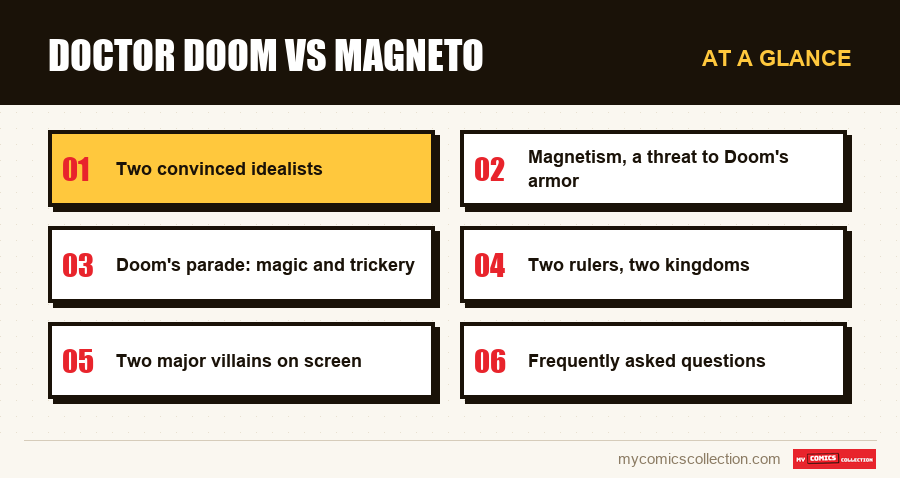
Two convinced idealists
Doctor Doom and Magneto share a fundamental trait: they are two idealists convinced of acting for a just cause. Magneto, marked by a tragic past, fights for the survival and supremacy of mutants, convinced that his fight is legitimate in the face of a world that persecutes them. Doom, monarch of Latveria, is convinced that the world would be better under his control, that his rule would bring order. Both thus go beyond the figure of the ordinary villain: they are not agents of chaos, but men driven by a sincere conviction, ready to do anything for a vision that they consider superior. This ideological proximity makes their comparison a particularly rich subject, opposing two nuanced figures from the Marvel universe.
This dimension of misguided idealists brings Doom and Magneto together, while revealing their differences. Magneto draws his conviction from the pain and memory of a persecuted people; Fatalis, in his pride and his certainty of being the most worthy to govern. One defends a community, the other aspires to personal power. This nuance distinguishes the two characters, despite their common idealism. For the reader, comparing Fatalis and Magneto allows us to appreciate the richness of these villains motivated by convictions, whose opposition goes beyond the simple struggle of good against evil. These two figures, among the most complex in Marvel, embody different ideals but the same intensity. The Fatalis hub brings together our guides to explore the monarch of Latveria facing the great figures of Marvel.
Magnetism, a threat to Doom's armor
Magneto's major advantage against Doom is obvious: his control of magnetism. However, Doom's armor, the source of his physical power, is made of metal. This characteristic makes the armor potentially vulnerable to the master of magnetism, capable of manipulating metals at will. In theory, Magneto could exert a hold on the Latverian monarch's armor, distorting it, immobilizing it, or turning it against him. This unique threat gives the confrontation between Doom and Magneto a particular dimension: what is the strength of the monarch of Latveria could become his weak point. This vulnerability illustrates how a character's abilities can, when faced with a specific opponent, turn into a handicap.
This threat of magnetism is what makes the clash between Doom and Magneto so interesting. Against most opponents, armor is an unconditional asset; facing Magneto, it becomes a weakness to manage. This particular dynamic forces Fatalis to rethink its strategy, not to rely solely on its technological range. For the reader, this vulnerability is a key element of the comparison, illustrating that even the greatest assets have their limits against certain adversaries. Magneto's magnetism, against the metal of the armor, creates an opposition where the outcome is not obvious, where the monarch of Latveria must compensate for an unusual disadvantage. This tension is at the heart of the confrontation between the two figures. The Doom Hub brings together our guides to explore character armor.
Doom's parade: magic and trickery
Faced with the threat of magnetism, Doom, however, has decisive assets: his magic and his cunning. Unlike a purely technological opponent, the Monarch of Latveria is not disarmed if his armor is neutralized. His mastery of sorcery allows him to operate in terrain that magnetism cannot reach, casting spells and protecting himself through mystical means. His strategic genius, moreover, allows him to anticipate the threat and design countermeasures: armor designed to resist magnetism, Doombots as sacrifices, or stratagems exploiting Magneto's weaknesses. This versatility makes Fatalis an opponent capable of compensating for the disadvantage represented by magnetism, transforming an unfavorable confrontation into an uncertain duel.
This parrying ability illustrates the richness of Doom's assets. Where a purely technological villain would be vulnerable against Magneto, the monarch of Latveria has a range of assets that allows him to compete. His magic, in particular, is the weapon that rebalances the confrontation, offering a means of action independent of metal armor. For the reader, this dimension is essential: it shows that Fatalis is not reducible to his technology, and that he can confront Magneto in a field where magnetism is not enough. This combination of science, magic, and cunning makes the monarch of Latveria a formidable adversary, capable of overcoming the unique threat posed by the master of magnetism. The Fatalis hub brings together our guides to explore the magic of the character.
Two rulers, two kingdoms
Beyond their abilities, Doom and Magneto share a leadership status. Doom rules Latveria, a sovereign state from which he draws resources, funding and diplomatic immunity. Magneto also led a territory, seeking to build a refuge for mutants. This political dimension brings together the two characters, who are not simple powerful individuals, but leaders with considerable means. This characteristic enriches their comparison: beyond a personal confrontation, Doom and Magneto embody visions of power and government. Their opposition thus goes beyond the physical duel to touch on questions of leadership, vision and responsibility towards those they lead.
This dimension of leaders underlines the depth of the two characters. Fatalis and Magneto do not only seek to defeat their enemies: they have projects, kingdoms, ideals to defend. This responsibility distinguishes them from villains acting alone, giving them a particular stature. For the reader, understanding this political dimension allows them to appreciate the richness of the comparison between Fatalis and Magneto, two heads of state with opposing visions. This common characteristic, despite different objectives, illustrates the complexity of these figures, which embody forms of power more than simple threats. This dimension considerably enriches their opposition, taking it beyond the framework of simple confrontation. The Doom Hub brings our guides together to explore the Latverian Monarch.
Collecting this series?
Track what you own, what you are missing and what your collection is worth. 7 day trial.
Start my trial →So who wins?
The question “Fatalis or Magneto, who would win?” » does not require a simple answer. Magneto has a unique advantage: magnetism, which directly threatens Doom's armor. But the monarch of Latveria can compensate with his magic, his cunning and appropriate parries, transforming an unfavorable confrontation into an uncertain duel. The outcome would depend on the circumstances: if Magneto manages to neutralize the armor, he gains the upper hand; if Fatalis manages to operate in the field of magic, he rebalances the combat. This uncertainty, born from the opposition between magnetism and versatility, makes the comparison particularly fascinating, with no obvious winner.
This lack of a clear-cut answer illustrates the richness of the two characters. Fatalis and Magneto, two formidable idealists, embody complementary forces whose confrontation is unpredictable. For the reader, this debate is fascinating, pitting the master of magnetism against the monarch of Latveria, in a duel where Doom's armor plays a central role. There is no absolute winner: it all depends on the versions, the contexts and the ability of each person to exploit their strengths. This ambiguity makes the comparison rich, inviting us to reflect on the strengths and vulnerabilities of these two figures. Doom and Magneto remain two of the most complex and fascinating villains in the Marvel Universe. The Fatalis hub brings together our guides to explore the character.
Two major villains on screen
Beyond the comics, Fatalis and Magneto share a special place in the screen adaptations. Magneto is one of the most striking antagonists of the X-Men films, a character whose complexity and conviction have had a lasting impact on audiences. His dimension as a tragic idealist, carried by memorable interpretations, made him much more than a simple villain. Doom, for his part, is preparing to take center stage with Avengers: Doomsday, where he plays the great antagonist uniting the heroes against him. This on-screen exhibition brings the two figures together: both are major villains, whose moral richness offers valuable material for the cinema. This dimension underlines the importance of the two characters in popular culture.
This presence on screen illustrates why Doom and Magneto fascinate beyond the pages of the comics. Their complexity, their conviction and their status as leaders make them antagonists of rare depth, capable of carrying ambitious stories. For the viewer as for the reader, these two figures embody the idea that the greatest villains are those whose motivations resonate, those who sincerely believe in their cause. At a time when Doom joins the forefront of Marvel cinema, this kinship with Magneto, a key figure in mutant adaptations, takes on a particular resonance. The two characters, each in their own way, show that an antagonist's wealth depends as much on his convictions as on his powers. This dimension enriches the comparison, extending it beyond comics towards popular culture. The Doom Hub brings our guides together to explore the Latverian Monarch.
This relationship between two formidable idealists, one a mutant, the other a monarch, sums up what makes their opposition interesting. Doom and Magneto don't just compete in strength: they embody worldviews, convictions and responsibilities that give their clash rare depth. Magnetism versus armor, magic versus metalbending, the Latverian ideal versus the mutant cause: so many facets that make this comparison one of the most stimulating to explore. For the collector as for the reader, understanding these two figures means grasping the full richness of Marvel's great villains, those whose ambiguity and conviction go beyond the simple role of adversary.
Frequently asked questions
In theory, yes: Doom's armor is metallic, and Magneto masters magnetism, which allows him to manipulate metals. This characteristic makes the armor potentially vulnerable to the master of magnetism, capable of deforming it, immobilizing it or turning it against him.
By his magic and his cunning. Unlike a purely technological adversary, Fatalis is not disarmed if his armor is neutralized: his mastery of sorcery allows him to operate on terrain that magnetism cannot reach, and his genius for designing suitable parades.
Yes, on an essential point: they are two idealists convinced of acting for a just cause. Magneto fights for mutants, Doom for a world he believes is better under his control. Both are also leaders. But their ideals and motivations differ.
It depends on the circumstances. Magneto has a unique advantage with magnetism, which threatens Doom's armor. But the monarch of Latveria can compensate with his magic and cunning. The outcome is uncertain: if Magneto neutralizes the armor, he gains the upper hand; otherwise, Fatalis rebalances the combat.
These two major Marvel figures crossed paths in the comics. Their opposition involves a unique dynamic: Magneto's magnetism versus the metal of Doom's armor, which makes their interactions particularly interesting to follow.
Want to collect Doom comics? Estimate the value for free of your numbers with our tool based on current eBay listings.