
Doctor Doom vs Lex Luthor: Marvel's biggest villain versus DC's. Two human geniuses without innate superpowers, two inordinate egos, two rivals obsessed with a hero: Reed Richards for one, Superman for the other. We compare these two emblematic figures, often presented as reflections of each other from one universe to another.
Marvel versus DC: Doom and Lex Luthor embody the archetype of human genius consumed by pride. Comparison of two titans of intelligence and ambition. Decryption.
As always in this guide, only verified information (established character elements) is stated; the analysis and comparison are ours, without reproduction of plates or protected dialogue.
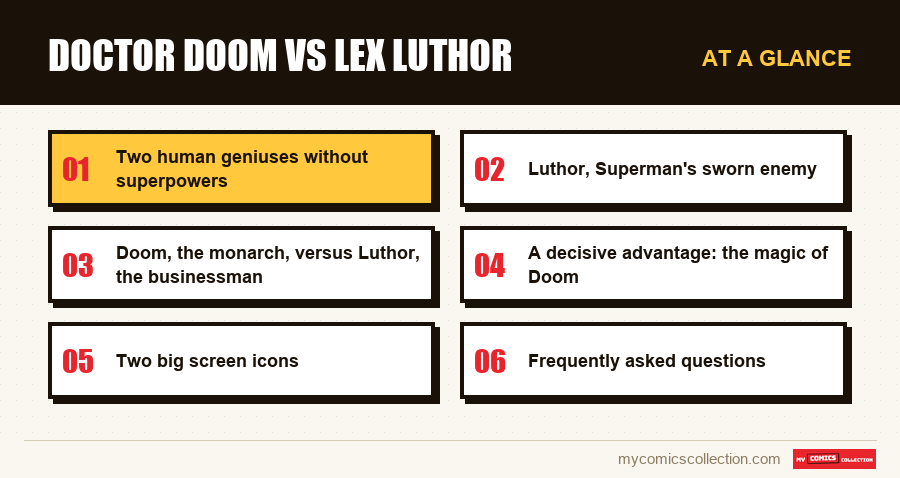
Two human geniuses without superpowers
Doctor Doom and Lex Luthor share a fundamental characteristic: they are two human geniuses, devoid of innate superpowers. Their power does not rest on a mutation or a cosmic origin, but on their exceptional intelligence. Doom compensates for his human nature with his armor, magic and inventions; Luthor, through his technology, his resources and his strategic mind. This absence of innate powers makes their success all the more remarkable: both rise to the rank of the greatest threats in their universe by the sole force of their genius. This similarity makes the comparison between Doom and Luthor a fascinating exercise, opposing two figures who embody the triumph of human intelligence, even if it is misguided.
This dimension of self-taught geniuses brings Fatalis and Luthor considerably closer. Unlike villains with supernatural powers, the two men built their power through talent alone, proving that a human spirit can rival the most extraordinary beings. This common characteristic explains why they are often presented as each other's equivalents from one universe to another: Luthor is, in many ways, the DC counterpart of Doom. For the reader, this comparison is revealing of how Marvel and DC have shaped their greatest human villains, two geniuses driven by ambition. This kinship, between the monarch of Latveria and Superman's nemesis, is at the heart of what makes their opposition so interesting. The Doom Hub brings our guides together to explore the Latverian Monarch.
Luthor, Superman's sworn enemy
Lex Luthor is inseparable from his rivalry with Superman. A billionaire genius, businessman and sometimes politician, Luthor sees Superman as a threat, an overly powerful being whose existence calls into question the supremacy of humanity, and his own. This obsession structures the character: Luthor is driven by the desire to surpass, defeat, even humiliate the Man of Steel. His intelligence, his resources and his lack of scruples make him Superman's most formidable adversary, the one who compensates for his human vulnerability with his genius. This rivalry, one of the most famous in DC, defines Luthor and sheds light on his psychology: a man convinced of his superiority, incapable of tolerating that someone surpasses him.
This obsession with Superman finds a striking echo in Doom, whose rivalry with Reed Richards similarly structures the character. Like Luthor jealous of Superman's power, Doom cannot stand the intellectual superiority he attributes to Reed Richards. This kinship in rivalry, a human genius obsessed with a hero he judges illegitimately superior, is one of the most revealing commonalities between the two characters. For the reader, understanding Luthor's obsession with Superman allows us to appreciate what brings him closer to Doom: the same inability to accept being surpassed, the same wounded pride that fuels hatred. This common dynamic sheds light on the psychology of the two villains. The Doom hub brings our guides together to explore Doom's rivalry with Reed Richards.
Doom, the monarch, versus Luthor, the businessman
Despite their similarities, Doom and Luthor are distinguished by their relationship to power. Fatalis is a monarch, sovereign of a state which he governs with an iron fist, claiming royal legitimacy and aristocratic dignity. Luthor embodies modern power: that of money, business and politics, having built an economic empire and held public office. This difference illustrates two visions of power: one anchored in monarchical tradition and national sovereignty, the other in capitalism and influence. Fatalis reigns from the throne; Luthor, through fortune and political ambition. This distinction enriches the comparison, opposing two equally formidable forms of domination.
This difference in relationship to power reveals distinct identities behind similar profiles. Fatalis, with his Latveria, embodies a quasi-feudal figure, an enlightened despot claiming a divine right to rule. Luthor, with his businesses and political ambitions, reflects the mechanisms of contemporary power. This opposition, between the monarch and the businessman, is one of the most interesting nuances of the comparison. For the reader, it shows that Doom and Luthor, despite their kinship, embody visions of power anchored in different traditions. This distinction considerably enriches their opposition, taking it beyond simple resemblance to reveal singular identities. Fatalis the monarch and Luthor the businessman remain two complementary archetypes of the great villain. The Doom Hub brings our guides together to explore the Latverian Monarch.
A decisive advantage: the magic of Doom
One element clearly distinguishes Doom from Luthor: mastery of magic. Where Luthor relies exclusively on science, technology and strategy, the monarch of Latveria combines his technological genius with a mastery of sorcery inherited from his mother. This science-magic duality gives Doom a versatility that Luthor does not possess, allowing him to operate in a terrain, the mystical, totally foreign to Superman's enemy. This asset is one of the main advantages of Doom in a hypothetical comparison: faced with a purely technological opponent like Luthor, magic offers the monarch of Latveria an additional range of options, a formidable factor of unpredictability.
This magical dimension illustrates the particular richness of Fatalis. While Luthor embodies scientific genius in its purest form, the monarch of Latveria adds sorcery to his arsenal, making him more versatile and unpredictable. This difference is essential in the comparison: if the two men compete in intelligence, Doom has an advantage that Luthor does not have. For the reader, this dimension highlights what sets the Monarch of Latveria apart from his DC equivalent: a unique combination of science and magic, rare among great villains. This asset, decisive in a confrontation, illustrates the singularity of Fatalis, capable of competing on multiple terrains. The Fatalis hub brings together our guides to explore the magic of the character.
Collecting this series?
Track what you own, what you are missing and what your collection is worth. 7 day trial.
Start my trial →So who wins?
The question “Fatalis or Luthor, who is more formidable?” » opposes two geniuses from different universes, which makes the comparison largely theoretical. In terms of pure intelligence, the two men are comparable, each being the greatest mind in their respective universe. But Doom has additional assets: his armor, which gives him physical power, and especially his magic, which gives him a versatility that Luthor does not possess. In a hypothetical confrontation, these assets would tilt in favor of the Latverian monarch. However, Luthor compensates with his absolute mastery of science and his ability to exploit the slightest weakness, which makes the outcome uncertain.
This comparison, between Marvel's greatest villain and DC's, is one of the most fascinating to imagine. Doom and Luthor embody the same archetype-the human genius consumed by pride and obsessed with a hero-while exhibiting telling differences. For the reader, this debate illustrates how Marvel and DC shaped their greatest minds, two related but distinct figures. There is no absolute winner: everything depends on the criteria and contexts. This ambiguity is the richness of the comparison, opposing two titans of intelligence and ambition. Fatalis, with his magic and his armor, and Luthor, with his genius and his resources, remain two of the greatest villains in comics. The Fatalis hub brings together our guides to explore the character.
Two big screen icons
The comparison between Doom and Luthor naturally extends into the realm of adaptations. Lex Luthor is one of the most frequently portrayed villains on screen, played by numerous actors throughout the Superman adaptations, making him an icon of popular culture. His figure as a Machiavellian genius, rival of the Man of Steel, is deeply anchored in the collective imagination. Doom, long awaited at the cinema, is about to experience major exposure with Avengers: Doomsday, where he plays the great antagonist. This arrival on the scene brings the two characters together: after dominating their respective comic book universes, both occupy a prominent place in the adaptations, confirming their status as icons of the genre.
This on-screen presence underlines the enduring kinship between Doom and Luthor. The two villains, human geniuses consumed by pride, offer the cinema rich material, that of credible and complex antagonists, whose threat does not rest on powers but on intelligence and ambition. For the viewer, this dimension is fascinating: it shows that the greatest villains are not always the most powerful, but the most skillful and the most determined. At a time when Doom joins the forefront of Marvel cinema, his relationship with Luthor, emblematic figure of the DC adaptations, takes on a particular resonance. These two titans of intelligence, each in their own universe, embody the archetype of the formidable human genius, as fascinating on paper as on the screen. The Doom Hub brings our guides together to explore the Latverian Monarch.
This comparison between Marvel's greatest villain and DC's ultimately illustrates a truth about comics: competing universes echo each other, shaping parent figures who reveal their respective identities. Doom and Luthor, two human geniuses without superpowers, two egos obsessed with a hero, two ambitious leaders, are mirrors of each other, while each bearing the mark of their universe: magic and royalty for Doom, money and politics for Luthor. For the reader and the collector, exploring this comparison means better understanding what makes the monarch of Latveria unique, by comparing him to his closest equivalent. This comparison highlights all the richness of Fatalis, an essential figure among the great villains of comics.
Frequently asked questions
In many ways, yes. Both are human geniuses without innate superpowers, driven by inordinate egos and obsessed with a hero they deem illegitimately superior: Reed Richards for Doom, Superman for Luthor. This relationship strongly brings them together from one universe to another.
Their relationship to power and magic. Doom is a monarch claiming royal legitimacy, and he is proficient in sorcery; Luthor embodies modern power (money, business, politics) and relies exclusively on science. Magic gives Doom a versatility that Luthor doesn't have.
On pure intelligence, the two are comparable. But Doom has additional assets, his armor and especially his magic, which would lean in his favor. Luthor compensates with his mastery of science and his ability to exploit weaknesses. The outcome remains uncertain and largely theoretical.
Yes, during crossovers between Marvel and DC, the two universes have crossed paths, bringing together their greatest villains. These exceptional encounters pit two close archetypes against each other, the human genius consumed by pride, which makes them particularly striking for readers.
Because Doom and Luthor embody the same archetype in two competing universes. Comparing them allows you to appreciate how Marvel and DC shaped their greatest human villains, revealing striking similarities and telling differences about each universe.
Want to collect Doom comics? Estimate the value for free of your numbers with our tool based on current eBay listings.