
In short
The Huntress is two characters who share a name. Helena Wayne, Earth-2's daughter of Batman and Catwoman, debuts in DC Super Stars #17 and All-Star Comics #69 (1977), created by Paul Levitz and Joe Staton with Bob Layton. She dies in Crisis on Infinite Earths #12 (1986). Helena Bertinelli, a mob heiress, replaces her in The Huntress #1 (1989), becomes Batgirl in 1999 and anchors Birds of Prey, while Helena Wayne returns in the 2011 reboot.
Most characters have one publication history. The Huntress has two, braided together by a shared artist, a shared first name and a company that kept moving the pieces. A collector who types the name into a catalog gets entries from 1977 and entries from 1989 side by side, and the only way to sort them is to follow the timeline.
Each credit, issue and year for Helena Wayne and Helena Bertinelli was read in publication histories of the two characters. Our own contribution is the interpretation of how the lineage changed between those dates.
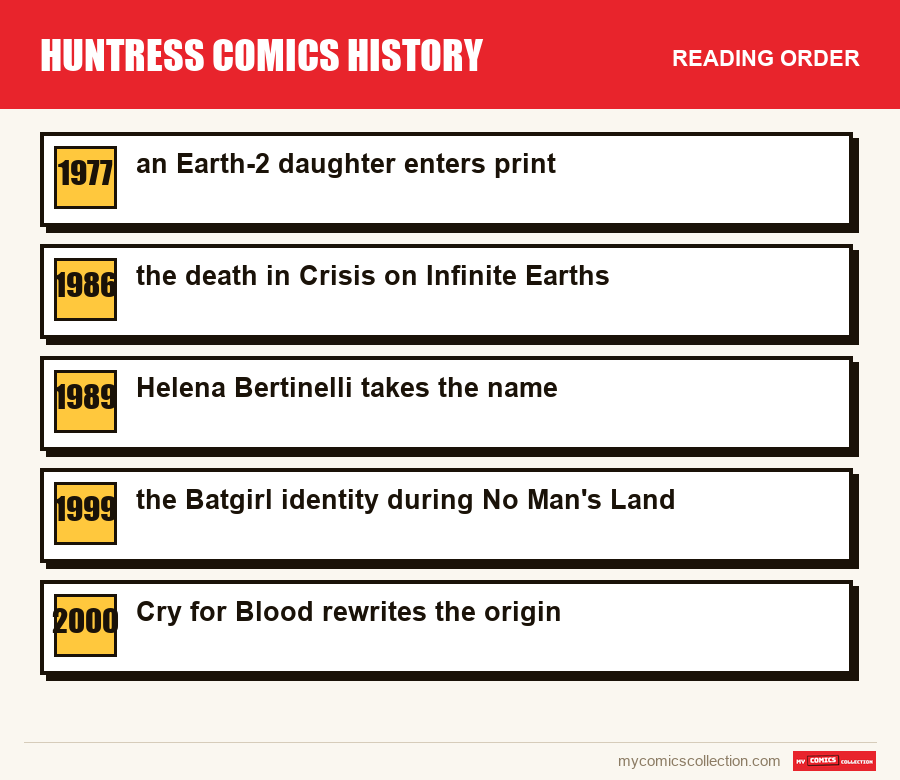
1977: an Earth-2 daughter enters print
Helena Wayne arrives at the end of 1977 in two places at nearly the same moment. DC Super Stars #17 carries her origin; All-Star Comics #69 brings her into the Justice Society pages. Paul Levitz and Joe Staton are her principal creators, and Staton designed the character. Bob Layton, the inker who suggested adding a revamped Earth-2 Batgirl to the Justice Society, is credited as co-creator, and the editor Joe Orlando is listed among her creators.
The premise matters more than the date. Helena is the grown daughter of the Earth-2 Bruce Wayne and Selina Kyle, living on the parallel world where the Golden Age heroes had aged. A second-generation heroine gave that world a younger lead who was not a sidekick.
For collectors the 1977 pair is the reference point for the whole character. Everything after 1989 is understood by contrast with this design, and the later Helena was co-created by the same artist, with a costume that first echoed this one.
1978 to 1983: backup stories and a noir tone
After the debut, the character moved into the Batman family titles. Batman Family #17 to #20 carry her appearances, and #17 (April-May 1978) includes a visit to Earth-One written by Bob Rozakis with pencils by Don Heck. Those issues came at the end of the series, when it moved to the larger Dollar Comics format.
The longer run came in Wonder Woman. From #271 (September 1980) Helena headlined backup stories that were mostly written by Levitz and penciled by Staton. In #291 (May 1982) she fights the Adjudicator in a story by Levitz and Roy Thomas, with Gene Colan on pencils and Frank McLaughlin on inks. In #307 (September 1983) the backup "Side Effects" is credited to Joey Cavalieri, Michael Bair and Frank Giacoia.
That last credit is worth noticing. Cavalieri would write the first Bertinelli series six years later, so the person who handed Helena Wayne one of her last stories became the architect of her successor. The backups also explain why a complete Wayne collection is built from a magazine, a team book and a run of short stories rather than from one title.
1986: the death in Crisis on Infinite Earths
Crisis on Infinite Earths #12 (March 1986) is where Helena Wayne dies, and she is erased from history with the Earth-2 she belonged to. The consequence was structural: for a time DC no longer had a daughter of Batman, an Earth-2, or a place for the Justice Society's second generation.
The name and the costume were still available, and the next Huntress would arrive without the family tie that the Crisis had removed. The wider event is mapped in our Crisis on Infinite Earths checklist.
1989: Helena Bertinelli takes the name
The Huntress #1 (April 1989) introduces Helena Bertinelli, written by Joey Cavalieri and drawn by Joe Staton, who is credited as her co-creator. The series ran nineteen issues. In its version of her origin she belongs to a New York mafia family, is kidnapped as a child, sees her parents murdered at nineteen, and learns every form of combat from the bodyguard assigned to protect her.
This Helena is a different kind of character from the Earth-2 original. She has no Wayne blood and no family inheritance of heroism; her motive is vengeance against the world that made her, and the series reads as a street-level crime book rather than a legacy story. The original costume closely resembled Helena Wayne's, which is why catalog images of the two are easy to confuse. Staton had drawn both women twelve years apart.
She also turns up in Justice League America #26 (May 1989) and #30 (September 1989), an early sign of the team-book future that would later define her.
1999: the Batgirl identity during No Man's Land
The Huntress becomes a Batman-office character in the late 1990s. In March 1999, Batman: Shadow of the Bat #83 puts Bertinelli in the Batgirl costume, and she wears it during the No Man's Land storyline. She argues with Batman after she fails to protect his territory from Two-Face and his gang, and she joins a group whose leader Batman had steered her toward. Two of the issues in that crossover are No Man's Land #0 and Legends of the Dark Knight #120.
For a collector, this is where numbering becomes tricky. The period has a Batgirl who is not Barbara Gordon and not Cassandra Cain, and the lines of the Bat-books are crowded. Our Batgirl comics history places this episode within the longer succession of women who wore the costume.
2000: Cry for Blood rewrites the origin
Batman/Huntress: Cry for Blood (2000) is a six-issue miniseries written by Greg Rucka with art by Rick Burchett and Terry Beatty. It revises Bertinelli's past: she sees her family killed at age eight, the man she called father turns out not to be her biological father, and her real father is a rival don. She is framed for murder, comes into conflict with Batman and Nightwing, and later returns to Gotham City to confront her true father.
The importance of this miniseries is that it fixed Bertinelli's modern outline. Later writers treat the rival-father revelation as the baseline, and the book was collected in 2002. If you see two incompatible Bertinelli origins in a back-issue box, the 1989 version and the 2000 revision explain the split.
Do you collect this series?
Track what you own, what you are missing and what your collection is worth. 7-day trial.
Start my trial →
2003 to 2011: Birds of Prey, then Earth-2 returns
The most durable Bertinelli run is in Birds of Prey, the team book led by Oracle and Black Canary, and shaped in these years by Gail Simone. Helena appears in Birds of Prey #57 (September 2003) with a cover by Ed Benes, becomes a full-time agent, and leaves and returns during the "Hero Hunters" arc around #80 (May 2005), when she realizes Oracle has been manipulating her. After Black Canary departs, Helena becomes Oracle's senior operative, and after Birds of Prey #100 she is the field commander in the One Year Later era.
What changes for the character is her tone. In the 1989 series she works alone; in the Birds she is a teammate who argues, goes on missions and teaches school, and in the Hush story she saves Batman's life, after which Batman sees himself in her. Readers meeting the Huntress through this team often never know there was an Earth-2 original. The Black Canary history covers the same team from the other side.
Her origin was told again in Huntress: Year One (May to July 2008), a six-issue miniseries credited to Ivory Madison and Cliff Richards, set in Sicily days before she turns twenty-one and receives her inheritance.
After 52, the parallel Earth-2 came back, and with it a rebooted Helena Wayne in Justice Society of America (volume 3), including its Annual #1, where Power Girl meets the restored Earth-2. The character who had been erased in 1986 therefore existed again alongside Bertinelli, and the Bertinelli version became her modern-day predecessor and retroactive namesake.
The Power Girl history is the best companion for this stretch, since the two women are tied together by the same parallel world.
2011 to 2017: the reboot shuffles the names
When the New 52 relaunch arrived in 2011, Helena Wayne of Earth-2 took the Huntress identity and Bertinelli was presumed dead. The 1977 co-creator Paul Levitz wrote the revived Worlds' Finest, drawn by George Pérez and Kevin Maguire. Her world then appeared in Earth 2, in Convergence, and in Earth 2: Society (2015 to 2017), where she takes over her father's Batman role.
Bertinelli did not stay away. Nightwing volume 3 #30 (2014) introduces a Prime Earth Bertinelli as Matron of the spy agency Spyral, and Grayson, by Tim Seeley and Tom King, builds on it: she recruits Dick Grayson, becomes the agency's director, and is later shot by Minos but survives. With Rebirth she reclaims the Huntress name, tracks Santo Casamento, learns that her mother Maria survived, and joins the Birds of Prey, as in Batgirl and the Birds of Prey #6.
2017 to today: Doomsday Clock and a Justice Society future
Helena Wayne is not seen again after Doomsday Clock (2017 to 2019). In Batman annual #2 (2017), Tom King shows a possible future where Selina and Bruce have a child named Helena. The Batman/Catwoman series of 2021 continued that storyline.
The newest version comes from Geoff Johns and Todd Nauck, who introduce a New Golden Age Huntress, another incarnation of Helena Wayne, in Stargirl Spring Break Special #1 (2021). She appears in The New Golden Age (2022 to 2024) and in Justice Society of America volume 4 (2023 to 2024), where she ends up joining the Justice Society in the 31st century. That is the current state of the lineage: a Huntress who is again tied to the Justice Society, the team where Helena Wayne began.
The key issues across her history
- DC Super Stars #17 (1977): the origin of Helena Wayne, by Paul Levitz and Joe Staton.
- All-Star Comics #69 (1977): Helena Wayne meets the Justice Society.
- Wonder Woman #271 (1980): the start of the Huntress backup stories by Levitz and Staton.
- Crisis on Infinite Earths #12 (1986): the death of Helena Wayne.
- The Huntress #1 (1989): the debut of Helena Bertinelli, by Joey Cavalieri and Joe Staton.
- Batman: Shadow of the Bat #83 (1999): Bertinelli as Batgirl.
- Batman/Huntress: Cry for Blood #1 (2000): the rewritten origin, by Greg Rucka, Rick Burchett and Terry Beatty.
- Nightwing volume 3 #30 (2014): the Spyral Matron, a Prime Earth Bertinelli.
How to collect the Huntress
Decide first which Helena you want, then buy by series, not by name. For Helena Wayne, the 2006 collection Huntress: Darknight Daughter gathers DC Super-Stars #17, Batman Family #18 to #20 and a long run of the Wonder Woman backups, so it replaces most of a 1970s and 1980s hunt. For Bertinelli, the stable entry points are the 1989 series, the 2000 miniseries (collected in 2002), Huntress: Year One (collected in 2009) and the Simone-era Birds of Prey volumes.
Two traps to avoid. First, All-Star Comics #69 and DC Super Stars #17 both claim to hold her debut, so a listing should say which of the two it is. Second, the 2011 reboot swapped the identities, so a modern issue labeled Huntress may be either woman. Check the story, not the cover. Our guide to the best Huntress comics sorts the reading list by Helena, and the guide to All-Star Comics #69 goes deeper into the 1977 issue.
Frequently asked questions
The original Huntress is Helena Wayne, daughter of the Earth-2 Bruce Wayne and Selina Kyle. She debuts in 1977 in DC Super Stars #17 and All-Star Comics #69, with Paul Levitz writing, Joe Staton drawing and Bob Layton credited as co-creator. She dies in Crisis on Infinite Earths #12 in 1986.
Helena Bertinelli is the second Huntress, a mob heiress introduced in The Huntress #1 (1989) by Joey Cavalieri and Joe Staton. She has no Wayne family tie. She later wears the Batgirl costume in 1999, stars in Cry for Blood in 2000, and becomes a core member of Birds of Prey.
For Helena Wayne, two issues from late 1977 share the debut: DC Super Stars #17, which tells her origin, and All-Star Comics #69, where she meets the Justice Society. For Helena Bertinelli, the debut is The Huntress #1 from April 1989. Which one you want depends on which Helena you collect.
In the New 52 relaunch, Helena Wayne of Earth-2 took the Huntress identity and Bertinelli was presumed dead. Paul Levitz, her 1977 co-creator, brought Helena Wayne back as the Huntress in the revived Worlds' Finest. Bertinelli returned in 2014 as Spyral's Matron, and under Rebirth she reclaimed the Huntress name.
For Helena Bertinelli, start with the Gail Simone era of Birds of Prey, then read Batman/Huntress: Cry for Blood. For Helena Wayne, the Huntress: Darknight Daughter collection gathers the 1977 origin, the Batman Family appearances and the Wonder Woman backups, which is the most direct way into the 1970s original.
Holding a Huntress issue from 1977 or 1989 and unsure which Helena it belongs to? Send it for an estimate.
Estimate my comic