
In short
Helena Wayne, the Earth-2 daughter of Batman and Catwoman, enters print in 1977 through a pair of magazines that hit stands together. DC Super-Stars #17 (November-December 1977) carries her origin story; All-Star Comics #69 (December 1977) is where the Justice Society first meets her. Paul Levitz wrote them and Joe Staton drew them; Bob Layton, who inked #69, is credited as co-creator. Collectors who want the Justice Society debut look for #69.
A search for "Huntress first appearance" returns two answers that sound identical and are not. One is a magazine with a fresh origin tale, the other is a Justice Society issue with a cliffhanger entrance, and both carry the same creative team and nearly the same date. This guide takes the All-Star Comics side of that pair: what the issue is, who made it, what it introduces and what a buyer should look at on a copy.
Every name and date for #69 was cross-checked against histories of the revival, of Helena Wayne and of the companion magazine; the case for why this issue earns a slot on a Justice Society shelf is our own judgment, not an official ranking.

Two debut issues, one release day
Helena Wayne has the unusual distinction of arriving in print twice at once. DC Super-Stars #17 is cover-dated November-December 1977 and tells her origin. All-Star Comics #69 is the Justice Society issue in which the team learns that she exists. The two shipped the same day in 1977, so no one can honestly say that one came out "before" the other on the stands. Cover dates are the only ordering a collector can lean on: November-December 1977 for the magazine, December 1977 for #69, the same late-1977 window.
That is why the label "first appearance" gets shared between them. A buyer who cares about the origin story reaches for DC Super-Stars #17. A buyer who collects Earth-2 and the Justice Society, and who already owns the 1976 revival, tends to want #69 because it sits inside a numbered run that began with Power Girl and ended in 1978. Neither choice is wrong. What matters is not to call one of them the sole debut in a listing, and to say in your own records which of the two you hold.
The All-Star Comics number itself carries history. The title went back to the Justice Society in 1976 and kept the numbering of the original Golden Age run, so the revival opens at #58 with a January-February 1976 cover date and closes at #74 in September-October 1978, seventeen issues in all. From #66 the title is hyphenated on the cover, which means a #69 reads All-Star Comics and not All Star Comics. Issue #69 is the twelfth installment of the revival, a detail that helps when a seller lists a number without a year.
The credits on All-Star Comics #69
Paul Levitz wrote the series in this period and shaped Helena Wayne's origin. Joe Staton penciled the book and designed the character. Bob Layton inked, and his suggestion of a revamped Earth-2 Batgirl is what pushed the idea of a new heroine forward. Joe Orlando was the editor who approved Staton's design. That is the full list we are willing to print: we leave the letterer and colorist of #69 off this page rather than guess at them.
If you need an exact story title or a cover credit for a specific copy, read it off the issue itself, from the contents page and the indicia. For a listing or a collection record, "written by Paul Levitz, penciled by Joe Staton, inked by Bob Layton" is accurate and enough.
The same trio appears on the companion origin in DC Super-Stars #17, where Levitz writes, Staton draws and Layton also works on the issue. Reading the two issues back to back is the most efficient way to see how one creative team staged a single character twice: a standalone introduction in a rotating anthology, and a team-book entrance that sets up membership.
How Helena Wayne reaches the page
In All-Star Comics #69 the Huntress is introduced to the Justice Society of America. The issue's job is to put a new heroine in front of the team and the reader, and it does so without yet making her a member; she formally joins the roster in #72, three issues later. For a collector this gap is useful. It means #69 is the entrance, #70 and #71 are the lead-up, and #72 is the membership issue, and a page that blurs the three is guessing.
Her identity is the draw. Helena is the daughter of Bruce Wayne and Selina Kyle of Earth-2, the parallel world where the Golden Age Batman and Catwoman grew up and raised a child. That premise only works because the Justice Society lives on that Earth; a book about the team is the natural stage for her. When she steps in, she is not a sidekick to anyone. She is a second-generation hero with a family inheritance she is deciding how to use.
The name Huntress was not new to DC. It was borrowed from a Golden Age villainess, Paula Brooks, which is part of why a loose search for the word can return pages about someone else entirely. Her costume, her fighting style and her place in the team are what define the Helena Wayne version, and the 1977 pair of issues are where those are fixed.
Who created her, and why in 1977
The revival of All-Star Comics in 1976 was an attempt to bring a Golden Age team back to the stands with new faces beside the old ones. Power Girl had arrived in #58, and the Helena Wayne Huntress was the next major addition. Staton designed her, Levitz built her origin, and Layton's idea of a refreshed Earth-2 Batgirl supplied the spark. So when a catalog credit says "created by Paul Levitz and Joe Staton," it describes the writer and the artist who shaped her, with an inker whose suggestion mattered.
The timing also explains why her first year is short in print. The revival ended in 1978 with #74, a cancellation tied to DC's company-wide cutbacks, and the Justice Society's adventures moved into Adventure Comics. A character introduced in the final stretch of a series that ends a year later has a small first-year footprint, which is exactly why the 1977 issues are the ones people hunt for.
For the editorial view of Earth-2 as a place, our guide to the best Huntress comics gives the reading order. This page stays on the issue itself.
Do you collect this series?
Track what you own, what you are missing and what your collection is worth. 7-day trial.
Start my trial →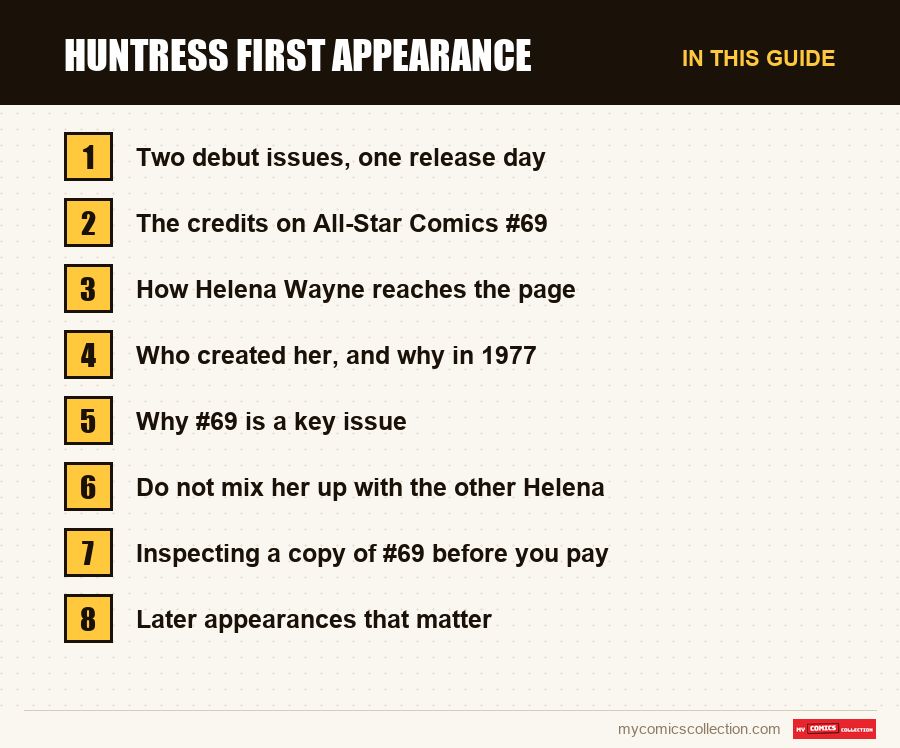
Why #69 is a key issue
A key issue earns that label by what it sets in motion, and the Huntress debut sets in motion a lot for a character who spent much of her life on a world that was later erased. After the entrance in #69, she joins the team in #72. She appears in Batman Family #17 to #20, with #17 holding her first visit to Earth-One, the main world of the day. Her own solo stories run in Wonder Woman beginning with #271, cover-dated September 1980. She is briefly associated with Infinity, Inc. Her original run closes when Crisis on Infinite Earths #12 wipes her out in March 1986.
Each of those is a purchasable line in a collection, and the debut anchors all of them. It also anchors the later reinterpretations. When DC later returned Helena Wayne to its pages, notably in a Worlds' Finest revival written by Paul Levitz, the new version is a reimagining, not a retelling of the 1977 pair.
For a wider frame on what makes any number "key," see what is a key issue. In short: a debut with real follow-up. This one has it.
Do not mix her up with the other Helena
The most common cataloging error around this issue is a mix-up with Helena Bertinelli. Bertinelli belongs to The Huntress #1 of April 1989, a solo series from Joey Cavalieri and Joe Staton that was cancelled after nineteen issues. She is born into a New York mafia family and has no blood tie to Batman. Staton drew both Helenas, which adds to the confusion, but the characters and the eras are distinct.
When you see a listing that says "Huntress #1 first appearance," check the year. 1989 means Bertinelli. 1977 means Wayne, and then the question is which of the two 1977 issues is for sale. Collection notes that treat the two women as one person will also mis-sort the follow-up issues, so correct the entry once at the start.
Two other mix-ups come up. A seller may confuse the 1977 revival numbering with the 1940s run, since both use the same title and the same continuous numbering; check the year printed in the indicia. And a copy of All-Star Comics #69 is sometimes confused with a nearby number, so read the cover, not just the sticker on the bag.
Inspecting a copy of #69 before you pay
This is a bronze-age newsstand book, and the usual wear points apply. Start with the spine, where a stress line or a color-breaking crease from the way the issue was racked is the most common defect. Look next at the corners, then at the staples for rust or tension in the paper around them, then at the cover gloss, which on this period shows scuffing quickly. Hold the book to a light and tilt it: a repair, a color touch or a pressed crease will show up as a different sheen.
On a certified copy, read the label itself and not just the grade. Purple on a slab means restoration work was declared; for a 1977 issue that shifts the comparison pool, and restoration and its impact on value walks through the method. A blue label marks a universal grade, and a signature series label records a signing, which is a separate attribute from condition. Check the page-quality line, because off-white pages in a 1977 book are normal and white pages are a selling point.
Finally, confirm the issue number from the cover and indicia and match the title. If the seller shows only the front, ask for the back cover and a spine photo, and decide in advance how much you will pay for a copy you cannot fully inspect. Comparing three recent sold results of the same grade, in one currency, gives a much better anchor than any single figure; we do not quote one here because prices move.
Later appearances that matter
Once you hold the debut, there are five numbers worth tracking, in this order of usefulness for a Helena Wayne set.
DC Super-Stars #17 comes first because it completes the 1977 pair; the Huntress story in it has been reprinted in recent collected editions, including the 2006 collection Huntress: Darknight Daughter. All-Star Comics #72 follows, as the issue where she formally joins the team. Batman Family #17, with her first visit to Earth-One, is next; the run through #20 shows how DC used her alongside the main-universe Batman cast. Then Wonder Woman #271 (September 1980), where her solo backup stories begin. And last, Crisis on Infinite Earths #12 (March 1986), the issue of her death and erasure, which closes the original arc.
If you collect around the Justice Society's revival, All-Star Comics #58 belongs on the same shelf, since it opens the run that #69 sits in. For the Bat-family side, our Batgirl key issues page covers the other women who wore the costume in the books near Helena's world.
Frequently asked questions
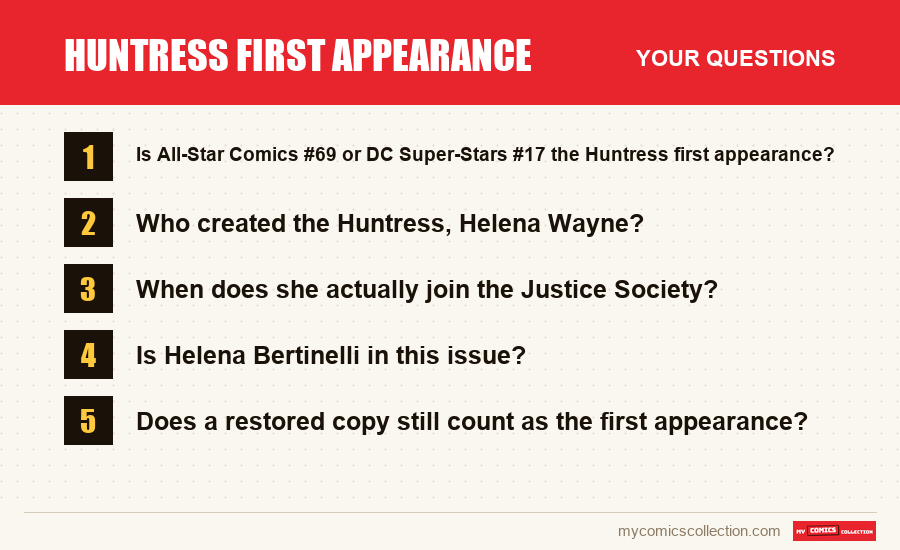
Both. They reached stands the same day in 1977. DC Super-Stars #17 is cover-dated November-December 1977 and tells her origin, while All-Star Comics #69 introduces her to the Justice Society. Cover dates cannot separate them cleanly, so say which one you mean when you list or sell a copy.
Writer Paul Levitz and penciler Joe Staton shaped the character, with inker Bob Layton, whose idea of a revamped Earth-2 Batgirl helped start the project. Staton designed her look. Joe Orlando was the editor who approved that design. Her name was borrowed from a Golden Age villainess, Paula Brooks.
Not in #69. That issue introduces her to the team, and she formally joins in All-Star Comics #72. If you build a set around her membership, #69 is the entrance, #72 is the induction, and the issues in between are the lead-up.
No. Bertinelli arrives with The Huntress #1 in April 1989, from Joey Cavalieri and Joe Staton. She is a different character with no family tie to Batman. Helena Wayne debuted in 1977, twelve years earlier, and the crossover of Crisis on Infinite Earths #12 removed her in March 1986.
Yes, it is the same issue, but the label matters. A purple label records restoration, so a restored #69 belongs in its own comparison group, apart from unrestored copies of the same look. Judge it against other restored copies, and check the listing wording carefully.
Holding a 1977 Justice Society issue or the Huntress origin? Run its details through our free valuation tool.
Estimate my comic