In short
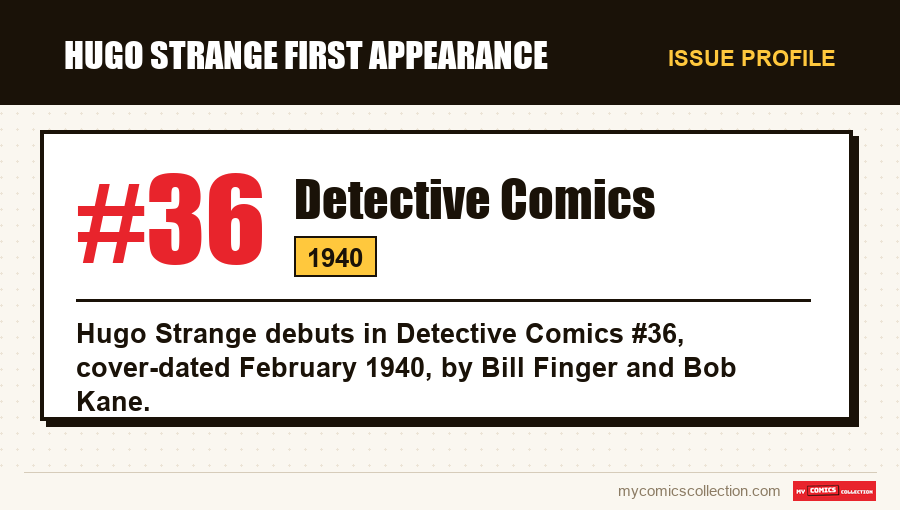
Hugo Strange first appears in Detective Comics #36, cover-dated February 1940, in a story by Bill Finger and Bob Kane. He debuts as the head of a gang that robs banks under cover of a fog made by a stolen machine, and he ends the issue in jail after Batman breaks free in his lair and defeats him. The issue sits two numbers before Robin's debut and is a core Golden Age Batman villain number.
Few Batman villains have a debut as easy to misread as this one. Hugo Strange is remembered today as a psychiatrist obsessed with unmasking the hero, yet the character who walks into Detective Comics #36 is a criminal organizer with a gang and a machine. Knowing which version you are buying, and which of the nearby 1940 numbers carries the debut, is the whole job of this page.
Cover date, creator credits, the plot of the debut, his 1940 returns and the later appearances named here were checked against published listings. What we add is the reading of the 1940 gang story, its place in a Batman collection and the inspection steps; no art or dialogue is reproduced.
The identity of Detective Comics #36
The issue carries a February 1940 cover date. A seller should put February 1940 next to the number 36 in any listing heading. Bill Finger is credited as writer and Bob Kane as artist, and the two are Hugo Strange's credited creators. A buyer who sees only "1940" on a listing should still confirm February, because the neighboring numbers carry other months of the same year and are easy to mix up.
The calendar around this number is what gives it weight. Two issues later, Detective Comics #38, cover-dated April 1940, introduces Robin. Batman #1 appears in the spring of 1940, the same season. So Strange debuts in the stretch that also brings Robin and the solo series, which places his debut among the books that built the early Batman mythos. If you are tracing that stretch, the Detective Comics #38 collector guide covers the next landmark on the same shelf.
One practical consequence follows. Collectors who chase the 1940 run of Detective Comics often talk about the numbers around #27 and #38, and #36 can sit between them without much notice. That is a reason to check listings carefully, since a seller who describes only the bigger neighbors may under-describe this one, and a buyer who knows the number can recognize a debut that a casual description would not flag.
How Hugo Strange enters the story
In Detective Comics #36, Strange runs a gang that robs banks under fog produced by a stolen machine. A henchman commits a murder, and Batman investigates. Strange's men ambush Batman and knock him out, and he is held in Strange's lair, where he breaks free and defeats Strange, who is jailed. The plot is a crime serial of its period: a gang, a gadget, a lair and a capture, with the hero carried through it by a reversal at the end.
The debut differs from the version readers meet in later decades. The Strange of 1940 is a villain who commands criminals and uses a stolen device, and his link to psychiatry, which defines the character in the 1990s, is not what the debut story is about. That gap is useful to know. A collector who buys the issue expecting a story about a mind-games doctor will find a gang story instead, and one who buys it as the origin of an organized-crime villain will find what the issue delivers.
The fog machine is also a reminder of how pulp-influenced early Batman was. A stolen apparatus, a gang and a lair are staples of the serials and pulps of the period, and Finger and Kane use them as the frame for a villain with a name that sounds like a mad scientist's. For anyone reading the story as a historical document rather than as a modern thriller, that frame is the point.
What happens to him in 1940
Strange does not stay in jail. In Batman #1, dated spring 1940, he escapes, breaks five asylum patients out, and uses an artificial growth hormone to turn them into monsters. Batman stops the monsters and sends Strange apparently to his death in a fall from a cliff, although Batman suspects that Strange survived. Later that year, in Detective Comics #46, cover-dated December 1940, Strange returns with a fear-inducing powder, and a punch from Batman again sends him off a cliff, apparently to his death.
With three appearances in one calendar year, Strange counts as one of Batman's first recurring villains. He is not a one-appearance character, and his 1940 run establishes a pattern in which he is defeated, presumed dead and brought back. For a collector building a set of the character's Golden Age appearances, the 1940 trio of Detective Comics #36, Batman #1 and Detective Comics #46 is the core. The middle one is a landmark for other reasons and sits in a different class of collecting, as the Batman #1 value guide explains.
Creators and the editorial moment
Bill Finger and Bob Kane are the credited creators, and the pairing is typical of Batman's early years: Finger on the scripts that shaped much of the supporting cast, and Kane as the credited artist and the name on the character. For a collector, the useful habit is to attribute scripts to Finger where listings do so and to treat the creator line on a cover as a credit line, not a record of who wrote a given story. The Bob Kane author page lists the other articles in this series that involve him.
Batman himself was under a year old in print when Strange arrived. The character had debuted in Detective Comics #27, and the series was building a roster of villains and supporting players at speed. Strange arrives in that build-out, and his debut makes sense as part of a push to give the hero opponents with distinct hooks. A reader comparing this issue to the debut of the hero himself can use the Detective Comics #27 guide to see how the series looked a few dozen issues earlier.
Do you collect this series?
Track what you own, what you are missing and what your collection is worth. 7-day trial.
Start my trial →
Why it became a key issue
Strange has a long afterlife. In 1977 and 1978, the "Strange Apparitions" arc in Detective Comics, spanning #469 to #479, brings him back as Dr. Todhunter, and Steve Englehart and Marshall Rogers worked on the Batman stories in issues #471 to #476, dated August 1977 to April 1978. The Detective Comics #475 guide covers the best-known issue from that run, and it shows why those books turned a 1940 villain into a name that readers recognized again.
In Batman Annual #10 (1986), Strange tries to bankrupt Bruce Wayne and is sent to prison. In Batman: Prey, published in Batman: Legends of the Dark Knight #11 to #15, with Doug Moench writing and Paul Gulacy and Terry Austin on art, he is a psychiatrist who runs a campaign against Batman and has a personal stake in learning his identity. The video game Batman: Arkham City later makes him the warden. Those later uses are the source of the modern image, and they are why the 1940 debut draws interest: it is where that character starts.
The demand for the debut, then, is a function of reputation more than of the story itself. The 1940 plot is a gang story, and the later books are what made the name worth looking up. A collector can use that to set expectations. The issue is a historical purchase tied to a major villain and a pivotal year, not a showpiece of storytelling.
Numbers that get confused with it
Three confusions come up. The first is with Detective Comics #38, which is the Robin issue and sits two numbers later. A listing that mentions "1940 Detective Comics" without a number can point to either. The second is with Batman #1, which also features Strange but is a different book at a different tier. And the third is with the 1977 and 1978 "Strange Apparitions" issues, which share the series title and bring Strange back but do not carry the debut.
There is also a name trap that sends searchers astray. Hugo Strange and Marvel's Doctor Strange are unrelated characters from different publishers, and a search for "Strange first appearance" can return either. The Batman villain debuts in Detective Comics #36, and the sorcerer's debut sits in a Marvel anthology. If a listing says only "Strange," read the publisher and the series title before you do anything else.
What to check before you buy Detective Comics #36
Begin with the identification: series title, number 36 and the February 1940 cover date. This is a comic that has aged for more than eight decades. Ask for scans of the front, the back and the spine.
Look at the paper and the structure. Newsprint of 1940 browns and goes brittle, and the edges chip first. Check the spine for splits and the staples for rust, the centerfold for detachment, and the corners for rounding. A back cover can hide staining and writing that the front does not show, so ask for it. Then check for restoration: color touch, tape, spine reinforcement, cleaning and replaced pages. A restored copy can be a sensible purchase, but it should be sold, priced and recorded as restored.
If the copy carries a third-party grading label, read it, not just the number. Confirm that the series, issue number and cover date on the label match the book in the photographs, and read the restoration notes. Labels can contain data-entry errors, and a mismatch is worth a question before payment. Once the copy is yours, write down its issue number, cover date, wear and any repairs, so you can compare it fairly with the next one you see. For the wider market behavior of books from this era, the Golden Age collecting guide covers storage, handling and common pitfalls.
Where to read Hugo Strange next
Batman #1 (spring 1940) is the sequel to the debut, in which Strange escapes and creates monsters from asylum patients. It is the next book in his story and a landmark for the series.
Detective Comics #46 (December 1940) brings a fear-inducing powder and another apparent death, and it closes out his 1940 run.
The "Strange Apparitions" issues, Detective Comics #469 to #479 (1977 and 1978), return him as Dr. Todhunter and set up the modern revival of the character.
Batman Annual #10 (1986) shows him trying to bankrupt Bruce Wayne before he is sent to prison.
The five-part Prey story ran through Legends of the Dark Knight #11 to #15, with Doug Moench writing and Paul Gulacy and Terry Austin on art. It casts Strange as a psychiatrist hunting the Batman. For a broader reading plan around Gotham's detective title, the best Detective Comics runs gives a ranked order.
Frequently asked questions
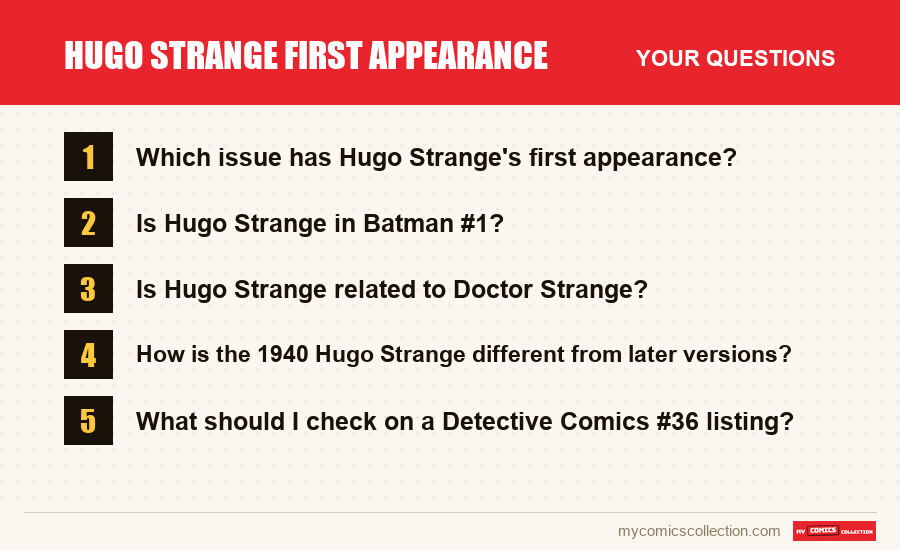
Hugo Strange debuts in Detective Comics #36, cover-dated February 1940. The story is by Bill Finger and Bob Kane. He appears as the leader of a bank-robbing gang that works under fog from a stolen machine, and he is jailed at the end of the issue.
Yes. In Batman #1, dated spring 1940, Strange escapes, breaks five asylum patients out and turns them into monsters with an artificial growth hormone. Batman stops them, and Strange apparently falls to his death from a cliff. The debut itself remains Detective Comics #36.
No. Hugo Strange is a Batman villain published by DC Comics, while Doctor Strange is a Marvel sorcerer. The similar surname causes search mix-ups. The Batman character debuts in Detective Comics #36 in 1940, so check the publisher and series title on any listing.
The 1940 debut presents him as a gang leader using a stolen fog machine. The psychiatrist who hunts Batman and tries to learn his identity belongs to later stories, notably Batman: Prey in Batman: Legends of the Dark Knight #11 to #15, written by Doug Moench.
Check the title, the 36 and the February 1940 date, then ask for images of the front, back and spine. Note any spine splits, rust at the staples, chipped edges or repairs. If the copy has a grading label, compare its restoration notes and data with the book itself.
Holding Detective Comics #36 or another early Batman villain debut? Describe its condition and see where it stands.
Estimate my comic