How many Spawn comics are there? The main series has run since 1992 and still counts as one: launched in May 1992 by Todd McFarlane at Image Comics, it has never been relaunched at #1 and now runs past #350. In 2019, passing the 300-issue mark made it the longest-running independent comic series of all time. Around it, four spin-off series with known boundaries total ninety-nine issues, plus a few miniseries and the Spawn universe titles launched in 2021.
The question of how many issues there are comes up here the opposite way from the big publishers: no relaunch every five years, no counter that restarts at zero, but a continuous thread over more than three decades and a swarm of neighboring series that you need to know how to shelve alongside it. This guide fixes the main line, then the spin-offs one by one.
As always in this guide, only verified information (creators, issue numbers, dates) is stated as fact; the analysis is our own, with no reproduction of protected artwork or dialogue.
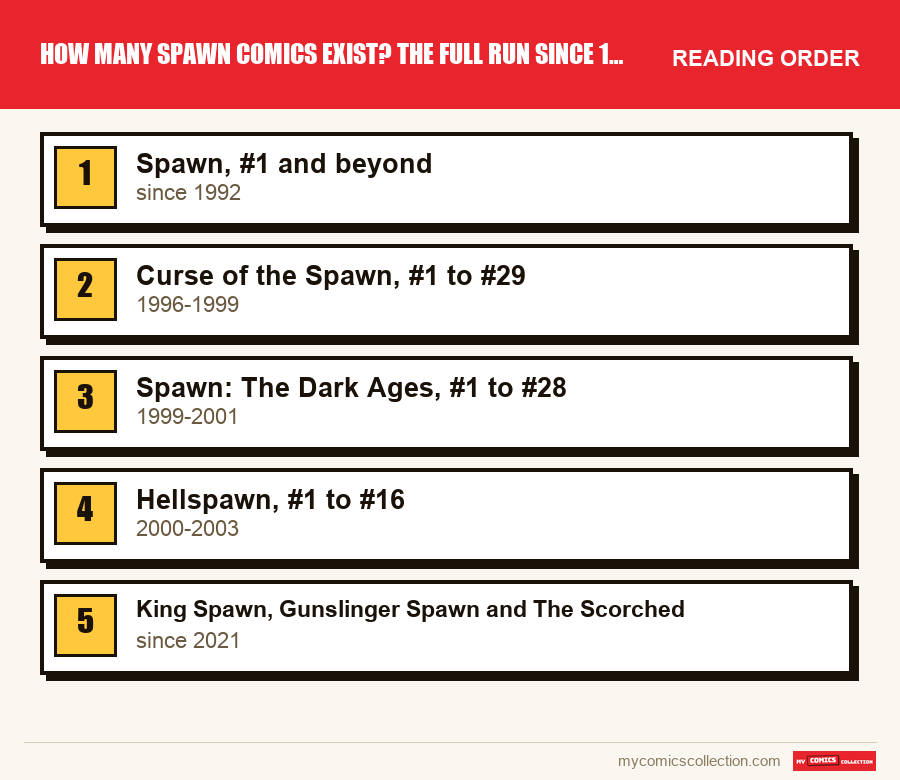
Series 1: Spawn, #1 and beyond (since 1992)
#1 comes out in May 1992 at Image Comics. Todd McFarlane creates the character and signs the first issues as writer and artist. The first 1992 single issue tops a million and a half copies sold, with 1.7 million on the counter. Our analysis of the launch of Spawn #1 goes back over that start.
Since that #1, the cover number has climbed without a break: no relaunch, no new title, no event has ever sent the counter back to #1. #200 comes out in 2011 and sells out on the day of release, earning a second printing the following month. In 2019, #300 makes Spawn the longest-running independent comic series of all time. Following on from #350, a new line of titles is announced in February 2024.
For a collector, this continuity simplifies the work a great deal: a single line to keep, from #1 to the latest issue released, with no correspondence table between volumes. On the other hand, the final boundary moves with the publisher's calendar, and a guide that wrote it as a figure would quickly go out of date: that is why we stop at verified boundaries.
A simple method is to cut the line into blocks of fifty issues: #1 to #50, #51 to #100, and so on up to #300 and beyond. Each block can be checked at a glance, and a gap is quickly spotted. The detailed milestones below, #8 to #11 for the guest writers, #71 to #150 for Brian Holguin's period, #200 for 2011 and #300 for 2019, fall naturally on these blocks and help you decide where to dive in.
The creative teams of the main series
The series has had several teams, and they serve as handy markers for slicing up the line. Greg Capullo draws a large share of the issues between #16 and #100, then returns notably for #200 and #300. Brian Holguin writes issues #71 to #150, then returns for #185 to #190. Steve Niles signs #105 and #106. Todd McFarlane remains the signature that runs through the whole.
The early issues are marked by guest writers: Alan Moore writes #8, Neil Gaiman #9, Dave Sim #10 and Frank Miller #11. Alan Moore returns for #37. #9 introduces Angela and Cogliostro, which makes it the issue covered by our page on Angela's arrival in Spawn #9.
These markers do not create separate series. They go in the same thread, with the same numbering, and are noted in a "period" column of your list, not in a "series" column. Mixing the two artificially inflates the number of lines to track.
Series 2: Curse of the Spawn, #1 to #29 (1996-1999)
In 1996 the first long-running spin-off monthly starts: Curse of the Spawn, which restarts at #1 and runs twenty-nine issues until 1999. Its counter is not to be confused with that of the parent series.
It was preceded by Spawn: Blood Feud, a four-issue miniseries published in 1995, written by Alan Moore and drawn by Tony Daniel. This miniseries goes before Curse of the Spawn in chronological order, and it enters no monthly's total: four issues, with no numbered sequel.
Series 3: Spawn: The Dark Ages, #1 to #28 (1999-2001)
Spawn: The Dark Ages appears in 1999 and runs twenty-eight issues until 2001. The title gets its own #1, not to be confused with the 1992 one. A second volume of the same title appears from 2025 to 2026, with its own boundaries.
The trap with this series lies in the name. A listing for "Spawn #1" can mean the 1992 series, a #1 of a spin-off series, or the second volume of The Dark Ages; stating the full title and the cover year removes the doubt. Check both details on every single issue before logging it.
Series 4: Hellspawn, #1 to #16 (2000-2003)
From 2000 to 2003, Hellspawn runs sixteen issues. The series first brings together Brian Michael Bendis on script and Ashley Wood on art. It restarts at #1 and does not belong to the main thread.
Sixteen issues make it the shortest of the four spin-off series with known boundaries, which makes it easy to bound. As with the other spin-offs, note the title, number and year from the cover.
Do you collect this series?
Track what you own, what you are missing and what your collection is worth. 7-day trial.
Start my trial →
Series 5: King Spawn, Gunslinger Spawn and The Scorched (since 2021)
In 2021 and 2022, three monthlies launch in the Spawn universe: King Spawn, Gunslinger Spawn and The Scorched. An oversized one-shot, Spawn's Universe, appears in 2021 to set them up. These three series each have their own counter, and we do not give a final issue number for them.
The line is still moving, and it is kept up to date issue by issue. For a reading guide that puts these series back in story order, see the Spawn reading order.
Renumberings: there are none
The main series has seen neither a relaunch at #1 nor legacy numbering: the number printed on the cover of the latest issue is the total of the thread. This is what sets Spawn apart from many titles at the major publishers, where a modern #1 coexists with a legacy #800 or #300 and where you have to add up several series to recover an overall counter.
The 2019 #300 is therefore not a renumbering event, but a simple boundary: three hundred consecutive single issues since May 1992. #350 has been passed since. When a sale listing talks about an "anniversary issue," it means these round boundaries, which are the most sought after and the ones that hasty lists forget to verify.
The arithmetic of the total
For the main line, no calculation is needed: the counter is the answer, from #1 to the latest issue released. What we can add up are the boundaries of the spin-offs written above. Curse of the Spawn runs twenty-nine issues, The Dark Ages twenty-eight, Hellspawn sixteen and Sam & Twitch twenty-six, for ninety-nine numbered single issues. With the four issues of Blood Feud, we reach one hundred and three.
This total includes neither the main series, nor Case Files: Sam & Twitch (2003-2006), nor the second volume of The Dark Ages, nor the three 2021 series, nor the specials. Each exclusion is a decision on your part: a broad definition of the Spawn universe gives a noticeably higher figure, a narrow definition falls back on the 1992 thread alone.
Also keep in mind the difference between a total of single issues and a total of titles: the main line is counted in issues, whereas the spin-offs as a whole are better counted in series, six if you include Curse of the Spawn, The Dark Ages, Hellspawn, Sam & Twitch, Case Files: Sam & Twitch and Blood Feud, and nine with the three 2021 titles. Announcing a single figure for all of this mixes two units of measurement, which explains the gaps between the lists you come across.
The 2021 series calls for one extra precaution: King Spawn, Gunslinger Spawn and The Scorched each have their own counter, and we give no boundary for them. Keep them on an open line, which you complete when the numbering settles.
Annuals and spin-off series
Beyond the series described, Sam & Twitch deserves a separate mention: this series runs twenty-six issues from 1999 to 2004, and Case Files: Sam & Twitch runs from 2003 to 2006. Both go in the spin-off line. Our page on Spawn spin-offs and specials helps you choose which ones deserve a place in a collection.
We do not claim to be exhaustive: the universe also includes one-shots, collected editions and special issues whose boundaries are independent of the monthly. The main line and the five series above are enough to build a coherent collection, to be enriched afterward according to your taste.
Completing the run: where to start
First decide your scope: the main line alone, or the main line plus one or two spin-offs. For the parent series, the method is that of an arithmetic sequence: list the issues you own, spot the gaps, and handle them in order of priority rather than in numerical order. The markers in this guide, #8 to #11 for the guests, #71 to #150 for Brian Holguin's period and #300 for the 2019 boundary, serve as milestones for this split.
For the spin-offs, create one line per title. One line for Curse of the Spawn, one for The Dark Ages, one for Hellspawn, one for Sam & Twitch: each with its own boundary, and each checked against the cover, full title and year included. Note the miniseries and one-shots separately, as they have no sequence to complete.
Before buying, note the title, the number and the year, then compare them with your list. A copy listed as "Spawn #1" with no further detail may belong to a different line from the one you are after. Our complete guide to collecting Spawn details the checks to run on the condition and provenance of a single issue.
If you are taking on an inherited collection or one bought as a lot, start with a flat inventory: one title, one number, one year per line, without grouping. Grouping comes afterward, once you know what is in the box. This step avoids discovering, at the moment of an apparent gap in the parent series, that it was a copy of Curse of the Spawn filed in the wrong place.
Finally, keep a "condition" column separate from the "number" column: the same issue number can exist in several copies of very different quality, and it is this column that later decides what you keep, replace or resell.
Frequently asked questions
The main series started in May 1992 and has never been relaunched: it reached #300 in 2019 and now runs past #350. The total therefore grows every month. The spin-off series with known boundaries add 99 issues, plus the miniseries and the 2021 titles.
No. Unlike many titles at the major publishers, Spawn has never reset its counter. The number printed on the cover is the single issue's rank since #1 in May 1992, so the 2019 #300 is not a legacy number, but a milestone.
Because in 2019, passing the 300-issue mark made it the longest-running independent comic series of all time. It is published by Image Comics, created by Todd McFarlane, and has kept a continuous counter since May 1992, with no relaunch or title change.
They are separate series, each with its own #1: Curse of the Spawn runs 29 issues from 1996 to 1999, The Dark Ages 28 from 1999 to 2001. Keep them on a line separate from the main series, so as not to skew its total.
Alan Moore writes #8 and #37, Neil Gaiman #9, Dave Sim #10 and Frank Miller #11. Steve Niles writes #105 and #106. They are part of the same thread as the rest of the series, with no separate numbering.
Once you have settled your Spawn scope, get an estimate for the copy you own or are being offered.
Estimate my comic