
The most strategically important Spawn-family book for a collection is Spawn #9 (March 1993), the first appearance of Angela, co-created by Neil Gaiman: a €13 eBay median (100 listings, June 2026), but with a CGC 9.8 copy holding around $60-$70 per GoCollect. Beyond it, the real key issues live in the spin-off series (Curse of the Spawn , The Dark Ages , Sam & Twitch) and the recent relaunches. Here's what matters, and why.
Spawn debuted in 1992 (Modern/Image era), so there is no "Silver Age" or "Bronze Age" grail of the character. The first appearances with lasting value are concentrated in the main series and a handful of spin-off first issues.
This guide sticks to the verifiable: real-time eBay medians via our estimator (limited to the main Spawn series) and documented facts. The spin-off series aren't indexed by the estimator, so we treat them qualitatively rather than inventing a value.
The spin-off first issues that matter
The Spawn galaxy expanded as early as the mid-1990s with dedicated spin-off series. Three first issues stand out for their place in the Hellspawn mythology:
| Issue | Date | Significance |
|---|---|---|
| Curse of the Spawn #1 | Sep 1996 | 1st appearance of Daniel Llanso; explores other Hellspawn (29 issues through March 1999) |
| Spawn: The Dark Ages #1 | Mar 1999 | 1st appearance of Lord Iain Covenant, Medieval Spawn; Todd McFarlane variant cover (28 issues) |
| Sam & Twitch #1 | 1999 | First solo series for the detectives; written by Brian Michael Bendis pre-Marvel fame (26 issues) |
Sources: Wikipedia, Image Comics Database, Key Collector Comics. All three remain broadly affordable, but their appeal comes from what they introduce: a character, a parallel universe, or a creative team that would later become historic.
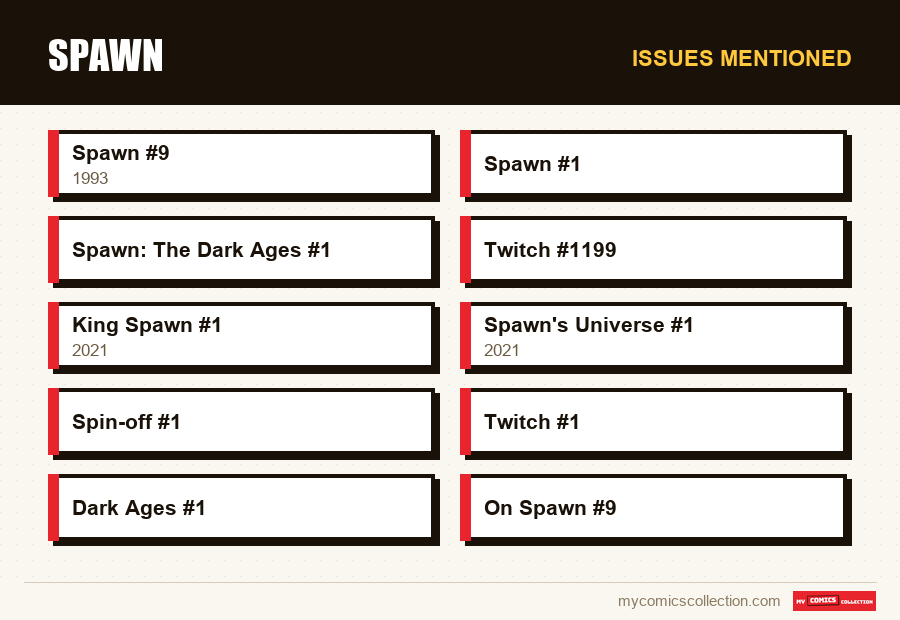
Spawn #9: the most strategic "special"
It isn't a one-shot, but it's the main-series issue every spin-off collector targets first. Spawn #9 (March 1993) contains the first appearance of Angela, co-created by Neil Gaiman. Its value works on two levels:
- The raw median. A €13 eBay median, all editions and grades combined (from €9 to €19 across listings, 100 active listings). It's a heavily printed issue, so it's accessible.
- High grade. In CGC 9.8, the copy holds around $60-$70 (source: GoCollect), with a demand peak between 2013 and 2015 tied to Angela's move to Marvel.
- The legal backstory. The Gaiman/McFarlane rights dispute over Angela, settled in 2012, then the Marvel acquisition in 2013, turned this issue into a textbook case: a first appearance whose value depends as much on publishing history as on the art.
The recent relaunches: sales records, not scarcity
Since 2021, McFarlane has relaunched his franchise with spectacular numbers. A caution: these issues break sales records, not rarity records: they're printed en masse.
- King Spawn #1 (2021): roughly 497,000 copies in pre-orders, the biggest new superhero monthly launch in 25 years (source: AIPT / Image Comics).
- Spawn's Universe #1 (June 2021): over 200,000 copies sold (source: GoCollect), the launch point of the expanded universe.
Those massive print runs mean short-term speculative value is low: these are issues to buy for the reading and the universe, not for resale.
Collector strategy (grounded in real data)
- Spawn #9 = the priority. The only first appearance in the Spawn galaxy with proven demand and a meaningful raw-vs-high-grade gap.
- Spin-off #1s = affordable fun. Curse of the Spawn , The Dark Ages and Sam & Twitch #1 are cheap to find: aim for high grade and variant covers (like the McFarlane variant on The Dark Ages #1).
- Grade is everything. On Spawn #9 and the spin-off first issues alike, the gap between a raw copy and a high-grade CGC slab is where the value sits. Always check live values: the medians above are from June 2026.
Own a Spawn spin-off or special? Get a free valuation with our tool based on real eBay sales to find its low, median and high value.
Organizing a Spawn Collection by Series
Spawn was born in 1992, in the modern era: there is no Silver Age or Bronze Age grail, so the collection is built by series rather than by single pieces. The simplest method is to go series by series, in the order they appeared, checking off each issue as you go.
The trunk: the main series
Start with the parent series. Spawn #1 (May 1992) founds the character and Spawn #9 (March 1993), written by Neil Gaiman, adds Angela, the Medieval Spawn and Cogliostro. These are the first two milestones to secure before spreading out into the spin-off series.
The three spin-off series in order
In chronological order: Curse of the Spawn (from September 1996, 29 issues through March 1999), then, in 1999, Spawn: The Dark Ages (28 issues) and Sam & Twitch (26 issues). Together that makes 83 issues, which remains a reasonable goal for a patient collector. Since each series has its own #1, keep a list per title to avoid buying the same issue twice.
First issues, variants and condition
For the spin-offs, the first issues are the ones that introduce a new character or creative team: Daniel Llanso in Curse of the Spawn, Lord Iain Covenant in The Dark Ages, the detectives of Sam & Twitch written by Brian Michael Bendis. If you are aiming for a quality copy, look at condition first, then at variant covers, such as the Todd McFarlane variant of The Dark Ages #1.
The 2021 relaunches: to read, not to speculate on
King Spawn #1 and Spawn's Universe #1 were printed in the hundreds of thousands. That means no scarcity is to be expected: buy them for reading and for the extended universe, without turning them into short-term investments. One copy per issue is enough.
In short, keep three markers in mind: Spawn #9 is the issue to secure first, as it is the only first appearance in the Spawn galaxy with proven demand. The first issues of the spin-offs can be found cheaply and make for an affordable pleasure. In both cases, grade and variant covers make all the difference, and the price should always be checked at the time of purchase.
Frequently asked questions
Three first issues stand out: Curse of the Spawn #1 (September 1996, first appearance of Daniel Llanso, 29 issues through March 1999), Spawn: The Dark Ages #1 (March 1999, Lord Iain Covenant, the Medieval Spawn, 28 issues) and Sam & Twitch #1 (1999, by Brian Michael Bendis, 26 issues).
It holds the first appearance of Angela, co-created by Neil Gaiman. Its value is understood in two steps: a modest raw median because the issue is heavily printed, and a large gap with high grade. The rights dispute over Angela, settled in 2012, then her acquisition by Marvel in 2013, made it a textbook case.
No, they are sales records, not scarcity records. King Spawn #1 (2021) was ordered at about 497,000 copies, the biggest monthly superhero launch in 25 years, and Spawn's Universe #1 (June 2021) passed 200,000 copies. Short-term speculative value is low.
It introduces Lord Iain Covenant, the Medieval Spawn, and exists with a Todd McFarlane variant cover. The title remains broadly affordable, but its interest comes from what it introduces: a character, a parallel universe or a creative team. Aim for high grade and variants.
Yes. On Spawn #9 as on the first issues of the spin-offs, the gap between a raw copy and a certified high-grade copy makes up most of the value. Always check the price at the time of purchase, since prices change.